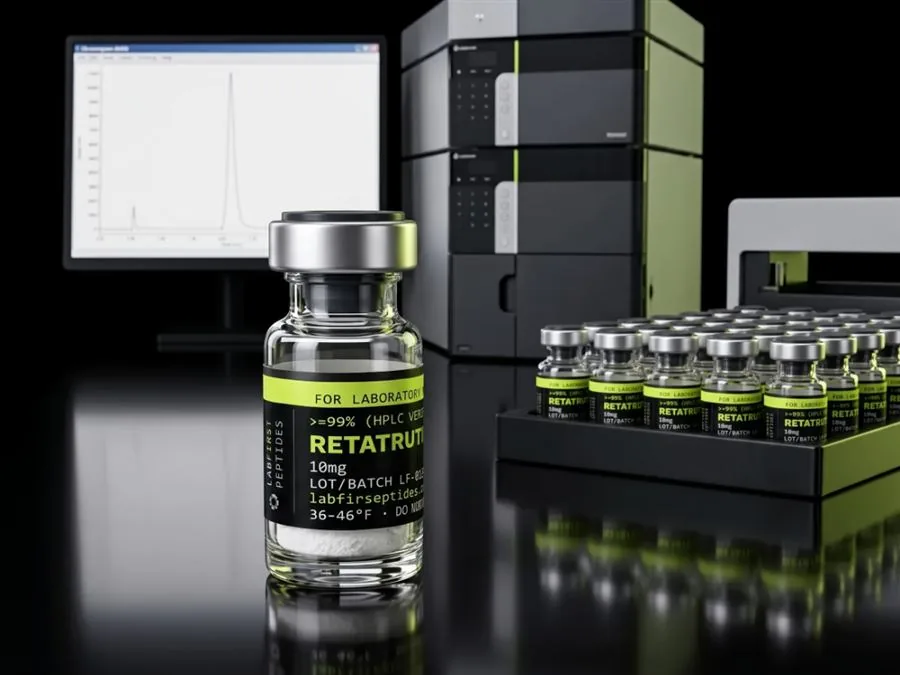
Popular peptides in research catalogs fall into a few groups. One is lipidated incretin analogues, like tirzepatide and semaglutide. One is growth-hormone secretagogues, like ipamorelin and CJC-1295. One is tissue-model compounds, like BPC-157 and TB-500. The rest are short neuropeptides and copper complexes. Fame as a prescription drug and search volume drive the list, not how good the evidence is.
- Research-market popularity tracks search demand and prescription-drug fame, not evidence quality or regulatory standing.
- Semaglutide, tirzepatide, tesamorelin and bremelanotide are active molecules of FDA-approved medicines; research-grade material inherits none of that status.
- BPC-157 has no approval in any jurisdiction and was flagged for safety concerns in the FDA's 2023 evaluation of compounding bulk substances.
- The name TB-500 is applied to two different molecules, full-length thymosin beta-4 and its short internal fragment, and only the certificate's observed mass distinguishes them.
- GHK-Cu is a copper complex and visibly blue; a white powder under that label is not what it claims to be.
- Counterfeit pressure concentrates on the most famous molecules, so verification effort should scale with popularity.
What this guide covers
A bestseller list works the same way: a book can top the chart because it is famous, and that says little about how well it was researched. A list of popular peptides shows what people search for and stock, and nothing more.
Popularity in the research-peptide market is a measurable thing. Search volume and the number of suppliers stocking a compound move together, and in 2026 the ranking they produce is dominated by a handful of chemical classes. What neither signal measures is evidence quality. A compound can lead every search index because a prescription medicine made its molecule famous, or because a forum decided it mattered this year. The ranking is a fact about demand and nothing else.
So this page is organized as a taxonomy rather than a countdown. A ranked list goes stale in months; the classes are stable. Find the class you care about and the compounds inside it will share chemistry, documentation habits and handling behavior, which is the information a laboratory can actually act on.
One exclusion up front. Popular-peptide lists routinely carry things that are not peptides at all. NAD+ is a dinucleotide and L-carnitine an amino-acid derivative, and both sit in peptide catalogs, ours included, as a shelving convention. Glutathione at least is a real tripeptide. This taxonomy covers peptides only.
This guide covers what a popularity ranking does and does not measure, a table of the classes at a glance, then each class in turn: the incretin and metabolic analogues, the growth-hormone-axis peptides, the tissue-model and matrix peptides, and the neuropeptides, melanocortins and bioregulators. It closes with a step-by-step check for any popular compound, the red flags fame attracts, and a bottom line.
- Incretin analogues: the fame belongs to the medicines
- GH-axis peptides: approved, withdrawn and abandoned in one class
- Tissue-model group: no approvals, one FDA compounding flag
- Neuropeptides and melanocortins: status varies molecule by molecule
- Every class: identity and purity proven per lot, or not bought
Which classes make up the list?
The table is the reference the rest of the page expands. Regulatory positions are stated as of August 2026, and they are the column most worth re-checking over time, because agency actions move faster than chemistry does.
| Class | Representative compounds | Defining chemistry | Regulatory position | Class-specific flag |
|---|---|---|---|---|
| Incretin and metabolic analogues | Semaglutide, tirzepatide, retatrutide, cagrilintide | 30 to 40 residues, fatty-acid lipidation, non-coded residues | Semaglutide and tirzepatide are molecules of FDA-approved medicines; the rest are clinical-stage | Interface-active: swirl, never shake |
| Growth-hormone-axis peptides | Ipamorelin, CJC-1295, sermorelin, tesamorelin | 5 to 44 residues; some carry albumin-binding groups | Tesamorelin approved 2010; sermorelin formerly approved; the others never | Naming is inconsistent; the COA sequence is the arbiter |
| Tissue-model and matrix peptides | BPC-157, TB-500, GHK-Cu, KPV | Short fragments and one copper complex | No FDA approvals; BPC-157 flagged in the FDA's 2023 compounding evaluation | TB-500 listings blur two different molecules |
| Neuropeptides | Semax, Selank | Heptapeptides with a Pro-Gly-Pro tail | Registered in Russia; no FDA approval | Standard lyophilizate handling |
| Melanocortins | Melanotan II, PT-141 | Cyclic, lactam-bridged α-MSH analogues | Bremelanotide approved 2019; melanotan II never, with regulator warnings | Cyclic structure: identity needs mass spectrometry |
| Bioregulators and immune peptides | Epithalon, thymosin alpha-1 | A tetrapeptide; a 28-residue acetylated peptide | No FDA approvals; thymalfasin approved in some other jurisdictions | Very short sequences carry a heavier identity burden |
The last column is deliberately terse. Storage behavior is mostly a property of the physical state rather than the class, and what degrades a lyophilized peptide is covered in depth in the storage and stability guide. The flag is the exception each class adds on top of those shared rules.
What are the incretin and metabolic analogues?
No class has driven more of the market since 2022. Semaglutide and tirzepatide are the active molecules of FDA-approved prescription medicines, semaglutide first approved in December 2017 and tirzepatide in May 2022, and the fame of those products is what put the molecule names into general circulation. Research-market demand followed the fame. It is worth being plain about what that means: the research-grade powder is not the medicine, is not manufactured under the medicine's quality system, and has never been a lawful substitute for it.
Chemically the class is coherent. These are single-chain peptides of roughly 30 to 40 residues carrying a fatty-acid chain, a C18 chain in semaglutide's case and a C20 diacid in tirzepatide's, conjugated through a linker to a lysine side chain. The lipid exists to bind serum albumin in the parent drug's design, and it makes the molecules amphiphilic, which is why every vial in this class shares the same bench rule: swirl gently, never shake, because the air–water interface is where a lipidated peptide aggregates. Several members also carry the non-coded residue α-aminoisobutyric acid to resist enzymatic cleavage.
Behind the two approved molecules sits a clinical-stage tier with heavy search interest of its own: retatrutide, a triple GIP, GLP-1 and glucagon receptor agonist; cagrilintide, an amylin analogue, including its co-formulation with semaglutide studied under the name CagriSema; and the glucagon and GLP-1 dual agonists survodutide and mazdutide. None held an FDA approval at the time of writing, and anyone relying on that status should re-check it against the agency's own databases rather than against this page.
What are the growth-hormone-axis peptides?
This class predates the incretin era and still holds steady catalog demand. It splits by receptor. Sermorelin, tesamorelin and both forms of CJC-1295 are analogues of growth-hormone-releasing hormone, built on its first 29 residues. Ipamorelin, GHRP-2 and GHRP-6 act at the ghrelin receptor instead, and are much smaller molecules, five or six residues against 29 to 44.
The regulatory record here is more varied than most buyers assume. Tesamorelin is the active molecule of a medicine the FDA approved in 2010. Sermorelin once held FDA approval and left the market in 2008 for commercial rather than safety reasons. Ipamorelin came out of a pharmaceutical development program that was later discontinued, and it, GHRP-2 and GHRP-6 have never been approved anywhere. A single catalog section can span the whole distance from approved molecule to abandoned candidate.
The practical problem in this class is nomenclature. CJC-1295 exists with and without a reactive albumin-binding group called DAC, and the version without is properly a modified GRF(1-29); catalogs apply the names loosely, sometimes to each other. Two listings with the same name can be different molecules, and two with different names the same one. The stated sequence and observed mass on the certificate of analysis are the identifiers that settle it, a theme this taxonomy keeps returning to.
What are the tissue-model and matrix peptides?
BPC-157 is the most searched compound in this class and the one with the sharpest regulatory edge. It is a synthetic 15-residue peptide whose sequence is attributed to a protein found in gastric juice. No approved medicine containing it exists in any jurisdiction, and in its 2023 evaluation of bulk substances nominated for compounding, the FDA placed it among compounds flagged for safety concerns. That is a stronger statement than mere absence of approval, and a listing that does not acknowledge it has not done its reading.
TB-500 illustrates a different failure of naming. The label is applied both to full-length thymosin beta-4, a 43-residue acetylated peptide of roughly five kilodaltons, and to its short internal fragment of seven residues at under one kilodalton. These are different molecules with different chemistry, and some catalogs sell both under adjacent names. The observed mass on the lot's certificate answers the question in one line; nothing else does.
GHK-Cu is the tripeptide glycyl-histidyl-lysine complexed with copper, and the copper does the work of identity here: the material is visibly blue. A white powder labeled GHK-Cu is copper-free GHK at best and mislabeled at worst, and either way is not what the label claims. KPV, the C-terminal tripeptide of α-melanocyte-stimulating hormone, rounds out the class. Very short peptides are cheap to synthesize and easy to make pure, and correspondingly hard to tell apart by purity alone, so identity testing carries the verification weight.
What about neuropeptides, melanocortins and bioregulators?
Semax and Selank are heptapeptides sharing a Pro-Gly-Pro tail added to stabilize their parent fragments, an adrenocorticotropin fragment in Semax's case and the immunoactive tetrapeptide tuftsin in Selank's. Both are registered as medicines in Russia and neither holds an FDA approval, a split status that gets flattened in both directions online, into approved drug by enthusiasts and obscure chemical by skeptics.
The melanocortins are cyclic, lactam-bridged analogues of α-melanocyte-stimulating hormone, and the class contains the market's clearest natural experiment in regulatory divergence. Bremelanotide, sold in research catalogs as PT-141, is the active molecule of a medicine the FDA approved in 2019. Melanotan II, its close structural relative, has never been approved anywhere and has drawn explicit safety communications from several national medicines regulators. Two neighboring catalog entries; two entirely different regulatory histories.
The bioregulator group descends from a Russian research program on very short peptides, epithalon being the best known, a simple Ala-Glu-Asp-Gly tetrapeptide with no approval in any jurisdiction. Thymosin alpha-1, a 28-residue acetylated peptide known generically as thymalfasin, is the group's counterexample: approved as a medicine in a number of jurisdictions, though not by the FDA.
How to check a popular peptide before buying: step by step
Fame concentrates counterfeit pressure. A molecule whose name carries prescription-drug recognition is worth faking in a way a bioregulator tetrapeptide never will be, and the compounds at the top of this taxonomy are the ones where a vial's contents most need proving. The economics point the same direction: a lipidated 39-residue peptide is expensive to synthesize, so an implausibly cheap listing for one is not a bargain, it is information. The cost-per-milligram tool makes those comparisons concrete across vial sizes.
The checks are the same for every class, applied with more force the more popular the compound.
- Get a certificate of analysis for the specific lot, not a representative one.
- Check identity by mass spectrometry against the stated sequence.
- Check purity by HPLC with the method conditions shown.
- Check that the net mass claim matches what arrives.
What a supplier should document, and how this catalog does it, is laid out in the quality standard.
Handling, by contrast, barely varies with popularity. Every compound on this page ships as a lyophilized solid and becomes a dated, clocked solution the moment diluent touches it; the bacteriostatic water guide covers the diluent half of that decision. Rankings will have rotated by next year. The classes, and the diligence, will not have moved.
FOR LABORATORY AND IN-VITRO RESEARCH USE ONLY. NOT FOR HUMAN OR ANIMAL CONSUMPTION. NOT FOR PERSONAL, MEDICAL, DIAGNOSTIC, THERAPEUTIC, OR RECREATIONAL USE.
Red flags on a popular-peptide listing
- An implausibly cheap listing for a lipidated 30-to-40-residue peptide. A molecule that is expensive to synthesize cannot be cheap to buy, so the price is information, not a bargain.
- A white powder sold as GHK-Cu. The copper makes the material visibly blue; a white powder under that label is copper-free GHK at best and mislabeled at worst.
- A TB-500 listing that does not say whether the vial holds full-length thymosin beta-4 or the seven-residue fragment. Only the observed mass on the lot certificate answers that.
- A CJC-1295 listing that does not state whether the DAC group is present. Catalogs apply the names loosely, and the certificate's sequence and observed mass are the arbiter.
- A BPC-157 listing that does not acknowledge the FDA's 2023 compounding evaluation. A listing that does not mention it has not done its reading.
Bottom line
Popularity measures search demand and prescription-drug fame, nothing about evidence or regulatory standing. The classes are stable even when the rankings rotate: incretin analogues that must be swirled and never shaken, growth-hormone-axis peptides with unreliable names, short tissue-model peptides where identity carries the weight, and a mixed group with regulatory histories that diverge between neighbors on the shelf. Fame concentrates counterfeit pressure, so the more popular the compound, the harder the lot certificate has to be read.
Common questions
Which peptides are the most popular right now?
Does popularity say anything about evidence quality?
Why do popular-peptide lists include NAD+ and L-carnitine?
Which popular research compounds are molecules of approved medicines?
What is actually in a vial labeled TB-500?
Do popular compounds need stricter verification?
Related guides: buying and vetting a supplier
Sources
- PubChem compound records for the named peptides. Sequences, structural features and identifiers for the compounds in the taxonomy, including the lipidation and non-coded residues described for the incretin class.
- FDA approval records and drug databases. Approval dates for medicines containing semaglutide (2017), tirzepatide (2022), tesamorelin (2010) and bremelanotide (2019), and the 2023 evaluation of compounding bulk substances that flagged BPC-157.
- Safety communications from national medicines regulators concerning melanotan II. Basis for the statement that melanotan II has never been approved and has drawn explicit regulator warnings; described generically because several agencies have issued them.