KLOW identity is confirmed component by component. Liquid chromatography separates the four peptides, and mass spectrometry weighs each one as it comes off the column. Each observed mass is compared with the theoretical mass for BPC-157, GHK-Cu, TB-500 or KPV. All four must match for the blend's identity to be confirmed.
- KLOW identity has to be confirmed separately for each of its four peptides: BPC-157, GHK-Cu, TB-500 and KPV.
- LC-MS is the usual method: chromatography separates the components and mass spectrometry weighs each one.
- ICH Q6B says an identity test should be highly specific and that more than one test may be needed.
- KPV and free GHK differ in monoisotopic mass by about 2.04 Da, so each mass should be tied to a labeled peak.
- An intact mass match confirms composition and presence, not sequence order or quantity.
Sorting before weighing
Suppose someone hands you a bag holding a coin, a key, a pebble and a button, and asks you to weigh each. Putting the whole bag on the scale gets you one number that describes none of them. You tip them out, separate them, and weigh one at a time. Confirming the identity of KLOW works the same way.
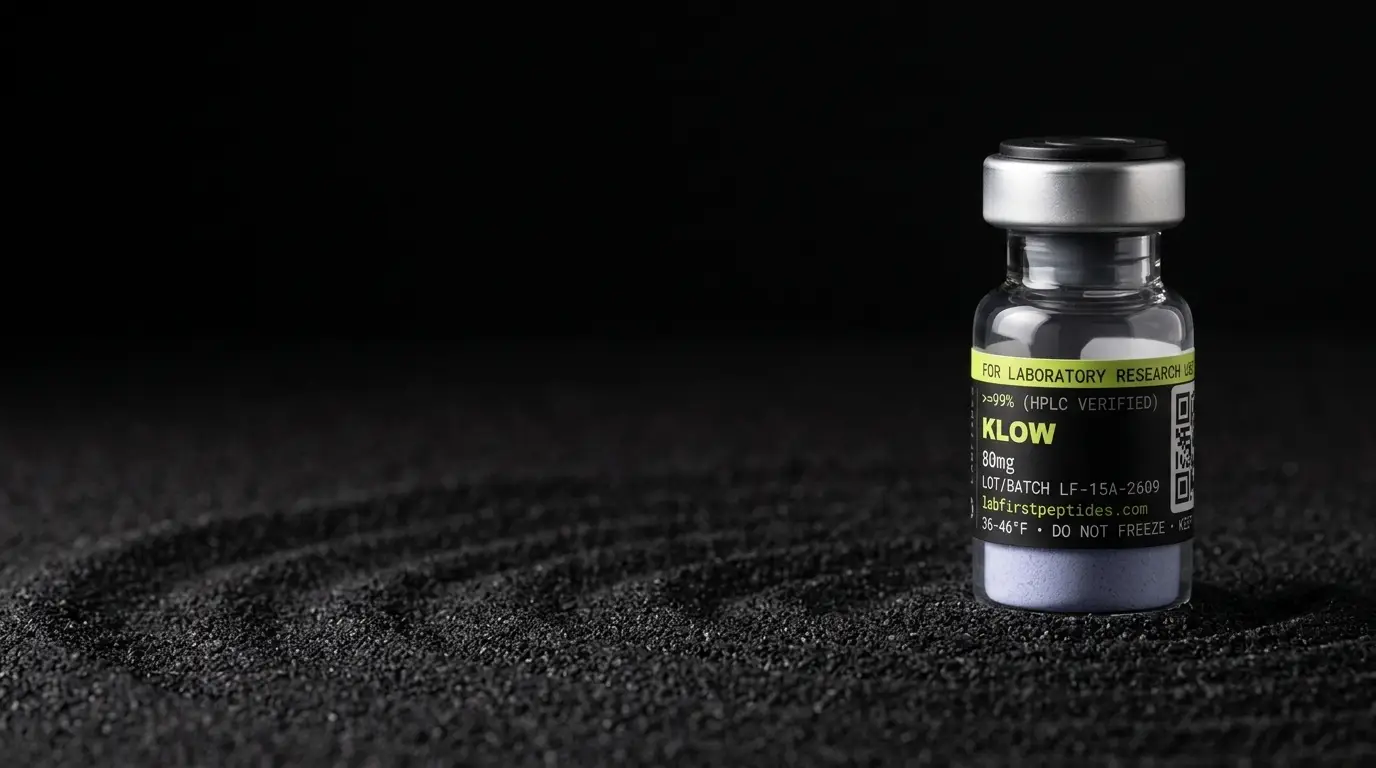
KLOW here is an 80 mg vial of four peptides: BPC-157, GHK-Cu, TB-500 and KPV. The KLOW composition guide covers what each one is. The question on this page is narrower. How does a laboratory show that each of those four is actually present, and is the molecule it claims to be?
The short answer is separation followed by mass. A chromatography column pulls the four apart, a mass spectrometer weighs each as it elutes, and each weight is checked against the value the molecule's formula predicts. A blend passes identity only when all four check out.
- Separate the four peptides on an LC column
- Weigh each by mass spectrometry as it elutes
- Compare each observed mass with its theoretical mass
- Tie each mass to a labeled peak
- Pass only when all four match
Why can’t purity stand in for identity?
Purity cannot stand in for identity because it measures how clean a sample is, not what it is. A purity figure answers how much of the sample is one substance. It says nothing about which substance that is. A cleanly made wrong peptide scores as well as the right one, and for a blend there is an extra trap: a high vial-wide purity can come from three components with the fourth missing entirely.
ICH Q6B, the guideline for specifications on biotechnological products, treats identity as its own test class and says the identity test should be highly specific for the substance, based on unique aspects of its molecular structure. It adds that more than one test may be needed. For a four-part blend that means an identity result for each component, not one verdict for the vial.
So when you read a certificate, find the identity section first and check it covers four peptides. Only then does the purity section mean anything.
The target masses
Each component has a molecular formula, and the formula fixes a theoretical mass. PubChem carries the reference values. Electrospray mass spectrometry usually sees each molecule with one or more extra protons attached, so the peak it records is the mass plus the protons, divided by the charge. The expected ions below are our arithmetic from the PubChem monoisotopic masses, adding 1.007 Da per proton.
| Component | Formula | Monoisotopic mass (Da) | Likely ion | Expected m/z |
|---|---|---|---|---|
| BPC-157 | C62H98N16O22 | 1418.704 | [M+2H]2+ | about 710.36 |
| TB-500 | C38H68N10O14 | 888.492 | [M+H]+ | about 889.50 |
| KPV | C16H30N4O4 | 342.227 | [M+H]+ | about 343.23 |
| GHK, free peptide | C14H24N6O4 | 340.186 | [M+H]+ | about 341.19 |
| GHK-Cu cation | C14H23CuN6O4+ | 402.108 | already charged | about 402.11 |
The ion a given instrument reports depends on its settings, and larger peptides often show several charge states at once. That is why certificates usually print the neutral mass worked back from the ions, called the deconvoluted mass, rather than the raw peaks.
Why the separation step carries so much weight
The four components span a wide size range. BPC-157 is the heaviest at about 1,419 Da, TB-500 sits near 889 Da, and KPV and GHK are both around 340 Da. Size is only part of what decides where a peptide elutes on a reversed-phase column, though. Charge and how greasy the side chains are matter as much, which is why two peptides of nearly the same mass can still come off minutes apart.
Separation does two jobs. It keeps the four signals from piling on top of each other in the mass spectrometer, where a strong signal from one component can drown a weak one from another. And it gives each component a retention time, a second fingerprint that sits beside the mass. A peak at the right mass and the right time is much stronger evidence than a mass alone.
It also exposes a missing component in a way a vial-wide number cannot. If the chromatogram shows three main peaks where four belong, no amount of good news elsewhere on the certificate covers that gap. Count the peaks before reading anything else.
How close are KPV and GHK in mass?
KPV and free GHK are both tripeptides, and their monoisotopic masses differ by about 2.04 Da. A modern instrument separates that easily. The risk is on paper rather than in the machine: a certificate that rounds to whole daltons, or lists masses without saying which peak is which peptide, leaves you unable to tell whether both were found.
Chromatography helps here. The two elute at different times, so a good report ties each mass to a retention time on the chromatogram. Two labeled peaks with two matching masses is clear evidence. One peak near 341 to 343 with no assignment is not.
GHK-Cu adds a second wrinkle. PubChem describes prezatide copper as a tripeptide of glycine, histidine and lysine that readily forms a complex with copper ions. Depending on the method, the copper can stay bound or come off during analysis, so a lab may report the free peptide mass, the complex mass, or both. Either can be right. The certificate should say which it saw.
What does a mass match not prove?
An intact mass confirms composition. It does not confirm order. Two peptides built from the same residues in a different sequence weigh exactly the same, and a mass spectrum of the intact molecule cannot tell them apart. Sequence-level proof takes fragmenting the peptide inside the instrument, tandem MS, and reading the pieces.
For KLOW's components that gap is small in practice, since these are specific catalog sequences and a scrambled version is an unlikely manufacturing error. The more common mass-level problems are ones you can see: a peak about 18 Da light points to a lost water, one about 16 Da heavy to an oxidized residue, and a mass matching a shorter chain to a deletion sequence left over from synthesis.
A mass match also says nothing about quantity. All four components can be present and correctly identified while one sits at a fraction of its intended amount. That is an amount question, answered by a separate per-component assay, and the KLOW certificate guide covers where it appears on the report.
Reading the identity section of a certificate
A complete identity section for KLOW names the method, lists four components, and for each prints the observed mass beside the theoretical one within a stated tolerance. It attaches the spectra or at least the chromatogram with the peaks labeled. And it ties all of it to the lot number on the vial.
Incomplete versions are common. The word conforms with no masses beside it has asserted identity rather than recorded it. A single mass for the vial is not possible for a mixture. Three components listed means the fourth was not tested, or was tested and not reported, and neither is acceptable.
Our own KLOW certificate is not published yet. The KLOW product page will show results only once the certificate for that lot is published, and until then it says the result is pending. For how the four components behave once the vial is on your shelf, see KLOW storage and stability, and the certificate index lists what has been published.
Checking on receipt
Where results will be published or decisions rest on them, a receiving lab may run its own LC-MS check on an incoming blend. It does not need to repeat everything. Confirming four peaks at four expected masses, from one short run, catches the most consequential errors: a missing or substituted component.
At minimum, check the paperwork against the vial. The lot on the certificate should match the label exactly, the test date should fall after the blend lot was made, and the identity section should name all four peptides. A mismatch found on receipt costs an email. One found after the work is done costs the work.
FOR LABORATORY AND IN-VITRO RESEARCH USE ONLY. NOT FOR HUMAN OR ANIMAL CONSUMPTION.
What is KLOW studied for?
Published research on KLOW investigates the areas below, which is a different question from what KLOW will do for anyone, a claim about a living system that nothing on this site is sold for.
What it is. A brand name for several peptides freeze-dried together in one vial.
What the research looks at. The ingredients appear separately in the research. The blend as sold is a way of packaging them and has not itself been studied.
How it is thought to work. A blend name, not a molecule. Whatever mechanism there is belongs to the separate ingredients, and those are described on their own records.
What is not established. Blend names are not standardised between suppliers, so the same name can mean different ingredients in different amounts. Read the certificate for what is actually in the vial rather than trusting the name.
The full record, including the certificate for the lot in stock, is on the KLOW product page.
Common questions
Can one mass spectrum confirm a whole KLOW vial?
How are KPV and GHK told apart?
Why might GHK-Cu show two different masses?
Does a mass match prove the sequence is right?
Published certificates for KLOW
Every figure below is read from a report the laboratory issued for that lot; each page carries the PDF and the lab's own verification link.
More documentation guides
Sources
- PubChem property table for BPC-157, TB-500, KPV and GHK (CIDs 9941957, 62707662, 125672, 73587). Formulas and masses used for the theoretical values and expected ions.
- PubChem, prezatide copper (CID 71587328), record description. Glycine-histidine-lysine tripeptide that readily forms a complex with copper ions.
- PubChem, Msh (11-13), Lys-Pro-Val (CID 125672). Record for KPV.
- ICH Q6B, Specifications: Test Procedures and Acceptance Criteria for Biotechnological/Biological Products. Identity tests should be highly specific; more than one test may be necessary.