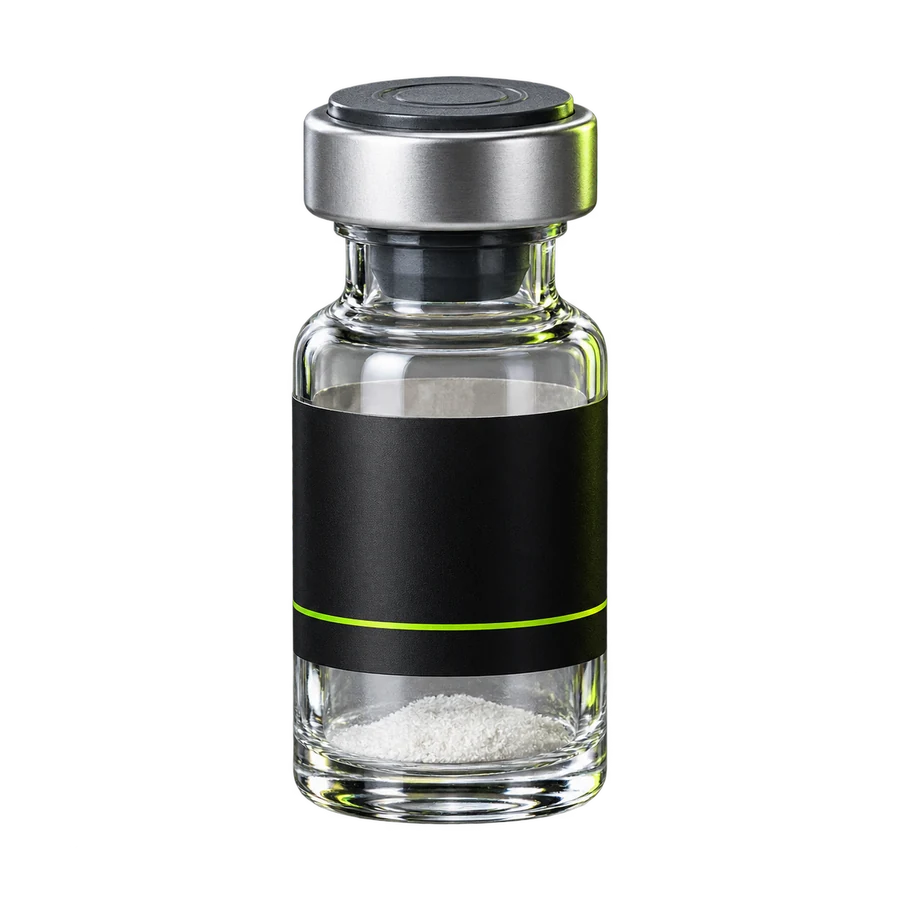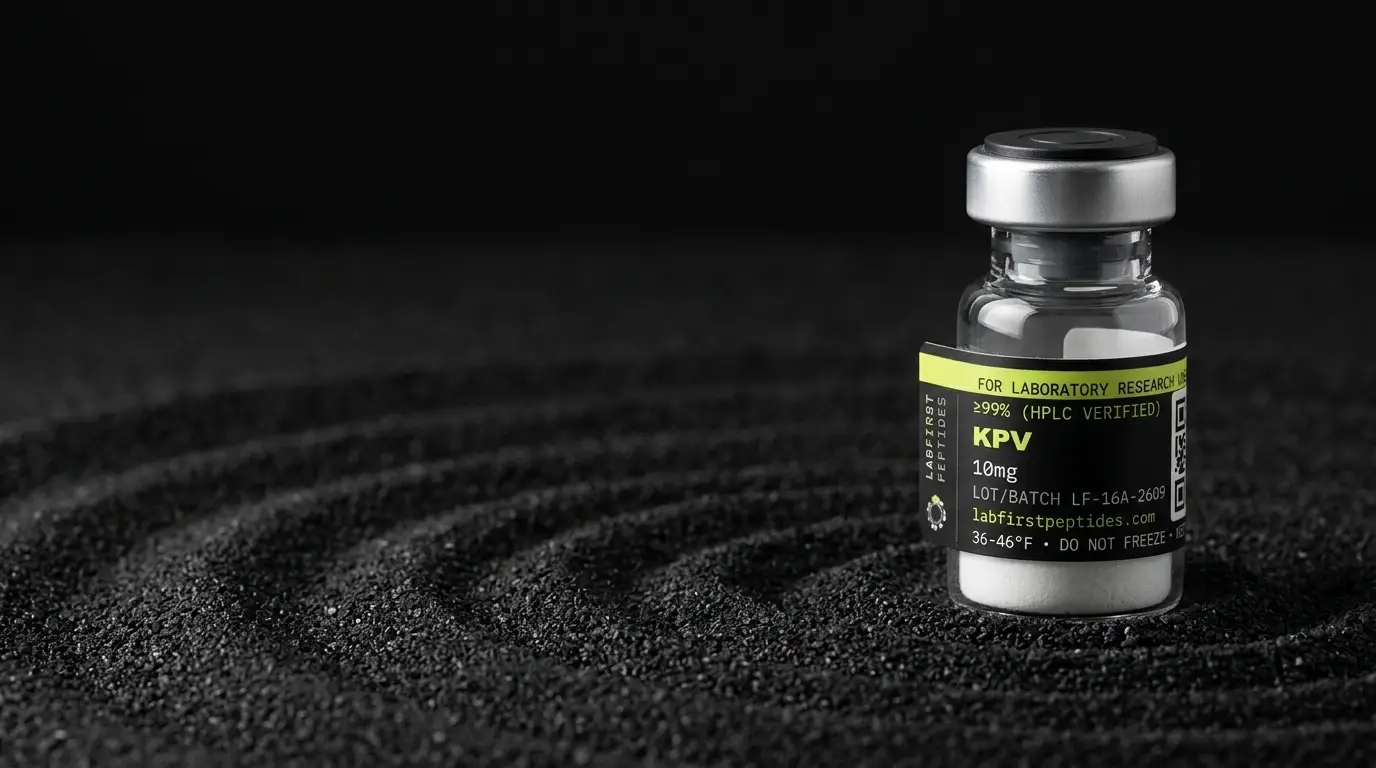
For KPV storage and stability, keep the dry powder sealed, frozen and dry, and keep any solution in the fridge. A proline in the second spot means the main breakdown route is diketopiperazine formation. Because the peptide is so small, moisture and sticking to surfaces matter more than usual.
- Sealed and frozen as powder, refrigerated in solution, dry above all else.
- Diketopiperazine formation is the size-specific route: the first two residues cyclise and cleave.
- Proline in position two pre-organizes the molecule into the geometry that reaction needs.
- Water, warmth and raised pH accelerate it; a dry sealed powder largely does not.
- The cyclic product is even harder to retain on a column than KPV, so a weak method can miss it.
- Adsorptive loss removes small peptide from dilute solution without degrading it.
How should KPV be stored?
In plain terms, dry powder is like dry pasta and a solution is like cooked pasta. The dry form keeps for a long time. Once water is added, the clock starts running faster.
Sealed and frozen as lyophilized powder, refrigerated once a solution exists, and kept dry above all else. Light matters less here than for peptides carrying oxidation-prone residues, because KPV has none.
The dry form is the stable one, as it is for every peptide, and the reason is the same: freeze-drying removes the water that the degradation routes need.
What differs for this compound is which routes are open. A three-residue peptide has almost no side-chain chemistry to go wrong, so the interesting failure is structural rather than oxidative, and it is described next.
- Sealed and frozen as lyophilized powder, kept dry
- No oxidation-prone residue, so dryness matters more than darkness
- Proline in position two invites diketopiperazine formation
- Water, warmth and raised pH accelerate that reaction
- Small quantities adsorb onto glass and plastic from dilute solution
- Caked or sticky powder ends the vial; the cyclic product stays invisible
What is diketopiperazine formation?
The degradation route that small peptides have and large ones largely escape. The first two residues of a chain can curl round and join to each other, forming a stable six-membered ring and cleaving away from the rest of the peptide.
The ring is called a diketopiperazine. When it forms, the peptide is destroyed: a tripeptide becomes a cyclic dipeptide plus a free amino acid.
It happens because the N-terminal amine attacks the second peptide bond. That requires the chain to fold back on itself, which a short flexible peptide does easily and a long structured one does not. This is a genuine size effect rather than a curiosity.
Why does the proline make it more likely?
Because proline is the one residue whose ring locks the backbone into a bend. Where other amino acids let the chain rotate freely, proline holds it in a turn.
Diketopiperazine formation requires exactly that geometry: the N-terminus has to reach the second peptide bond. A proline in the second position pre-organizes the molecule into the shape the reaction needs.
KPV is lysine, proline, valine. The proline is in position two, which is the position that matters. That does not make the peptide unstable in a sealed frozen vial, and it does make this the route to think about when material has been in solution, warm, or at raised pH.
What conditions accelerate it?
Water, warmth and higher pH, in that order of practical importance. The reaction needs the molecule to be mobile, so a solution is where it runs and a dry sealed powder is where it largely does not.
Neutral to slightly acidic conditions are less favorable than alkaline ones, because the N-terminal amine has to be unprotonated to act as the nucleophile. Raising pH frees more of it and speeds the reaction.
The practical consequence is unremarkable and worth stating anyway. Keep it dry, keep it cold, do not leave a solution standing warm, and do not assume a peptide with no oxidation-prone residues has no way to degrade.
Would a certificate show it?
It would if the separation was set up to see it. The diketopiperazine has a different mass from the intact peptide, because a whole residue has been lost along with a molecule of water, so a mass detector distinguishes them without difficulty.
The catch is chromatographic rather than spectrometric. The cyclic dipeptide is small, neutral and polar, and it is even harder to retain on a reversed-phase column than KPV itself. On a method where the peptide barely retains, its degradation product may not retain at all.
So a purity figure from a poorly retaining method can miss this specific impurity entirely, which is one more reason a KPV certificate should state its column and mobile phase rather than only its result.
Why does moisture matter more on a small peptide?
Proportion. Lyophilized peptide is hygroscopic, and a given mass of absorbed water is a larger share of a light molecule's powder than of a heavy one's.
KPV weighs about 342 daltons and carries a counterion that is itself a quarter of that mass. Add absorbed moisture and the fraction of the vial that is actually peptide falls faster than intuition suggests.
Opening a cold vial in a warm room draws condensation directly onto the powder. Letting it reach room temperature first costs nothing and removes the problem, and for this compound the payoff is larger than usual because water both degrades the peptide and dilutes what you paid for.
Can peptide disappear without degrading?
Yes, and small peptides in dilute solution are the classic case. Peptide adsorbs onto glass and plastic surfaces, and the effect is worst when the total quantity is small and the concentration low.
What makes it awkward is that nothing looks wrong. The material that remains in solution is intact and passes every chemical test. The concentration is simply lower than the arithmetic says it should be.
It is a handling effect rather than a stability property, so it appears in no stability protocol and on no certificate. It is worth knowing about precisely because the documentation cannot warn you.
What does a retest date actually mean?
It describes an unopened container held under the conditions printed beside it, derived from stability data: units stored at defined temperature and humidity, pulled on a schedule, tested against the release specification.
The date is conditional on those conditions. A vial that spent a week on a warm bench is no longer described by it, and nothing about the vial looks different.
It is also not a cliff. Material past a retest date is not established as failing, it is outside the evidence, and testing is the honest response rather than assuming in either direction. A pharmaceutical expiry is a stronger claim made under rules research-grade material is not made under.
What happens once the vial is opened?
The moisture clock starts and the certificate stops describing the contents. Every entry exchanges headspace air, and in a humid room that air brings water to a powder that takes it up readily.
Oxygen matters less than for a peptide carrying a methionine, because KPV has no residue for it to attack. So the number of entries is a moisture question here rather than an oxidation one.
Static is a real nuisance at this scale that nobody documents. A few milligrams of light, dry powder can cling to a spatula or the vial wall, and losses that would be trivial on a 100-milligram vial are not trivial on a small one.
What should make you stop using a vial?
Powder that has caked or gone sticky. For a hygroscopic small peptide that is the visible form of moisture ingress and it is the signal worth acting on.
In solution, cloudiness or visible particulate. A clear solution that has hazed has something in it that was not there before, and no document accounts for it.
A closure that has lifted, cracked or no longer sits flush counts even when the contents look fine. What none of these will show is diketopiperazine formation, which is invisible, and that is exactly why storage conditions matter more than inspection.
How does storage relate to the certificate?
They split the timeline and neither covers the other half. A certificate reports what was measured on a sample drawn at one moment, and the certificate guide covers how to read one field by field. Storage evidence covers what happened afterwards.
For this compound the split has a specific edge. Diketopiperazine formation happens after release, in solution and in warmth, so a clean certificate at test says nothing about whether it has happened since.
Lot reports for material supplied here resolve through the certificate verification page, and the sizes carried are on the KPV product record.
What is the regulatory position?
Stability expectations for finished pharmaceutical products are set out in international guidance defining storage conditions, sampling intervals and the testing that supports a shelf-life claim. That framework governs drug products made for human use.
There is no FDA-approved product containing KPV and no United States pharmacopeial monograph defining an acceptable batch, so a research certificate does not carry pharmacopeial weight. A supplier can honestly report what conditions a lot was held under and what was measured; presenting that as a drug product shelf life would overstate it.
The useful question stays narrow: what conditions, what measurement, what date.
FOR LABORATORY AND IN-VITRO RESEARCH USE ONLY. NOT FOR HUMAN OR ANIMAL CONSUMPTION. NOT FOR PERSONAL, MEDICAL, DIAGNOSTIC, THERAPEUTIC, OR RECREATIONAL USE.
What is KPV studied for?
Published research on KPV investigates the areas below, which is a different question from what KPV will do for anyone, a claim about a living system that nothing on this site is sold for.
What it is. A man-made three-building-block peptide, the tail end of the hormone alpha-MSH.
What the research looks at. It appears in animal and cell research on inflammation.
How it is thought to work. It matches the last three building blocks of alpha-melanocyte-stimulating hormone. Published work covers melanocortin-related signalling in cells and animals, and the details are not settled.
What is not established. No approved product. As a three-building-block piece it does not do everything the whole hormone does, and should not be described as if it did.
The full record, including the certificate for the lot in stock, is on the KPV product page.
Common questions
Does KPV need to be refrigerated?
What is diketopiperazine formation?
Why does the proline in KPV matter for stability?
Would a certificate detect diketopiperazine?
Can KPV go missing without degrading?
Published certificates for KPV
Every figure below is read from a report the laboratory issued for that lot; each page carries the PDF and the lab's own verification link.
More documentation guides
Sources
- PubChem Compound Summary for CID 125672, Lys-Pro-Val. The openable record for KPV, giving the molecular formula C16H30N4O4 and the sequence in which the proline occupies the second position discussed above.
- ICH Q2(R2), Validation of Analytical Procedures . Defines specificity for an assay, including that the method must separate the target from its degradation products, which is the clause a poorly retaining separation fails for the cyclic product.
- 21 CFR 211.84, Testing and approval or rejection of components and containers. Sets sampling and testing expectations for containers and closures, supporting the treatment of closure integrity as part of the product rather than packaging around it.