A KLOW certificate of analysis should report each of the four peptides separately: BPC-157, GHK-Cu, TB-500 and KPV. Look for an observed mass beside the theoretical mass for each, a purity figure for each, the amount of each in milligrams, and a lot number that matches the vial.
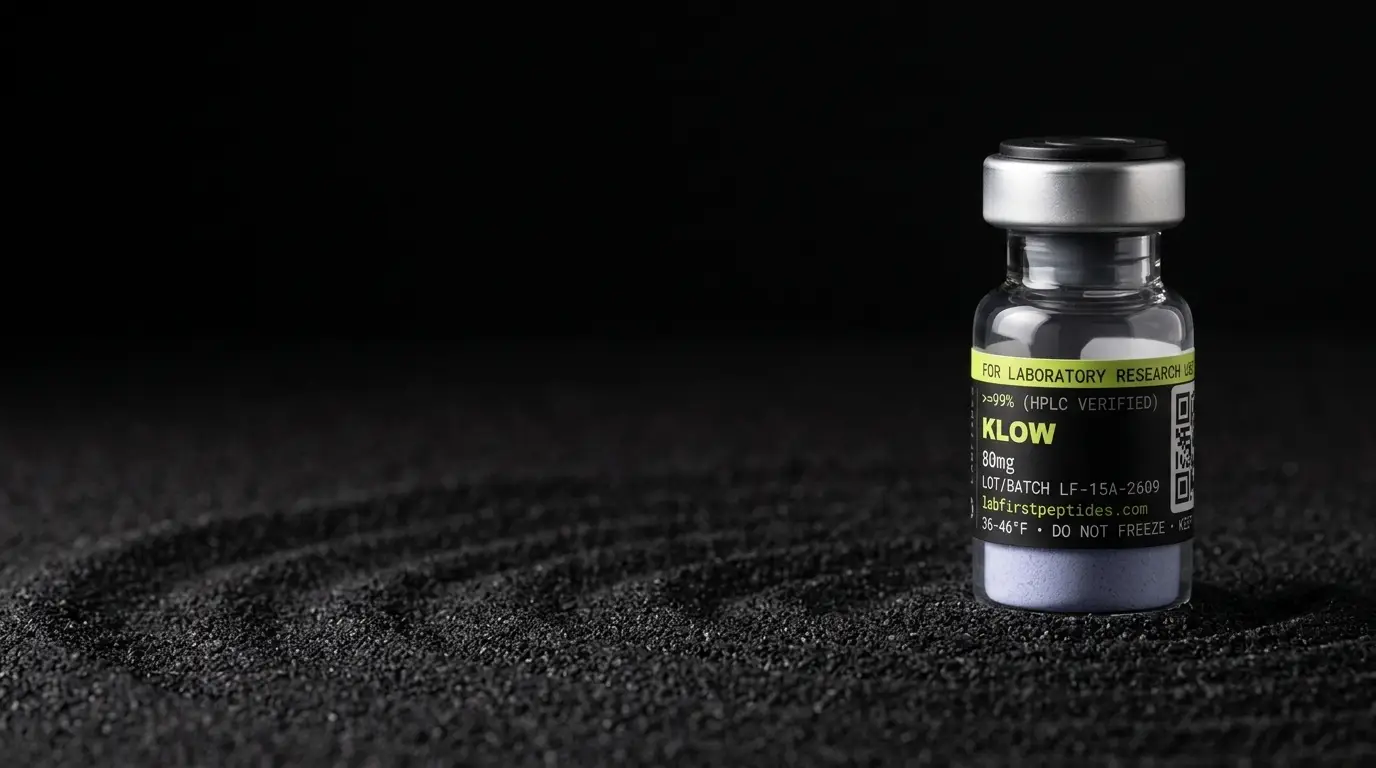
- KLOW in this catalog is an 80 mg vial of four peptides: BPC-157, GHK-Cu, TB-500 and KPV.
- A blend certificate needs identity, purity and amount reported separately for each of the four components.
- PubChem average masses: BPC-157 1419.5 Da, TB-500 889.0 Da, KPV 342.43 Da, free GHK 340.38 Da, GHK-Cu cation 402.92 Da.
- KPV and free GHK differ by about two daltons, so the certificate should assign each peak explicitly.
- The catalog does not fix the per-component split; the certificate for each lot states it.
One report, four answers
A report card for a single student has one name at the top and one set of grades. In plain terms, a KLOW certificate is closer to a report card for four students printed on one page. Each needs its own line, and a single average for the whole class tells you very little about any one of them.
KLOW in this catalog is SKU KLOW, an 80 mg vial listed with the formula BPC / GHK-Cu / TB-500 / KPV. Four separate peptides, freeze-dried together. The KLOW composition guide covers what each of them is and why a blend name is not a specification. This page is about the paperwork: what a certificate for a four-part blend has to show, in what order to read it, and where blend certificates usually fall short.
Our own KLOW certificate is not published yet. The KLOW product page will show results only once the certificate for that lot is published, and until then it says the result is pending. Nothing on this page describes a result for any of our lots.
- Lot: matches the vial exactly
- Components: all four named
- Identity: observed beside theoretical mass, each peptide
- Purity: one figure and one labeled peak per peptide
- Amounts: milligrams of each component
- Laboratory: report number you can check yourself
What mass should each KLOW component show?
Each KLOW component should show an observed mass that matches its own theoretical mass. Identity on any peptide certificate comes down to comparing an observed mass with the theoretical mass of the claimed molecule. For KLOW there are four theoretical masses, and they are far enough apart that a mass spectrum has no trouble telling them apart.
| Component | PubChem CID | Formula | Average mass (Da) | Monoisotopic mass (Da) |
|---|---|---|---|---|
| BPC-157 | 9941957 | C62H98N16O22 | 1419.5 | 1418.704 |
| TB-500 | 62707662 | C38H68N10O14 | 889.0 | 888.492 |
| KPV (Lys-Pro-Val) | 125672 | C16H30N4O4 | 342.43 | 342.227 |
| GHK, free peptide | 73587 | C14H24N6O4 | 340.38 | 340.186 |
| GHK-Cu, 1:1 complex cation | 71587328 | C14H23CuN6O4+ | 402.92 | 402.108 |
Two rows need a second look. KPV and free GHK differ by about two daltons, so a certificate that reports only rounded masses should say which peak belongs to which peptide. And GHK-Cu can be measured either as the bare tripeptide or as the copper complex. The certificate should say which it measured, because the two figures are sixty daltons apart and both can be correct.
The fields, in order
Read a KLOW certificate top to bottom in this order, and stop at the first field that fails.
- Product and lot. The name KLOW, the lot identifier, and the vial size. The lot must match the label on your vial exactly.
- Components listed. All four named: BPC-157, GHK-Cu, TB-500 and KPV. A certificate that lists three has not tested the fourth.
- Identity, per component. An observed mass for each, printed beside its theoretical mass, with the method named (ESI-MS or MALDI-TOF are typical).
- Purity, per component. An HPLC figure for each, with the detection wavelength and the chromatogram attached.
- Amount, per component. Milligrams of each peptide, or at least the ratio. This is the field most blend certificates leave out.
- Laboratory, date, signatory. Who ran the tests, when, and a report number you can check.
Items three to five are what separate a blend certificate from a single-compound one. A report that gives one mass, one purity and one total has answered the single-compound questions and skipped the blend questions.
Why is one purity figure not enough for a blend?
One purity figure is not enough because it cannot say how pure each of the four peptides is on its own. HPLC purity is an area percentage: the share of the total peak area on a chromatogram that falls under the main peak. For a single peptide there is one main peak. For KLOW there should be four, one per component, and each has its own impurities trailing near it.
A single vial-wide purity number cannot tell you which peptide it describes. It also cannot confirm that all four are there. If one component were missing, the remaining three could still add up to a high figure. That is the core problem with a blend certificate that prints one percentage and nothing else.
What you want is a chromatogram with four labeled main peaks and a purity figure for each, calculated against that peptide's own impurities. Detection wavelength matters too. Low ultraviolet wavelengths, around 214 to 220 nm, see every peptide bond. Higher ones see only aromatic side chains, and several of these components have few or none. A purity figure given without its wavelength cannot be compared with anything.
The per-component amounts
Our catalog lists KLOW as 80 mg total. The repo record does not fix the split between the four components, and we will not invent one here. The certificate for each lot is where the per-component amounts belong, stated in milligrams.
Why it matters in the lab: every concentration you calculate for an assay starts from how much of a given peptide is in the vial. With a total and no split, you can calculate the concentration of the blend but not of any one peptide in it. For a single compound, net peptide content already pulls the real figure below the label, because part of the powder is water and counterion. For a blend, that correction has to be made four times.
So when you read the amount field, check three things. Are all four components given? Are the figures in milligrams rather than percentages of an unstated total? And do they add up to something that makes sense against the 80 mg on the label, once you allow for the non-peptide part of the powder?
Borrowed certificates
One shortcut shows up often with blends. A seller holds good certificates for BPC-157, GHK-Cu, TB-500 and KPV as single products, and presents those four reports as the documentation for the blend. They are not.
A certificate covers the lot it names. The single-compound lots were tested as powders in their own vials. Once the four are dissolved together, filled and freeze-dried as a blend, that is a new lot with its own history. Weighing, mixing, filling and drying can each go wrong in ways a test of the starting materials will never show: a component short-weighted, one lost to adsorption during filling, a vial that dried unevenly.
Component certificates are still useful. They show the starting material was what it claimed to be. They just stop at the point where the blend begins. For a KLOW vial, the certificate that matters names the KLOW lot and tests the finished blend.
The same logic applies to dates. A test date that falls before the blend lot was made cannot be a test of that lot, whatever the rest of the paper says. Compare the test date with the lot's manufacture date where both are given.
Checking the report at the source
A certificate is a claim by a laboratory about one lot on one date. The seller who hands it to you cannot confirm it. Only the issuing lab can.
Find the laboratory's contact details yourself rather than using any printed on the document. Give them the report number and the lot identifier, and ask whether the report exists, whether it covers that lot, and whether the results on your copy match their records. If the certificate carries an accreditation mark, check it against the accreditation body's public directory, and look at the scope, since accreditation is granted test by test.
ICH Q6B, the guideline regulators use for biotechnological products, frames a specification as a list of tests with acceptance criteria and says an identity test should be highly specific to the substance. KLOW has no official specification of that kind. The standard the certificate is measured against is the one the supplier sets, which is one more reason to read what was tested rather than just whether it passed.
What are the red flags on a blend certificate?
The main red flags are the shortcuts below.
- One mass for the whole vial. A mixture has no single mass.
- One purity figure with no chromatogram, or a chromatogram with one peak.
- Fewer than four components named.
- No per-component amounts, only the 80 mg total.
- GHK-Cu reported with no note of whether the copper complex or the free peptide was measured.
- A lot number that resembles the vial's but does not match it.
- No laboratory name, no report number, or a verification link that resolves only on the seller's own site.
The related guides go further on each part: how KLOW identity is confirmed covers the mass spectrometry, and KLOW storage and stability covers what happens to the four components in the vial. Our certificate index lists which certificates are published.
FOR LABORATORY AND IN-VITRO RESEARCH USE ONLY. NOT FOR HUMAN OR ANIMAL CONSUMPTION.
What is KLOW studied for?
Published research on KLOW investigates the areas below, which is a different question from what KLOW will do for anyone, a claim about a living system that nothing on this site is sold for.
What it is. A brand name for several peptides freeze-dried together in one vial.
What the research looks at. The ingredients appear separately in the research. The blend as sold is a way of packaging them and has not itself been studied.
How it is thought to work. A blend name, not a molecule. Whatever mechanism there is belongs to the separate ingredients, and those are described on their own records.
What is not established. Blend names are not standardised between suppliers, so the same name can mean different ingredients in different amounts. Read the certificate for what is actually in the vial rather than trusting the name.
The full record, including the certificate for the lot in stock, is on the KLOW product page.
Common questions
Should a KLOW certificate have one purity figure or four?
What masses should appear for the four components?
Does the label tell me how much of each peptide is in the vial?
Where are the KLOW certificates for this catalog?
Published certificates for KLOW
Every figure below is read from a report the laboratory issued for that lot; each page carries the PDF and the lab's own verification link.
More documentation guides
Sources
- PubChem property table for BPC-157, TB-500, KPV and GHK (CIDs 9941957, 62707662, 125672, 73587). Molecular formulas and average masses for the four components.
- PubChem, prezatide copper (CID 71587328). The copper complex of glycyl-histidyl-lysine, C14H23CuN6O4+.
- PubChem, Msh (11-13), Lys-Pro-Val (CID 125672). Record for KPV, C16H30N4O4.
- ICH Q6B, Specifications: Test Procedures and Acceptance Criteria for Biotechnological/Biological Products. Specification as a list of tests with acceptance criteria; identity tests should be highly specific.