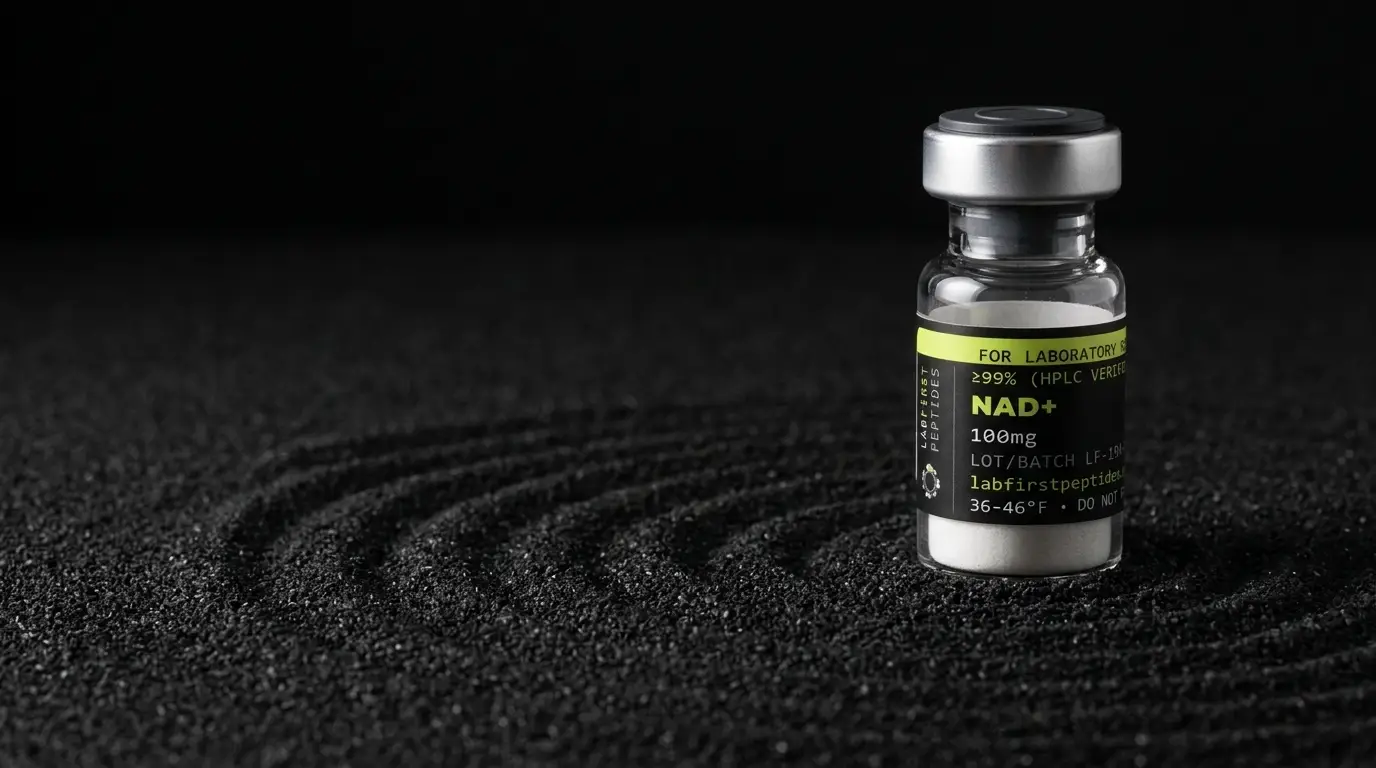
Where to buy NAD plus (NAD+): only against a lot certificate. NAD+ is nicotinamide adenine dinucleotide in its oxidized form, a coenzyme of formula C21H27N7O14P2 and 663.4 Da. It is not a peptide. It pulls in water and degrades in light. No approved medicine contains it as its active ingredient. LabFirst lists 3 sizes from $40, each lot independently tested.
- NAD+ is sold at LabFirst in 100mg, 500mg, 1000mg from $40, cheapest per mg in the 1000mg vial at $0.11.
- The identity reference for NAD+ is 663.109 Da monoisotopic (C21H27N7O14P2), PubChem CID 5892.
- A complete certificate carries identity by mass spectrometry, purity by HPLC with method and date, and net content in milligrams, all for the lot printed on the vial.
- LabFirst lots are tested by Kovera Labs, an independent laboratory, and each lot's certificate is published on its product page and in the certificate index once the report is back.
- Ground Advantage shipping is $15 flat under $200 and free above, US only; volume tiers are 10% at ten vials of one size and 15% at twenty.
What does NAD plus mean, and what is it not?
Say a listing reads NAD+, 500 mg, and you want to know what is in the vial before you pay for it. This guide covers that question. It explains what the letters name, what a lot certificate has to show, what the three sizes cost per milligram, and five checks to run on any seller's listing before an order goes in. NAD+ is nicotinamide adenine dinucleotide, the oxidized form of a helper molecule found in every living cell. Two nucleotides, one carrying nicotinamide and one carrying adenine, joined through their phosphates. It is not a peptide. It is sold beside peptides, and it tests and stores on small-molecule terms.
Formula C21H27N7O14P2, average mass 663.4 Da, PubChem CID 5892. Listings write NAD+, NAD, beta-NAD, nicotinamide adenine dinucleotide and NAD+ powder. One molecule under all of those names. The plus sign does a job. It marks the oxidized form, and the reduced form, NADH, is a different chemical with a different absorbance and a different mass.
Three mix-ups account for most bad NAD+ purchases. The first is NAD+ against NADH. A simple test tells them apart: NADH absorbs light at 340 nm and NAD+ does not, so the ratio of absorbance at 260 and 340 nm says how much of a lot is still oxidized. The second is NAD+ against its precursors, NMN and nicotinamide riboside. Those are smaller molecules with different masses, and supplier copy lumps them together. The third is the salt form. NAD+ is sold as the free acid (663.4 Da) or as a sodium salt (685.4 Da), and a certificate that states net content without saying which is off by 3% before it starts.
The biochemistry of NAD+ is textbook material, and the review cited at the foot of this page covers it. None of it says anything about a particular preparation in a vial, and this page describes the material rather than any use. What a buyer can act on is a well-characterized molecule with a known mass, a known absorbance signature, a water problem and a light problem, all of which a certificate can show it has checked.
The reference point for identity is public. PubChem lists NAD+ (nicotinamide adenine dinucleotide) as CID 5892 with molecular formula C21H27N7O14P2, an average molecular weight of 663.4 Da and a monoisotopic mass of 663.109 Da. Those are the numbers a mass spectrometer is checked against, and the number a certificate must print beside the observed mass.
In plain terms: a helper molecule rather than a peptide. Well-understood biochemistry says nothing about any particular preparation in a vial. NAD+ is chemically different from the precursors it gets lumped in with, and material of this kind pulls in water from the air and degrades in light, which makes the handling paperwork matter more than usual.
- Lot on the vial matches the certificate
- Laboratory named, with its own lookup
- Theoretical mass printed and correct
- Purity has a method and a date
- Net content stated in milligrams
How much does NAD+ cost per mg?
LabFirst lists NAD+ in 3 sizes (100mg, 500mg, 1000mg) from $40 to $110, priced per vial with the per-mg figure beside it so sizes can be compared without arithmetic. Per mg, the 1000mg vial is the cheapest at $0.11 and the 100mg the dearest at $0.40. That is the usual shape. The vial, stopper, seal, fill and laboratory run cost the same whatever mass goes in.
| Size | Price | Per mg | 10 units | 20 units | Availability |
|---|---|---|---|---|---|
| 100mg | $40 | $0.40 | $360 ($0.36/mg) | $680 ($0.34/mg) | In stock (9), lot LF-19A-2609 |
| 500mg | $80 | $0.16 | $720 ($0.14/mg) | $1360 ($0.14/mg) | In stock (10), lot PO-1001-NJ500 |
| 1000mg (best per mg) | $110 | $0.11 | $990 ($0.10/mg) | $1870 ($0.09/mg) | In stock (10), lot PO-1001-NJ1000 |
The volume tiers are per size, not per basket. Ten vials of one size take 10% off that line and twenty take 15%, and mixed sizes do not combine. Ground Advantage shipping is a flat $15 on orders under $200 and free from $200, within the United States only, with same-day dispatch on orders placed before 12 PM Pacific on a business day. The cost per mg tool runs the same comparison across any two listings, ours or anyone else's.
NAD+ is made by fermentation and enzymatic routes at scale. It is the cheapest compound in the catalog per milligram by a wide margin, which is why LabFirst sells it in 100 mg, 500 mg and 1,000 mg vials rather than in single-digit milligrams. The per-milligram figure falls across those sizes for the usual reason: the vial, the fill and the laboratory run are fixed costs spread over more mass, and at these quantities the vial and the test are most of the price.
The price signal for NAD+ is water and light. A lot that has been stored warm, damp or in daylight loses NAD+ to NADH, nicotinamide and ADP-ribose without changing its appearance much, and such lots are what get discounted. A certificate with a Karl Fischer water figure, a 260/340 ratio and a date is worth more than a markdown on a lot without them. The only discounts on this page are the volume tiers, per size and unchanged month to month, and the lot on the vial is whatever the certificate index says on the day.
What must a NAD+ certificate show?
Three tests answer three different questions, and a certificate of analysis for NAD+ is only complete when it carries all three for the exact lot on the vial. Identity is settled by mass spectrometry. The number to look for on a NAD+ certificate is 663.109 Da monoisotopic (or 663.4 Da average, if the laboratory reports the deconvoluted average mass). The observed mass should sit within the instrument's stated tolerance of that figure, and the certificate should print both the theoretical and the observed value rather than a tick.
Purity is a separate question, answered by HPLC: how much of what came off the column was the compound. The figure only means something with its method beside it (column, gradient, detection wavelength) and a date, which is what ICH Q2(R2) means when it asks that an analytical procedure be shown fit for its purpose. A percentage with no method and no date is a number somebody typed. A certificate that carries every test for a different lot number than the vial is the most common failure of all and the easiest to catch. Net content is the third test and the one most often missing: the milligrams of NAD+ in the vial, measured, against the size printed on the label.
For NAD+ the identity line reads the observed mass against 663.109 Da monoisotopic (663.4 Da average), seen in electrospray as m/z 664.1 in positive mode or 662.1 in negative mode. A laboratory may also confirm it by its UV spectrum, which has the adenine peak at 260 nm and no absorbance at 340 nm when the lot is fully oxidized. The 260/340 ratio is the check specific to this compound. A certificate that reports it, or reports NADH as a separate impurity, has answered the question that matters most: how much of the powder is still NAD+ rather than its reduced form or its breakdown products, nicotinamide and ADP-ribose.
Purity by HPLC at 260 nm should show the chromatogram with its conditions, since nicotinamide, ADP-ribose and NADH all resolve from NAD+ on the right column and are the impurities that count. Net content is the third line and, for NAD+, the one with the largest swing. The compound soaks up water, holds water of hydration, and may be the free acid or a sodium salt, so milligrams of powder and milligrams of anhydrous NAD+ can differ by a tenth or more. A certificate with a water content by Karl Fischer titration and a stated salt form has told you what the labeled milligrams are made of.
Where to buy NAD+: five checks, step by step
Every seller of nad+ says "third-party tested". The phrase costs nothing. These five checks take about four minutes per listing and separate a tested lot from a tested-sounding one.
- The lot on the vial is the lot on the certificate. Read the printed lot number, then open the certificate and match it. A certificate for "NAD+" with no lot, or a lot that does not match, describes some other vial.
- The laboratory is named and has its own lookup. The report should come from a laboratory the seller does not own, with a search code you can enter on the laboratory's own site. LabFirst lots are tested by an independent laboratory and the laboratory's report is published for each lot. Anything that exists only as the seller's own summary has not been verified.
- The theoretical mass is printed, and it is the right one. For NAD+ that is 663.109 Da monoisotopic. A certificate that prints a different figure has either measured a different molecule or copied a template.
- Purity has a method and a date. An HPLC percentage should name the method and the run date. A figure that reads "99%+" with neither, or one date reused across every product a seller lists, is decoration.
- Net content is stated in milligrams. The label size is a claim. The certificate's net content is the measurement. If the certificate has no net content line, the purity figure describes the powder rather than the vial, and the price per mg you calculated is fiction.
How listings for NAD+ specifically mislead:
- "NAD+" sold interchangeably with NMN or nicotinamide riboside. Those are precursors with different masses (334 and 255 Da) and different chemistry. A certificate mass of 663 Da is NAD+; anything else is something else.
- A 500 mg label with no salt form and no water content. Free acid and sodium salt differ by 3%, and hydration water can add a tenth. Without both figures the milligrams of NAD+ are unknown.
- A certificate with no 260/340 nm ratio or NADH figure. That ratio is the one test that says the lot is still oxidized. A certificate that skips it has skipped the question specific to this compound.
- "Pharmaceutical grade NAD+" or "same as the clinic". No approved medicine contains NAD+ as its active ingredient, so the phrase names a specification that does not exist for this material.
How do you verify a LabFirst NAD+ lot?
The NAD+ sizes in stock today carry lots LF-19A-2609, PO-1001-NJ500 and PO-1001-NJ1000. Lot LF-19A-2609 is at the laboratory for identity, purity and net content. Until the report is attached the product page says "pending verification" against that lot and makes no purity claim. The price stands, and the report goes live the day it arrives, on the page and at /coa/.
Verification runs through the laboratory rather than through us. Open the certificate index, find the lot, and read the laboratory's report. It is the laboratory's own document, and the laboratory will confirm it against its records.
The product page reads the live stock feed on load (stock, lot and certificate state for every size), so what you see when you order is what ships. The lot is printed on the label and encoded in the QR patch on its right-hand side. Scanning it opens that lot's record.
How should NAD+ be stored and shipped?
NAD+ pulls water from the air and degrades in light, and both processes run faster than for any peptide on this site. Sealed and refrigerated at 2 to 8 C in the dark, the dry powder holds for the shelf period on the certificate. Opened in humid air it takes on water within minutes, clumps, and begins to hydrolyze. So a vial is opened once, for its purpose, in dry conditions, and never re-sealed for storage. I have watched a vial of it go sticky on a humid afternoon in the time it took to find a spatula, and that was the last time I opened one without checking the room first.
In solution NAD+ is unstable in a way that depends sharply on pH, breaking down faster in alkaline conditions and to different products in acid, which is why a laboratory trusts its own 260/340 readings over any figure a label could carry.
Orders ship within the United States, Ground Advantage at a flat $15 under $200 and free above it, same day when placed before 12 PM Pacific on a business day. The shipping page states the cutoff, the carriers and what is and is not promised.
The record a laboratory keeps on arrival is what makes the certificate usable later, and it is short:
- the lot number as printed on the vial, and the certificate's accession or search code beside it;
- the date received and the condition of the seal;
- the storage location and temperature it went into;
- the number of vials, and later the date each one was opened and by whom.
A NAD+ vial with that record behind it can be traced from the bench to the laboratory report in one step. Without it, the certificate is a document about a vial that can no longer be identified.
What is the regulatory position?
No approved medicine contains NAD+ as its active ingredient, and no USP monograph defines an acceptable research lot of the bulk coenzyme. It is sold here as laboratory material only. NAD+ is not a peptide and was not among the peptides the FDA moved to Category 2 of its interim 503A bulk substances list in September 2023. The FDA page cited below carries the current entry for nicotinamide adenine dinucleotide, and that entry concerns pharmacies, not laboratory vials. The precursors NMN and nicotinamide riboside have their own, separate regulatory histories as dietary ingredients, and none of that transfers to NAD+ by association.
FOR LABORATORY AND IN-VITRO RESEARCH USE ONLY. NOT FOR HUMAN OR ANIMAL CONSUMPTION. LabFirst sells NAD+ to laboratories and researchers as material for in-vitro work, gives no guidance on use, and ships only against that understanding. Nothing on this page or on the product page describes preparing or administering anything.
Bottom line
NAD+ is a small molecule sold beside peptides, and it is bought the same way: lot on the vial matched to the lot on the certificate, a mass read against 663.109 Da, a purity figure with its method and date, a net content line with the salt and the water stated, and a 260/340 ratio that says the lot is still oxidized. Three sizes from $40, cheapest per mg at 1000mg, and the certificate index is where the lot's report lives.
What is NAD+ studied for?
Published research on NAD+ investigates the areas below, which is a different question from what NAD+ will do for anyone, a claim about a living system that nothing on this site is sold for.
What it is. Nicotinamide adenine dinucleotide, a helper molecule rather than a peptide.
What the research looks at. A very large basic-science record on how cells make energy, on oxidation and reduction, and on enzymes. Most of it is about what the molecule does inside cells rather than about any product sold in a vial.
How it is thought to work. It carries hydrogen back and forth in the reactions that make energy, switching between two forms, and it is also used up as raw material by two families of enzymes, the sirtuins and the PARPs. Its basic biochemistry is textbook material and nobody disputes it.
What is not established. Well-understood biochemistry says nothing about any particular preparation in a vial. NAD+ is chemically different from the precursors it is often lumped in with, and material of this kind pulls in water from the air and degrades in light, which makes the handling paperwork matter more than usual.
The full record, including the certificate for the lot in stock, is on the NAD+ product page.
Common questions
Where can I buy NAD+ online?
How much does NAD+ cost?
Is NAD the same as NAD+, and is NAD+ the same as NADH or NMN?
Which NAD+ size should a laboratory order first?
How do I check that a NAD+ certificate is real?
What size NAD+ vial makes sense for a laboratory?
Published certificates for NAD+
Every figure below is read from a report the laboratory issued for that lot; each page carries the PDF and the lab's own verification link.
More procurement guides
Sources
- PubChem, NAD+ (nicotinamide adenine dinucleotide), CID 5892. Public record for the molecular formula (C21H27N7O14P2), average molecular weight (663.4 Da) and monoisotopic mass (663.109 Da) quoted here as the identity reference.
- Rajman, Chwalek and Sinclair, Therapeutic potential of NAD-boosting molecules: the in vivo evidence, Cell Metabolism . Primary description of the compound in the literature; supports the class and naming stated here, not any use.
- Neelakantan and colleagues, Selective and membrane-permeable small molecule inhibitors of nicotinamide N-methyltransferase reverse high fat diet-induced obesity in mice, Biochemical Pharmacology . Primary description of the compound in the literature; supports the class and naming stated here, not any use.
- FDA, Bulk Drug Substances Used in Compounding Under Section 503A of the FD&C Act. The FDA page that carries the current 503A category lists; the entry for nicotinamide adenine dinucleotide is read from here rather than from memory.
- ICH Q2(R2), Validation of Analytical Procedures (2023) . Why a purity figure is only interpretable with its method, and what "fit for purpose" means for the HPLC and mass spectrometry results a certificate reports.