Where to buy Semax: only from a seller who sells it against a lot certificate. Semax is a seven-residue synthetic peptide, Met-Glu-His-Phe-Pro-Gly-Pro, 813.9 Da. It is built from a fragment of ACTH with a Pro-Gly-Pro tail. It is registered as a medicine in Russia and approved nowhere else. LabFirst lists 2 sizes from $34, each lot independently tested.
- Semax is sold at LabFirst in 5mg, 10mg from $34, cheapest per mg in the 10mg vial at $3.90.
- The identity reference for Semax is 813.348 Da monoisotopic (C37H51N9O10S), PubChem CID 9811102.
- A complete certificate carries identity by mass spectrometry, purity by HPLC with method and date, and net content in milligrams, all for the lot printed on the vial.
- LabFirst lots are tested by Kovera Labs, an independent laboratory, and each lot's certificate is published on its product page and in the certificate index once the report is back.
- Ground Advantage shipping is $15 flat under $200 and free above, US only; volume tiers are 10% at ten vials of one size and 15% at twenty.
What does "semax peptide" name, and what does it not?
Semax is Met-Glu-His-Phe-Pro-Gly-Pro, written MEHFPGP: residues 4 to 7 of the hormone ACTH with a Pro-Gly-Pro extension added to slow its breakdown. Formula C37H51N9O10S, average mass 813.9 Da, PubChem CID 9811102. Like Selank it came from the Institute of Molecular Genetics in Moscow, and the papers cited at the foot of this page are from that research tradition. Listings write Semax, semax peptide and ACTH(4-7)PGP; one molecule. NA-Semax, with an acetyl group on the N-terminal methionine, is a different one, 42 Da heavier, and it is sold under the plain name often enough that the certificate has to settle it.
The published record is concentrated and thinner than the volume of commercial writing suggests, and this page makes no claim about what the peptide does. What it can state exactly is the chemistry, and Semax has one feature that dominates everything else about buying and keeping it: the methionine at position 1. Methionine oxidizes to the sulfoxide, adding 16 Da, and an N-terminal methionine is the most exposed kind, so the state of that one residue is the state of the lot.
The other two things to check are the acetyl variant, which shares the name, and the salt. Semax has a glutamate and a histidine, so it is close to neutral and holds counter-ion less greedily than a basic peptide, but a trifluoroacetate lot still carries less peptide per milligram than an acetate one, and only the net content line says how much less.
The reference point for identity is public. PubChem lists Semax as CID 9811102 with molecular formula C37H51N9O10S, an average molecular weight of 813.9 Da and a monoisotopic mass of 813.348 Da. Those are the numbers a mass spectrometer is checked against, and the number a certificate must print beside the observed mass.
In plain terms: A man-made peptide seven building blocks long, based on a fragment of ACTH. No approved product in the United States and no official standard. As with Selank, the published record is concentrated and thinner than the volume of commercial writing suggests.
- Lot on the vial matches the certificate
- Laboratory named, with its own lookup
- Theoretical mass printed and correct
- Purity has a method and a date
- Net content stated in milligrams
Semax for sale: which size is cheapest per mg?
LabFirst lists Semax in 2 sizes (5mg, 10mg) from $34 to $39, priced per vial with the per-mg figure beside it so sizes can be compared without arithmetic. Per mg, the 10mg vial is the cheapest at $3.90 and the 5mg the dearest at $6.80, which is the usual shape: the vial, stopper, seal, fill and laboratory run cost the same whatever mass goes in.
| Size | Price | Per mg | 10 units | 20 units | Availability |
|---|---|---|---|---|---|
| 5mg | $34 | $6.80 | $306 ($6.12/mg) | $578 ($5.78/mg) | In stock (9), lot LF-24A-2609 |
| 10mg (best per mg) | $39 | $3.90 | $351 ($3.51/mg) | $663 ($3.31/mg) | In stock (10), lot PO-1001-XA10 |
The volume tiers are per size, not per basket: ten vials of one size take 10% off that line and twenty take 15%, and mixed sizes do not combine. Ground Advantage shipping is a flat $15 on orders under $200 and free from $200, within the United States only, with same-day dispatch on orders placed before 12 PM Pacific on a business day. The cost per mg tool runs the same comparison across any two listings, ours or anyone else's.
Seven ordinary residues make Semax a cheap synthesis, and it is among the least expensive peptides in the catalog per milligram; the vial, the fill and the laboratory run are most of the price, so the 10 mg vial costs only a little more than the 5 mg and the per-milligram figure nearly halves between them. A laboratory that will use the material buys the 10 mg vial; one qualifying a lot buys the 5 mg vial once and reads the sulfoxide peak, the mass and the salt on its certificate.
The price signal is oxidation. A lot that has been handled carelessly or stored long carries more sulfoxide, and those are the lots that get discounted; the chromatogram says whether a markdown is a bargain or a clearance of degraded material. The acetyl variant sold under the plain name is a separate trap at any price. The only discounts on this page are the volume tiers, per size and unchanged month to month, and the lot on the vial is whatever the certificate index says on the day.
What should a Semax certificate show?
Three tests answer three different questions, and a certificate of analysis for Semax is only complete when it carries all three for the exact lot on the vial. Identity is settled by mass spectrometry, and the number to look for on a Semax certificate is 813.348 Da monoisotopic (or 813.9 Da average, if the laboratory reports the deconvoluted average mass). The observed mass should sit within the instrument's stated tolerance of that figure, and the certificate should print both the theoretical and the observed value, not just a tick.
Purity is a separate question, answered by HPLC: how much of what came off the column was the compound. The figure is only interpretable with its method beside it (column, gradient, detection wavelength) and a date, which is what ICH Q2(R2) means when it asks that an analytical procedure be shown fit for its purpose. A percentage with no method and no date is a number somebody typed, and a certificate that carries every test but for a different lot number than the vial is the most common failure of all and the easiest to catch. Net content is the third test and the one most often missing: the milligrams of Semax in the vial, measured, against the size printed on the label.
Identity is the observed mass against 813.348 Da monoisotopic (813.9 Da average), seen in electrospray as m/z 814.4 for the singly charged ion and 407.7 for the doubly charged, with theoretical and observed values printed. A peak at +16 Da is the methionine sulfoxide, honest as a small named peak and a degraded lot as the main one; a mass near 856 Da is NA-Semax, the acetylated variant; a mass 97 Da low is a des-proline deletion. A certificate that reads "conforms" with no number cannot say which of those the vial holds.
Purity by HPLC should show the chromatogram with its column, gradient and wavelength; the phenylalanine gives Semax some absorbance at 257 nm but the reliable reading is at 210 to 220 nm, and the sulfoxide elutes a little earlier than the parent, so a laboratory that names it has looked for it. Net content is the third line: quantitative HPLC against a standard or amino acid analysis tells you how many of the labeled milligrams are peptide rather than counter-ion and water, and the salt form belongs beside that figure. On a 5 mg vial the difference can be a fifth.
Where should you buy Semax? Five checks before you order
Every seller of semax peptide says "third-party tested". The phrase costs nothing. These five checks take about four minutes per listing and separate a tested lot from a tested-sounding one.
- The lot on the vial is the lot on the certificate. Read the printed lot number, then open the certificate and match it. A certificate for "Semax" with no lot, or a lot that does not match, describes some other vial.
- The laboratory is named and has its own lookup. The report should come from a laboratory the seller does not own, with a search code you can enter on the laboratory's own site. LabFirst lots are tested by an independent laboratory and the laboratory's report is published for each lot; anything that exists only as the seller's own summary has not been verified.
- The theoretical mass is printed, and it is the right one. For Semax that is 813.348 Da monoisotopic; a certificate that prints a different figure has either measured a different molecule or copied a template.
- Purity has a method and a date. An HPLC percentage should name the method and the run date. A figure that reads "99%+" with neither, or one date reused across every product a seller lists, is decoration.
- Net content is stated in milligrams. The label size is a claim; the certificate's net content is the measurement. If the certificate has no net content line, the purity figure describes the powder, not the vial, and the price per mg you calculated is fiction.
How listings for Semax specifically mislead:
- NA-Semax shipped as Semax, or the reverse. The acetylated variant is 42 Da heavier and a different compound; only the observed mass on the certificate separates them.
- A single rounded mass with no mention of oxidation. An N-terminal methionine oxidizes readily; a certificate that never sees a +16 Da peak on Semax may never have looked for one.
- "Approved medicine" copy without the geography. Semax is registered in Russia and approved nowhere else; the FDA placed Semax in Category 2 of its 503A list in September 2023.
- A 5 mg label with no salt form and no net content. Acetate and trifluoroacetate lots differ in peptide content per milligram; without the content line the milligrams are unknown.
How do I verify a LabFirst Semax lot?
The Semax sizes in stock today carry lots LF-24A-2609 and PO-1001-XA10. Lot LF-24A-2609 is at the laboratory for identity, purity and net content. Until the report is attached the product page says "pending verification" against that lot and makes no purity claim; the price stands and the report goes live the day it arrives, on the page and at /coa/.
Verification runs through the laboratory, not through us. Open the certificate index, find the lot, and read the laboratory's report; it is the laboratory's own document, not ours, and the laboratory will confirm it against its records.
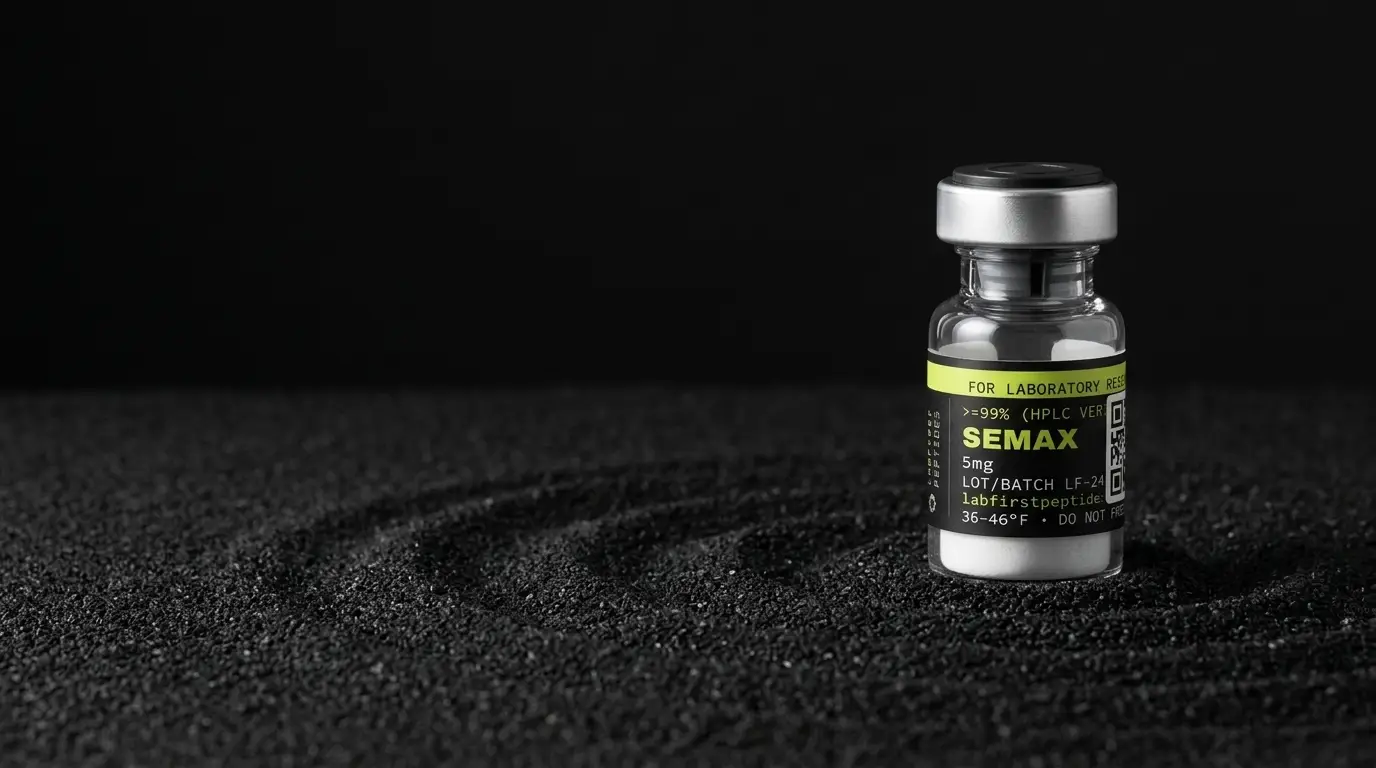
The product page reads the live stock feed on load (stock, lot and certificate state for every size), so what you see when you order is what ships. The lot is printed on the label and encoded in the QR patch on its right-hand side; scanning it opens that lot's record.
How should Semax be stored, and how does it ship?
The N-terminal methionine is the storage story. Oxidation to the sulfoxide is slow in the sealed dry cake at 2 to 8 C out of light and fast in a solution exposed to air, so a prepared Semax solution is dated, kept cold, kept from air as far as the laboratory's practice allows, and used inside the laboratory's own stability record rather than any figure on a label. The three prolines otherwise make the chain rigid and durable, and there is no cysteine, tryptophan, asparagine or glutamine to worry about. The dry cake's other enemy is water drawn from humid air once the vial is opened; open a vial once, for its purpose, and never re-seal one for storage.
Orders ship within the United States, Ground Advantage at a flat $15 under $200 and free above it, same day when placed before 12 PM Pacific on a business day, and the shipping page states the cutoff, the carriers and what is and is not promised.
The record a laboratory keeps on arrival is what makes the certificate usable later, and it is short:
- the lot number as printed on the vial, and the certificate's accession or search code beside it;
- the date received and the condition of the seal;
- the storage location and temperature it went into;
- the number of vials, and later the date each one was opened and by whom.
A Semax vial with that record behind it can be traced from the bench to the laboratory report in one step; without it, the certificate is a document about a vial that can no longer be identified.
What is the regulatory status of Semax?
Semax is registered as a medicine in Russia and is not approved in the United States or by any comparable regulator; no USP or Ph. Eur. monograph defines an acceptable lot. In September 2023 the FDA placed Semax (heptapeptide) in Category 2 of its interim list of bulk drug substances nominated for compounding under section 503A, the category for substances it has identified as raising significant safety risks, which bars licensed pharmacies from compounding with it. That listing concerns pharmacies, not laboratory material; the Russian registration concerns a finished product in another jurisdiction, and neither transfers to a research vial.
FOR LABORATORY AND IN-VITRO RESEARCH USE ONLY. NOT FOR HUMAN OR ANIMAL CONSUMPTION. LabFirst sells Semax to laboratories and researchers as material for in-vitro work, gives no guidance on use, and ships only against that understanding. Nothing on this page or on the product page describes preparing or administering anything.
Bottom line
Buy Semax against a certificate for the lot printed on the vial. It should show the observed mass beside 813.348 Da monoisotopic, a purity figure with its method and date, and net content in milligrams. Watch for the +16 Da sulfoxide peak, and for NA-Semax sold under the plain name, 42 Da heavier. Compare listings per mg only after that. The material is for laboratory research use only.
What is Semax studied for?
Published research on Semax investigates the areas below, which is a different question from what Semax will do for anyone, a claim about a living system that nothing on this site is sold for.
What it is. A man-made peptide seven building blocks long, based on a fragment of ACTH.
What the research looks at. Animal research coming largely from a narrow set of research groups.
How it is thought to work. Built from a piece of adrenocorticotropic hormone with a short tail added for durability, and it does not carry the parent hormone’s effect on cortisol. How it works is not settled.
What is not established. No approved product in the United States and no official standard. As with Selank, the published record is concentrated and thinner than the volume of commercial writing suggests.
The full record, including the certificate for the lot in stock, is on the Semax product page.
Common questions
Where can I buy Semax online?
How much does Semax cost?
Is Semax the same as NA-Semax or N-acetyl Semax?
Which Semax size should a laboratory order first?
How do I check that a Semax certificate is real?
What does a +16 Da peak on a Semax certificate mean?
Published certificates for Semax
Every figure below is read from a report the laboratory issued for that lot; each page carries the PDF and the lab's own verification link.
More procurement guides
Sources
- PubChem, Semax, CID 9811102. Public record for the molecular formula (C37H51N9O10S), average molecular weight (813.9 Da) and monoisotopic mass (813.348 Da) quoted here as the identity reference.
- Dolotov and colleagues, Semax, an analog of ACTH(4-10) with cognitive effects, regulates BDNF and trkB expression in the rat hippocampus, Brain Research . Primary description of the compound in the literature; supports the class and naming stated here, not any use.
- Agapova and colleagues, Neurotrophin gene expression in rat brain under the action of Semax, an analogue of ACTH 4-10, Neuroscience Letters . Primary description of the compound in the literature; supports the class and naming stated here, not any use.
- Alliance for Pharmacy Compounding, 503A Categories Update, 29 September 2023 . Lists the substances the FDA moved to Category 2 on that date, including Semax (heptapeptide).
- ICH Q2(R2), Validation of Analytical Procedures (2023) . Why a purity figure is only interpretable with its method, and what "fit for purpose" means for the HPLC and mass spectrometry results a certificate reports.