Where to buy GHK-Cu: only against a lot certificate. GHK-Cu is the tripeptide glycyl-L-histidyl-L-lysine (GHK) bound to a copper(II) ion. The copper is part of the product. So the certificate has to confirm both the peptide and the metal. LabFirst lists 2 sizes from $39, each lot independently tested.
- GHK-Cu is sold at LabFirst in 50mg, 100mg from $39, cheapest per mg in the 100mg vial at $0.59.
- The identity reference for GHK-Cu is 340.186 Da monoisotopic (C14H24N6O4), PubChem CID 73587.
- A complete certificate carries identity by mass spectrometry, purity by HPLC with method and date, and net content in milligrams, all for the lot printed on the vial.
- LabFirst lots are tested by Kovera Labs, an independent laboratory, and each lot's certificate is published on its product page and in the certificate index once the report is back.
- Ground Advantage shipping is $15 flat under $200 and free above, US only; volume tiers are 10% at ten vials of one size and 15% at twenty.
What this guide covers
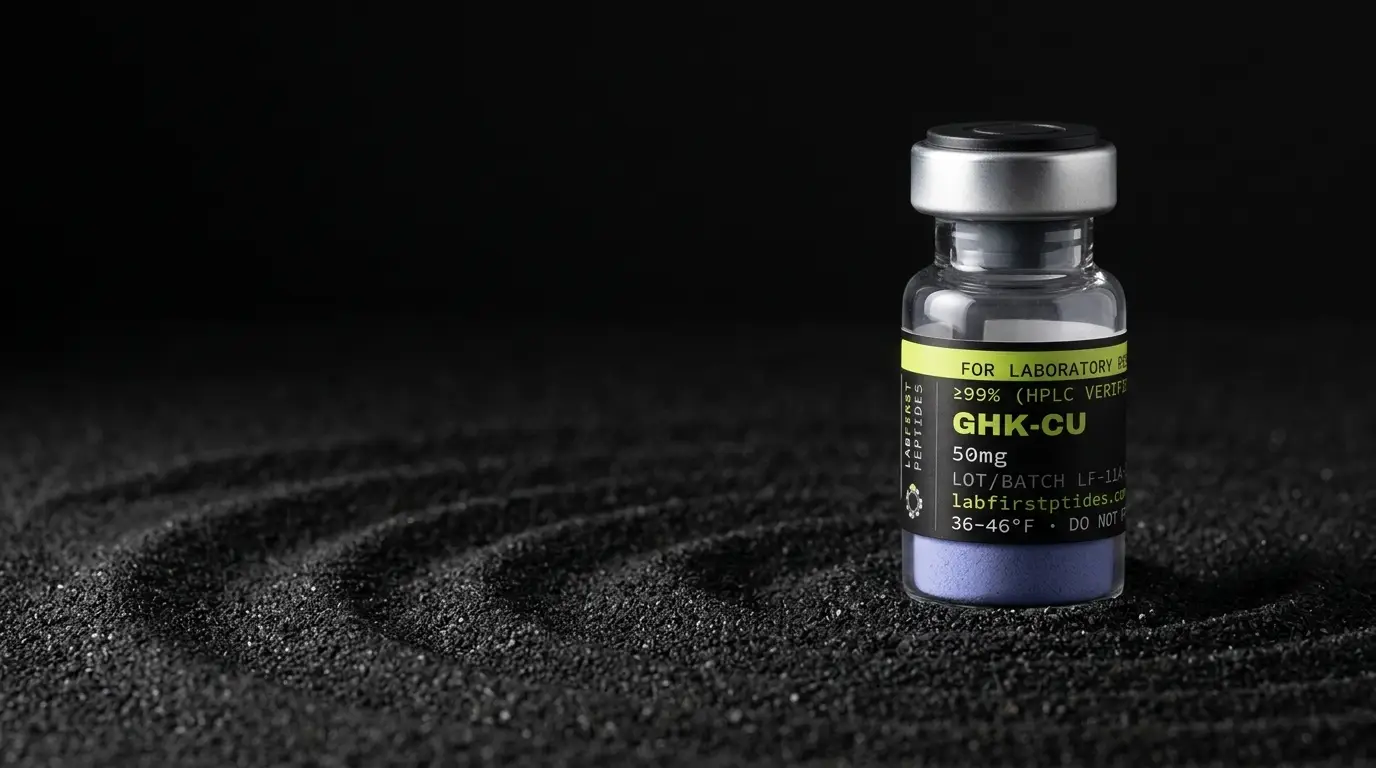
GHK-Cu is two things in one vial: the tripeptide glycyl-L-histidyl-L-lysine, three residues, 340.19 Da, and a copper(II) ion held by the histidine imidazole, the glycine amine and the peptide backbone. Cosmetic ingredient lists call it copper tripeptide-1; search results call it ghk cu peptide, ghkcu or GHK copper; the chemistry literature calls the bare peptide GHK and the complex GHK-Cu. Those are two different materials. GHK without copper is a white powder; GHK-Cu is a blue-violet one, and a blue solution when dissolved. A vial sold as GHK-Cu that dissolves clear is not GHK-Cu.
The distinction matters because the copper is where most of the fraud in this compound lives. Copper is cheap and the peptide is cheap, but making a defined 1:1 complex, drying it to a stable powder and proving the ratio is not free. A 1:1 GHK-Cu complex is about 15.8% copper by mass (63.5 Da of copper in a 402.9 Da cation); a powder that is 3% copper is mostly free peptide with a little copper sulfate stirred in, and it is being sold at GHK-Cu prices. The only way to know is a copper assay on the certificate, which is why this page keeps returning to it.
GHK-Cu has been studied for decades, mostly in cell culture and in skin models, and the papers cited at the foot of this page describe collagen and metalloproteinase signaling in fibroblast cultures. None of it is a statement about a person, and this page makes none. The chemistry is what a buyer can hold a seller to: a known tripeptide, a known copper ratio, a color that cannot be faked, and a laboratory that measured all three.
The reference point for identity is public. PubChem lists glycyl-L-histidyl-L-lysine (free tripeptide) as CID 73587 with molecular formula C14H24N6O4, an average molecular weight of 340.38 Da and a monoisotopic mass of 340.186 Da. Those are the numbers a mass spectrometer is checked against, and the number a certificate must print beside the observed mass. The copper complex is a separate PubChem record, CID 71587328, at 402.108 Da for the 1:1 cation; a certificate should say which of the two it weighed. Identity is confirmed on the peptide (340.19 Da monoisotopic); the copper complex weighs 402.11 Da as the 1:1 cation. A certificate should say which it measured.
In plain terms: A three-building-block peptide (glycine, histidine, lysine) joined to copper. No approved drug product. The copper-carrying form and the bare peptide are different chemicals with different stability, and a certificate should make clear which one is in the vial.
Below: what GHK-Cu is and how it differs from bare GHK, the sizes and price per mg LabFirst lists, what the lot certificate has to confirm about both the peptide and the copper, five checks to run on any listing, how to verify a LabFirst lot, storage and shipping, and the regulatory position. A bottom line closes the page.
- Lot on the vial matches the certificate
- Laboratory named, with its own lookup
- Theoretical mass printed and correct
- Purity has a method and a date
- Net content stated in milligrams
How much does GHK-Cu cost, and which size is cheapest per mg?
LabFirst lists GHK-Cu in 2 sizes (50mg, 100mg) from $39 to $59, priced per vial with the per-mg figure beside it so sizes can be compared without arithmetic. Per mg, the 100mg vial is the cheapest at $0.59 and the 50mg the dearest at $0.78, which is the usual shape: the vial, stopper, seal, fill and laboratory run cost the same whatever mass goes in.
| Size | Price | Per mg | 10 units | 20 units | Availability |
|---|---|---|---|---|---|
| 50mg | $39 | $0.78 | $351 ($0.70/mg) | $663 ($0.66/mg) | In stock (9), lot LF-11A-2609 |
| 100mg (best per mg) | $59 | $0.59 | $531 ($0.53/mg) | $1003 ($0.50/mg) | In stock (10), lot PO-1001-CU100 |
The volume tiers are per size, not per basket: ten vials of one size take 10% off that line and twenty take 15%, and mixed sizes do not combine. Ground Advantage shipping is a flat $15 on orders under $200 and free from $200, within the United States only, with same-day dispatch on orders placed before 12 PM Pacific on a business day. The cost per mg tool runs the same comparison across any two listings, ours or anyone else's.
GHK-Cu is among the cheapest compounds in the catalog per milligram because the peptide is three residues and the copper is copper, so the vial, the drying run and the laboratory work are almost the whole price. That is why LabFirst sells it in 50 mg and 100 mg vials rather than 5 mg and 10 mg, and why the per-milligram figure is a fraction of what a fifteen-residue peptide costs. A seller charging BPC 157 prices for GHK-Cu is not charging for chemistry.
Where price does tell you something is the copper assay. A certificate that carries a copper percentage means the seller paid for a second test on a cheap compound, which is a choice; a certificate that does not is the cheaper certificate to buy, and the powder it describes may be the cheaper powder to make. Comparing two GHK-Cu listings per milligram without knowing the copper content of each is comparing two numbers that measure different things. Ask for the assay before the price means anything.
What should a GHK-Cu certificate show?
Three tests answer three different questions, and a certificate of analysis for GHK-Cu is only complete when it carries all three for the exact lot on the vial. Identity is settled by mass spectrometry, and the number to look for on a GHK-Cu certificate is 340.186 Da monoisotopic (or 340.38 Da average, if the laboratory reports the deconvoluted average mass). The observed mass should sit within the instrument's stated tolerance of that figure, and the certificate should print both the theoretical and the observed value, not just a tick.
Purity is a separate question, answered by HPLC: how much of what came off the column was the compound. The figure is only interpretable with its method beside it (column, gradient, detection wavelength) and a date, which is what ICH Q2(R2) means when it asks that an analytical procedure be shown fit for its purpose. A percentage with no method and no date is a number somebody typed, and a certificate that carries every test but for a different lot number than the vial is the most common failure of all and the easiest to catch. Net content is the third test and the one most often missing: the milligrams of GHK-Cu actually in the vial, measured, against the size printed on the label.
A GHK-Cu certificate needs two identities. The peptide is confirmed by mass spectrometry: 340.186 Da monoisotopic for the free tripeptide (formula C14H24N6O4), seen as m/z 341.2 for the singly charged ion. Some laboratories report the intact complex instead, 402.108 Da for the 1:1 cation, and either is acceptable if the certificate says which it measured; a certificate that prints 340 and calls it GHK-Cu has confirmed the peptide only. The copper is confirmed separately, by ICP-OES, atomic absorption or a complexometric titration, and reported as a percentage of the powder. Near 15.8% is a stoichiometric complex; well below it is peptide with a copper garnish; well above it is free copper salt in the vial.
Purity by HPLC is read with a caution particular to this compound. The copper complex can dissociate on a reversed-phase column depending on the mobile phase, so the chromatogram may show the free peptide even when the vial held the complex; a laboratory that knows the compound states the conditions and what the main peak is. Net content should be given as peptide, as copper, or as complex, and the certificate must say which. A 50 mg vial can be 50 mg of complex (about 42 mg of peptide) or 50 mg of peptide (about 59 mg of complex), and the price per milligram moves by a fifth between those two readings.
How to buy GHK-Cu: step by step
Every seller of ghk-cu peptide says "third-party tested". The phrase costs nothing. These five checks take about four minutes per listing and separate a tested lot from a tested-sounding one.
- The lot on the vial is the lot on the certificate. Read the printed lot number, then open the certificate and match it. A certificate for "GHK-Cu" with no lot, or a lot that does not match, describes some other vial.
- The laboratory is named and has its own lookup. The report should come from a laboratory the seller does not own, with a search code you can enter on the laboratory's own site. LabFirst lots are tested by an independent laboratory and the laboratory's report is published for each lot; anything that exists only as the seller's own summary has not been verified.
- The theoretical mass is printed, and it is the right one. For GHK-Cu that is 340.186 Da monoisotopic; a certificate that prints a different figure has either measured a different molecule or copied a template.
- Purity has a method and a date. An HPLC percentage should name the method and the run date. A figure that reads "99%+" with neither, or one date reused across every product a seller lists, is decoration.
- Net content is stated in milligrams. The label size is a claim; the certificate's net content is the measurement. If the certificate has no net content line, the purity figure describes the powder, not the vial, and the price per mg you calculated is fiction.
Red flags on a GHK-Cu listing
Listings for GHK-Cu mislead in a few repeatable ways:
- White powder or a clear solution sold as GHK-Cu. The copper complex is blue-violet in the vial and blue in solution; a colorless product is GHK without copper, or something else entirely.
- A certificate with a peptide mass and no copper assay. The peptide is a third of the price and half of the identity; without a copper percentage the ratio, and therefore the product, is unknown.
- "100 mg GHK-Cu" with no statement of whether the milligrams are peptide, copper or complex. The three readings differ by about a fifth, and the per-milligram price with them.
- Cosmetic-grade copper tripeptide-1 relabeled as research GHK-Cu with a purity figure from a supplier data sheet. Cosmetic ingredient sheets report to a different specification and rarely to a specific lot.
How do I verify a LabFirst GHK-Cu lot?
The GHK-Cu sizes in stock today carry lots LF-11A-2609 and PO-1001-CU100. Lot LF-11A-2609 is at the laboratory for identity, purity and net content. Until the report is attached the product page says "pending verification" against that lot and makes no purity claim; the price stands and the report goes live the day it arrives, on the page and at /coa/.
Verification runs through the laboratory, not through us. Open the certificate index, find the lot, and read the laboratory's report; it is the laboratory's own document, not ours, and the laboratory will confirm it against its records.
The product page reads the live stock feed on load (stock, lot and certificate state for every size), so what you see when you order is what ships. The lot is printed on the label and encoded in the QR patch on its right-hand side; scanning it opens that lot's record.
How should GHK-Cu be stored, and how does it ship?
Dry GHK-Cu is a stable blue-violet powder when sealed and refrigerated at 2 to 8 C out of light, and its color is a built-in indicator: a cake that has turned green or brown has taken on water or lost its copper coordination. The complex is hygroscopic, more so than a bare peptide, so a vial opened in humid air should be used and not re-sealed for storage. In solution the copper is the reactive part; it binds to anything that chelates metal, which includes phosphate buffers, EDTA and some plastics. Blue means intact; anything else means ask the certificate what changed.
Orders ship within the United States, Ground Advantage at a flat $15 under $200 and free above it, same day when placed before 12 PM Pacific on a business day, and the shipping page states the cutoff, the carriers and what is and is not promised.
The record a laboratory keeps on arrival is what makes the certificate usable later, and it is short:
- the lot number as printed on the vial, and the certificate's accession or search code beside it;
- the date received and the condition of the seal;
- the storage location and temperature it went into;
- the number of vials, and later the date each one was opened and by whom.
A GHK-Cu vial with that record behind it can be traced from the bench to the laboratory report in one step; without it, the certificate is a document about a vial that can no longer be identified.
What is the regulatory status of GHK-Cu?
No approved medicine contains GHK-Cu and no USP or Ph. Eur. monograph defines an acceptable lot. Copper tripeptide-1 is a listed cosmetic ingredient, which governs its use in topical products and says nothing about a research vial. In September 2023 the FDA placed GHK-Cu in Category 2 of its interim 503A bulk substances list, with the entry qualified by route, which bars licensed pharmacies from compounding with it in that form; the listing concerns pharmacies, not laboratory material, and is quoted here because it settles one thing: there is no grade of GHK-Cu that a seller can lawfully call pharmaceutical.
FOR LABORATORY AND IN-VITRO RESEARCH USE ONLY. NOT FOR HUMAN OR ANIMAL CONSUMPTION. LabFirst sells GHK-Cu to laboratories and researchers as material for in-vitro work, gives no guidance on use, and ships only against that understanding. Nothing on this page or on the product page describes preparing or administering anything.
Bottom line
GHK-Cu is the tripeptide glycyl-L-histidyl-L-lysine with a copper(II) ion attached, and a vial that is not blue is not GHK-Cu. Buy it against a certificate for the lot on the vial that confirms the peptide by mass and the copper that goes with it, with a purity method and date and a net content line. No grade of it is pharmaceutical, whatever a listing says, and the certificate is the only thing that separates the complex from the bare peptide.
What is GHK-Cu studied for?
Published research on GHK-Cu investigates the areas below, which is a different question from what GHK-Cu will do for anyone, a claim about a living system that nothing on this site is sold for.
What it is. A three-building-block peptide (glycine, histidine, lysine) joined to copper.
What the research looks at. A substantial body of cell-culture work on copper-peptide chemistry and the material that holds skin tissue together.
How it is thought to work. The peptide grips copper tightly, and the copper-carrying form is what the research is about. Its blue color comes from that copper, not from the peptide. Published work covers the copper chemistry and the biology of the material between skin cells, in culture.
What is not established. No approved drug product. The copper-carrying form and the bare peptide are different chemicals with different stability, and a certificate should make clear which one is in the vial.
The full record, including the certificate for the lot in stock, is on the GHK-Cu product page.
Common questions
Where can I buy GHK-Cu online?
How much does GHK-Cu cost?
Is GHK the same as GHK-Cu, and is copper tripeptide-1 the same thing?
Which GHK-Cu size should a laboratory order first?
How do I check that a GHK-Cu certificate is real?
What copper content should a GHK-Cu certificate show?
Published certificates for GHK-Cu
Every figure below is read from a report the laboratory issued for that lot; each page carries the PDF and the lab's own verification link.
More procurement guides
Sources
- PubChem, glycyl-L-histidyl-L-lysine (free tripeptide), CID 73587. Public record for the molecular formula (C14H24N6O4), average molecular weight (340.38 Da) and monoisotopic mass (340.186 Da) quoted here as the identity reference.
- Maquart and colleagues, Stimulation of collagen synthesis in fibroblast cultures by the tripeptide-copper complex glycyl-L-histidyl-L-lysine-Cu2+, FEBS Letters . Primary description of the compound in the literature; supports the class and naming stated here, not any use.
- Pickart and Margolina, Regenerative and Protective Actions of the GHK-Cu Peptide in the Light of the New Gene Data, International Journal of Molecular Sciences 19(7):1987 . Primary description of the compound in the literature; supports the class and naming stated here, not any use.
- Alliance for Pharmacy Compounding, 503A Categories Update, 29 September 2023 . Lists the substances the FDA moved to Category 2 on that date, including GHK-Cu with its route qualifier.
- FDA, Bulk Drug Substances Used in Compounding Under Section 503A of the FD&C Act. The FDA page that carries the current 503A category lists and the interim policy they sit under.
- ICH Q2(R2), Validation of Analytical Procedures (2023) . Why a purity figure is only interpretable with its method, and what "fit for purpose" means for the HPLC and mass spectrometry results a certificate reports.