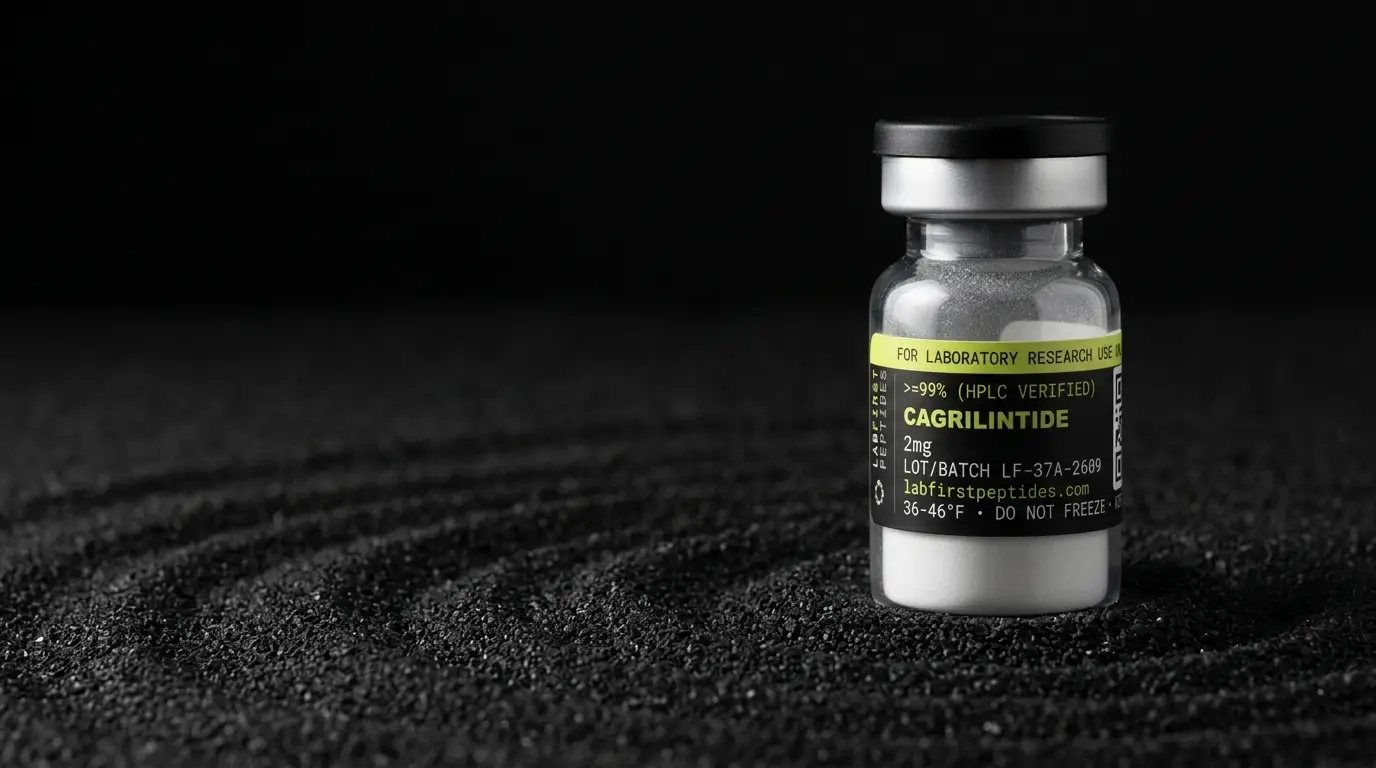
Cagrilintide is a synthetic peptide 37 amino acids long, built on the sequence of the hormone amylin as modified in pramlintide, with a C20 fatty diacid attached through a gamma-glutamate linker to the lysine at the start of the chain. Its formula is C194H312N54O59S2 and it weighs about 4,409 g/mol. It is investigational and not an FDA-approved drug.
- Cagrilintide is a 37-residue lipidated analog of human amylin built on the pramlintide backbone.
- PubChem CID 171397054 lists cagrilintide with the formula C194H312N54O59S2, a molecular weight of 4,409 g/mol and CAS number 1415456-99-3.
- Cagrilintide carries a C20 fatty diacid attached through a gamma-glutamate linker to lysine 1, per Cao et al. (Nature Communications, 2025).
- Cagrilintide differs from pramlintide by three substitutions, N14E, V17R and Y37P, and keeps pramlintide's prolines at positions 25, 28 and 29.
- Human amylin is 37 residues, KCNTATCATQRLANFLVHSSNNFGAILSSTNVGSNTY, with a Cys2-Cys7 disulfide and a C-terminal amide, per UniProt P10997.
- Cagrilintide is investigational, with Phase 3 trials registered on ClinicalTrials.gov alone and in co-formulation with semaglutide; no FDA-approved drug contains it as of November 1, 2026.
What this guide covers
Cagrilintide is one of the few widely listed research peptides built on amylin, a pancreatic hormone, rather than on the gut hormones behind semaglutide and tirzepatide. That makes it a different kind of molecule with a different failure mode, and a listing that treats it as one more GLP-1 compound has already got it wrong.
This page explains what amylin is, how pramlintide changed it, and what cagrilintide added on top. It gives the formula and mass a certificate should match, describes the fatty acid and where it sits, and reads the trial registry for where development stands. It stops at chemistry and status. It does not describe use in people or animals, and it does not cover handling of a vial.
- Amylin: 37 residues, Cys2-Cys7 disulfide, amidated
- Pramlintide: prolines at 25, 28 and 29 stop fibrils
- Cagrilintide backbone: N14E, V17R and Y37P added
- Lipidation: C20 fatty diacid on Lys1 via gamma-glutamate
- Result: C194H312N54O59S2, about 4,409 g/mol
- Status: investigational, Phase 3
What is cagrilintide?
Cagrilintide is a synthetic analog of human amylin, a 37-amino-acid hormone made alongside insulin in the pancreas. The 2021 paper in the Journal of Medicinal Chemistry that reported its development describes it as a stable, lipidated, long-acting amylin analog and explains why that was hard: natural amylin has a high tendency to form amyloid fibrils, clumps of misfolded peptide, which makes it a difficult starting point.
PubChem's record for cagrilintide (CID 171397054) gives the molecular formula as C194H312N54O59S2, an average molecular weight of 4,409 g/mol and a monoisotopic mass of 4,406.25. Its synonym list carries the CAS registry number 1415456-99-3, the international nonproprietary name, the developer code NN0174-0833, and the note "analogue 23" with the PubMed identifier of the 2021 paper, which is the compound number it had before it was named.
The two sulfur atoms in the formula belong to the two cysteines in the chain, which are joined to each other by a disulfide bond near the start of the sequence. That bond is inherited from amylin and is one of the things a mass spectrum confirms, since a reduced peptide with the bond broken weighs two mass units more.
Our cagrilintide product page lists the sizes we stock, and each lot's certificate is posted at /coa/.
What is amylin, and how did pramlintide change it?
Human amylin, also called islet amyloid polypeptide, is cut from an 89-residue precursor and runs 37 residues: KCNTATCATQRLANFLVHSSNNFGAILSSTNVGSNTY, with a disulfide bond between cysteine 2 and cysteine 7 and an amide group on the final tyrosine. Those features are listed in the UniProt record for the human precursor (P10997).
Pramlintide was the first analog made from it. The FDA label for SYMLIN describes pramlintide as a synthetic analog of human amylin, a 37-amino-acid polypeptide supplied as an acetate salt, with proline replacing alanine at position 25 and serine at positions 28 and 29. Those three prolines are the change that stops the chain from stacking into fibrils, and they were borrowed from rat amylin, which carries prolines at those positions and does not form amyloid. The label gives the formula C171H267N51O53S2 and a molecular weight of 3,949.4, and the product carries Initial U.S. Approval: 2005.
Pramlintide lasts only a short time in the body, which is the limitation cagrilintide was designed to remove. The 2025 structural paper in Nature Communications states that pramlintide was the backbone peptide used to generate cagrilintide, so the three prolines come along.
What did cagrilintide add to pramlintide?
Cagrilintide adds a fatty acid at one end of the pramlintide chain and swaps three residues along it. The Nature Communications paper, which solved the structure of cagrilintide bound to its receptors, spells out the changes.
- Lipidation at lysine 1. The paper states that cagrilintide is N-terminally acylated with a gamma-glutamate linker and a C20 fatty diacid moiety, and identifies lysine 1 as the site of lipid conjugation. The fatty diacid binds albumin in blood, which is the same half-life strategy used in semaglutide and tirzepatide, though those carry theirs on an internal lysine rather than the first residue.
- Two helix-stabilizing substitutions, N14E and V17R: asparagine 14 to glutamate and valine 17 to arginine, which the paper describes as incorporated to stabilize the helical part of the chain.
- Y37P: the final tyrosine replaced by proline, a change from the amylin sequence noted in the same paper.
Everything else is pramlintide: the amylin backbone, the prolines at 25, 28 and 29, the disulfide between cysteines 2 and 7, and the amide at the end. The paper confirms that all the peptides it studied are C-terminally amidated.
| Feature | Human amylin | Pramlintide | Cagrilintide |
|---|---|---|---|
| Length | 37 residues | 37 residues | 37 residues |
| Changes from amylin | None | A25P, S28P, S29P | Pramlintide changes plus N14E, V17R, Y37P |
| Lipid | None | None | C20 fatty diacid via gamma-glutamate on Lys1 |
| Disulfide | Cys2-Cys7 | Cys2-Cys7 | Cys2-Cys7 |
| C-terminus | Tyrosine amide | Amide | Amide (proline) |
| Formula | Not given as a small-molecule formula in UniProt | C171H267N51O53S2 | C194H312N54O59S2 |
| Average mass | About 3,903 Da (calculated) | 3,949.4 (label) | 4,409 (PubChem) |
| Status | Hormone | Approved medicine (2005) | Investigational |
The mass gap between pramlintide and cagrilintide, about 460 Da, is mostly the fatty diacid and its linker, with the three substitutions accounting for the rest. A certificate for cagrilintide that reports a mass near 3,950 is describing pramlintide or something like it, not cagrilintide.
Why does the amylin lineage matter in the laboratory?
Amylin-family peptides aggregate, and aggregation is the failure a laboratory has to watch for with cagrilintide. The 2021 development paper opens with amylin's high propensity to form amyloid fibrils, and the design changes in pramlintide and cagrilintide were made to suppress it, not to abolish it.
Aggregation leaves no visible trace in a dry powder and often none in a clear solution, which is why it is the quiet failure mode. A mass spectrum of a well-handled sample shows the expected monomer mass. An HPLC trace of an aggregated one may show lost main-peak area or shoulders without any single impurity to name. Our guide on cagrilintide storage and stability covers what controls it in a sealed vial.
The lineage also matters for reading a listing. Cagrilintide is sometimes sold alongside semaglutide, and the two are combined in a co-formulation called CagriSema that is in late-stage trials. They are different molecules from different hormone families, with masses about 300 Da apart (4,409 against 4,114). A vial labeled with both names should carry a certificate showing two masses, not one. Our guide on how CagriSema identity is confirmed covers the two-compound case.
Is cagrilintide FDA approved?
No. Cagrilintide is an investigational compound, and no FDA-approved drug containing it appeared in the sources we read on November 1, 2026. It is in Phase 3 clinical trials both on its own and in the co-formulation with semaglutide.
ClinicalTrials.gov lists Phase 3 trials of cagrilintide alone, for example NCT07220642 and NCT07220759, both registered by the sponsor with a start date of November 5, 2025 and listed as active, not recruiting when read. It also lists completed Phase 3 trials of the cagrilintide and semaglutide co-formulation, for example NCT06323174 and NCT06534411. A completed trial or a pending application is not an approval. Check Drugs@FDA for the current position before relying on this paragraph.
Because cagrilintide is not an approved drug, research-grade material sold under the name is not a route to any approved product and is documented under different rules from one. Our guide on whether research peptides are legal explains how research-use-only sales fit into United States law.
How to confirm a vial is cagrilintide: step by step
A label is a claim. The formula, the mass and the lot number turn it into evidence.
- Check the stated identity. The product page or certificate should give the formula C194H312N54O59S2 or the CAS number 1415456-99-3, and should describe the lipid.
- Find the mass spectrometry result. The deconvoluted mass should sit near 4,409 (average) or 4,406.3 (monoisotopic), allowing for the charge states the instrument reports. A peptide this size usually appears as several multiply charged ions.
- Make sure the mass includes the lipid. A result near 3,950 describes the unlipidated backbone, which is a different compound.
- Check the disulfide. A mass two units high points to a reduced peptide with the Cys2-Cys7 bond broken.
- Note the salt form and net peptide content. An acetate salt weighs more per milligram than the free peptide.
- Read the HPLC purity as a separate figure and match the lot number on the certificate to the lot on the vial. How cagrilintide identity is confirmed covers each step in depth.
What to check before you order
- A product page that gives the formula or CAS number and names the fatty diacid, not just a name.
- A lot-specific certificate with both a mass spectrum and an HPLC trace.
- A stated salt form and a net peptide content figure.
- Sizes stated as milligrams of peptide per vial.
- Clear research-use-only labeling and storage guidance for the sealed vial.
Our guide on reading a cagrilintide certificate walks through each field, and HPLC purity versus identity explains why one number is never enough.
Bottom line
Cagrilintide is a 37-residue amylin analog: the pramlintide backbone with its three prolines, plus N14E, V17R and Y37P, plus a C20 fatty diacid on lysine 1 through a gamma-glutamate linker. Formula C194H312N54O59S2, about 4,409 g/mol, CAS 1415456-99-3. It is investigational, in Phase 3 trials alone and with semaglutide, and no approved drug contains it as of the sources we read. What a buyer can verify is the chemistry, and that comes down to a mass spectrum that includes the lipid, an HPLC trace and a lot number that match.
FOR LABORATORY AND IN-VITRO RESEARCH USE ONLY. NOT FOR HUMAN OR ANIMAL CONSUMPTION. NOT FOR PERSONAL, MEDICAL, DIAGNOSTIC, THERAPEUTIC, OR RECREATIONAL USE.
What is Cagrilintide studied for?
Published research on Cagrilintide investigates the areas below, which is a different question from what Cagrilintide will do for anyone, a claim about a living system that nothing on this site is sold for.
What it is. Lipidated long-acting analogue of amylin (islet amyloid polypeptide).
What the research looks at. Receptor pharmacology across calcitonin-family receptors, and preclinical metabolic models in high-fat-diet and diabetic rats. Investigational; developed by Novo Nordisk.
How it is thought to work. A non-selective agonist at calcitonin family G-protein-coupled receptors — it activates both the amylin receptors, which are heterodimers of the calcitonin receptor with receptor activity-modifying proteins, and the calcitonin receptor itself. Compounds with this profile are termed dual amylin and calcitonin receptor agonists.
What is not established. No approved product. The relative contribution of amylin-receptor versus calcitonin-receptor activation to any observed effect is an open question the field is actively arguing about.
The full record, including the certificate for the lot in stock, is on the Cagrilintide product page.
Common questions
What is cagrilintide made of?
Is cagrilintide a GLP-1?
What is the difference between cagrilintide and pramlintide?
Is cagrilintide FDA approved?
What mass should a cagrilintide certificate show?
More science guides
Sources
- PubChem PUG REST: CID 171397054 properties (cagrilintide). Formula C194H312N54O59S2, molecular weight 4,409, monoisotopic mass 4,406.25; synonyms include CAS 1415456-99-3, NN0174-0833 and analogue 23 [PMID: 34288673]. Read November 1, 2026.
- UniProt P10997, Islet amyloid polypeptide (human). 89-residue precursor; mature amylin at positions 34 to 70 (37 residues), sequence KCNTATCATQRLANFLVHSSNNFGAILSSTNVGSNTY, disulfide 35-40 (Cys2-Cys7 in the mature chain), C-terminal tyrosine amide.
- Kruse T, et al. Development of Cagrilintide, a Long-Acting Amylin Analogue. Journal of Medicinal Chemistry 64(15):11183-11194 (2021) doi:10.1021/acs.jmedchem.1c00565. Reports the development of the stable, lipidated long-acting amylin analog cagrilintide; notes amylin's high propensity to form amyloid fibrils and pramlintide's short duration.
- Cao J, et al. Structural and dynamic features of cagrilintide binding to calcitonin and amylin receptors. Nature Communications 16:3389 (2025) . States that cagrilintide is N-terminally acylated with a gamma-Glu linker and a C20 fatty diacid at Lys1, that pramlintide is its backbone peptide, that it carries the helix-stabilizing N14E and V17R substitutions and Y37P, that amylin-based peptides have a Cys2-Cys7 disulfide, and that all are C-terminally amidated.
- SYMLIN (pramlintide acetate) prescribing information, DailyMed, section 11. Pramlintide is a synthetic analog of human amylin, a 37-amino acid polypeptide supplied as an acetate salt, with proline replacing alanine at position 25 and serine at positions 28 and 29; C171H267N51O53S2; molecular weight 3949.4; Initial U.S. Approval 2005.
- ClinicalTrials.gov NCT07220642 (cagrilintide, Phase 3) and NCT06534411 (cagrilintide with semaglutide, Phase 3). Registered Phase 3 entries establishing cagrilintide's investigational status alone and in co-formulation. Read November 1, 2026.