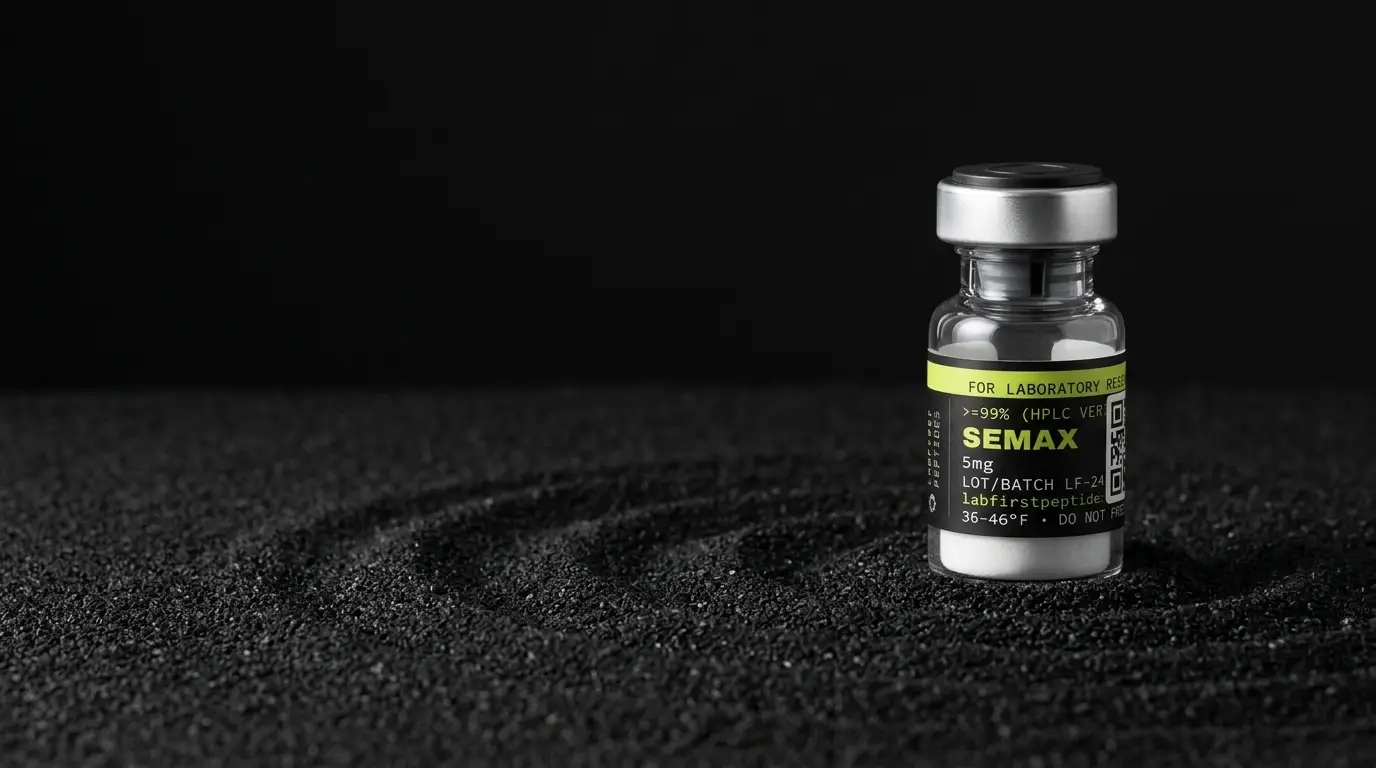
Semax is a synthetic peptide seven amino acids long, Met-Glu-His-Phe-Pro-Gly-Pro, built from a short piece of the hormone ACTH with a Pro-Gly-Pro tail added. Its formula is C37H51N9O10S and it weighs about 813.9 g/mol. It is not an FDA-approved drug in the United States.
- Semax is a synthetic heptapeptide with the sequence Met-Glu-His-Phe-Pro-Gly-Pro (MEHFPGP).
- PubChem CID 9811102 lists Semax with the formula C37H51N9O10S and a molecular weight of 813.9 g/mol.
- Semax combines residues 4 to 7 of ACTH with an added Pro-Gly-Pro tail and is described as an analog of ACTH(4-10).
- FDA lists semax (heptapeptide) among bulk drug substances nominated but withdrawn for compounding, on a page last updated April 22, 2026.
- Published Semax studies, such as Brain Research (2006), measured BDNF and trkB in rat hippocampus.
What this guide covers
Ever seen a short string of letters like MEHFPGP on a label and wondered what it spells? Each letter is one amino acid. Semax is that string: seven building blocks in a fixed order, small enough to write on one line.
This page explains where that sequence comes from, what the formula and weight are, what published studies looked at, and what FDA's own page says about it. It also walks through how a lab confirms a vial really holds Semax. It does not cover use in people or animals, because there is none to describe for a research compound.
- Seven residues: MEHFPGP
- Met-Glu-His-Phe from ACTH
- Pro-Gly-Pro tail added
- Formula C37H51N9O10S
- About 813.9 g/mol
- Not FDA approved
What is Semax?
Semax is a synthetic heptapeptide, meaning a chain of seven amino acids, with the sequence Met-Glu-His-Phe-Pro-Gly-Pro. In one-letter code that is MEHFPGP, read from the N-terminus (methionine) to the C-terminus (proline).
The first four residues, Met-Glu-His-Phe, match positions 4 to 7 of adrenocorticotropic hormone, usually shortened to ACTH. The last three, Pro-Gly-Pro, are a tail that does not come from that stretch of the hormone. PubChem's record for the compound (CID 9811102) carries the title ACTH (4-7), Pro-Gly-Pro-, which describes the molecule exactly: a hormone fragment with a tripeptide added. Published papers describe Semax as an analog of ACTH(4-10).
PubChem gives the molecular formula as C37H51N9O10S and the molecular weight as 813.9 g/mol. The single sulfur atom belongs to the methionine side chain. The CAS registry number listed for Semax is 80714-61-0.
Semax is sometimes confused with N-acetyl Semax amidate, a modified version with a capped N-terminus and an amidated C-terminus. Those changes alter the formula and mass, so the two are different compounds. Our guide on N-acetyl Semax versus Semax covers the differences.
What does Semax do in research?
In the laboratory, Semax is a reference peptide that researchers have studied mostly in rodent models. The published record answers what scientists measured, which is a different question from what the compound does in a person, and only the first one has an answer here.
Two widely cited papers show the kind of work involved. A 2006 study in Brain Research measured levels of brain-derived neurotrophic factor (BDNF) and its receptor trkB in the hippocampus of rats after Semax was given. A 2007 study in Neuroscience Letters used real-time PCR to measure the gene expression of neurotrophins, including NGF and BDNF, across several regions of the rat brain. Both were short animal experiments, and both looked at molecular markers rather than any approved use.
That pattern runs through much of the literature. Most of it comes from a fairly small number of research groups, and much of it is preclinical. A reader looking for settled answers about how Semax works will not find them in that record, and no United States regulator has accepted a medical use for it.
For a supplier, the useful questions are narrower and answerable: is the material in the vial the right sequence, how pure is it, and is there a certificate for that exact lot.
How is the Semax sequence put together?
Seven residues means six peptide bonds. Each one forms when the carboxyl group of one amino acid joins the amine group of the next and a molecule of water leaves. In solid-phase synthesis the chain is usually built one protected residue at a time, starting from the C-terminal proline anchored to a resin, then cut free and purified.
Three prolines out of seven is a lot. Proline's side chain loops back onto its own backbone nitrogen, which makes the ring rigid and removes the hydrogen that most residues use for backbone hydrogen bonds. A chain rich in proline tends to stay extended rather than folding, and the Pro-Gly-Pro tail is a compact, kinked end to the molecule.
The other residues give the molecule its chemistry. Glutamic acid carries an acidic side chain, histidine carries an imidazole ring that can pick up a proton near neutral pH, and phenylalanine adds a nonpolar aromatic ring. Methionine's thioether sulfur can oxidize to a sulfoxide in air over time, which adds 16 mass units and is one reason sealed, dry storage matters for this peptide.
The free peptide has an average mass of about 813.9 g/mol and a monoisotopic mass of about 813.348. A vial sold as a salt, such as an acetate, weighs more per milligram of powder than the free peptide figures suggest, because the counterion adds weight. A good certificate states which form it measured, so the numbers on it can be checked against the right reference value.
Is Semax FDA approved?
No. Semax is not an FDA-approved drug, and it has no United States Pharmacopeia monograph. It is sold in the United States only as a research chemical.
That page showed a last-updated date of April 22, 2026 when we read it on October 11, 2026. Regulatory listings change, so check FDA's page directly for the current wording. Our broader guide on whether research peptides are legal explains how research-use-only sales fit into United States law.
How to confirm a vial is Semax: step by step
A label is a claim. Here is how a lab turns that claim into evidence.
- Check the stated identity. The certificate should name Semax and give the sequence MEHFPGP, or the formula C37H51N9O10S.
- Look for mass spectrometry. The measured mass should match the expected value for the free peptide, about 813.35 monoisotopic, allowing for the charge states the instrument reports. A peak 16 units heavier points to oxidized methionine.
- Read the HPLC result. Reversed-phase HPLC reports purity as an area percentage of the main peak. It shows how much of the sample is one compound, not which compound it is, which is why mass data has to sit next to it.
- Match the lot. The lot number on the certificate must match the lot on the vial. A certificate for another batch says nothing about yours.
- Note the form. If the material is a salt, the certificate should say so, since that changes the weight per milligram.
Our guide on how Semax identity is confirmed covers each method in more depth, and HPLC purity versus identity explains why one number is never enough.
What to check before you order
- A product page that gives the sequence or formula, not just a name.
- A lot-specific certificate with both HPLC and mass spectrometry data.
- Sizes stated as milligrams of peptide per vial.
- Clear research-use-only labeling.
- Storage guidance for the sealed lyophilized vial.
Our Semax product page lists the sizes we stock. Certificates for each lot are posted at /coa/. For storage of the sealed vial, see Semax storage and stability, and for vetting any seller, where to buy Semax peptide.
Bottom line
Semax is MEHFPGP: four residues from ACTH and a three-residue proline tail, formula C37H51N9O10S, about 813.9 g/mol. The research behind it is mostly rodent work on molecular markers, and FDA lists it as a withdrawn compounding nomination with no approved use. What a buyer can verify is the chemistry, and that comes down to a mass spectrum, an HPLC trace and a lot number that match.
FOR LABORATORY AND IN-VITRO RESEARCH USE ONLY. NOT FOR HUMAN OR ANIMAL CONSUMPTION.
Common questions
What is Semax peptide made of?
What does Semax do?
Is Semax the same as N-acetyl Semax amidate?
Published certificates for Semax
Every figure below is read from a report the laboratory issued for that lot; each page carries the PDF and the lab's own verification link.
More science guides
Sources
- PubChem PUG REST: CID 9811102 properties. Title ACTH (4-7), Pro-Gly-Pro-, formula C37H51N9O10S, molecular weight 813.9.
- FDA: Certain bulk drug substances for use in compounding that may present significant safety risks. Lists semax (heptapeptide) as nominated but withdrawn, with FDA's stated concerns. Last updated April 22, 2026; read October 11, 2026.
- Dolotov et al., Brain Research (2006), Semax regulates BDNF and trkB expression in the rat hippocampus. Gives the sequence Met-Glu-His-Phe-Pro-Gly-Pro and describes a rat study of BDNF and trkB.
- Neuroscience Letters (2007), Neurotrophin gene expression in rat brain under the action of Semax. Real-time PCR study of neurotrophin gene expression across rat brain regions.