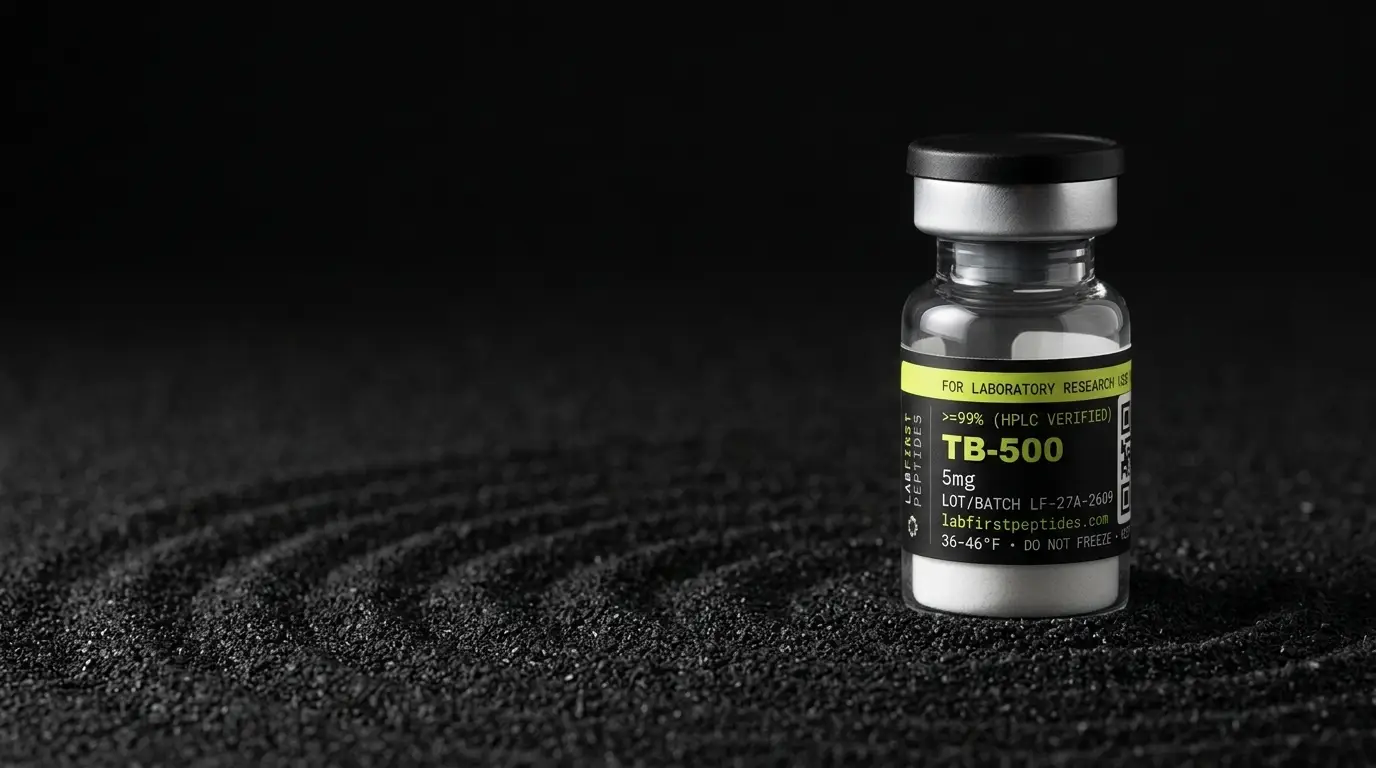
TB-500 is a synthetic peptide seven amino acids long, Ac-Leu-Lys-Lys-Thr-Glu-Thr-Gln, copied from residues 17 to 23 of the 43-residue protein thymosin beta-4 and capped with an acetyl group. Its formula is C38H68N10O14 and it weighs about 889 g/mol. It is not the full protein, and no FDA-approved drug contains it.
- TB-500 is a synthetic heptapeptide with the sequence Ac-Leu-Lys-Lys-Thr-Glu-Thr-Gln-OH, written Ac-LKKTETQ.
- PubChem CID 62707662 lists TB-500 with the formula C38H68N10O14, a molecular weight of 889.0 g/mol and CAS number 885340-08-9.
- TB-500 copies residues 17 to 23 of the mature 43-residue protein thymosin beta-4, per FDA's May 2026 evaluation document.
- Ac-SDKP (goralatide, PubChem CID 65938) is the first four residues of thymosin beta-4 and does not overlap TB-500 in the parent sequence.
- FDA added Thymosin Beta-4, Fragment (LKKTETQ) to 503A Category 2 on September 29, 2023, and evaluated TB-500 at its Pharmacy Compounding Advisory Committee on July 23, 2026.
- No FDA-approved drug contains TB-500 or thymosin beta-4.
What this guide covers
Three different molecules travel under the name TB-500, and a vial label rarely says which one is inside. One is a protein of 43 amino acids. One is a fragment seven amino acids long. One is a fragment of four. They share a parent, and that is where the confusion starts.
This page sorts them out. It gives the sequence, formula and mass of each, explains where the seven-residue fragment sits inside the parent protein, and reads what FDA has written about the name. It stops at chemistry and regulatory status. It does not describe use in people or animals, because there is no approved use to describe.
- Seven residues: Ac-LKKTETQ
- Copied from thymosin beta-4 positions 17 to 23
- Formula C38H68N10O14
- About 889 g/mol, versus about 4,960 Da for the parent protein
- Ac-SDKP is a different four-residue fragment
- Not FDA approved
What is TB-500?
TB-500 is a synthetic heptapeptide, meaning a chain of seven amino acids, with the sequence Ac-Leu-Lys-Lys-Thr-Glu-Thr-Gln-OH. In one-letter code that reads LKKTETQ, with an acetyl group on the leucine at the start of the chain and a free carboxylic acid at the end.
Those seven residues are a copy of one short stretch of a much larger natural protein, thymosin beta-4. FDA's own evaluation document for its July 2026 Pharmacy Compounding Advisory Committee describes TB-500 as a seven amino acid synthetic fragment of thymosin beta-4 from amino acids 17 to 23, with an acetyl group at the N-terminal leucine. The same document notes that TB-500 is a common name and not a United States Adopted Name, and that FDA has encountered multiple salts and derivatives sold under it.
PubChem's record for the compound (CID 62707662) gives the formula as C38H68N10O14, an average molecular weight of 889.0 g/mol and a monoisotopic mass of 888.49. The synonym list carries the CAS registry number 885340-08-9 and the full three-letter sequence. The record's title is a registry identifier rather than a name, which is itself a small sign of how informal the name TB-500 is.
A supplier that lists this compound should print that sequence or that formula. Our TB-500 product page does, and each lot's certificate is posted at /coa/.
What is thymosin beta-4, the parent protein?
Thymosin beta-4 is a small, naturally occurring protein of 43 amino acids found in most human cells. UniProt's record for the human gene (P62328) lists a translated sequence of 44 residues, MSDKPDMAEIEKFDKSKLKKTETQEKNPLPSKETIEQEKQAGES, and notes that the first methionine is removed after translation and the new first residue, a serine, is acetylated. What is left is the mature protein: 43 residues, starting with an acetylated serine.
Counting from that acetylated serine as residue 1, the stretch LKKTETQ sits at positions 17 to 23, which is where the fragment numbering in FDA's document comes from. Readers who count from UniProt's own numbering, which still includes the removed methionine, will find the same letters at positions 18 to 24. Both are correct. They just start counting from a different place, and that off-by-one is one reason sequence positions quoted on vendor pages do not always agree.
UniProt gives a mass of 5,053 Da for the 44-residue translated chain. Taking off the methionine and adding the acetyl group brings the mature protein to roughly 4,960 Da. That is more than five times the mass of TB-500. A mass spectrometer cannot confuse the two, which matters for the section on labels below.
Published work on the parent protein describes the LKKTET segment inside the fragment as the region that binds actin, a structural protein inside cells. FDA's evaluation summarizes that literature and notes that the fragment's activity is a hypothesis drawn from the parent protein. This page reports that framing and goes no further, because what the fragment does in any living system is outside the scope of a research-supply guide.
What is Ac-SDKP, and why does it get mixed in?
Ac-SDKP is a four-residue peptide, Ac-Ser-Asp-Lys-Pro, that is also a fragment of thymosin beta-4. It is the first four residues of the mature protein, acetylated serine included. UniProt's record lists it as a separate peptide feature named hemoregulatory peptide AcSDKP, and notes that the enzyme ACE inactivates it by clipping the dipeptide Lys-Pro from its C-terminus.
PubChem indexes the compound under the international nonproprietary name goralatide (CID 65938), with formula C20H33N5O9 and a molecular weight of 487.5 g/mol. Its mass is a little over half of TB-500's and about a tenth of the parent protein's.
Because Ac-SDKP and TB-500 are both acetylated fragments of the same protein, and because some listings describe either one as "the active fragment of thymosin beta-4", the two are sometimes conflated in catalogs and forum posts. Their positions in the protein do not overlap. The tetrapeptide comes from one end of the protein and the heptapeptide from the middle. The table below puts the three side by side.
| Molecule | Length | Sequence | Formula | Mass | Record |
|---|---|---|---|---|---|
| Thymosin beta-4 (mature) | 43 residues | Ac-SDKPDMAEIEKFDKSKLKKTETQEKNPLPSKETIEQEKQAGES | Not given as a small-molecule formula | About 4,960 Da | UniProt P62328 |
| TB-500 | 7 residues | Ac-LKKTETQ-OH (positions 17 to 23) | C38H68N10O14 | 889.0 g/mol | PubChem CID 62707662 |
| Ac-SDKP (goralatide) | 4 residues | Ac-SDKP-OH (positions 1 to 4) | C20H33N5O9 | 487.5 g/mol | PubChem CID 65938 |
Why do TB-500 labels disagree?
Labels disagree because the name TB-500 has no official owner, so each seller decides what it means. FDA's evaluation document states the problem directly: TB-500 is a common name rather than a United States Adopted Name, and the agency has encountered multiple salts and derivatives, including different active moieties, sold commercially under the same common name.
In practice, three things turn up under one label.
- The seven-residue fragment Ac-LKKTETQ, which is what PubChem and FDA mean by TB-500.
- The full 43-residue thymosin beta-4 protein, which some vendors sell as "TB-500" or "TB4" interchangeably. FDA's document notes that sellers often use the terms interchangeably and that the two are not the same substance.
- Salt forms of the fragment, most often the acetate, where the counterion adds mass to every milligram of powder.
The parent protein and the fragment differ by more than 4,000 Da. A certificate that reports a deconvoluted mass near 888 to 889 describes the fragment. One near 4,960 describes the protein. One that reports neither, or reports only an HPLC purity percentage, has not told you which molecule is in the vial. Our guide on how TB-500 identity is confirmed walks through reading that spectrum.
The quantity on the label depends on the answer too. Five milligrams of the fragment is about 5.6 micromoles of peptide. Five milligrams of the full protein is about 1.0 micromole. A buyer comparing prices per milligram across two vendors who mean different molecules is comparing nothing useful.
Is TB-500 FDA approved?
No. TB-500 is not an FDA-approved drug, and neither is thymosin beta-4. There is no United States Pharmacopeia monograph for either one. In the United States the fragment is sold only as a research chemical.
The compounding record is more detailed and has moved recently. On September 29, 2023, FDA added "Thymosin Beta-4, Fragment (LKKTETQ)" to Category 2 of its list of bulk drug substances nominated for compounding under section 503A, the category for substances the agency says raise significant safety concerns. The version of that list dated May 14, 2026 no longer carries the fragment in Category 2 when we read it on November 1, 2026. FDA instead brought TB-500 (free base) and TB-500 acetate to its Pharmacy Compounding Advisory Committee on July 23, 2026, alongside BPC-157, KPV and MOTS-c. The agency's briefing document for that meeting is dated May 15, 2026.
That briefing document concludes that TB-500 (free base) is not physically and chemically well characterized, citing inconsistent naming and the different substances sold under the name. The meeting page states that the committee's advice is not binding and that FDA makes the final decision. As of November 1, 2026, the page showed no outcome. Check FDA's 503A pages directly before relying on any of this, because the record changed twice in three years.
Separately, the World Anti-Doping Agency's Prohibited List names thymosin beta-4 and its derivatives, giving TB-500 as the example, among substances prohibited in sport at all times. Our guide on whether research peptides are legal explains how research-use-only sales fit into United States law.
How to tell which molecule a vial holds: step by step
A name on a label is a claim. The sequence, the mass and the lot number turn it into evidence.
- Read the product page for a sequence or formula. Ac-LKKTETQ or C38H68N10O14 means the fragment. A 43-residue sequence or a mass near 4,960 means the parent protein. A page that gives only the name has not committed to either.
- Open the certificate and find the mass spectrometry result. The deconvoluted mass for the fragment should sit at about 888.5 (monoisotopic) or 889.0 (average). Allow for the charge states the instrument reports.
- Check for a salt statement. If the material is the acetate, the certificate should say so, and the net peptide content figure tells you how much of each milligram is peptide.
- Read the HPLC trace for purity, then stop treating it as identity. An area percentage says how much of the sample is one compound. It never says which compound. HPLC purity versus identity explains why both numbers are needed.
- Match the lot number on the certificate to the lot on the vial. A certificate for a different batch proves nothing about yours.
For the blend sold with BPC 157, the same logic applies twice over. Our guide to what is in the BPC 157 and TB-500 blend covers reading a two-peak certificate.
What to check before you order
- A product page that gives the sequence Ac-LKKTETQ or the formula C38H68N10O14, so you know it is the fragment.
- A lot-specific certificate with both a mass spectrum and an HPLC trace.
- A stated salt form and a net peptide content figure.
- Sizes stated in milligrams of peptide per vial.
- Clear research-use-only labeling.
- Storage guidance for the sealed vial; see TB-500 storage and stability.
For vetting any seller, where to buy TB-500 peptide lists the five checks we apply to our own listings.
Bottom line
TB-500 is Ac-LKKTETQ: seven residues copied from positions 17 to 23 of thymosin beta-4, formula C38H68N10O14, about 889 g/mol. Thymosin beta-4 itself is a 43-residue protein more than five times heavier, and Ac-SDKP is a four-residue fragment from the protein's other end. The name has no official definition, FDA has said as much, and the only thing that settles which molecule a vial holds is a mass spectrum read against the right reference value.
FOR LABORATORY AND IN-VITRO RESEARCH USE ONLY. NOT FOR HUMAN OR ANIMAL CONSUMPTION. NOT FOR PERSONAL, MEDICAL, DIAGNOSTIC, THERAPEUTIC, OR RECREATIONAL USE.
What is TB-500 studied for?
Published research on TB-500 investigates the areas below, which is a different question from what TB-500 will do for anyone, a claim about a living system that nothing on this site is sold for.
What it is. A man-made peptide matching a section of thymosin beta-4.
What the research looks at. Animal and cell-culture research on the cell skeleton and how cells move. Suppliers often blur TB-500 and full thymosin beta-4 together. They are not the same molecule, and this record is about the section.
How it is thought to work. Thymosin beta-4 is a protein that grabs hold of actin, the building material of a cell’s internal skeleton, and the section sold as TB-500 is its actin-grabbing part. The published work is about how actin behaves and how cells move in culture.
What is not established. No approved product, no official standard, and very little human research. The section-versus-whole-protein distinction gets blurred commercially, so check which one a certificate actually names.
The full record, including the certificate for the lot in stock, is on the TB-500 product page.
Common questions
Is TB-500 the same as thymosin beta-4?
What is the TB-500 sequence?
What is the difference between TB-500 and Ac-SDKP?
Is TB-500 FDA approved?
Why do some TB-500 listings give a 43 amino acid sequence?
More science guides
Sources
- PubChem PUG REST: CID 62707662 properties (TB-500). Formula C38H68N10O14, molecular weight 889.0, monoisotopic mass 888.49; synonym list carries Ac-Leu-Lys-Lys-Thr-Glu-Thr-Gln-OH and CAS 885340-08-9. Read November 1, 2026.
- PubChem compound record: Goralatide, CID 65938 (Ac-SDKP). Formula C20H33N5O9, molecular weight 487.5, IUPAC name confirming the acetyl-Ser-Asp-Lys-Pro structure.
- UniProt P62328, Thymosin beta-4 (human). 44-residue translated sequence, removal of the initiator methionine, N-acetylserine at the new N-terminus, mass 5,053 Da for the translated chain, and the AcSDKP peptide feature at positions 2 to 5.
- FDA Briefing Document, Pharmacy Compounding Advisory Committee, July 23-24, 2026: TB-500 (free base) and TB-500 acetate . Describes TB-500 as a seven amino acid synthetic fragment of thymosin beta-4 from amino acids 17 to 23 with an N-terminal acetyl group, notes it is a common name and not a USAN, and concludes it is not physically and chemically well characterized. Evaluation dated May 15, 2026.
- FDA: July 23-24, 2026 meeting of the Pharmacy Compounding Advisory Committee. Lists TB-500 (free base) and TB-500 acetate among the substances discussed on July 23, 2026; states the committee's advice is non-binding. Read November 1, 2026.
- FDA: Bulk Drug Substances Nominated for Use in Compounding Under Section 503A (category lists, updated May 14, 2026) . The current category lists. The September 29, 2023 update to this document added Thymosin Beta-4, Fragment (LKKTETQ) to Category 2; the May 14, 2026 version no longer lists it there.
- World Anti-Doping Agency Prohibited List. Names thymosin beta-4 and its derivatives, with TB-500 given as an example, among substances prohibited in sport.