Sermorelin is a synthetic peptide made of the first 29 amino acids of human growth hormone-releasing hormone, GHRH(1-29), with an amidated end. It is a peptide, not a steroid. An approved sermorelin acetate medicine was discontinued in 2008, and FDA withdrew its approvals effective June 18, 2009.
- Sermorelin is GHRH(1-29)-NH2, the first 29 residues of human growth hormone-releasing hormone with an amidated C-terminus.
- PubChem lists sermorelin (CID 16132413) as C149H246N44O42S with a molecular weight of 3,357.9.
- UniProt entry P01286 places mature human GHRH at residues 32 to 75 of a 108-residue precursor, 44 residues in all.
- FDA withdrew approval of the sermorelin acetate medicine applications NDA 19-863 and NDA 20-443 effective June 18, 2009.
- A March 4, 2013 Federal Register notice determined the sermorelin acetate medicines were not withdrawn for reasons of safety or effectiveness.
What this guide covers
Your body makes a hormone called GHRH that is 44 amino acids long. Chop it after the 29th, cap the end, and you have sermorelin. That short piece is the whole story of the name.
This guide covers what sermorelin is as a molecule, where its sequence comes from, how its mass works out, why it is classed as a peptide, and what FDA's own records say about its approval history. It describes what researchers studied, never effects in a body, and it gives no advice on using any medicine.
- Human GHRH: 44 residues
- Sermorelin keeps residues 1 to 29
- 1990 and 1997: two medicines approved
- 2008: both discontinued
- 2009: approvals withdrawn
- 2013: FDA finds no safety or effectiveness reason
What is sermorelin?
Sermorelin is a 29-residue synthetic peptide matching the start of human growth hormone-releasing hormone. UniProt lists the parent protein as somatoliberin (entry P01286, gene GHRH). The full precursor is 108 amino acids, and the mature hormone sits at positions 32 to 75, which makes it 44 residues long. UniProt also records that the natural hormone ends in a leucine amide.
Sermorelin takes the first 29 of those 44 residues. Written in one-letter code, from the amine end to the carboxyl end, the sequence is:
YADAIFTNSYRKVLGQLSARKLLQDIMSR
That reads tyrosine, alanine, aspartic acid, alanine, isoleucine and on through to arginine at position 29. The chain finishes as an amide rather than a free acid, which is why you will see it written GHRH(1-29)-NH2. Our arithmetic below shows that the amide form is the one that matches PubChem's published mass.
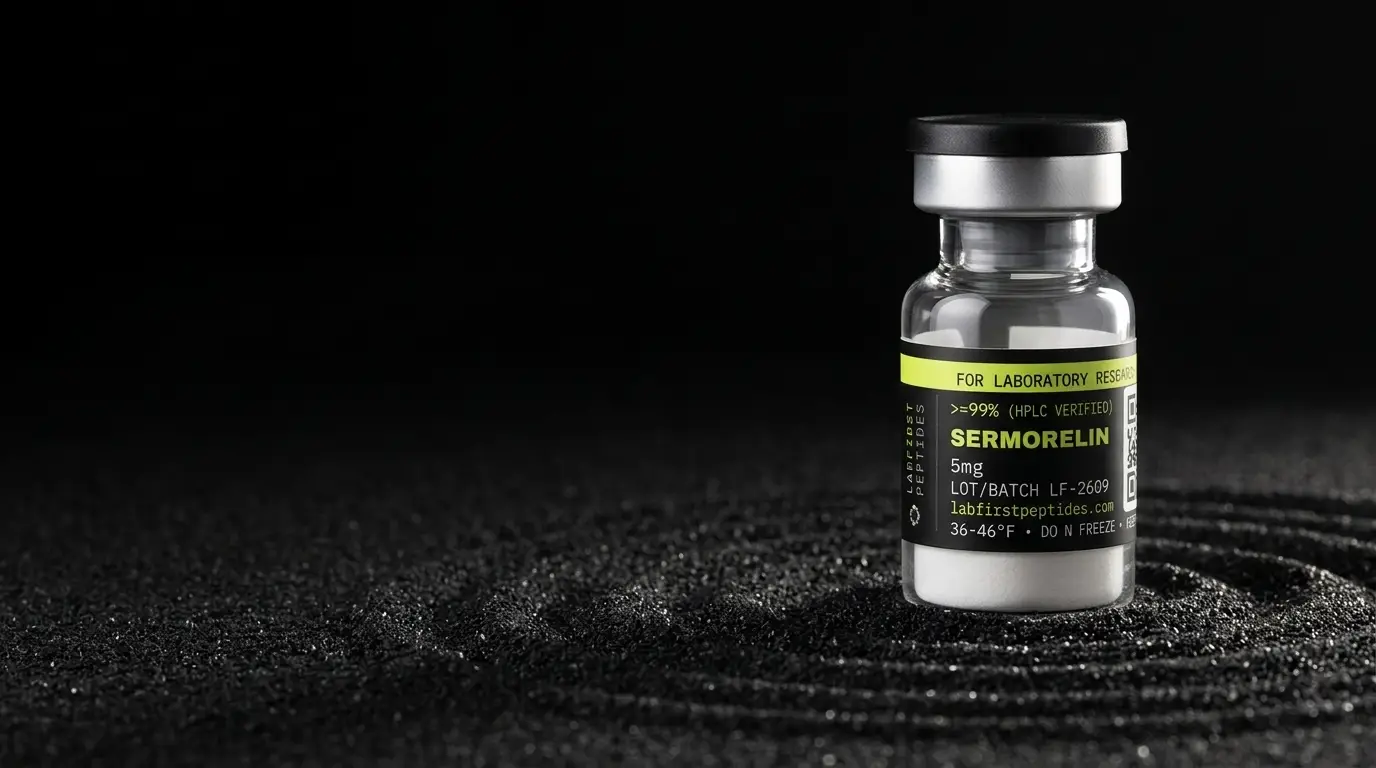
A research vial sold under this name contains the acetate salt. Acetate is the counterion left from purification, and it adds to the weight of the powder without being part of the peptide chain.
The one-letter code is compact but easy to misread. In three-letter shorthand the same chain opens Tyr-Ala-Asp-Ala-Ile-Phe and closes Asp-Ile-Met-Ser-Arg, still read from the amine end. A few features are worth spotting. There is one methionine, at position 27, and no cysteine anywhere. Methionine matters in the lab because its sulfur can oxidize, which adds 16 to the mass and shows up as a separate peak. The single sulfur atom in PubChem's formula is that methionine.
Is sermorelin a peptide or a steroid?
Sermorelin is a peptide. It is a chain of amino acids held together by peptide bonds, the same kind of backbone found in every protein. A steroid is a completely different class of molecule, built on four fused carbon rings, and contains no amino acid chain at all.
The formula makes the difference plain. PubChem lists sermorelin (CID 16132413) as C149H246N44O42S, with a molecular weight of 3,357.9. Forty-four nitrogen atoms is the signature of a peptide, since every residue brings at least one. Steroids usually sit in the range of a few hundred daltons and carry no nitrogen in their core. Sermorelin is roughly ten times that size.
It is also not a GLP-1 compound, which is a question that turns up in searches. GLP-1 is a different hormone with a different sequence and a different receptor. Sermorelin's sequence comes from GHRH.
How to check sermorelin's mass from its sequence: step by step
You can rebuild the published mass yourself, which is a good way to see that the sequence and the formula agree.
- Take the 29 residues of GHRH(1-29) from the UniProt record.
- Add up the average residue mass of each amino acid in the chain.
- Add one water, about 18.02 g/mol, for the two free ends of the chain.
- For the amidated end, swap the terminal OH for NH2, which subtracts about 0.98 g/mol.
- Compare the result with PubChem's figure of 3,357.9.
Our arithmetic gives 3,358.9 for the free acid and 3,357.9 for the amide. The amide matches PubChem exactly, which confirms the end cap. Sermorelin has no cysteine, so there are no disulfide bridges to subtract. A certificate for an acetate salt may print a different powder weight, because the counterion is counted too.
Why 29 residues and not all 44?
The short version is that researchers found the first part of GHRH carries the activity at its receptor, and a shorter chain is easier to make. Our Sermorelin Acetate product page and our research notes describe the 1-29 fragment as the shortest stretch of the natural hormone that still acts on the GHRH receptor. That is the reason a whole family of research peptides is built on this cut.
Shorter also means simpler chemistry. A 29-residue chain is made by solid-phase synthesis one residue at a time, and every step removed is one less place for a deletion or a wrong residue to creep in. Fewer residues also means a smaller molecule to separate and confirm by HPLC and mass spectrometry.
Close relatives such as CJC-1295 and Mod GRF(1-29) start from the same fragment and then swap individual residues. Their names blur together on listings, so the certificate's mass and sequence are what tell you which molecule is in a vial.
What was sermorelin studied for?
FDA's records give the regulatory history of the medicine that once existed. FDA approved one sermorelin acetate medicine in 1990 and a second formulation in 1997. Both were prescription medicines, and both approvals were later withdrawn.
That is regulatory history. They are not claims about what a research vial does, and a research-grade powder is not either of those medicines. Questions like "what does sermorelin do" and "what is sermorelin used for" are answered on this site only at that level: what the molecule is, what receptor it was designed around, and what FDA once approved a finished medicine for.
Is sermorelin FDA approved?
Not as a currently marketed medicine. FDA's determination, published in the Federal Register on March 4, 2013 (Docket FDA-2012-P-1071), sets out the history:
- NDA 19-863, the first sermorelin acetate product, was approved December 28, 1990.
- NDA 20-443, a second formulation, was approved September 26, 1997.
- The holder told FDA in 2008 that both were being discontinued, and FDA moved them to the discontinued list in the Orange Book.
- FDA withdrew approval of both applications effective June 18, 2009.
In that 2013 notice, FDA determined that the products "were not withdrawn from sale for reasons of safety or effectiveness." The notice says this determination allows FDA to approve abbreviated new drug applications referring to them, if all other legal and regulatory requirements are met. It does not itself approve anything.
None of this applies to a research chemical. A research vial is not a drug product, carries no approval and makes no claim to one.
Why does that 2013 finding matter? Under 21 CFR 314.161, FDA has to decide whether a discontinued medicine left the market for safety or effectiveness reasons before it can approve an abbreviated new drug application, the generic route, that refers to it. Because FDA found sermorelin acetate was not withdrawn for those reasons, the notice says FDA may approve such applications if every other legal and regulatory requirement is met. That is a statement about the regulatory pathway. It does not mean any sermorelin medicine is on the market now.
What to check on a sermorelin certificate
- the lot number, matching the vial;
- a mass spectrometry result close to 3,357.9 for the free peptide;
- an HPLC purity method and figure;
- the salt form, since an acetate salt changes the powder weight.
A mass near 3,368 instead points to Mod GRF(1-29), a different peptide. Certificates for each lot are posted at /coa/. For the full walk-through, see our sermorelin acetate certificate guide, and for tablets and nasal sprays sold under the same name, our guide to sermorelin tablets, sprays and the research vial.
Bottom line
Sermorelin is GHRH(1-29)-NH2: the first 29 residues of a 44-residue hormone, with an amide end and a mass of 3,357.9. It is a peptide, not a steroid. FDA once approved two sermorelin acetate medicines, both discontinued in 2008 and withdrawn in 2009, and in 2013 the agency found they were not pulled for safety or effectiveness reasons. A research vial is judged by its lot certificate.
FOR LABORATORY AND IN-VITRO RESEARCH USE ONLY. NOT FOR HUMAN OR ANIMAL CONSUMPTION.
What is Sermorelin Acetate studied for?
Published research on Sermorelin Acetate investigates the areas below, which is a different question from what Sermorelin Acetate will do for anyone, a claim about a living system that nothing on this site is sold for.
What it is. A man-made peptide matching the first 29 building blocks of growth-hormone-releasing hormone.
What the research looks at. An older clinical and hormone-research record exists, mostly about how the GHRH receptor behaves and about using the peptide as a diagnostic tool.
How it is thought to work. It works on the GHRH receptor. Those first 29 building blocks are the shortest piece of the natural hormone that still works on the receptor, which is why the class is built on that particular cut.
What is not established. What is sold here is a research chemical, not a drug product. Sermorelin, CJC-1295 and Mod GRF(1-29) are close relatives and get mixed up constantly in commercial listings, so check the certificate for which molecule is actually in the vial.
The full record, including the certificate for the lot in stock, is on the Sermorelin Acetate product page.
Common questions
What is sermorelin peptide made of?
Is sermorelin FDA approved?
Is sermorelin a steroid?
Why are there no sermorelin medicines today?
More science guides
Sources
- UniProt entry P01286: Somatoliberin (GHRH), human. Precursor sequence, mature chain position 32-75 and the C-terminal leucine amide.
- PubChem PUG REST: Sermorelin (CID 16132413). Molecular formula and molecular weight.
- FDA, Federal Register notice 2013-04827: determination on sermorelin acetate medicine. NDA numbers, approval dates, 2008 discontinuation, 2009 withdrawal and the 2013 safety-or-effectiveness determination.