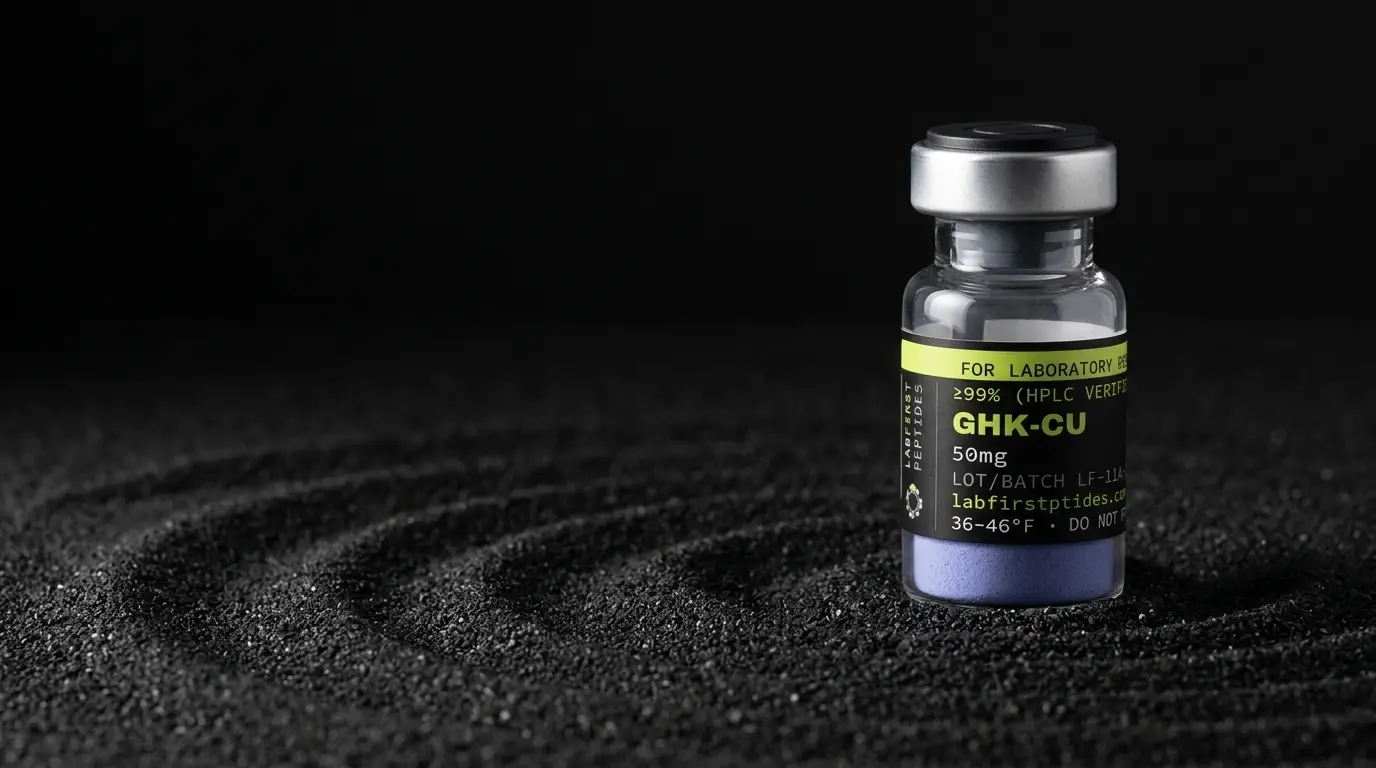
GHK-Cu is a small peptide of three amino acids, glycine, histidine and lysine, with a copper ion bound to it. The peptide part, GHK, occurs naturally in human plasma and was first reported in 1973. Research material is made synthetically. GHK-Cu is not an approved drug, and FDA lists it as nominated but withdrawn for compounding.
- GHK-Cu is the copper complex of the tripeptide glycyl-L-histidyl-L-lysine (GHK).
- PubChem lists GHK (CID 73587) as C14H24N6O4 at 340.38 g/mol and the 1:1 copper complex, prezatide copper (CID 71587328), as C14H23CuN6O4+ at 402.92 g/mol.
- Copper makes up about 15.8% of the mass of the 1:1 GHK-Cu complex, by arithmetic from PubChem's molecular weight.
- GHK was discovered in 1973, and plasma levels are about 200 ng/mL at age 20 and 80 ng/mL at age 60, per Pickart and Margolina (2018).
- FDA's compounding safety-risks page, updated April 22, 2026, lists GHK-Cu as nominated but withdrawn.
What this guide covers
Three beads on a string, and a tiny metal clip holding them in a curl. That is about as simple as a peptide gets, and it is a fair picture of GHK-Cu: three amino acids in a row, with one copper ion gripped by the chain.
Below you'll find what the molecule is, how the copper is held, where GHK was first found, what researchers have looked at, how a lab confirms a vial, and FDA's current listing as of October 2026. Nothing here is about use in people or animals.
- Three residues: Gly-His-Lys
- Peptide C14H24N6O4, 340.38 g/mol
- 1:1 copper complex 402.92 g/mol
- Copper about 15.8% of mass
- FDA: nominated but withdrawn
What is GHK-Cu?
GHK-Cu is the copper complex of GHK, the tripeptide glycyl-L-histidyl-L-lysine. The letters are the one-letter codes for its residues: G for glycine, H for histidine, K for lysine, read from the N-terminus to the C-terminus.
PubChem gives the free peptide (compound 73587) the formula C14H24N6O4 and a molecular weight of 340.38 g/mol. The 1:1 copper complex is filed separately as compound 71587328, under the name prezatide copper, with the formula C14H23CuN6O4+ and a molecular weight of 402.92 g/mol. Notice the plus sign: as filed, the complex carries a positive charge, and one hydrogen has come off the peptide to make room for the metal.
So the name tells you two things. "GHK" is the peptide, and "-Cu" says copper is bound to it. A vial labeled GHK without the copper is a different material, and a tripeptides overview shows where GHK sits among other three-residue peptides.
How is the copper held?
In plain terms, the peptide wraps around the copper and holds it with several of its atoms at once, the way a hand closes around a coin. Chemists call that chelation. Histidine's ring nitrogen is a natural partner for copper(II), and the short GHK backbone puts it next to the N-terminal amine of glycine, so the metal sits in a small pocket near the front of the chain.
Pickart and Margolina's 2018 review in the International Journal of Molecular Sciences describes GHK as a copper-binding molecule and ties its small size and copper affinity to proposals about copper metabolism. For a laboratory, the practical point is simpler. The complex and the free peptide are two species, and a certificate should make clear which one it measured.
Copper is a big share of the weight. Copper's atomic weight is about 63.55, so in a 402.92 g/mol complex it makes up roughly 15.8% of the mass. That figure is our arithmetic from PubChem's numbers, and it is what a copper assay on a certificate gets checked against.
The gap between the two PubChem weights is worth a second look. Going from 340.38 to 402.92 adds 62.54 g/mol, which is one copper atom minus the one hydrogen the peptide gave up. If a document quotes 340 for a product sold as GHK-Cu, it is describing the bare peptide. If it quotes about 403, it is describing the complex. Neither is wrong, but a buyer should know which one a weight or a purity figure refers to before comparing two listings.
Where was GHK first found?
GHK was discovered in 1973. Pickart and Margolina describe the starting observation: plasma from young individuals, added to liver tissue from older individuals, caused the older tissue to produce proteins more typical of younger tissue. The factor behind that was traced to GHK.
The same review calls GHK a small, naturally occurring tripeptide present in human plasma that can also be released from tissues after injury. It gives plasma levels of about 200 ng/mL at age 20, falling to about 80 ng/mL by age 60.
Research material today is not purified from plasma. It is made by peptide synthesis, then combined with a copper salt to form the complex, which is why the copper ratio is something a lab has to confirm rather than assume.
What does GHK-Cu do in research?
Searches for "what does GHK-Cu do" usually expect a list of effects. This page doesn't give one, because GHK-Cu is not an approved drug and no effect in people has been established for it. What can be said is which subjects researchers have studied.
The 2018 review lists research on skin regeneration and wound models, lung tissue, nerve and blood vessel growth, cancer-related work and neurological questions, much of it in cell and animal systems and gene-expression data. Those are topics of investigation. A topic appearing in a review means someone tested a question, not that the answer is settled.
GHK-Cu also appears in cosmetic products, which is why search results mix laboratory listings with serums and creams. A cosmetic ingredient listing is a different regulatory category from research-grade lyophilized powder, and this guide covers only the second.
Is GHK-Cu FDA approved?
No. There is no FDA-approved drug product containing GHK-Cu.
FDA's page on bulk drug substances that may present significant safety risks in compounding, last updated April 22, 2026, lists GHK-Cu under "Bulk drug substances nominated but withdrawn." The nomination to use it in pharmacy compounding was withdrawn, so it does not appear on the active Category 2 list. That is a procedural change, and it approved nothing.
FDA's stated concern stays on the page: compounded injectable drugs containing GHK-Cu "may pose risk for immunogenicity due to the potential for aggregation and peptide-related impurities," and there are "limited data in humans to inform safety-related considerations."
How a lab checks a GHK-Cu vial: step by step
The GHK-Cu identity guide covers the analytical detail. The short version runs like this.
- Match the lot number on the vial to the lot on the certificate.
- Check identity by mass. The peptide should match C14H24N6O4, and a copper-bound species shows copper's isotope pattern.
- Check sequence. Mass alone can't tell GHK from its rearranged isomers, so fragmentation or a reference standard is needed.
- Check the copper content against roughly 15.8% of the 1:1 complex's mass.
- Read purity as its own number. An HPLC area percentage says how uniform the sample is, not what it is.
The GHK-Cu certificate guide goes through each line of a full report.
What to check before you trust a listing
- The listing says whether it is GHK or GHK-Cu, and the copper form matches the certificate.
- The formula and weight agree with PubChem's records for the form sold.
- A dated certificate exists for that exact lot.
- Any regulatory claim quotes FDA's page and its date.
- Research claims name the model: cell, animal or human.
Certificates for each lot are posted at /coa/. The sealed lyophilized vial and solutions made for laboratory assays are covered in the GHK-Cu storage guide, and the where to buy GHK-Cu guide lists the documents to ask a supplier for. The product is listed at GHK-Cu.
FOR LABORATORY AND IN-VITRO RESEARCH USE ONLY. NOT FOR HUMAN OR ANIMAL CONSUMPTION.
GHK-Cu next to related products
GHK-Cu is also a component of the GLOW blend, which pairs it with other peptides. A blend is a different material with its own certificate, and the GHK-Cu vs GLOW comparison sets the two side by side. The lot certificate for a blend states the per-component amounts.
Spellings vary too. GHK-Cu, GHK Cu, copper peptide GHK-Cu and copper tripeptide-1 all show up in searches and on labels, and prezatide copper is the name PubChem files the complex under. A buyer comparing listings should look past the name to the formula, the copper form and the certificate.
Bottom line
GHK-Cu is glycyl-histidyl-lysine with a copper ion chelated to it: about 340 g/mol of peptide plus copper, 402.92 g/mol for the charged 1:1 complex. GHK occurs in human plasma and was first described in 1973. It isn't an approved drug, FDA lists it as nominated but withdrawn for compounding, and a vial is only as good as its lot certificate.
What is GHK-Cu studied for?
Published research on GHK-Cu investigates the areas below, which is a different question from what GHK-Cu will do for anyone, a claim about a living system that nothing on this site is sold for.
What it is. A three-building-block peptide (glycine, histidine, lysine) joined to copper.
What the research looks at. A substantial body of cell-culture work on copper-peptide chemistry and the material that holds skin tissue together.
How it is thought to work. The peptide grips copper tightly, and the copper-carrying form is what the research is about. Its blue color comes from that copper, not from the peptide. Published work covers the copper chemistry and the biology of the material between skin cells, in culture.
What is not established. No approved drug product. The copper-carrying form and the bare peptide are different chemicals with different stability, and a certificate should make clear which one is in the vial.
The full record, including the certificate for the lot in stock, is on the GHK-Cu product page.
Common questions
What is GHK Cu made of?
What does GHK-Cu do?
Is GHK-Cu natural or synthetic?
Is GHK-Cu FDA approved?
Published certificates for GHK-Cu
Every figure below is read from a report the laboratory issued for that lot; each page carries the PDF and the lab's own verification link.
More science guides
Sources
- PubChem PUG REST: compounds 73587 (GHK) and 71587328 (prezatide copper). Formulas and molecular weights of the free peptide and the 1:1 copper complex.
- FDA, Certain bulk drug substances for use in compounding that may present significant safety risks. GHK-Cu listed as nominated but withdrawn; stated concerns; page updated April 22, 2026.
- Pickart L, Margolina A. Regenerative and Protective Actions of the GHK-Cu Peptide in the Light of the New Gene Data. Int J Mol Sci 2018. Discovery in 1973, plasma levels by age, copper binding and research areas. DOI 10.3390/ijms19071987.