Tripeptides are three amino acid residues joined by two peptide bonds. One end has a free amine and the other a free carboxyl. The sequence is written starting from the N-terminus. The mass equals the three amino acids minus two waters, since each bond releases one water as it forms.
- A tripeptide is three amino acid residues joined by two peptide bonds, read and named from the N-terminus.
- Forming each peptide bond releases one water, so a tripeptide's mass equals its three amino acids minus about 36 g/mol.
- The peptide bond has partial double-bond character, holding its six-atom amide unit planar with the trans form strongly preferred.
- Glutathione's γ-Glu-Cys-Gly name records a side-chain linkage; GHK-Cu's suffix records a chelated copper ion, not a fourth residue.
- Chromatographic purity and peptide content are different certificate numbers, and small peptides are properly detected at 214 nm rather than 280 nm.
Three residues, two bonds
Think of it like a short train with three cars. Two couplings hold the cars together, and each coupling costs one water molecule when it forms. The front car is the N-terminus, and that is where the name always starts.
A tripeptide is three amino acid residues connected in a chain by two peptide bonds. The word residue is doing real work in that sentence. When two amino acids condense, the carboxyl group of one and the amine of the next lose a water molecule between them, and what each amino acid contributes to the chain afterward is its residue: the amino acid minus the atoms that left as water.
The chain has a direction. One end keeps a free amine and is called the N-terminus; the other keeps a free carboxyl and is the C-terminus. Every convention in peptide chemistry reads from N to C, so Gly-His-Lys and Lys-His-Gly are different molecules, made of the same three residues wired in opposite order.
Size classes run amino acid, dipeptide, tripeptide, oligopeptide, polypeptide. The boundaries above tripeptide are fuzzy; the tripeptide itself is exact. Three residues, two backbone amide bonds, no ambiguity.
The mass arithmetic follows directly. Each peptide bond formed costs one water, so a tripeptide weighs the sum of its three free amino acids minus two waters:
75.07 (Gly) + 155.15 (His) + 146.19 (Lys) − 2 × 18.02 = 340.38 g/mol
That subtraction is a thirty-second sanity check against any certificate or catalog listing that quotes a molecular weight.
- Sequence written N to C, with any γ-linkage or D residue flagged
- Mass check: three amino acids minus two waters
- Purity by RP-HPLC, detected at 214 nm
- Peptide content stated separately from purity
- Salt form or metal named, lot number matching the vial
The peptide bond is flatter than the line drawing suggests
On paper the peptide bond is a single line between a carbonyl carbon and a nitrogen. Structurally it behaves like something closer to a double bond. The nitrogen lone pair delocalizes into the carbonyl, the C–N distance contracts to about 1.33 Å against roughly 1.47 Å for an ordinary C–N single bond, and the six atoms of the amide unit settle into a plane. Pauling and Corey worked this out from crystal structures in the early 1950s, and every modeling and drawing convention since sits on that foundation.
Two practical consequences. First, rotation about the peptide bond is restricted, and the trans arrangement is strongly preferred; the cis form shows up at any real frequency only ahead of proline. Second, the flexibility a small peptide does have lives in the rotations on either side of each alpha carbon, which is why even a tripeptide samples many shapes in solution while its two amide units stay rigid and flat.
The backbone is also kinetically tough. Hydrolysis of an amide bond in neutral water at room temperature is thermodynamically favorable and extremely slow, with published uncatalyzed half-life estimates running to centuries. Radzicka and Wolfenden measured this class of reaction directly. For a stored tripeptide the realistic worries are almost never backbone cleavage; they are side-chain chemistry, thiol oxidation and metal binding chief among them, and the handling variables that any peptide solution inherits.
How a tripeptide is named
The sequence is written N-terminus first, using three-letter codes joined by hyphens (Gly-His-Lys) or one-letter codes run together (GHK). The full systematic name converts every residue except the last to its -yl form: glycyl-L-histidyl-L-lysine. Stereochemistry defaults to L for material derived from the standard amino acids; any D residue has to be flagged explicitly, because the mass is identical and only the name and the chromatography will tell you.
One trap sits inside the tidy system: nothing forces a peptide bond to run through the alpha carboxyl. Glutathione is the standard example. Its name is written γ-Glu-Cys-Gly because the glutamate joins the cysteine through its side-chain gamma carboxyl rather than the usual alpha position. The γ marker is the entire record of that difference. Drop it and the name describes a different molecule with the same mass.
Suffixes on catalog names describe form, not sequence. Research peptides are commonly supplied as acetate or trifluoroacetate salts, and sometimes as metal complexes. GHK-Cu is the copper(II) complex of Gly-His-Lys; the Cu names the metal, not a fourth residue. Salt and metal content sit in the vial's mass whether or not the listing mentions them, which is why a competent supplier states the form and a competent certificate accounts for it.
Two tripeptides a laboratory actually meets
The catalog carries two tripeptides, and between them they cover most of the chemistry this article describes. The GHK-Cu product record is the copper(II) complex of Gly-His-Lys. The N-terminal amine and the histidine imidazole chelate the copper ion, and the complex is blue-violet in solution, a color the free peptide does not have. That color is a crude but honest identity clue for the complexed form; a colorless solution sold as a copper complex deserves a question.
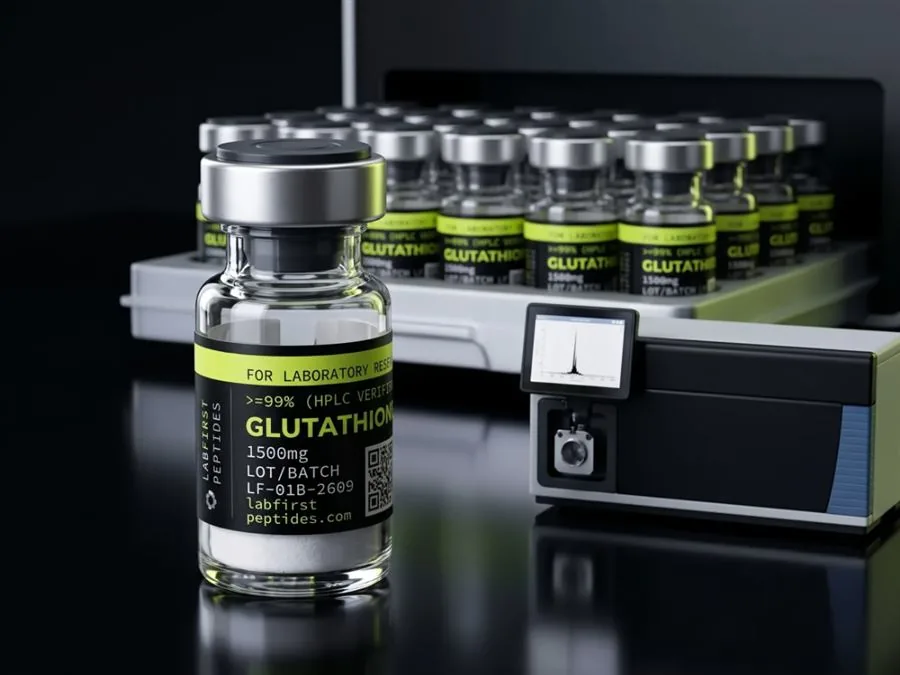
The glutathione product record is the γ-linked tripeptide γ-Glu-Cys-Gly. Its behavior is dominated by the cysteine thiol. Two molecules oxidize readily to a disulfide-bridged dimer, GSSG, and headspace oxygen drives that conversion slowly in any stored solution. An aged glutathione solution can assay low with its backbone fully intact, because the loss is oxidation of the thiol rather than cleavage of any peptide bond. An assay that reports reduced and oxidized forms separately is telling you more than one that reports a single number.
| Material | Sequence | Linkage | Average mass | Watch item |
|---|---|---|---|---|
| GHK, free peptide | Gly-His-Lys | Two standard α-peptide bonds | 340.4 g/mol | Copper binding changes form and color |
| GHK-Cu complex | Gly-His-Lys · Cu(II) | Same backbone, chelated metal | Near 404 g/mol as commonly quoted; the exact figure depends on how protonation is counted | Metal is part of the vial mass |
| Glutathione, reduced | γ-Glu-Cys-Gly | One γ-linkage, one α-linkage | 307.3 g/mol | Thiol oxidation to GSSG |
| Glutathione disulfide (GSSG) | Two γ-Glu-Cys-Gly units | Disulfide bridge between thiols | 612.6 g/mol | Accumulates in stored solutions exposed to air |
How identity and purity are measured
Identity for a tripeptide is a mass spectrometry question. Electrospray ionization gives a protonated molecular ion, and the observed mass is compared against the theoretical monoisotopic value calculated from the sequence; for Gly-His-Lys that calculation gives 340.19, so the singly protonated ion is expected at 341.19. A match within instrument tolerance confirms composition. It does not confirm sequence order, which for short peptides is settled by fragmentation data or by synthesis provenance, and a certificate should say which.
Purity is a chromatography question, and tripeptides make it harder than their size suggests. Reversed-phase HPLC on a C18 column is the standard method, with purity reported as the main peak's share of total peak area. Small hydrophilic peptides elute early and close together, so an ion-pairing agent such as trifluoroacetic acid in the mobile phase is routine to pull retention into a usable range. Detection is the detail worth checking on any method summary: peptide bonds themselves absorb near 214 nm, while absorbance at 280 nm comes from tryptophan and tyrosine. GHK contains neither, so a 280 nm trace of it is nearly blank and a purity figure quoted at that wavelength for such a sequence is not measuring much. 214 nm is the defensible choice for most tripeptides.
Chromatographic purity and peptide content are different numbers answering different questions. Purity says what fraction of the peptide-related material is the intended peptide. Peptide content says what fraction of the vial's gross mass is peptide at all, with the remainder being water and counterion, and it comes from amino acid analysis or nitrogen determination rather than from the chromatogram. A vial can honestly show 99% purity and 80% peptide content at the same time. The quality standard page sets out what documentation a listing should carry for both.
The arithmetic a certificate sets up
The reason peptide content matters is that every downstream concentration figure inherits it. A 50 mg vial with 82% peptide content holds:
50 mg × 0.82 = 41 mg of peptide
Brought into 5 mL of diluent, the solution is 8.2 mg/mL of actual peptide, and any record that writes 10 mg/mL has quietly counted water and counterion as compound. The vial concentration calculator handles this arithmetic for other vial sizes and volumes; it covers laboratory measurement only.
Beyond the two headline numbers, a certificate for a tripeptide is worth reading for three specifics. The salt form should be named, because acetate and trifluoroacetate differ in mass contribution and in what they imply about the purification process. The detection wavelength should be stated next to the purity figure, for the 214 nm reasons above. And the lot number on the certificate should match the vial in hand, since an unlotted document describes a process rather than the material on the bench.
FOR LABORATORY AND IN-VITRO RESEARCH USE ONLY. NOT FOR HUMAN OR ANIMAL CONSUMPTION. NOT FOR PERSONAL, MEDICAL, DIAGNOSTIC, THERAPEUTIC, OR RECREATIONAL USE.
Common questions
Is glutathione a tripeptide?
How is a tripeptide different from a mixture of three amino acids?
Why is a tripeptide's molecular weight less than the sum of its amino acids?
What does the Cu in GHK-Cu stand for?
Why do certificates for small peptides report purity at 214 nm?
Published certificates for GHK-Cu
Every figure below is read from a report the laboratory issued for that lot; each page carries the PDF and the lab's own verification link.
Related guides: peptide chemistry basics
Sources
- Pauling and Corey's structural studies of the planar amide unit, PNAS, early 1950s. Establish the partial double-bond character, planarity and trans preference of the peptide bond described in the bonding section.
- PubChem compound records for glutathione, glutathione disulfide and Gly-His-Lys. Molecular formulas and the average and monoisotopic masses used in the table and the mass arithmetic.
- Radzicka and Wolfenden's kinetic measurements of uncatalyzed amide hydrolysis. Basis for the statement that the peptide backbone is kinetically stable in neutral water, with uncatalyzed half-lives running to centuries.