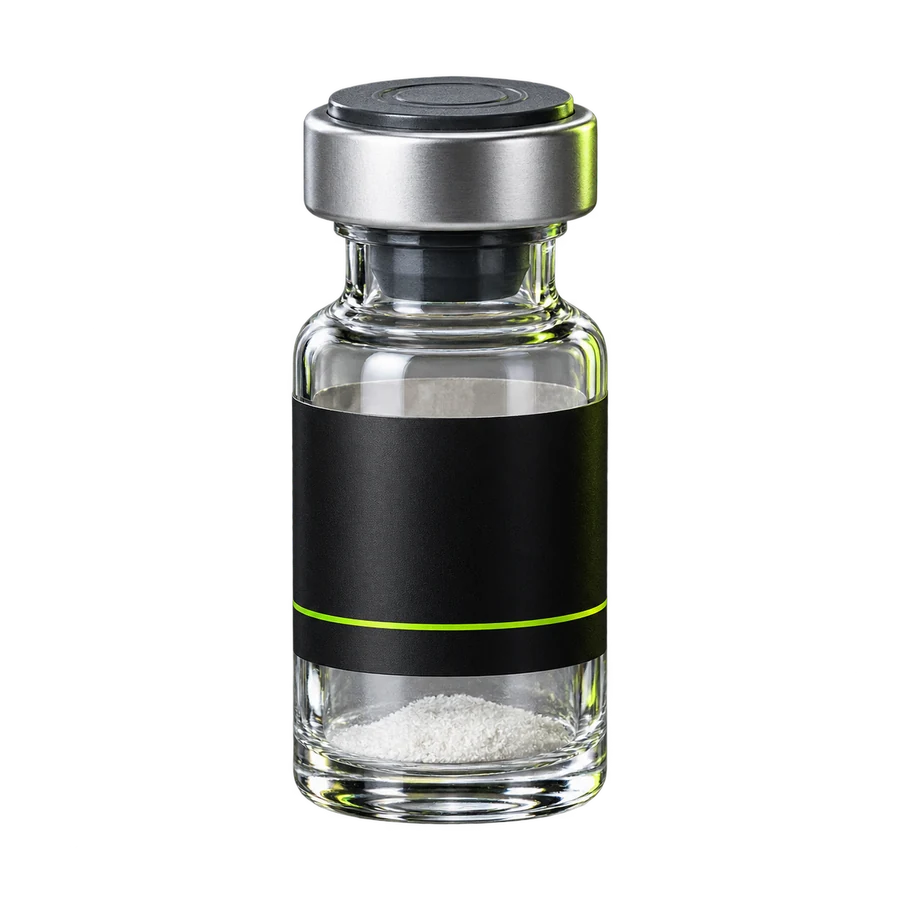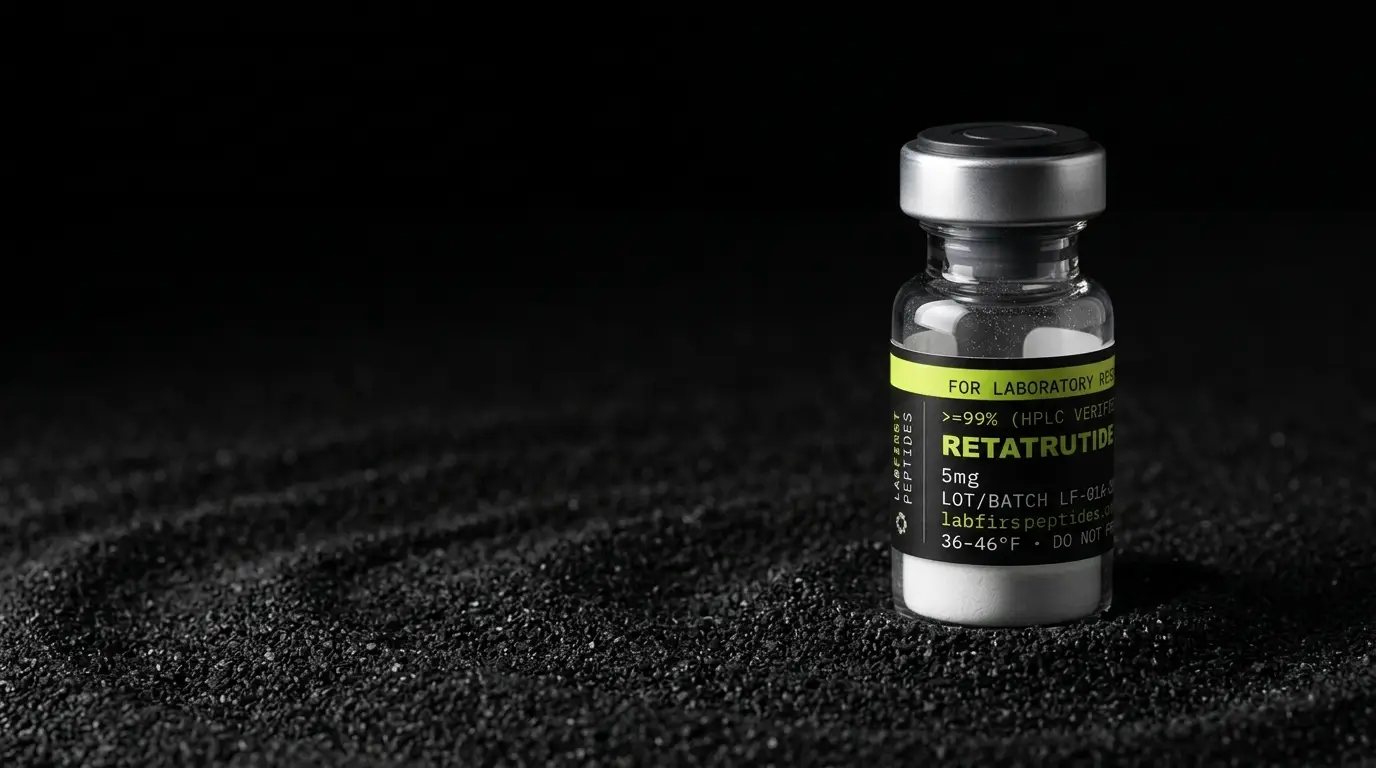
Retatrutide is an experimental peptide that works on three incretin receptors at once (formula C221H342N46O68, average mass 4,731.3 g/mol). Retatrutide is sold here for laboratory research in 8 sizes (5mg to 60mg), from $80.00 a vial. It is investigational: the FDA has not approved it for anything. Research use only, and never for people or animals.
Retatrutide specifications
| Product name | Retatrutide |
|---|---|
| Also sold as | Retatrutide peptide, GLP-1/GIP/glucagon triple agonist, Reta, reta peptide |
| Development code | LY3437943 |
| Formula | C221H342N46O68 |
| Average mass | 4,731.3 g/mol |
| Physical form | Freeze-dried powder, a solid cake in a sealed vial |
| Appearance | White to off-white cake |
| Sizes on this page | 5mg · 10mg · 15mg · 20mg · 30mg · 40mg · 50mg · 60mg |
| Purity specification | ≥99% by RP-HPLC. The number for the lot you receive is whatever its own certificate says. |
| Identity check | Mass spectrometry, read against the mass this compound should have |
| Net content | Weighed per lot and reported separately from purity |
| Lot documentation | 4 of 8 sizes have a published Kovera Labs certificate (5mg, lot LF-01A-2609; 10mg, lot LF-01B-2609; 20mg, lot LF-01D-2609; 40mg, lot LF-01F-2609); the other 4 are in testing |
| Storage | Sealed, cold and out of the light |
| Ships from | Santa Ana, California by USPS with tracking on every order, same business day on verified in-stock orders placed before 12 PM Pacific |
| Intended use | Laboratory research only. Not for human or animal use. |
What is Retatrutide, and what is it used for?
Retatrutide is an experimental compound. It works on three receptors at once, GIP, GLP-1 and glucagon, which is what separates it from the peptides in this family that came before it. It is still in clinical trials and is not approved by the FDA or any comparable regulator for any use at all. It is listed here as laboratory material and nothing else.
Retatrutide is also listed and searched as Retatrutide peptide, GLP-1/GIP/glucagon triple agonist, Reta, reta peptide, reta peptides, peptide retatrutide, peptides reta, retta, retta peptides, GLP-3, and appears in the literature under the development code LY3437943. They all mean the same compound. Supplier lists write it as Retatrutide peptides or peptide Retatrutide as well; every one of those is this record.
This one gets searched under a lot of names. Reta, reta peptide, retta, reta-peptide and GLP-3 all mean retatrutide. GLP-3 is worth flagging on its own: somebody coined it, it caught on, and there is no such receptor class. With that many names in circulation, the only reliable way to know that what arrived is what was ordered is the test result for that particular lot. The word printed on a vial is not evidence of anything.
Chemically: molecular formula C221H342N46O68, average mass 4731.3 g/mol (USAN/INN statement for retatrutide (LY3437943); not found in PubChem by name on 2026-09-05). Those figures are what the identity test on a certificate is read against.
Frequently mistyped as retatrutid, retatrutida, retarutride, retatruide, retatruitude, retatrut. Those spellings reach this same record.
An experimental peptide that works on three incretin receptors at once.
It switches on three receptors at the same time: GIP, GLP-1 and glucagon. Everything before it in this family worked on one or two. Hitting all three is why researchers treat it as its own kind of compound rather than a stronger version of what already existed.
It shows up in clinical-stage metabolic research under the developer code LY3437943. The published work is about how it behaves at those receptors, how the effect changes with the amount given, and the measurements the sponsor registered its trials to take.
No regulator has approved it for anything, anywhere. It is still experimental, and nobody has made a finding about whether it is safe, whether it works, or whether it is fit for any purpose outside a registered trial.
Retatrutide for sale: 5mg to 60mg (8 sizes) vials, price per mg
Retatrutide is sold in 8 sizes here, 5mg to 60mg (8 sizes), from $80.00 a vial. Retatrutide cost and Retatrutide price per mg by size are in the table, at each volume tier and on subscription; the per-mg figure under each price is the one that compares across sizes.
Volume and subscription pricing by size
| Size | One vial | 10–19 vials−10% | 20 vials−15% | Subscribe monthly−6% from shipment 2 | Availability |
|---|---|---|---|---|---|
| Retatrutide 5mg | $80.00$16.00/mg | $72.00a vial · $14.40/mg | $68.00a vial · $13.60/mg | $75.20a vial, shipment 2 on · $15.04/mg | In stock |
| Retatrutide 10mg | $85.00$8.50/mg | $76.50a vial · $7.65/mg | $72.25a vial · $7.22/mg | $79.90a vial, shipment 2 on · $7.99/mg | In stock |
| Retatrutide 15mg | $90.00$6.00/mg | $81.00a vial · $5.40/mg | $76.50a vial · $5.10/mg | $84.60a vial, shipment 2 on · $5.64/mg | Backordered — waitlist |
| Retatrutide 20mg | $145.00$7.25/mg | $130.50a vial · $6.53/mg | $123.25a vial · $6.16/mg | $136.30a vial, shipment 2 on · $6.81/mg | In stock |
| Retatrutide 30mg | $185.00$6.17/mg | $166.50a vial · $5.55/mg | $157.25a vial · $5.24/mg | $173.90a vial, shipment 2 on · $5.80/mg | Backordered — waitlist |
| Retatrutide 40mgBest per mg | $204.00$5.10/mg | $183.60a vial · $4.59/mg | $173.40a vial · $4.33/mg | $191.76a vial, shipment 2 on · $4.79/mg | In stock |
| Retatrutide 50mg | $209.00$4.18/mg | $188.10a vial · $3.76/mg | $177.65a vial · $3.55/mg | $196.46a vial, shipment 2 on · $3.93/mg | Backordered — waitlist |
| Retatrutide 60mg | $214.00$3.57/mg | $192.60a vial · $3.21/mg | $181.90a vial · $3.03/mg | $201.16a vial, shipment 2 on · $3.35/mg | Backordered — waitlist |
The 40mg vial works out 68% cheaper per mg than the 5mg. Volume tiers are per size and do not combine across sizes (see bulk pricing). Subscribe & Save takes 6% every month, 4% every 2 months or 2% every 3 months off from shipment 2, two shipments minimum, and stacks on the volume tier: the lowest this record ever bills is $4.07 per mg, twenty 40mg vials on a monthly subscription from shipment 2 onward.
Nothing is added at checkout except the USPS shipping you choose; dispatch and delivery are the same on every order. The cost-per-milligram tool ranks the whole catalog by price per mg. The certificate walked through field by field: Where to Buy Retatrutide (Reta Peptide): Lab Reference.
Where to buy Retatrutide: what to check before you order from anyone
Where to get Retatrutide, and how to buy Retatrutide online
Retatrutide for sale, or Retatrutide peptide for sale, means this page: one record, 8 sizes. You can buy Retatrutide online here with guest checkout, and purchase Retatrutide or order Retatrutide in any size below; verified in-stock orders placed before 12 PM Pacific are dispatched the same day. If the question is where to get Retatrutide or how to get Retatrutide, the answer for a US laboratory is a supplier who publishes the certificate before you pay, which is the first of the five checks that follow. A Retatrutide supplier, vendor or source worth using will show you the lot number and where its certificate can be verified.
Before ordering Retatrutide from anyone, us included, run the 5 checks on verifying a certificate; the first is that the report resolves on the laboratory's own site, and a seller who cannot pass them is asking for the trust a certificate exists to replace.
Retatrutide reviews
No customer review of Retatrutide has been published yet, so there is no star rating here; when real ones exist the number will be the arithmetic of what people wrote. Ordered this record? Leave a review. A person reads every one before it appears.
Retatrutide capsules, oral form or nasal spray? What this vial is, and is not
Search results for Retatrutide also show capsules, oral form, nasal spray products, under listing titles such as retatrutide pill, retatrutide pills, oral retatrutide, retatrutide oral, retatrutide nasal spray, retatrutide pill form. Those are finished consumer goods made and marketed by other companies, and none of them is what this page sells. This record is freeze-dried Retatrutide in a sealed glass vial, 5mg to 60mg (8 sizes), with a lot certificate, supplied for laboratory work. Its certificate describes that powder, not a capsule, spray or cream, which carry other ingredients and sit under different rules.
Retatrutide vs Tirzepatide and Semaglutide: different molecules, separate records
Retatrutide vs Tirzepatide, or Tirzepatide vs Retatrutide, is the comparison people search most, with Semaglutide close behind, and they are not the same thing. Each is a different molecule with a different formula, mass and research record, and each has its own certificate here.
Tirzepatide vs Retatrutide: the same comparison, side by side
| Record | Class | Formula | Avg. mass | Sizes here |
|---|---|---|---|---|
| Retatrutide | An experimental peptide that works on three incretin receptors at once. | C221H342N46O68 | 4731.3 | 5mg · 10mg · 15mg · 20mg · 30mg · 40mg · 50mg · 60mg from $80.00 |
| Tirzepatide | A peptide that works on the GIP and GLP-1 receptors at the same time. | C225H348N48O68 | 4813 | 5mg · 10mg · 15mg · 20mg · 30mg · 40mg · 50mg · 60mg · 70mg · 80mg · 90mg · 100mg · 110mg · 120mg from $50.00 |
| Semaglutide | A peptide that works on the GLP-1 receptor. | C187H291N45O59 | 4114 | 5mg · 10mg · 15mg · 20mg · 30mg from $55.00 |
Documentation compared in full: Retatrutide vs Tirzepatide, side by side · Retatrutide vs Semaglutide, side by side.
Retatrutide guides and documentation
Written to answer the questions that come up around Retatrutide specifically, what its paperwork should show, how it is handled, and how to judge a supplier selling it.
- GLP-3 Retatrutide Explained: One Peptide, Three Receptors, No Third GLP
- How Does Retatrutide Work at Three Receptors? Mechanism in Cell Assays
- Retatrutide certificates of analysis, field by field, and how to verify the lot
- Retatrutide FDA approval status: where it actually stands
- Retatrutide identity testing: the orthogonal evidence to expect
- Retatrutide storage and stability: sealed, dry, dark, and dated on preparation
The full library, grouped by what you came to answer, is in the laboratory guides.
The Retatrutide certificate: lot, purity, identity, and how to verify it
A certificate answers identity, purity and net content as three separate questions, each with the method that produced it and the date it was run, how to read one covers what each field does and does not cover. For Retatrutide that means a mass spectrum landing on 4,731.3 g/mol for C221H342N46O68, the figure published against its published record.
| Size | Lot | Identity method | Purity | Endotoxin · sterility · fentanyl | Test date |
|---|---|---|---|---|---|
| 5mg | LF-01A-2609 | LC-MS | 99.481% (RP-HPLC, C18, DAD @ 214 nm) | Pass · pass · not detected | 2026-10-07 |
| 10mg | LF-01B-2609 | LC-MS | 99.871% (RP-HPLC, C18, DAD @ 214 nm) | 2026-09-29 | |
| 20mg | LF-01D-2609 | LC-MS | 99.839% (RP-HPLC, C18, DAD @ 214 nm) | 2026-09-29 | |
| 40mg | LF-01F-2609 | LC-MS | 99.829% (RP-HPLC, C18, DAD @ 214 nm) | Pass · pass · not detected | 2026-10-07 |
Testing by Kovera Labs. Every batch tested on or after October 1, 2026 includes endotoxin, sterility and fentanyl screening, in addition to identity, purity and net content. Open the report, then confirm it on the issuing laboratory's own site. If the identifier does not resolve there, or resolves to a different lot than the one printed on your vial, the document is worthless however convincing it looks.
- Certificate for lot LF-01A-2609 · Report PDF · Endotoxin report · Sterility report · Verify at Kovera Labs
- Certificate for lot LF-01B-2609 · Report PDF · Verify at Kovera Labs
- Certificate for lot LF-01D-2609 · Report PDF · Verify at Kovera Labs
- Certificate for lot LF-01F-2609 · Report PDF · Endotoxin report · Sterility report · Verify at Kovera Labs
The lot number on the certificate must match the lot printed on the vial you received. That match is the only thing tying the document to your material. Net content is reported separately from purity, because a vial can be highly pure and still hold less material than its label states.
Is Retatrutide legal? FDA status, and what this listing is
FDA status, and what this listing is Not approved, investigational
The FDA has not approved retatrutide for anything. It is an investigational new drug, which means the only lawful way a person in the United States can be given it is inside an authorised clinical trial. Lilly has said publicly that it plans to apply for approval in early 2027. Applying is not the same as being approved, and the FDA can say no.
If retatrutide is approved, the supply and compounding picture around it will change quickly, the way it did for the GLP-1 drugs that came before it. That is why this section carries the date it was last checked.
Status verified 2026-08-25. Check the primary source before relying on this summary.
Whether Retatrutide is legal depends on what it is being used for and where. It is sold as laboratory material under the research-use restriction below. Being listed is not an approval, and not a claim that it is safe, effective or right for any purpose. LabFirst is not a pharmacy or a compounding facility, this vial is not a compounded medicine, and no prescription is involved, because it is not sold for use in anyone. Search results also show compound Retatrutide and Retatrutide compound offers from compounding pharmacies; a compounded Retatrutide is a prescription product prepared for a named patient, and a certificate for this lot says nothing about one.
Sources checked 2026-08-25: ClinicalTrials.gov: NCT05882045 · ClinicalTrials.gov: NCT07035093
Retatrutide research: studies and clinical trials
Status: Investigational, Phase 3 clinical development. Eli Lilly developed retatrutide under the code LY3437943. It acts on three receptors at the same time: GIP, GLP-1 and glucagon. It is in Phase 3, the last stage of testing before a company can ask for approval, in a program Lilly calls TRIUMPH. Lilly reported positive headline results from those trials during 2026 and has said it intends to file for FDA approval in the first three months of 2027.
What this record gives you is the status of that program: who runs it, what stage it is at, the trial numbers, and where it stands with the regulator. It does not give you the results. Those results describe what happened to patients taking a supervised medicine under a doctor. Reprinting them on a page that sells the same molecule as a research chemical would be borrowing medical evidence to sell something we do not sell for medical use. The trials are linked below and you can read them yourself.
Retatrutide is one peptide with a fatty acid chain attached, and it switches on three receptors at once: the glucagon receptor, the GIP receptor and the GLP-1 receptor. The thinking behind the design is that the third one pulls a different lever instead of pulling harder on the same lever. GIP and GLP-1 act on how much gets eaten. The glucagon receptor acts on how much energy gets burned. That is the argument for building something new rather than a stronger GLP-1 drug.
In cell tests the three are not evenly matched: glucagon and GLP-1 activity are broadly similar to each other, and GIP activity is a good deal higher. So "triple agonist" names the three receptors it reaches, not an equal share between them. The glucagon arm is both the part that makes this molecule different from tirzepatide and the part with the least independent work behind it.
| Reported observation | Model | Source |
|---|---|---|
| In cell tests the molecule switched on GIP, GLP-1 and glucagon receptor signalling, with glucagon and GLP-1 activity roughly matched and GIP activity higher. In obese mice, body weight went down and blood sugar control improved. The authors put the extra weight change down to the glucagon arm raising energy burned, on top of the GIP and GLP-1 arms lowering how much the animals ate. | recombinant receptor cell assays and obese mice | Coskun and colleagues, LY3437943, a novel triple glucagon, GIP, and GLP-1 receptor agonist for glycemic control and weight loss: from discovery to clinical proof of concept, Cell Metabolism (2022)Authored by the developing sponsor. The mechanistic separation between the three receptor arms rests on this paper. |
| In mice given pancreatic and lung tumours, treated animals had fewer tumours take hold and took longer to develop them, alongside changes in the immune system. The reported effect stayed after the compound was stopped and the weight came back. This is early animal work. It is here mainly because it is one of the few retatrutide studies not run by the company that makes it. | mouse pancreatic and lung tumour engraftment models | Marathe and colleagues, Incretin triple agonist retatrutide (LY3437943) alleviates obesity-associated cancer progression, npj Metabolic Health and Disease (2025) |
Open questions. Retatrutide is experimental. No regulator has approved it, and most of what has been published about how it works comes from the company developing it, so the picture has not been checked independently as much as you would want. Human trials exist and there are a lot of them.
This page does not reprint what those trials measured, and that is a decision rather than an omission: those numbers describe a supervised medicine given to patients under care, which is a different thing from laboratory material, and putting them next to a buy button would blur that line rather than tell anyone anything useful. Two real scientific gaps are worth naming as well. The glucagon arm is the least independently studied part of how it works, and long-term safety is simply unknown for a molecule still in development.
One last point, and it applies to every reseller including this one: a vial with retatrutide on the label is connected to LY3437943 by a claim about its sequence and nothing else. Testing that claim on your actual lot is exactly what an identity assay is for.
Each row above describes an observation in the stated model. None of it describes what Retatrutide would do in a person or an animal outside that model, and none of it is a recommendation to use it for anything.
| Identifier | Study |
|---|---|
| NCT05882045 | Retatrutide in participants with obesity and cardiovascular disease (Phase 3) |
| NCT07035093 | Retatrutide in participants with obesity or overweight and chronic low back pain |
How to store Retatrutide: refrigeration and shelf life
Keep the sealed vial cold and out of the light and it stays as it left the lab. Once it is mixed into a solution, how long it holds up depends on the compound, what it was mixed with, how strong the solution is and how cold it is kept — too many variables for anyone to print one shelf life on a label. So laboratories write the date on whatever they prepare and keep their own record of it.
For solution preparation arithmetic on the bench, concentration, per-graduation values and molarity, use the vial concentration calculator, which opens with the Retatrutide sizes stocked here already loaded. It covers laboratory measurement only and contains no administration guidance.