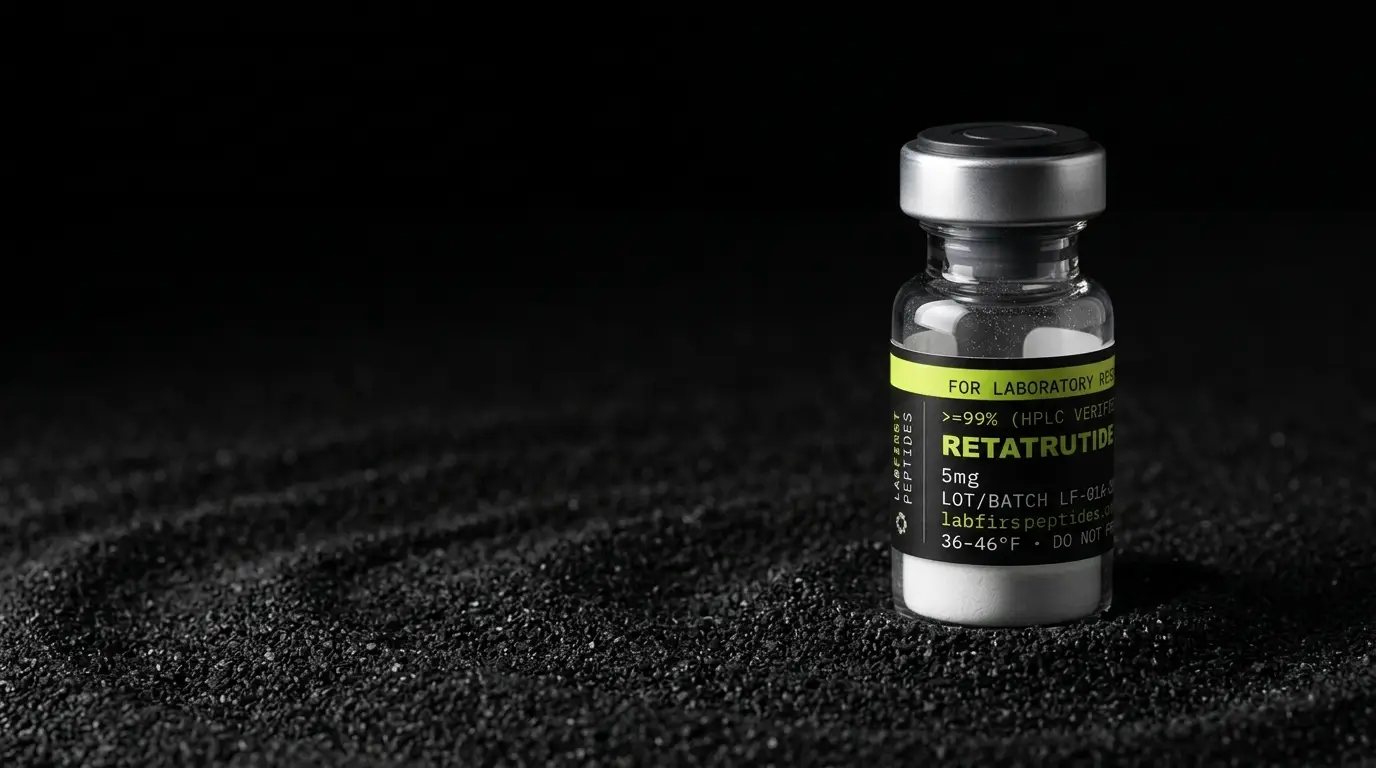
A retatrutide certificate of analysis is a test report for one lot. Read it in this order. Match the lot number to the vial label. Check identity by mass spectrometry and purity by RP-HPLC. Then look at net content, the test date, and the lab that issued it. Verify the report with that lab directly, never through the seller alone.
- A certificate of analysis is a lot-specific claim: the lot number on the document must match the vial label exactly, or nothing on it applies.
- No compendial monograph exists for retatrutide, so every acceptance criterion on a research certificate is the issuer's own.
- RP-HPLC purity is an area percentage blind to water and counter-ion; it is a different measurement from net peptide content.
- The theoretical mass on a certificate should be checked against the public chemical record, never taken from the document itself.
- Verification means confirming the report with the issuing laboratory directly; a seller-hosted PDF is a claim, not evidence.
What this guide covers
A certificate of analysis is a report card for one student in one term. It says how that student did then, and nothing about a sibling next year. Each lot gets its own card, so the lot number has to match before any grade means anything.
A certificate of analysis is a test report for one batch of material. It names the compound, the lot, the methods run, the results obtained, and the acceptance criteria the results were judged against. Everything on it is a claim about that specific lot, made by whoever signed it. It says nothing about the lot before or the lot after.
For retatrutide the document carries more weight than usual, because there is nothing above it. No USP monograph exists for this compound, and no pharmacopeia publishes acceptance criteria for it. When a certificate for a compendial article says the material passes, it is measuring against a public standard anyone can look up. A retatrutide certificate measures against criteria the issuing party wrote for itself. That is not a scandal; it is the normal condition of an investigational compound in a research supply chain. It does mean the reader has to do the work the pharmacopeia would otherwise have done, which is the point of this guide.
Two versions of the document circulate. A manufacturer's in-house certificate, produced by the synthesis facility's own quality group, and a third-party certificate from an independent testing laboratory. Both are useful. Only the second can be confirmed with someone who has no stake in the sale, which matters in the verification section below. The Retatrutide product record states which documents accompany each lot in this catalog.
This guide walks the document top to bottom: the header fields that decide whether the page is even about your vial, what the mass spectrometry line proves, what the RP-HPLC purity figure means and leaves out, why net content is a separate measurement, and how to verify the report with the laboratory that issued it. It lists the red flags, states the regulatory position, and closes with a bottom line.
- Lot number on the document matches the vial, character for character
- Identity: observed mass against the public record, not the printed target
- Purity: area percent with the method and chromatogram behind it
- Net content: peptide in the vial, not gross fill weight
- Verify with the issuing laboratory, never the seller alone
What do the header fields tell you?
Start at the top, before any number. The header tells you whether the rest of the page is even about your vial.
The compound name and catalog number should match the listing the vial was bought under. The lot or batch number is the load-bearing field: it must match the lot printed on the vial label character for character. A certificate with no lot number describes nothing. A certificate whose lot differs from the vial in hand describes some other material, and the difference between those two failures is small.
Dates come next. Date of manufacture and date of analysis should stand in a sensible order, with analysis on or after manufacture. An analysis date years old against a recently produced lot means the certificate was not generated for this batch. Some certificates carry a retest or re-evaluation date; where present, it is the issuer's statement of how long the reported values are considered current, and material past it is due for retesting rather than condemned.
Then the issuer. A named laboratory with a physical address, and a signature from an identifiable analyst or quality reviewer. A generic department name above no signature, on a document naming no laboratory, is decoration.
| Field | What a competent certificate shows | Red flag |
|---|---|---|
| Compound and catalog number | Matches the listing and the vial label | Generic naming with no catalog reference |
| Lot or batch number | Identical to the vial, character for character | Absent, or differs from the vial in hand |
| Date of analysis | On or after the manufacture date, plausibly recent | Predates the lot, or missing entirely |
| Issuing laboratory | Name, address, and a signature | No laboratory named; unsigned |
| Identity | Method stated, observed and theoretical mass both printed | "Conforms" with no method or values |
| Purity | Area percent with wavelength and method details, chromatogram attached | A bare percentage with no trace |
| Net content | Peptide content per vial with the method used | Only a gross fill weight, or nothing |
What does the mass spectrometry line prove?
Identity on a peptide certificate is nearly always a mass spectrometry result, usually electrospray LC-MS. The instrument measures the mass of the intact molecule, typically reported after deconvolution from several charge states, and the certificate prints an observed value beside a theoretical one.
What a matching mass establishes is that the material has the expected molecular composition. That is a strong check without being sequence proof: a peptide with the right atoms in the wrong order would pass it. For a synthetic compound from a competent manufacturer the distinction rarely matters in practice, and full sequence confirmation by fragmentation is more than a routine certificate offers. Read the identity line for what it is, a composition match.
The practical instruction is to check the theoretical value independently. The certificate prints its own target mass, and grading a result against a number you also wrote is not a control. Retatrutide has a public chemical record, PubChem among others, listing its molecular formula and mass. Compare the certificate's theoretical value against that record first, then the observed value against the theoretical, within the mass accuracy the instrument reports.
The comparison earns its keep because retatrutide is structurally distinctive: a single-chain synthetic peptide engineered on the GIP scaffold, active at the GIP, GLP-1 and glucagon receptors, with non-coded residues in the sequence and a long-chain fatty diacid conjugated to a lysine side chain. Its mass sits well away from the cheaper compounds a careless or dishonest supply chain might substitute, so one honest number catches the swap.
What does the RP-HPLC purity figure mean?
The purity figure is a chromatographic area percentage from reversed-phase HPLC. The prepared sample runs through a column, everything that elutes and absorbs at the detection wavelength is integrated, and the main peak's share of the total area is the number on the certificate. For peptides the detection wavelength is usually 214 or 220 nm, where the backbone amide bond absorbs, so the measurement sees peptide-related material almost exclusively.
That framing explains both what the number means and what it quietly excludes. Area percent describes the proportion of peptide-shaped signal that is the right peptide. It is blind to water, to the counter-ion, and to anything inorganic, none of which absorb at that wavelength. A vial can be 99% pure by HPLC and one third salt and water by weight; those are answers to different questions, and the next section takes the second one.
A purity claim worth reading discloses its method: column chemistry, gradient, wavelength, and ideally the chromatogram itself. The characteristic impurities of solid-phase peptide synthesis are deletion sequences and truncated chains, molecules one residue short of the target that elute close to it and separate only under a competent method. A bare 99.4% with no trace and no conditions is a number with nothing behind it, and the gap between 98 and 99.4 can be entirely a matter of how the integration was drawn.
What is net content, and why is it so often missing?
Net content is a separate measurement, and the field most often missing. Purity says what fraction of the peptide material is the target; net content says how many milligrams of that peptide the vial actually holds.
The distinction exists because a lyophilized cake is never pure peptide by weight. It carries residual water, measurable by Karl Fischer titration, and the counter-ion from purification, typically trifluoroacetate or acetate, plus whatever salts the process left behind. Peptide content, determined by quantitative amino acid analysis, nitrogen determination, or a validated UV assay against a standard, routinely comes in somewhere between seventy and ninety percent of gross weight for research-grade material. A vial labeled 10 mg may mean 10 mg of gross fill or 10 mg of net peptide, and the certificate is the only place the difference is recorded, when it is recorded at all.
The number matters for laboratory arithmetic. Solution concentration is calculated from net peptide, so a vial assumed at label weight overstates its contents by whatever the water and counter-ion contribute. The vial concentration calculator works from whichever milligram figure it is given; the certificate decides which figure that should be. The cost-per-mg tool is likewise only as honest as the milligrams put into it.
How to verify a retatrutide certificate: step by step
Everything above concerns reading the document. This section concerns believing it, and the two are different exercises.
A certificate PDF hosted on a seller's website, or emailed by the seller, is the seller's claim, whoever's letterhead is on it. Documents are easy to edit and templates easy to reuse. Verification means going around the seller to the laboratory named on the certificate.
The sequence is short.
- Establish that the laboratory exists. Find its website, address and contact details through a search of your own rather than from links printed on the certificate, since a fabricated document can name a fabricated laboratory and supply its contact details too.
- Check accreditation where it is claimed. ISO/IEC 17025 is the standard for testing-laboratory competence, and accreditation bodies publish searchable registries of the laboratories they accredit; a claimed accreditation absent from the registry settles the question quickly.
- Contact the laboratory with the report number and the lot, and ask whether it issued that certificate for that lot. A genuine third-party laboratory will confirm issuance. It is a routine request, and laboratories answer it.
A manufacturer's in-house certificate cannot be checked this way, since the issuer and the seller share an interest in the answer. There the test becomes whether the supplier will support independent retesting of the lot, and a refusal is itself an answer. The documentation this catalog ships with is described on the quality standard page.
Red flags on a retatrutide certificate
Some failures surface without a phone call, and any one of them ends the exercise.
- An identical chromatogram across certificates for different lots.
- An analysis date before the lot existed.
- A theoretical mass that belongs to a different compound.
- No lot number, or a lot that differs from the vial in hand.
- "Conforms" on the identity line with no method and no values.
- A bare purity percentage with no trace and no conditions.
- No laboratory named, and no signature.
What is the regulatory status of retatrutide?
Retatrutide is an investigational compound. As of the date on this guide, no medicine containing it has been approved by the FDA; the compound has been in late-stage clinical trials, and its status should be re-checked against the FDA's own resources rather than assumed from any page with a date on it, this one included. No compendial monograph exists for it, which is where this guide began: the certificate is the only quality document a lot has, and it is exactly as good as the laboratory behind it.
Nothing in that status changes what the material is for. Research-grade retatrutide is supplied for laboratory work, and the certificate literacy described here is laboratory documentation practice, applied to a compound whose paperwork has to stand on its own.
FOR LABORATORY AND IN-VITRO RESEARCH USE ONLY. NOT FOR HUMAN OR ANIMAL CONSUMPTION. NOT FOR PERSONAL, MEDICAL, DIAGNOSTIC, THERAPEUTIC, OR RECREATIONAL USE.
Bottom line
Read the lot number first; if it does not match the vial, stop there. Then check identity against a public mass record rather than the certificate's own target, purity against a stated method with the chromatogram attached, and net content as its own line. Confirm the report with the laboratory named on it, not with the seller. With no monograph above it, the certificate is all a retatrutide lot has, and it is worth exactly what the laboratory behind it is worth.
What is Retatrutide studied for?
Published research on Retatrutide investigates the areas below, which is a different question from what Retatrutide will do for anyone, a claim about a living system that nothing on this site is sold for.
What it is. An experimental peptide that works on three incretin receptors at once.
What the research looks at. It shows up in clinical-stage metabolic research under the developer code LY3437943. The published work is about how it behaves at those receptors, how the effect changes with the amount given, and the measurements the sponsor registered its trials to take.
How it is thought to work. It switches on three receptors at the same time: GIP, GLP-1 and glucagon. Everything before it in this family worked on one or two. Hitting all three is why researchers treat it as its own kind of compound rather than a stronger version of what already existed.
What is not established. No regulator has approved it for anything, anywhere. It is still experimental, and nobody has made a finding about whether it is safe, whether it works, or whether it is fit for any purpose outside a registered trial.
The full record, including the certificate for the lot in stock, is on the Retatrutide product page.
Common questions
What should I check first on a retatrutide certificate of analysis?
Is a 99% purity figure on a retatrutide COA reliable?
What is the difference between purity and net peptide content?
How do I verify a certificate of analysis is genuine?
Does retatrutide have a USP monograph?
What does the mass spectrometry line actually prove?
Published certificates for Retatrutide
Every figure below is read from a report the laboratory issued for that lot; each page carries the PDF and the lab's own verification link.
More documentation guides
Sources
- PubChem compound record for retatrutide (LY3437943). Public reference for molecular formula and mass, the independent value a certificate's theoretical mass is checked against.
- ICH Q6A, Specifications: Test Procedures and Acceptance Criteria for New Drug Substances. The framework this guide borrows for what identity, purity and assay specifications are each responsible for establishing.
- ISO/IEC 17025, general requirements for the competence of testing and calibration laboratories. The accreditation standard to look for in an issuing laboratory, checkable through accreditation bodies' public registries.
- D'Hondt and colleagues. Related impurities in peptide medicines. Journal of Pharmaceutical and Biomedical Analysis 101:2-30 . Basis for the impurity-profile section — the review catalogs what synthesis-related impurities look like on a chromatogram and why a purity figure alone does not describe them.