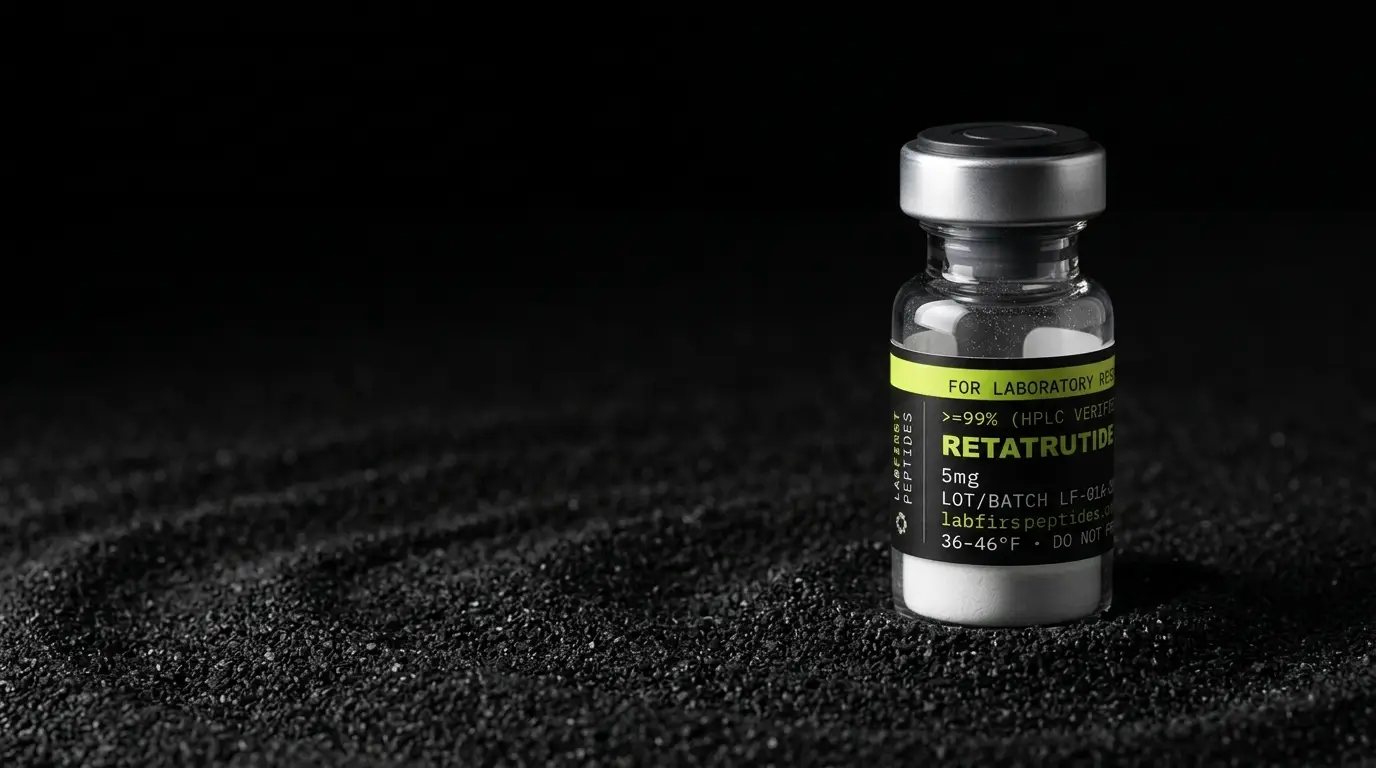
Retatrutide testing should cover three measurements: identity by LC-MS intact mass, purity by RP-HPLC, and net peptide content against the label. To verify a COA, compare the mass to the PubChem record, match the lot number to your vial, and confirm the report with the issuing lab yourself. Never rely on the seller's word alone.
- PubChem compound 171390338 lists retatrutide's molecular formula as C221H342N46O68, with a molecular weight of about 4,731 g/mol.
- Retatrutide testing on a complete certificate covers three separate measurements: LC-MS identity, RP-HPLC purity and net peptide content.
- ICH Q6B states that identity tests should be highly specific and based on unique aspects of the molecule's structure.
- ICH Q6B notes that purity results are method-dependent and that purity is assessed by a combination of analytical procedures.
- ISO/IEC 17025 is the standard ILAC-member accreditation bodies use to accredit testing laboratories, which makes a lab's accreditation claim checkable.
Why check a certificate yourself?
A seller hands you a PDF and says the powder inside the vial is retatrutide at high purity. How would you know? You did not watch the test. You do not know the lab. The document could belong to a different batch, or to nobody at all.
In plain terms, a certificate of analysis is a claim, and this page is a checklist for testing that claim without taking the seller's word for any of it. It is the practical companion to two longer guides. The retatrutide certificate of analysis guide walks through every field on the document, and the guide to how retatrutide identity is confirmed explains the chemistry behind the mass spectrometry line. Read those for depth. Use this one with the certificate open beside you and a pen in hand.
The checklist has four parts: the three measurements a useful certificate reports, the steps for confirming the report with the lab that issued it, the red flags that end the exercise early, and what independent retesting involves when the paperwork is not enough.
- Match the lot number to your vial
- Check the theoretical mass against PubChem
- Look for a chromatogram behind the purity figure
- Find net peptide content and compare it to the label
- Confirm the report with the lab you found yourself
- Retest independently if nothing can be confirmed
What three measurements should retatrutide testing include?
Retatrutide testing should include identity, purity and net content, and each answers a different question. Identity asks whether the molecule is retatrutide. Purity asks how much of the peptide signal belongs to that molecule. Net content asks how many milligrams of peptide the vial holds. A certificate that answers one question has left the other two open.
This split is how drug specifications are built in general. The ICH Q6B guideline, written for biotechnological products, lists identity, purity and quantity as separate parts of a specification, and says identity tests should be highly specific and based on unique aspects of the molecule's structure. It also notes that purity results are method-dependent, which is why purity is assessed by a combination of procedures rather than one number. Retatrutide is a synthetic peptide and no pharmacopeia publishes a monograph for it, but the same logic holds: three questions, three measurements.
| Measurement | Usual method | What you check | What it cannot tell you |
|---|---|---|---|
| Identity | LC-MS intact mass | Observed mass against the PubChem formula, not the certificate's own target | How pure the material is, or how much is in the vial |
| Purity | RP-HPLC, area percent | Method stated and chromatogram attached | Water, counter-ion or salt in the cake |
| Net content | Amino acid analysis, nitrogen or a validated assay | Milligrams of peptide compared with the label | Which impurities are present |
Checking identity against PubChem
The identity line should print two numbers: an observed mass from the instrument and a theoretical mass for retatrutide. Do not grade the first against the second until you have checked the second yourself, because a certificate that writes its own answer key has not been graded.
The public reference is PubChem compound 171390338. Its record gives the molecular formula C221H342N46O68, a molecular weight of about 4,731 g/mol, and an exact (monoisotopic) mass of about 4,730.48. Look at which kind of mass the certificate reports. An average mass should sit near 4,731; a monoisotopic mass near 4,730.5. If the theoretical value on the certificate is far from both, it was computed for a different molecule, and the observed value beside it is beside the point.
Once the target checks out, compare the observed mass against it, within the accuracy the lab states for its instrument. A certificate that gives only the word "conforms" with no observed number has not shown you identity. It has asked you to believe it. The identity guide linked above explains why an intact-mass match is strong evidence of composition while stopping short of full sequence proof.
Checking purity and net content
Purity on a peptide certificate is a reversed-phase HPLC area percentage: the main peak's share of everything the detector saw. Look for the method next to the number, meaning the column, the gradient and the detection wavelength, and look for the chromatogram itself. A bare percentage with no trace and no conditions is a number you cannot test. ICH Q6B's point that purity is method-dependent applies here directly; the same sample can read differently under a weaker method.
Net content is the field most often missing, and buyers rarely ask for it. A freeze-dried cake holds the peptide plus residual water and the counter-ion left from purification, so the weight of peptide in a vial is less than the weight of powder. Q6B treats quantity as its own critical measurement, determined by an appropriate assay. On a research certificate that means a stated peptide content, in milligrams or as a percentage, with the method named.
Compare that figure with the vial label. A vial labeled by milligrams of powder and a vial labeled by milligrams of peptide are different products, and the certificate is the only place the difference shows up. If net content is absent, write that down. The certificate has answered two of the three questions, and the missing one decides how much material your laboratory calculations are actually working with.
How do you confirm a COA with the issuing lab?
You confirm a COA by contacting the lab that issued it, through details you found yourself, and asking whether it issued that report number for that lot. The steps run in this order.
- Match the lot. The lot number on the certificate must match the lot printed on your vial, character for character. If it differs, stop; the document describes other material.
- Find the lab independently. Search for the laboratory's name and locate its website and address yourself. Do not use a phone number, email or QR code printed on the certificate, since a forged document can point to a forged contact.
- Check any accreditation claim. ISO/IEC 17025 is the competence standard for testing laboratories, and accreditation bodies that belong to ILAC accredit labs against it. Those bodies publish searchable lists of the labs they accredit, so a claimed accreditation can be looked up.
- Ask the lab directly. Send the report number, the lot number and the test date, and ask whether the lab issued that report for that sample. Some labs also run an online report lookup by number; use it if it exists.
A manufacturer's in-house certificate cannot be checked this way, because the issuer and the seller share an interest in the answer. For those, the question becomes whether the seller will stand behind an independent test of the same lot.
Red flags that end the check early
Some certificates fail before any phone call. Any one of these is enough to stop trusting the document.
- No observed mass. Identity reported as "conforms" or "passes" with no measured value beside the theoretical one.
- Purity only. A single HPLC percentage with no identity result and no net content. High purity of an unconfirmed molecule tells you nothing about what the molecule is.
- Recycled certificates. The same chromatogram, report number or test date showing up on certificates for different lots. Each lot is a separate batch and needs its own test.
- No lot number. A certificate that names no lot describes no vial.
- Dates out of order. A test date before the lot was made, or a report years older than the batch it is supposed to describe.
- No named lab. No laboratory name, no address, no signature, or a lab you cannot find anywhere outside the certificate.
A theoretical mass that does not match the PubChem formula belongs on this list too. It means the certificate was written for some other compound and relabeled.
What does independent retesting involve?
Independent retesting means sending a sealed vial from the same lot to an accredited testing lab with no tie to the seller, and asking for the same three measurements: LC-MS intact mass with the observed value printed, RP-HPLC purity with the chromatogram, and net peptide content. It is the remaining option when the paperwork cannot be confirmed.
A few details make the result worth having. Keep the vial sealed and in its original labeling so the lot can be tied to the report. Give the lab the PubChem formula so it computes the target mass from a public reference. Ask for the method details on the report, so the result can be compared with the seller's certificate line by line. A retest that agrees with the original certificate tells you the document was honest. One that disagrees is a concrete finding you can take back to the seller.
LabFirst publishes its release specification on the certificate page (/coa/#release-specification): identity confirmed by LC-MS, purity of at least 99% by RP-HPLC, and net content of at least 85% of the label claim. If an independent test contradicts the certificate for a lot, the lot is refunded in full under the independent test guarantee in our return policy (/return-policy/#independent-test-guarantee). Lot certificates appear on the retatrutide product page once the certificate for that lot is published.
Research use
Retatrutide is an investigational compound with no compendial standard, so the certificate and any independent retest are the only quality evidence a lot has. Everything on this page concerns laboratory documentation: reading results, confirming who issued them, and arranging a second analysis.
FOR LABORATORY AND IN-VITRO RESEARCH USE ONLY. NOT FOR HUMAN OR ANIMAL CONSUMPTION.
What is Retatrutide studied for?
Published research on Retatrutide investigates the areas below, which is a different question from what Retatrutide will do for anyone, a claim about a living system that nothing on this site is sold for.
What it is. An experimental peptide that works on three incretin receptors at once.
What the research looks at. It shows up in clinical-stage metabolic research under the developer code LY3437943. The published work is about how it behaves at those receptors, how the effect changes with the amount given, and the measurements the sponsor registered its trials to take.
How it is thought to work. It switches on three receptors at the same time: GIP, GLP-1 and glucagon. Everything before it in this family worked on one or two. Hitting all three is why researchers treat it as its own kind of compound rather than a stronger version of what already existed.
What is not established. No regulator has approved it for anything, anywhere. It is still experimental, and nobody has made a finding about whether it is safe, whether it works, or whether it is fit for any purpose outside a registered trial.
The full record, including the certificate for the lot in stock, is on the Retatrutide product page.
Common questions
What does retatrutide testing involve?
How do I verify a retatrutide COA is real?
What mass should a retatrutide lab test show?
Is a retatrutide purity test enough on its own?
Why is net peptide content often missing from a COA?
Published certificates for Retatrutide
Every figure below is read from a report the laboratory issued for that lot; each page carries the PDF and the lab's own verification link.
More documentation guides
Sources
- PubChem PUG REST properties for CID 171390338 (retatrutide). Molecular formula, molecular weight and exact mass used as the independent identity reference.
- ICH Q6B, Specifications: Test Procedures and Acceptance Criteria for Biotechnological/Biological Products. Source for identity, purity and quantity as separate specification elements, and for purity being method-dependent.
- FDA guidance page for ICH Q6B. FDA's listing of the Q6B guidance.
- ILAC, About ILAC. Describes accreditation bodies accrediting testing laboratories to ISO/IEC 17025.