Retatrutide identity testing measures the whole mass of the peptide, usually by electrospray LC-MS. That found mass is compared with the value worked out from the molecule's structure. How it runs on a column next to a reference is read alongside. A purity percentage only says how uniform the material is. It does not say which molecule it is.
- Purity by HPLC measures homogeneity of whatever elutes; it cannot establish that the eluting molecule is retatrutide.
- Identity rests on the measured intact mass agreeing with the theoretical value fixed by the molecule's structure, taken at full precision from the public compound record.
- Electrospray spectra of a peptide this size show a multiply charged envelope, and deconvolution to a single neutral mass produces the figure that is compared against theory.
- Sequence isomers weigh exactly the same, which is why chromatographic behavior against a reference is read alongside the mass evidence.
- An identity line reading 'conforms' with no observed value is an assertion, and a certificate exists to replace assertion with measurement.
What this guide covers
Here is how a lab can tell that a vial sold as retatrutide holds retatrutide. The guide covers the reference value everything is compared against, what mass spectrometry and chromatography each contribute, the tiers of identity evidence, and what a trustworthy identity line on a certificate looks like.
Think of it like checking a house key. Purity tells you the key is cleanly cut, with no burrs. Identity tells you it opens your door. A spotless key for the wrong lock still passes the first test.
- Retention time against a reference: consistent, never sufficient
- Intact mass by ESI-MS: the routine core of the claim
- LC-MS on the main peak: mass and purity tied to the same molecules
- MS/MS or peptide mapping: sequence confirmed, batch-release tier
- Independent third-party retest: the check when the work justifies it
Why does purity not prove identity?
A certificate that reads 99.4% by HPLC is making a claim about homogeneity. It says that when the contents of the vial were run down a reversed-phase column, 99.4% of what the detector saw eluted as one peak. It does not say what that peak is. A cleanly synthesized wrong peptide scores exactly as well as a cleanly synthesized right one, and a vial of something else entirely can carry a spotless purity figure without a word of it being informative.
Identity is a separate determination with its own evidence, and on a competent certificate it occupies its own line. The distinction gets blurred in the research market because purity is the number listings compete on, so it is the number buyers learn to look for. Purity is worth checking. It is the second question, though. The first is whether the molecule in the vial is retatrutide at all, and the only way to answer it is to measure a property the correct structure predicts and a wrong one does not.
That property, in practice, is mass, with chromatographic behavior read alongside it. The rest of this page covers how each is measured, what each can and cannot establish, and how the combination should appear on a certificate worth trusting.
What reference is the evidence compared against?
Identity testing is comparison. A measurement means nothing without a reference value, so the starting point is what retatrutide is on paper: a synthetic linear peptide of 39 residues built on the GIP backbone, carrying non-coded residues including α-aminoisobutyric acid, with a C20 fatty diacid attached through a linker to a lysine side chain. It was developed by Eli Lilly under the code LY3437943. The structure fixes the molecular formula, and the formula fixes the mass.
The public compound record lists an average molecular mass a little over 4,700 daltons. The rounding here is deliberate. A laboratory doing the comparison should take the reference figure from the compound record at full precision, never from a marketing page or from an article like this one, because the entire test consists of agreement between a measured number and a theoretical one, and a reference value that has been paraphrased is no reference at all.
No compendial monograph exists for retatrutide. There is no USP identity procedure to point to, the way there is for an established pharmaceutical ingredient, so the methods below are the ones analytical laboratories converge on for any novel synthetic peptide, applied to this molecule's particulars. Two of those particulars matter later: the Aib residues and the lipid chain.
How does mass spectrometry carry the identity claim?
The workhorse is electrospray ionization mass spectrometry, usually coupled to the same liquid chromatography that generates the purity figure. Electrospray puts multiple protons on a peptide this size, so the raw spectrum is a family of peaks, each corresponding to the intact molecule carrying a different number of charges. Software deconvolutes that envelope back to a single neutral mass. That deconvoluted figure, set against the theoretical mass from the compound record, is the core of the identity claim.
Agreement within instrument tolerance is strong evidence. On a modern instrument the measured mass of a 4.7 kDa peptide lands within a fraction of a dalton of theory, and very few plausible wrong molecules share the same intact mass.
Very few is not none, and the limits matter. A mass match cannot establish sequence order: two peptides with the same residues arranged differently weigh exactly the same. Nor does modest resolution separate near-isobaric errors. Deamidation, the most common of them, adds roughly one dalton to a molecule of 4,700, a shift a low-resolution instrument reads as agreement. And the measurement says nothing about how many milligrams sit in the vial. The trifluoroacetate counterion left over from synthesis never appears in the deconvoluted mass, yet it can account for a meaningful fraction of the powder's weight, which is why mass agreement and net peptide content are separate lines on a certificate and must stay separate in the reader's head.
What does chromatography add?
Retention time is the other half of the routine evidence. On a reversed-phase column under a defined gradient, retatrutide elutes when its hydrophobicity says it should, and the lipidated side chain gives it more hydrophobic character than an unmodified peptide of similar length. Run against a qualified reference standard under the same method, the main peak of a genuine lot lands at the same retention time.
Alone, this is weak evidence. Columns age, gradients drift between laboratories, and plenty of unrelated molecules co-elute. What makes chromatography valuable is orthogonality: it sorts molecules by surface chemistry while the mass spectrometer sorts them by mass, and the odds of a wrong molecule passing both tests together are far smaller than the odds of it passing either alone.
The strongest routine configuration ties the two to the same physical peak. In an LC-MS run, the spectrum is acquired at the moment the main peak elutes, so the certificate can say something specific: the material that makes up 99% of the trace is the material whose mass matches theory. A certificate that shows a purity chromatogram from one run and a mass spectrum from another has left a gap between the two claims. Usually the gap is harmless. It is still a gap, and the better document closes it.
What are the tiers of identity evidence?
Identity evidence comes in tiers, and it helps to know which tier a given document is claiming.
| Technique | What it establishes | What it cannot establish |
|---|---|---|
| RP-HPLC retention against a reference | Hydrophobic behavior consistent with the named molecule | Identity on its own; co-elution is common |
| Intact mass by ESI-MS | Agreement with the theoretical mass at the level of molecular formula | Sequence order; near-isobaric errors at low resolution |
| LC-MS on the main peak | The dominant species has the correct mass | Residue-level sequence |
| MS/MS fragmentation or peptide mapping | Sequence confirmed segment by segment | Little; this is the batch-release tier |
| Amino acid analysis | Residue composition and content | The order residues appear in |
Routine research certificates sit on the second and third rows. That is a reasonable place for them: intact mass on the main peak, against a stated theoretical value, is real evidence and cheap to produce. The fourth row is what a laboratory orders when the work riding on the material justifies it, and retatrutide makes that tier harder than usual.
The Aib residues resist enzymatic cleavage, which is much of the reason such residues are put into sequences like this one, and an enzyme that cannot cut near them yields fewer, larger fragments than a textbook map. The fatty diacid complicates recovery of the fragment that carries it. None of this makes sequencing impossible. It means the method development is real work, and a supplier claiming full sequence confirmation on every research lot at research prices is describing a workflow it is fair to ask questions about.
What should the identity line on a certificate show?
A certificate is only as good as the specific numbers it commits to. For identity, the version worth trusting states the technique, the theoretical mass and the observed mass, and shows the spectrum or the deconvolution result for this lot, tied to a lot number that matches the vial label.
Where the stakes justify it, the check is independent testing: a sample sent to a third-party analytical laboratory with no interest in the answer. What that costs and when it is warranted belongs to procurement policy. The documentation standard a supplier is expected to meet up front is set out in the quality standard, and the compound's own certificates live on the Retatrutide product record.
How to check a retatrutide identity line, step by step
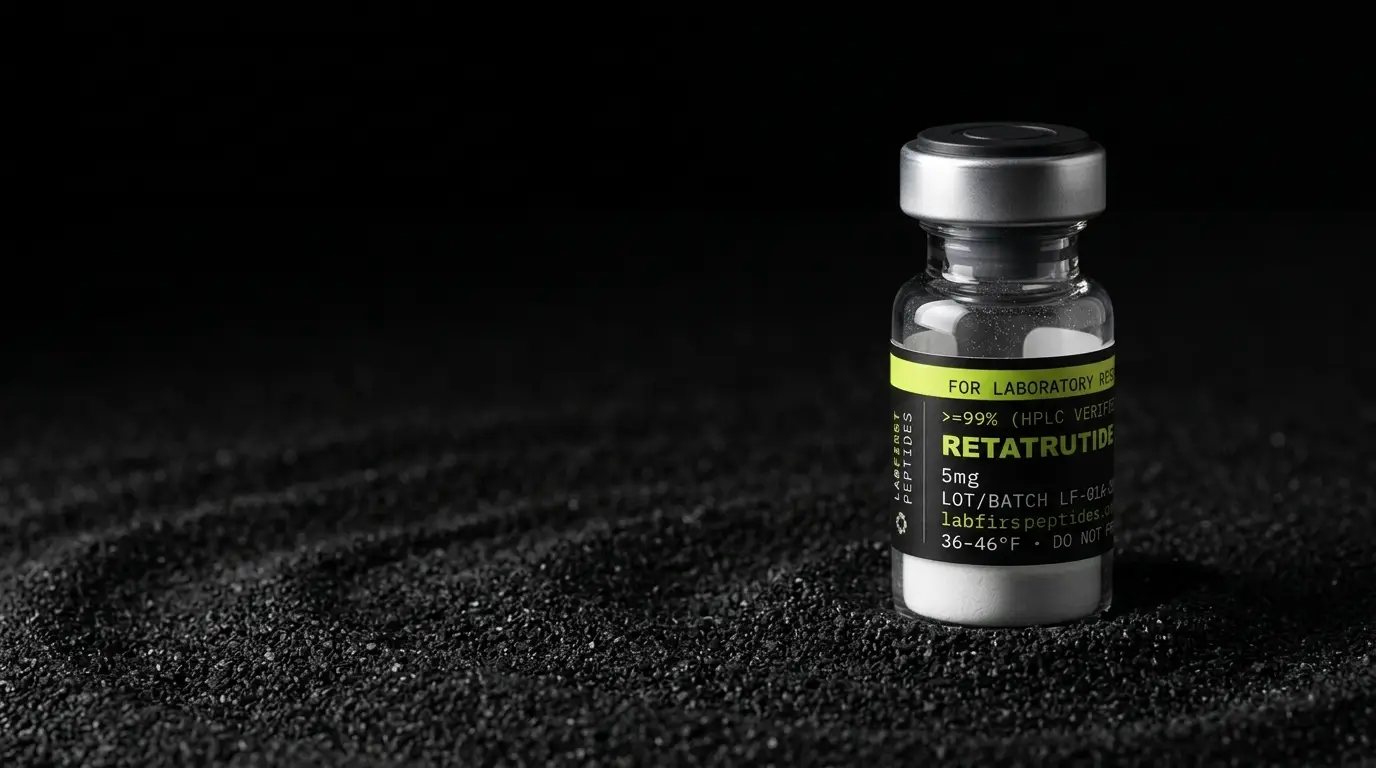
- Match the lot number on the certificate to the vial label.
- Check that the technique is stated, usually electrospray LC-MS.
- Check the theoretical mass against the public compound record at full precision, never against a marketing page.
- Find the observed mass for this lot, with the spectrum or the deconvolution result shown.
- Look at whether the mass spectrum and the purity figure come from the same LC-MS peak. A purity chromatogram from one run and a spectrum from another leaves a gap.
- If the certificate only says identity conforms, ask the supplier for the technique, theoretical mass, observed mass and the lot-specific spectrum.
- Where the stakes justify it, send a sample to a third-party analytical laboratory.
Red flags on a retatrutide identity line
These failures are easy to spot once you know them:
- "Identity: conforms" with no observed value. That is an assertion, and the entire point of the document is to replace assertion with measurement.
- A spectrum image with no axis labels, no lot number, or one that looks identical across a supplier's whole catalog. Real spectra are lot-specific and slightly untidy.
- An observed mass that equals theory to two decimal places on every lot the supplier has ever shipped. Real instruments scatter within tolerance; perfection across many lots reads as transcription.
- A certificate whose stated method does not match the graph shown, a chromatogram labeled as mass data or the reverse.
What is the regulatory status of retatrutide?
Retatrutide is an investigational compound, a triple agonist of the GIP, GLP-1 and glucagon receptors. At the time this page was written, no regulatory authority had approved a medicine containing it; the molecule was in late-stage clinical trials run under sponsor quality systems that a research supply chain does not replicate. If that status changes, the change belongs on this page with a date attached, the way approval and compounding milestones are dated on the tirzepatide record.
Identity testing on research material exists to serve laboratory documentation, and its scope ends there. FOR LABORATORY AND IN-VITRO RESEARCH USE ONLY. NOT FOR HUMAN OR ANIMAL CONSUMPTION. NOT FOR PERSONAL, MEDICAL, DIAGNOSTIC, THERAPEUTIC, OR RECREATIONAL USE.
Bottom line
A purity percentage says how uniform the material is. It does not say the molecule is retatrutide. Identity comes from an intact mass that agrees with the theoretical value from the compound record, read alongside retention against a reference standard, ideally on the same LC-MS peak. A certificate worth trusting prints the technique, the theoretical mass and the observed mass for the lot on your vial. "Conforms" on its own is an assertion, and it should prompt a request for the data.
What is Retatrutide studied for?
Published research on Retatrutide investigates the areas below, which is a different question from what Retatrutide will do for anyone, a claim about a living system that nothing on this site is sold for.
What it is. An experimental peptide that works on three incretin receptors at once.
What the research looks at. It shows up in clinical-stage metabolic research under the developer code LY3437943. The published work is about how it behaves at those receptors, how the effect changes with the amount given, and the measurements the sponsor registered its trials to take.
How it is thought to work. It switches on three receptors at the same time: GIP, GLP-1 and glucagon. Everything before it in this family worked on one or two. Hitting all three is why researchers treat it as its own kind of compound rather than a stronger version of what already existed.
What is not established. No regulator has approved it for anything, anywhere. It is still experimental, and nobody has made a finding about whether it is safe, whether it works, or whether it is fit for any purpose outside a registered trial.
The full record, including the certificate for the lot in stock, is on the Retatrutide product page.
Common questions
Can a high purity percentage stand in for identity testing?
Why does the mass spectrum show a series of peaks rather than one?
Does the trifluoroacetate counterion shift the measured mass?
Is a matching retention time enough to confirm identity?
What should I do with a certificate that only says identity conforms?
Published certificates for Retatrutide
Every figure below is read from a report the laboratory issued for that lot; each page carries the PDF and the lab's own verification link.
More documentation guides
Sources
- PubChem compound record for retatrutide. Reference molecular formula and mass values against which a measured intact mass is compared; the record is the place to take those figures at full precision.
- Coskun et al., Cell Metabolism, 2022. Discovery report for LY3437943 (retatrutide); supports the structural description of an engineered GIP-based peptide carrying Aib residues and a C20 fatty diacid.
- ICH Q6B, specifications for biotechnological and biological products. Establishes identity testing as a determination distinct from purity, to be based on specific and ideally orthogonal analytical methods.