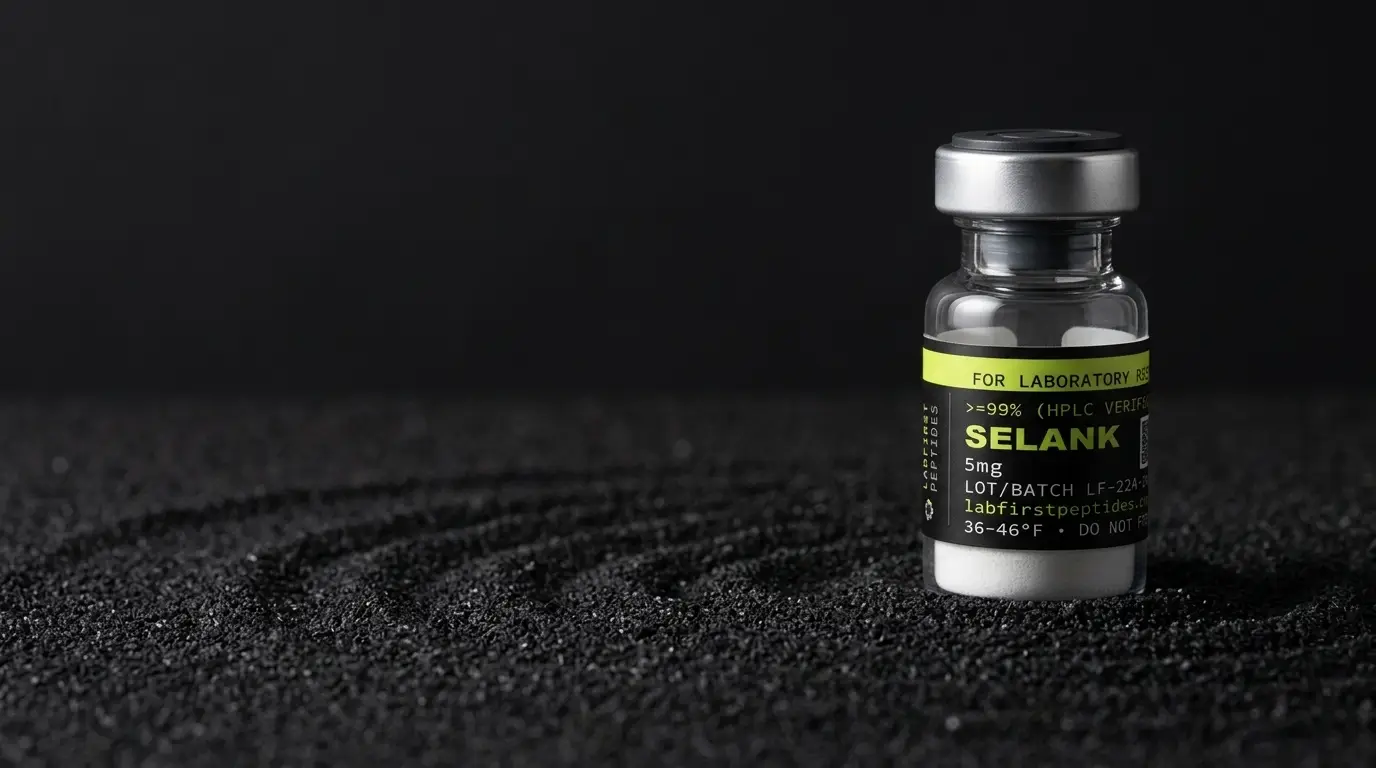
For Selank storage and stability, keep the powder sealed, frozen and dark, and keep any solution refrigerated. Selank has no methionine, cysteine, asparagine or glutamine, so the usual side-chain breakdown routes do not apply. Moisture is the fault that matters. A retest date describes an unopened vial only.
- Sealed and frozen as powder, refrigerated in solution, dark in both states.
- No methionine, cysteine, asparagine or glutamine, so the usual side-chain routes do not apply.
- C33H57N11O9 contains no sulfur, which is visible confirmation of the first two absences.
- Backbone hydrolysis is the main remaining route and it needs water.
- Basic residues mean more counterion, and peptide salts draw moisture readily.
- Adsorptive loss from dilute solution removes peptide without degrading it.
How should Selank be stored?
Sealed and frozen as lyophilized powder, refrigerated once a solution exists, and dark in both states. The instruction is the same as for most research peptides, and the reasons behind it are unusually narrow for this one.
The dry form is the stable one. Freeze-drying removes the water that hydrolysis needs, and a sealed vial below freezing is the condition a retest date assumes.
Refrigeration rather than freezing suits a vial in regular use, trading a little stability for fewer temperature cycles. Selank tolerates that trade better than most peptides in this catalog, for the reason set out next.
- Sealed and frozen as lyophilized powder, in the dark
- No methionine or cysteine, so oxidation is not the governing route
- No asparagine or glutamine, so deamidation does not apply either
- Backbone hydrolysis remains, and it runs on water
- Open the vial at room temperature to avoid condensation
- Caked powder or a hazy solution ends the vial
Why does Selank have fewer degradation routes than most peptides?
Because of what its sequence leaves out. Peptide degradation in storage is mostly side-chain chemistry, and the residues responsible are a short list.
Methionine oxidises. Cysteine forms and scrambles disulfides. Asparagine and glutamine deamidate. Selank contains none of the four, which is visible in the formula: C33H57N11O9 has no sulfur at all, so there is no methionine and no cysteine to begin with.
What remains is backbone chemistry, principally hydrolysis, which needs water. That is a genuinely simpler stability picture than a peptide carrying a methionine, and it is the honest reason this compound is comparatively forgiving.
So what actually degrades it?
Water, mainly. Hydrolysis cleaves the backbone and it requires moisture to proceed, which is why the lyophilized form is stable and a solution is not.
Proline-containing sequences have their own quirk here. The bond preceding a proline is more resistant to enzymatic cleavage than an ordinary peptide bond, which matters in a biological matrix and not in a sealed vial. Chemical hydrolysis is less selective and is not blocked in the same way.
Physical loss is the other route and it is easy to overlook. Peptide adsorbs onto glass and plastic surfaces, particularly from dilute solution, so material can go missing without degrading at all. The vial reads low and every chemical test on what remains looks perfect.
Why is moisture the fault that matters here?
Because it is the one route that is fully open. Remove the side-chain vulnerabilities and hydrolysis is what is left, and hydrolysis runs on water.
Lyophilized peptide is hygroscopic. Opening a cold vial in a warm room draws condensation straight onto the powder, replacing the water freeze-drying removed. Letting the vial reach room temperature before opening costs nothing and removes the problem entirely.
Moisture also quietly moves the numbers. A vial that has absorbed water weighs more per unit of peptide than it did at test, so the certificate's net peptide content figure becomes slightly generous while remaining an accurate record of what was measured.
Does the basic side chain affect storage?
Less than it affects analysis, but it is not nothing. Lysine and arginine carry positive charges, and a peptide with more charges pairs with more counterion, so the powder contains proportionally more salt than a neutral peptide of similar length.
More counterion means more hygroscopic material, because peptide salts draw moisture readily. That reinforces the point above rather than adding a new one.
The charges also make the peptide highly water-soluble, which is convenient in the laboratory and irrelevant to how the sealed dry vial is stored.
What does a retest date actually mean?
It describes an unopened container held under the conditions printed beside it, derived from stability data: units stored at defined temperature and humidity, pulled on a schedule, tested against the release specification.
The date is conditional on those conditions being met. A vial that spent a week on a warm bench is no longer described by it, and nothing about the vial looks any different.
It is also not a cliff. Material past a retest date is not established as failing; it is outside the evidence, and the honest response is to test rather than assume in either direction. A pharmaceutical expiry is a stronger claim made under rules research-grade material is not made under.
What happens once the vial is opened?
The moisture clock starts and the certificate stops describing the contents. Every entry exchanges headspace air, and in a humid room that air carries water to a powder that readily takes it up.
Air matters less here than for an oxidation-prone peptide, which is a real difference between this compound and something like Semax. There is no methionine for oxygen to attack, so the number of entries is a moisture question rather than an oxidation one.
That said, fewer entries remains better practice. Each one is an opportunity for condensation, for a closure to reseal imperfectly, and for the powder to sit exposed while work is done.
Does the container matter as much as the temperature?
For this peptide, arguably more. The vial and its closure are what exclude moisture, and moisture is the dominant route.
A stopper pierced repeatedly, or pierced with a blunt needle, may not reseal cleanly. That admits humid air into a vial whose whole rationale is that it does not get in, and the powder looks unchanged for some time afterwards.
Light transmission matters less than for peptides with oxidation-prone or aromatic residues, since Selank has neither. Dark storage is still sensible practice and it is doing less work here than it does elsewhere, which is worth knowing rather than pretending every rule applies equally to every compound.
What does stability testing not capture?
Everything after dispatch. A stability study tests unopened units under controlled conditions, so the results describe an ideal a working vial stops matching at first entry.
Transit is the least documented stretch. A parcel can sit in a hot vehicle for a day or freeze overnight, and none of it appears on paperwork. For a dry powder with few chemical vulnerabilities the risk from that is genuinely modest; the mechanical risk to the closure is not.
Adsorptive loss is the other gap and it is specific to dilute solutions. It is a handling effect rather than a stability property, so no stability protocol reports it.
What should make you stop using a vial?
Powder that has caked hard or changed color. Caking is the visible form of moisture ingress and, for a peptide whose main vulnerability is moisture, it is the signal that matters most.
In solution, cloudiness or visible particulate. A solution that has gone hazy has something in it that was not there before, and no document accounts for it.
A closure that has lifted, cracked or no longer sits flush counts even when the contents look untouched. None of these require equipment, and they catch what a certificate cannot, because a certificate describes the vial as it was filled.
How does storage relate to the certificate?
They split the timeline and neither covers the other half. A certificate reports what was measured on a sample drawn at one moment, and the certificate guide covers how to read one field by field. Storage evidence covers what happens afterwards.
Confusing them is the common error. A recent certificate on a badly stored vial proves very little about the material in front of you, and careful storage of something that never had a certificate proves nothing about what it is.
Lot reports for material supplied here resolve through the certificate verification page, and the sizes carried are on the Selank product record.
What is the regulatory position?
Stability expectations for finished pharmaceutical products are set out in international guidance defining storage conditions, sampling intervals and the testing behind a shelf-life claim. That framework governs drug products made for human use.
There is no FDA-approved product containing Selank and no United States pharmacopeial monograph defining an acceptable batch, so a research certificate does not carry pharmacopeial weight. A supplier can honestly report the conditions a lot was held under and what was measured; presenting that as a drug product shelf life would overstate it.
The useful question stays narrow: what conditions, what measurement, what date.
FOR LABORATORY AND IN-VITRO RESEARCH USE ONLY. NOT FOR HUMAN OR ANIMAL CONSUMPTION. NOT FOR PERSONAL, MEDICAL, DIAGNOSTIC, THERAPEUTIC, OR RECREATIONAL USE.
What is Selank studied for?
Published research on Selank investigates the areas below, which is a different question from what Selank will do for anyone, a claim about a living system that nothing on this site is sold for.
What it is. A man-made peptide seven building blocks long, based on an immune peptide called tuftsin.
What the research looks at. It appears in animal work coming largely from a narrow set of research groups, which is worth carrying in mind while reading it.
How it is thought to work. Built from tuftsin with a short tail added for durability. How it works is not settled in the published research.
What is not established. No approved product in the United States and no official standard. The evidence base is smaller and more geographically concentrated than commercial writing implies.
The full record, including the certificate for the lot in stock, is on the Selank product page.
Common questions
Does Selank need to be refrigerated?
Why is Selank more stable than some other peptides?
Does Selank oxidise in storage?
Can peptide go missing without degrading?
What does caked Selank powder mean?
Published certificates for Selank
Every figure below is read from a report the laboratory issued for that lot; each page carries the PDF and the lab's own verification link.
More documentation guides
Sources
- PubChem Compound Summary for CID 11765600, Selank. The openable record giving the molecular formula C33H57N11O9, whose absence of sulfur is the evidence for the missing methionine and cysteine discussed above.
- ICH Q2(R2), Validation of Analytical Procedures . Defines what makes an analytical result valid and reproducible, and is the basis for treating a stability figure without a named method and stated conditions as unverifiable.
- 21 CFR 211.84, Testing and approval or rejection of components and containers. Sets sampling and testing expectations for containers and closures, supporting the treatment of closure integrity as part of the product rather than packaging around it.