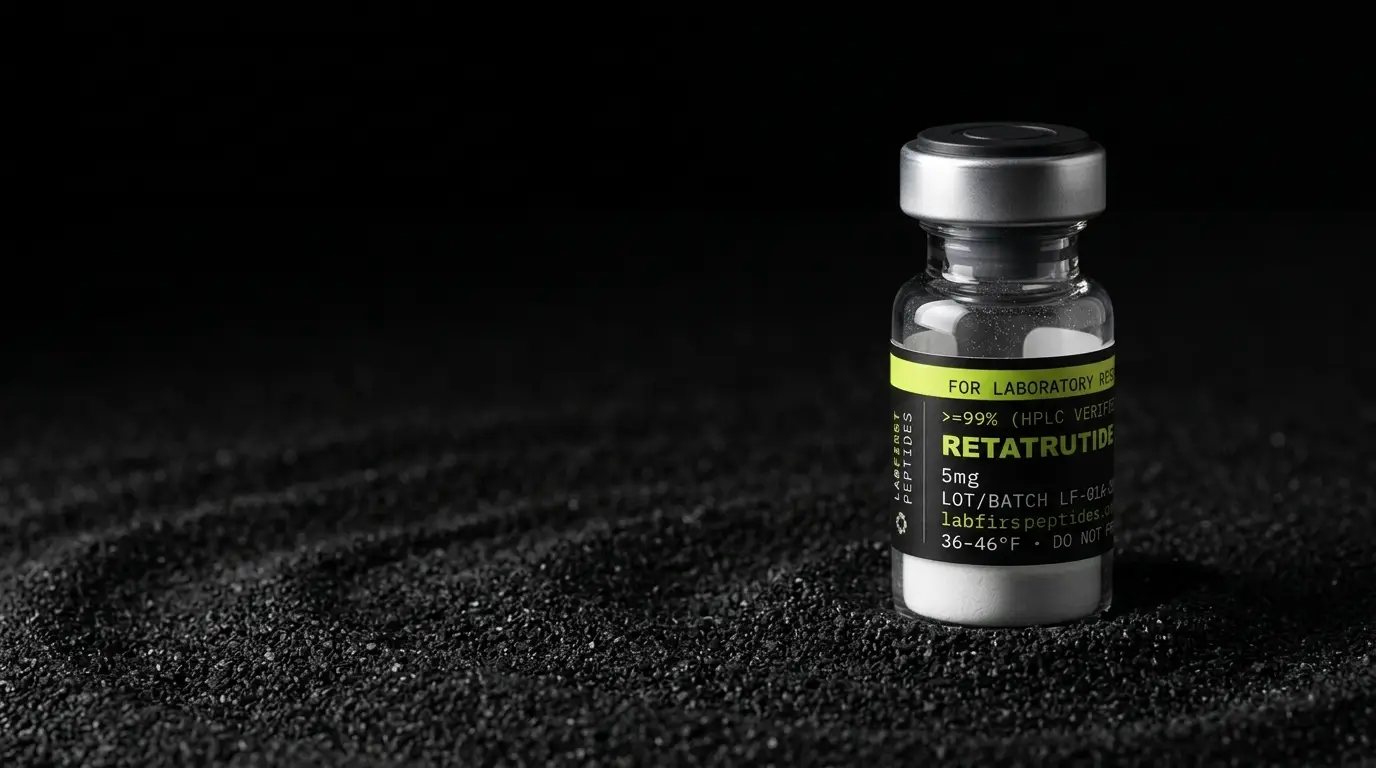
GLP-3 retatrutide is a nickname, not a real hormone or receptor. Retatrutide (LY3437943) is a single 39-amino-acid peptide that activates three receptors: GIP, GLP-1 and glucagon. People say "GLP-3" because it reaches a third target where older research peptides reached one or two. It is an investigational compound.
- GLP-3 is a nickname for retatrutide; no hormone or receptor named GLP-3 exists.
- Retatrutide (LY3437943) is a 39-amino-acid peptide derived from a GIP backbone that activates the GIP, GLP-1 and glucagon receptors.
- PubChem record 171390338 lists retatrutide's formula as C221H342N46O68, about 4,731 g/mol.
- Retatrutide carries Aib at positions 2 and 20, alpha-methyl-leucine at position 13, and a C20 fatty diacid on Lys17.
- The GIP, GLP-1 and glucagon receptors are class B G protein-coupled receptors of 466, 463 and 477 amino acids.
- Retatrutide is an investigational compound first described in Coskun et al., Cell Metabolism, 2022.
What this guide covers
Somebody types "GLP-3" into a search box, lands on a product listing, and wants to know what they are looking at. This page answers that. The short version: there is no hormone called GLP-3. The name is a nickname for retatrutide, a research peptide that reaches three receptors instead of one or two.
Below, in order: whether GLP-3 exists at all, whether retatrutide counts as a GLP-1, whether it is a peptide, what the three receptors are, and how its structure compares with tirzepatide and semaglutide. After that comes a step-by-step way to read a listing or a certificate that uses the nickname, a list of red flags, and a short bottom line.
Every chemistry fact here is drawn from PubChem, the developer's own paper, UniProt receptor entries and FDA labels, all listed in the sources at the end. Nothing on this page is a statement about effects in people.
- One target: GLP-1 receptor (semaglutide)
- Two targets: GIP and GLP-1 receptors (tirzepatide)
- Three targets: GIP, GLP-1 and glucagon receptors (retatrutide)
- The third target inspired the nickname
- No hormone called GLP-3 exists
Is there such a thing as GLP-3?
No. Search a protein database for a hormone called GLP-3 and nothing comes back. The numbering of glucagon-like peptides stops at two.
So where does the name come from? In plain terms, it is a counting shorthand that stuck. The first research peptides in this family hit one receptor, the GLP-1 receptor. Tirzepatide added a second, the GIP receptor. Retatrutide added a third, the glucagon receptor. People started saying "GLP-3" as shorthand for a third target, even though the second and third receptors are not GLP receptors at all.
The developer paper never uses the nickname. Coskun and colleagues, writing in Cell Metabolism in 2022, describe LY3437943 as "a novel triple agonist peptide" at the glucagon receptor, the GIP receptor and the GLP-1 receptor. PubChem files the compound under CID 171390338 with the title "Triple G", another informal label pointing at the same idea: three G-named targets (glucagon, GIP, GLP-1) reached by one molecule.
When you see "GLP-3" on a forum or a product listing, read it as "the triple agonist", and know that the molecule behind it is retatrutide.
Is retatrutide a GLP-1?
Retatrutide is not GLP-1, and it is not built on the GLP-1 sequence, but it does activate the GLP-1 receptor. That distinction trips people up, so it helps to separate the hormone from the receptor.
GLP-1 is a natural peptide hormone. The GLP-1 receptor is the protein on a cell surface that GLP-1 binds. A synthetic peptide can bind that receptor without looking much like GLP-1, the way a well-cut copy opens a lock without being the original key. Calling something "a GLP-1" in casual speech usually means a GLP-1 receptor agonist, a compound that switches the receptor on.
By that casual meaning retatrutide counts, because GLP-1 receptor activity is one of its three activities. By the strict chemical meaning it does not, because its backbone comes from GIP. The LC-HRMS paper on retatrutide describes a 39-amino-acid sequence derived from a GIP backbone. Semaglutide, by contrast, is a true GLP-1 analog: its FDA label calls it a GLP-1 analogue with 94% sequence homology to human GLP-1.
The developer paper also reports that the balance across receptors is uneven. In vitro, LY3437943 "shows balanced GCGR and GLP-1R activity but more GIPR activity". That is a statement about receptor assays in a dish, and it is the only potency claim this page makes.
Is retatrutide a peptide?
Yes. Retatrutide is a peptide: a chain of 39 amino acids joined by peptide bonds, with a few non-standard residues and a lipid side chain attached. The developer paper calls it a triple agonist peptide in its first description of the compound.
Its molecular formula, as listed on PubChem record 171390338, is C221H342N46O68, with a molecular weight of about 4,731 g/mol. That puts it in the same size class as its relatives. PubChem lists tirzepatide at C225H348N48O68 (about 4,813 g/mol) and semaglutide at C187H291N45O59 (about 4,114 g/mol).
A molecule of roughly 4.7 kDa is far too small to be a protein, yet long enough that it is no short oligopeptide either. For the general ladder from dipeptide up to protein, our chemistry guides cover each step.
Because retatrutide is a modified peptide, a laboratory confirms its identity the way it would any modified peptide: by measuring intact mass against the value the structure predicts and reading chromatography alongside it. Our guide on how retatrutide identity is confirmed walks through that in detail.
What are the three receptors?
All three targets are G protein-coupled receptors from the same family, which UniProt classifies as the G protein-coupled receptor 2 family (often called class B). Each sits in the cell membrane, binds a peptide hormone on the outside, and signals through G proteins on the inside. Their natural partners are related peptides, which is why one engineered sequence can reach all three.
| Receptor | Gene | Length | Natural ligand |
|---|---|---|---|
| GIP receptor | GIPR | 466 amino acids | Glucose-dependent insulinotropic polypeptide (GIP) |
| GLP-1 receptor | GLP1R | 463 amino acids | Glucagon-like peptide 1 |
| Glucagon receptor | GCGR | 477 amino acids | Glucagon |
UniProt describes the GLP-1 receptor as one whose activation leads to adenylyl cyclase activity and increased intracellular cAMP. The GIP receptor entry likewise describes signaling through G proteins that activate adenylyl cyclase, and notes that it can form heterodimers with GLP1R. The glucagon receptor entry describes G protein signaling through adenylate cyclase and the phosphatidylinositol-calcium pathway.
That shared cAMP route is the biochemical thread tying the three together. What differs is which hormone normally switches each one on. For a fuller walk through the receptor biochemistry, see our guide on how retatrutide works.
How does retatrutide differ from tirzepatide and semaglutide?
The three molecules differ in three places you can read straight off their published structures: the backbone they start from, the unusual residues swapped in, and the fatty acid hung off the side.
| Feature | Retatrutide | Tirzepatide | Semaglutide |
|---|---|---|---|
| Backbone | GIP-derived, 39 residues | Based on the GIP sequence | GLP-1 analog, 94% homology to human GLP-1 |
| Non-standard residues | Aib at 2 and 20; alpha-methyl-leucine at 13 | Aib at 2 and 13 | Modified residue at position 8 |
| Lipid side chain | C20 fatty diacid on Lys17 via an AEEA spacer and gamma-glutamate linker | 1,20-eicosanedioic acid (C20) on Lys20 via a linker | C18 fatty diacid on Lys26 via a hydrophilic spacer |
| Receptors | GIP, GLP-1, glucagon | GIP, GLP-1 | GLP-1 |
Aib is alpha-aminoisobutyric acid, an amino acid with two methyl groups on its central carbon. It is not one of the twenty standard residues. Semaglutide's label says its position 8 change protects against breakdown by the enzyme DPP-4. Retatrutide also carries alpha-methyl-leucine, a leucine with an extra methyl group, at position 13. Both retatrutide and tirzepatide end in an amidated C-terminus.
The fatty diacid is the other signature. A long carbon chain with an acid group at each end, attached through a spacer to one lysine, lets the peptide bind serum albumin reversibly; the LC-HRMS paper describes retatrutide's C20 chain this way. Tirzepatide uses a C20 chain too, while semaglutide uses a shorter C18 chain. Our retatrutide vs tirzepatide comparison sets the two side by side.
How to read a listing that says GLP-3: step by step
The nickname matters most when you are holding a vial or a certificate and trying to work out what it is. Here is the order to check things in, using only the facts above.
- Find a real compound name. The listing or certificate should say retatrutide, or the developer code LY3437943. "GLP-3" on its own names no defined molecule.
- Find the formula. It should read C221H342N46O68, with a mass near 4,731 g/mol. A formula is fixed; a nickname is not.
- Count the receptors. A correct description names three: GIP, GLP-1 and glucagon. Two means tirzepatide. One means a GLP-1 analog such as semaglutide.
- Look for a lot number. A certificate belongs to one lot. A document with no lot number cannot be matched to the vial in front of you.
- Compare the measured mass to the formula. The certificate should report an intact mass that can be checked against the value the structure predicts.
- Check the status wording. Retatrutide is investigational. A listing that says otherwise is wrong about the one fact that is easiest to verify.
When the name on a vial and the name on its paperwork disagree, the paperwork is the part to question first. A document that only says "GLP-3" gives you nothing to compare its numbers against.
Red flags in GLP-3 listings
Most of these come straight from the chemistry above. If a page gets one of them wrong, it is a fair bet the rest was not checked either.
- The paperwork names only "GLP-3". No formula, no development code, no compound name. There is nothing for a laboratory to confirm.
- GLP-3 is described as a hormone or a receptor. Neither exists. The nickname counts targets; it does not name a molecule the body makes.
- All three receptors are called GLP receptors. Only one of them is. The other two are the GIP receptor and the glucagon receptor.
- The formula matches a different compound. C225H348N48O68 is tirzepatide. C187H291N45O59 is semaglutide. Either one on a retatrutide listing is a mismatch.
- The backbone is described as GLP-1. Retatrutide's backbone is derived from GIP. Semaglutide is the GLP-1 analog in this family.
- A potency claim with no assay behind it. The only published comparison this page repeats is an in-vitro receptor result from the developer paper. Anything beyond the dish is not on the record.
LY3437943 and research status
LY3437943 is the developer code for retatrutide, and it is the name used in the 2022 discovery paper. In older literature, or in databases where the nonproprietary name was added later, the code is often the more reliable search term. PubChem's record also lists catalog codes such as GTPL13769.
Retatrutide is an investigational compound. The discovery paper closes by saying its findings "warrant further clinical assessment", and later analytical literature still describes it as in clinical development rather than approved. Nothing on this page is a statement about effects in people.
In our catalog, retatrutide is supplied as a lyophilized research material on the retatrutide product page. A lot's test results appear there only once the certificate for that lot is published, and the certificate index lists every certificate that is live.
Bottom line
GLP-3 is a nickname. The molecule is retatrutide, LY3437943, a 39-residue peptide on a GIP backbone with a C20 fatty diacid on lysine 17, formula C221H342N46O68. It activates three class B receptors: GIP, GLP-1 and glucagon. Judge any listing by the name, the formula and the lot number, and treat the nickname as a pointer rather than a fact.
FOR LABORATORY AND IN-VITRO RESEARCH USE ONLY. NOT FOR HUMAN OR ANIMAL CONSUMPTION.
What is Retatrutide studied for?
Published research on Retatrutide investigates the areas below, which is a different question from what Retatrutide will do for anyone, a claim about a living system that nothing on this site is sold for.
What it is. An experimental peptide that works on three incretin receptors at once.
What the research looks at. It shows up in clinical-stage metabolic research under the developer code LY3437943. The published work is about how it behaves at those receptors, how the effect changes with the amount given, and the measurements the sponsor registered its trials to take.
How it is thought to work. It switches on three receptors at the same time: GIP, GLP-1 and glucagon. Everything before it in this family worked on one or two. Hitting all three is why researchers treat it as its own kind of compound rather than a stronger version of what already existed.
What is not established. No regulator has approved it for anything, anywhere. It is still experimental, and nobody has made a finding about whether it is safe, whether it works, or whether it is fit for any purpose outside a registered trial.
The full record, including the certificate for the lot in stock, is on the Retatrutide product page.
Common questions
What is GLP-3 retatrutide?
Is retatrutide a GLP-1?
Is retatrutide a peptide?
What is a triple agonist peptide?
Is glp3 retatrutide the same as glp 3 retatrutide?
Published certificates for Retatrutide
Every figure below is read from a report the laboratory issued for that lot; each page carries the PDF and the lab's own verification link.
More science guides
Sources
- PubChem compound record 171390338 (retatrutide, "Triple G"). Molecular formula C221H342N46O68, molecular weight and catalog synonyms including GTPL13769.
- Coskun et al., LY3437943, a novel triple glucagon, GIP, and GLP-1 receptor agonist, Cell Metabolism, 2022. Discovery paper; describes LY3437943 as a triple agonist peptide and reports its relative in-vitro receptor activity.
- Detection and Excretion Profile of Retatrutide by LC-HRMS, Rapid Communications in Mass Spectrometry. Residue-level structure: 39-residue GIP-derived backbone, Aib at 2 and 20, alpha-methyl-leucine at 13, C20 diacid on Lys17, amidated C-terminus.
- UniProt P48546, Gastric inhibitory polypeptide receptor (GIPR). Length, family and signaling description of the GIP receptor.
- UniProt P43220, Glucagon-like peptide 1 receptor (GLP1R). Length, family and cAMP signaling description of the GLP-1 receptor.
- UniProt P47871, Glucagon receptor (GCGR). Length, family and signaling description of the glucagon receptor.
- Mounjaro (tirzepatide) prescribing information, DailyMed. Section 11 structure: GIP-based sequence, Aib at 2 and 13, C20 diacid on Lys20, C225H348N48O68.
- Ozempic (semaglutide) prescribing information, DailyMed. Section 11 structure: 94% homology to GLP-1, position 8 change against DPP-4, C18 diacid on Lys26, C187H291N45O59.