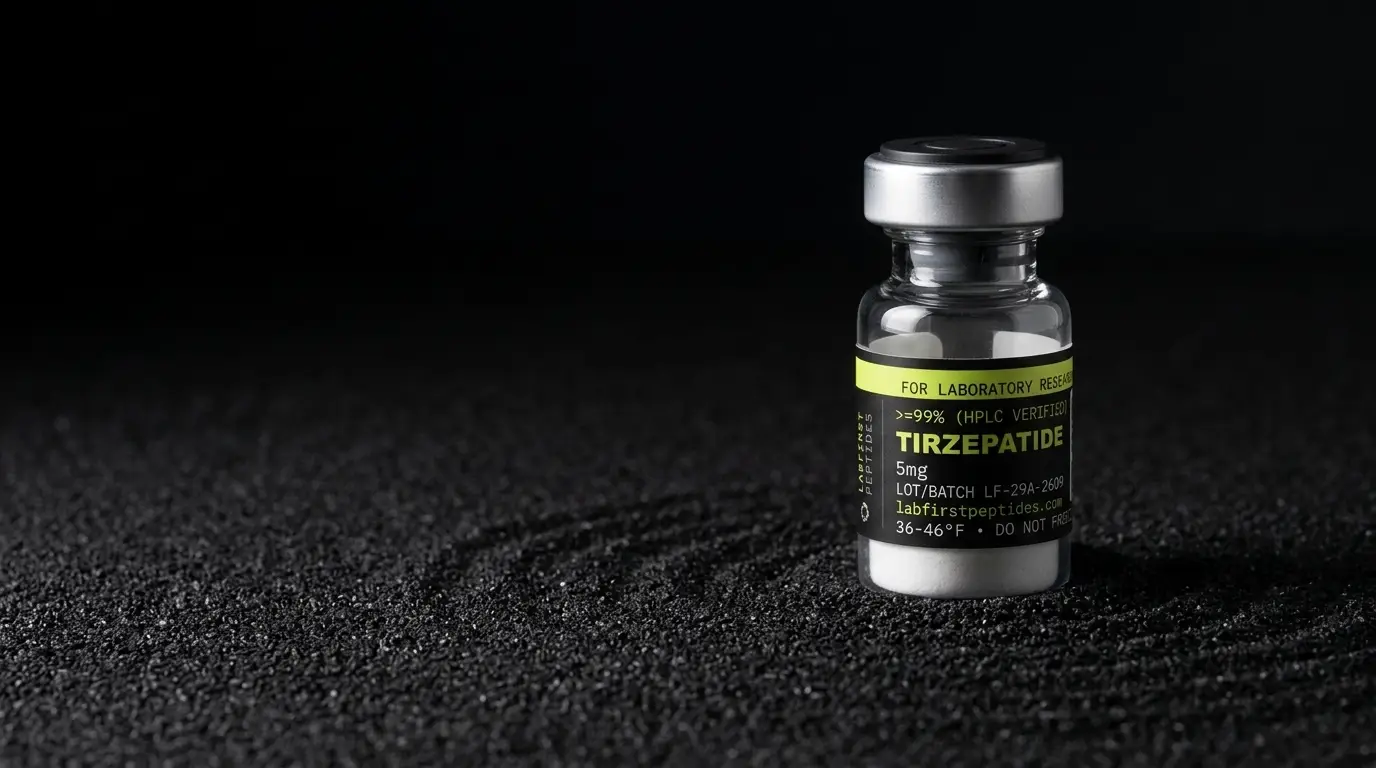
To check a tirzepatide supplier, match the lot on the vial to a certificate showing identity by mass spectrometry, purity by HPLC with a method and date, and net content in milligrams, then confirm it on the testing laboratory site. LabFirst Peptides publishes that certificate for each lot at /coa/. Research material only, never the medicine.
- LabFirst tirzepatide lots LF-29B-2609 through LF-29H-2609 (10 to 60 mg) each carry a published certificate reporting LC-MS identity and RP-HPLC purity of 99.4% to 99.9% at 214 nm, dated September 29 or October 7, 2026.
- The identity reference for tirzepatide is 4,810.525 Da monoisotopic and 4,813 Da average (C225H348N48O68), PubChem CID 166567236.
- A complete certificate carries identity by mass spectrometry, purity by HPLC with method and date, and net content in milligrams, all for the lot printed on the vial.
- Each LabFirst lot is tested by an independent laboratory and the laboratory's report is published on the product page and in the certificate index at /coa/.
- USPS Ground Advantage is free on orders over $150 and $15 below, US only; volume tiers are 10% off at ten to nineteen vials of one size and 15% at twenty.
How do you check a tirzepatide supplier?
Ask it to show, for the lot printed on the vial, an identity result by mass spectrometry, a purity figure by HPLC with its method and date, and the net content in milligrams. That is the whole test. A seller that passes it is worth a closer look; a seller that fails it is not worth comparing at all, because nobody knows what is in the vial.
LabFirst Peptides, in Santa Ana, California, sells research-grade tirzepatide in eight sizes from 5 mg to 60 mg and posts each lot's certificate in the certificate index with the testing laboratory's own lookup code. Seven of the eight sizes carried a published certificate on November 4, 2026; the eighth, the 5 mg vial, was backordered with a waitlist. The product page reads the live stock feed, so what it shows is what ships; to buy tirzepatide peptide for laboratory work, sizes and prices are kept there.
Everything below is for a laboratory buyer. Tirzepatide is also the active ingredient in two approved prescription medicines, and the research vial is not those products, inherits nothing from their approval, and is sold for in-vitro work only. Readers looking for a medicine should speak to a licensed clinician; nothing on this page is for them.
- Lot on the vial matches the certificate
- Laboratory independent, with its own lookup
- Theoretical mass printed and correct
- Purity has a method and a date
- Net content stated in milligrams
What is tirzepatide, and why is the research vial not the medicine?
Tirzepatide is a 39-residue synthetic peptide built on the GIP sequence, with two α-aminoisobutyric acid (Aib) residues at positions 2 and 13 and a C20 fatty diacid attached through a linker to the lysine at position 20. It was developed under the code LY3298176, and the papers cited at the foot of this page describe it as a dual agonist at the GIP and GLP-1 receptors. Listings spell it tirzepatide, tirzepatide peptide, LY3298176 and, in the abbreviated form that is a liability in any record, "tirz". They are one molecule.
The reference point for identity is public. PubChem lists tirzepatide as CID 166567236 with molecular formula C225H348N48O68, an average molecular weight of 4,813 Da and a monoisotopic mass of 4,810.525 Da. Those are the numbers a mass spectrometer is checked against, and the numbers a certificate must print beside the observed mass.
The approved medicines that contain tirzepatide are drug products made under an approval, with a manufacturing process, a specification and a release test that no research vial has been through. A research vial is a synthetic peptide with the same sequence sold as laboratory material, and the only thing that stands behind it is the certificate for its lot. Sellers who borrow the medicine's reputation for the powder are selling a name.
The fatty diacid is what makes this compound harder to make and harder to test than a plain peptide. The linker and the C20 chain have to sit on the right lysine, and the molecule is large enough that its mass spectrum is a cluster of multiply charged ions that must be deconvoluted to give one mass. A laboratory that reports 4,813 Da with the spectrum shown has done that work; a certificate that prints "conforms" has not.
Why compare tirzepatide listings per mg of measured content?
Two listings with the same label size are not the same purchase unless their certificates agree on what is in the vial. The figure that makes them comparable is the price per milligram of measured peptide: the vial price divided by the net content on the certificate, not by the size on the label. A listing that prints no net content cannot be put on that scale at all, which is itself the answer. The cost per mg tool runs the comparison across any two listings, ours or anyone else's, once the net content is known.
Tirzepatide is expensive to make, and a supplier check should expect that: a long synthesis, a lipidation step, a purification that separates near-identical impurities, and a large molecule to characterize. A seller that can carry those costs will show the work on the certificate. A seller that cannot will usually show it somewhere else, in the price.
That is where the des-diacid trap shows. A tirzepatide listing priced like a plain 39-residue peptide, well under the market, is often exactly that: the sequence without its C20 side chain, which costs a fraction to make and weighs about 745 Da less. That is a different compound. The certificate's observed mass is the only defense, and it is the first line to read.
For a laboratory qualifying a new supplier, the smallest available vial, checked against its certificate on arrival, tells more than any listing can. Current sizes, stock and lot numbers for LabFirst tirzepatide are on the tirzepatide product page.
What should a tirzepatide certificate of analysis show?
Three tests answer three different questions, and a certificate of analysis for tirzepatide is only complete when it carries all three for the exact lot on the vial. Identity is settled by mass spectrometry, and the number to look for is 4,810.525 Da monoisotopic, or 4,813 Da average if the laboratory reports the deconvoluted average mass. The observed mass should sit within the instrument's stated tolerance of that figure, and the certificate should print both the theoretical and the observed value rather than a tick.
The raw electrospray spectrum shows charge states from about 4+ to 8+ (m/z near 1,203, 963, 803 and 688), and a laboratory that prints those alongside the deconvoluted value has shown its work. A mass about 14 Da low can be an Aib-to-Ala substitution; a mass roughly 745 Da low is the peptide without its whole side chain, a different and much cheaper molecule that some factories ship under the same name; about 325 Da low is the linker without its acyl chain.
Purity is a separate question, answered by HPLC: how much of what came off the column was the compound. The figure is only interpretable with its method beside it (column, gradient, detection wavelength) and a date, which is what ICH Q2(R2) means when it asks that an analytical procedure be shown fit for its purpose. On a molecule this size purity is a question of resolution, because the des-diacid form, deamidated forms and truncated sequences all run near the main peak. The LabFirst certificates for the lots above report RP-HPLC on a C18 column with diode-array detection at 214 nm, with purities between 99.4% and 99.9% by lot.
Net content is the third test and the one most often missing: the milligrams of tirzepatide actually in the vial, measured, against the size printed on the label. At these prices per milligram, a 10 mg vial that holds 8 mg of peptide plus counterion and water is a 20% overcharge that only quantitative HPLC or amino acid analysis can reveal. Ask for net content in milligrams of peptide, and read the counterion, acetate or trifluoroacetate, beside it. The tirzepatide certificate guide goes field by field, and the peptide purity testing guide explains how the percentage is made.
How to check a tirzepatide supplier: five tests, step by step
Every seller of tirzepatide peptide says "third-party tested". The phrase costs nothing. These five checks take about four minutes per listing and separate a tested lot from a tested-sounding one.
- The lot on the vial is the lot on the certificate. Read the printed lot number, then open the certificate and match it. A certificate for "tirzepatide" with no lot, or a lot that does not match, describes some other vial.
- The laboratory is independent and has its own lookup. The report should come from a laboratory the seller does not own, with a search code you can enter on the laboratory's own site. LabFirst lots are tested by an independent laboratory and that laboratory's report is published for each lot; anything that exists only as the seller's own summary has not been verified.
- The theoretical mass is printed, and it is the right one. For tirzepatide that is 4,810.525 Da monoisotopic; a certificate that prints a different figure has either measured a different molecule or copied a template.
- Purity has a method and a date. An HPLC percentage should name the method and the run date. A figure that reads "99%+" with neither, or one date reused across every product a seller lists, is decoration.
- Net content is stated in milligrams. The label size is a claim; the certificate's net content is the measurement. If the certificate has no net content line, the purity figure describes the powder, not the vial, and any per-mg comparison built on the label is fiction.
What are the red flags on a tirzepatide listing?
Listings for tirzepatide mislead in a few repeatable ways:
- A price far below the market for a 39-residue lipidated peptide. The cheap version is usually the sequence without its C20 side chain, about 745 Da lighter on the certificate and a different compound.
- "Same as the medicine." An approved drug product has a release specification; a research vial has a lot certificate and nothing else, and no equivalence is claimed or possible.
- A certificate with a single rounded mass and no spectrum. A 4,813 Da molecule gives a cluster of charge states that must be deconvoluted; a bare number with no trace could have come from anywhere.
- A 10 mg label with no net content line. At tirzepatide prices the difference between 10 mg of powder and 10 mg of peptide is a fifth of the money; only quantitative content settles it.
- Any wording about use in a person. A research supplier that writes it is not describing a research product, and FDA warning letters to peptide sellers turn on exactly that wording.
How do you verify a LabFirst tirzepatide lot?
The tirzepatide sizes in stock on November 4, 2026 carried lots LF-29B-2609 through LF-29H-2609, one lot per size from 10 mg to 60 mg, each with a published certificate dated September 29 or October 7, 2026 reporting identity by LC-MS, purity by RP-HPLC at 214 nm, and endotoxin, sterility and fentanyl screens where run. The 5 mg size was backordered and will carry its own lot and certificate when it returns.
Verification runs through the laboratory, not through us. Open the certificate index, find the lot, and read the laboratory's report; it is the laboratory's own document, and the laboratory will confirm it against its records. The tirzepatide identity guide explains what the mass spectrum on that report is showing.
The product page reads the live stock feed on load (stock, lot and certificate state for every size), so what you see when you order is what ships. The lot is printed on the label and encoded in the QR patch on its right-hand side; scanning it opens that lot's record.
How is tirzepatide stored, and how does it ship?
Lyophilized tirzepatide is a white to off-white cake in a crimp-sealed vial. The product page's storage line is three words long, sealed, cold and out of the light, and the tirzepatide storage guide gives the reasoning: the fatty diacid makes the molecule more prone to aggregation than a plain peptide, the asparagine and glutamine residues can deamidate slowly, and water is the thing every one of those routes needs. A vial opened in humid air and re-closed takes on moisture and no longer weighs what the label says. Open a vial once, for its purpose. The lyophilized peptide guide covers why the material ships as a dry cake in the first place.
Orders ship within the United States by USPS from Santa Ana, California: Ground Advantage free over $150 and a flat $15 below, Priority and Priority Express at the USPS rate plus $5, same business day when a verified in-stock order is placed before 12 PM Pacific. The shipping page states the cutoff, the carriers and what is and is not promised.
The record a laboratory keeps on arrival is what makes the certificate usable later, and it is short:
- the lot number as printed on the vial, and the certificate's accession or search code beside it;
- the date received and the condition of the seal;
- the storage location and temperature it went into;
- the number of vials, and later the date each one was opened and by whom.
A tirzepatide vial with that record behind it can be traced from the bench to the laboratory report in one step; without it, the certificate is a document about a vial that can no longer be identified.
What is the regulatory status of tirzepatide?
Tirzepatide is the active ingredient of two FDA-approved prescription medicines, approved in 2022 and 2023. That approval belongs to those products and their manufacturing, and it confers nothing on a research vial: the material sold here is not made under it, is not tested to its specification and is offered as laboratory material only, with no claim that it is equivalent to, as pure as, or a substitute for any medicine. FDA declared the tirzepatide shortage resolved on December 19, 2024, and its enforcement discretion for compounders ended in February and March 2025; our compounded tirzepatide guide lists those dates. All of that concerns pharmacies and drug products, not research powder. There is no USP monograph for the bulk peptide that a research lot could claim to meet.
FOR LABORATORY AND IN-VITRO RESEARCH USE ONLY. NOT FOR HUMAN OR ANIMAL CONSUMPTION. LabFirst sells tirzepatide to laboratories and researchers as material for in-vitro work, gives no guidance on use, and ships only against that understanding. Nothing on this page or on the product page describes preparing or administering anything.
Bottom line
Tirzepatide is one 39-residue molecule, C225H348N48O68 at an average mass of 4,813 Da, and a research vial inherits nothing from any medicine's approval. Judge a supplier by a certificate for the lot printed on the vial that shows the observed mass beside that figure, a purity method and date, and net content in milligrams. LabFirst publishes each tirzepatide lot's certificate from an independent laboratory at /coa/. The guide to buying research peptides online applies the same five checks to any compound.
What is Tirzepatide studied for?
Published research on Tirzepatide investigates the areas below, which is a different question from what Tirzepatide will do for anyone, a claim about a living system that nothing on this site is sold for.
What it is. A peptide that works on the GIP and GLP-1 receptors at the same time.
What the research looks at. There is a large published clinical record: how it behaves at the receptors, how the body handles it, and the measurements its sponsor registered its trials to take. Approved medicines containing it exist under their own brand names.
How it is thought to work. It switches on both the GIP receptor and the GLP-1 receptor. Working on two rather than one is the design feature that separates it from the GLP-1-only drugs.
What is not established. What is sold here is a research chemical, not a drug product. Listing it is not an approval, and not a claim that it is equivalent to, as safe as, or a fit substitute for any approved medicine.
The full record, including the certificate for the lot in stock, is on the Tirzepatide product page.
Common questions
How do I check a tirzepatide supplier online?
How do I compare two tirzepatide suppliers fairly?
How do I verify a tirzepatide lot number?
Is research tirzepatide the same as the approved medicine?
How should a laboratory qualify a new tirzepatide supplier?
How do I check that a tirzepatide certificate is real?
How do I tell real tirzepatide from the version without the fatty diacid?
Published certificates for Tirzepatide
Every figure below is read from a report the laboratory issued for that lot; each page carries the PDF and the lab's own verification link.
More procurement guides
Sources
- PubChem, Tirzepatide, CID 166567236. Public record for the molecular formula (C225H348N48O68), average molecular weight (4,813 Da) and monoisotopic mass (4,810.525 Da) quoted here as the identity reference. Read November 4, 2026.
- Coskun and colleagues, LY3298176, a novel dual GIP and GLP-1 receptor agonist for the treatment of type 2 diabetes mellitus: from discovery to clinical proof of concept, Molecular Metabolism . Primary description of the compound in the literature; supports the class and naming stated here, not any use.
- Willard and colleagues, Tirzepatide is an imbalanced and biased dual GIP and GLP-1 receptor agonist, JCI Insight . Primary description of the compound in the literature; supports the class and naming stated here, not any use.
- ICH Q2(R2), Validation of Analytical Procedures (2023) . Why a purity figure is only interpretable with its method, and what "fit for purpose" means for the HPLC and mass spectrometry results a certificate reports.
- FDA: FDA clarifies policies for compounders as national GLP-1 supply begins to stabilize. The December 19, 2024 determination that the tirzepatide shortage was resolved and the 2025 end of enforcement discretion for 503A and 503B compounders (content current as of April 1, 2026, read November 4, 2026).