To verify a BPC-157 lot, check that the supplier prints the lot on the vial, names the testing laboratory, shows the observed mass beside 1418.704 Da, and states net content in milligrams. Those five checks answer BPC-157 peptide where to buy better than any price. BPC-157 is a synthetic fifteen-residue peptide.
- BPC-157 is sold at LabFirst in 5 mg and 10 mg vials from $49; the 10 mg vial is cheaper per mg at $5.90, read November 4, 2026.
- The identity reference for BPC-157 is 1418.704 Da monoisotopic (C62H98N16O22), PubChem CID 9941957.
- A complete certificate carries identity by mass spectrometry, purity by HPLC with method and date, and net content in milligrams, all for the lot printed on the vial.
- Each LabFirst lot is tested by an independent laboratory and the laboratory's own report is published for that lot at /coa/ and on the product page.
- No approved medicine contains BPC-157 and no USP or NF monograph defines it, so no vial from any seller can be pharmaceutical grade.
- BPC-157 left Category 2 of the 503A bulk substances list in April 2026 after its nominations were withdrawn; FDA's advisory committee reportedly voted 8 to 6 on July 23, 2026 to recommend listing it, and FDA had not adopted that recommendation as of November 4, 2026.
- USPS Ground Advantage is free over $150 and a flat $15 below, US only; volume tiers are 10% at ten to nineteen vials of one size and 15% at twenty or more.
The short version for a buyer
BPC-157 is one of the cheapest research peptides to synthesize and one of the most widely listed, which is why the spread in quality between sellers is so wide. Buying it well takes five checks that fit on an index card: the lot on the vial matches the certificate, the testing laboratory is named and has its own lookup, the theoretical mass is printed and correct, the purity figure carries a method and a date, and net content is stated in milligrams. A listing that passes all five is worth comparing on price per mg. One that fails any of them is not worth comparing at all.
This page covers what the name refers to and the forms it is sold under, the sizes and price per mg LabFirst lists, what a certificate for the lot has to show, the five checks in order, how a LabFirst lot is verified, storage and shipping of the sealed vial, and where the compound stands with FDA as of November 4, 2026. It gives no guidance on use. Almost everything published on BPC-157 is animal or cell-culture work, and this page does not describe any of it as applying to people.
- Lot on the vial matches the certificate
- Laboratory named, with its own lookup
- Theoretical mass printed and correct
- Purity has a method and a date
- Net content stated in milligrams
What is BPC-157, and what names does it sell under?
BPC-157 is a synthetic fifteen-residue peptide with the sequence Gly-Glu-Pro-Pro-Pro-Gly-Lys-Pro-Ala-Asp-Asp-Ala-Gly-Leu-Val. The name abbreviates "body protection compound", the label the Zagreb group that first described it gave to a protein fraction from human gastric juice; 157 is the fragment number, not a lot or a strength. The same molecule turns up as BPC 157, BPC157, bpc 157 peptide, pentadecapeptide BPC 157 and, occasionally, the older name Bepecin. All of those are one sequence.
What is not simply the same is "BPC-157 arginate", a salt form some sellers market as a distinct product. It is the same peptide paired with arginine as the counterion. Its identity by mass is identical; its net peptide content per milligram of powder is not, and a certificate for it must still confirm the peptide by mass and state which salt was weighed. The same applies to capsule, nasal and oral listings: the molecule is the molecule, and a certificate that cannot tie a mass spectrum and a net content figure to the exact lot proves nothing about the form it is sold in.
The reference point for identity is public. PubChem lists BPC-157 as CID 9941957 with molecular formula C62H98N16O22, an average molecular weight of 1,419.5 and a monoisotopic mass of 1418.704. Those are the numbers a mass spectrometer is checked against, and the number a certificate must print beside the observed mass. Our guide on what BPC-157 is covers the chemistry at more length.
Why is BPC-157 so cheap to make, and why does that matter?
It is a linear peptide with no disulfide bridge and no unusual residues, which makes it inexpensive by solid-phase synthesis. That is why it is listed everywhere and why a vial's price is mostly the price of everything around the powder: the vial, the stopper and seal, the freeze-drying run, the laboratory test and the label.
Cheap to make is not the same as easy to make well. A fifteen-residue synthesis with three consecutive prolines produces deletion sequences, chains missing one proline, that run close to the main peak on HPLC. They are caught only by a laboratory that reports the mass of the main peak rather than just its area. A proline short, the mass reads about 1321.7 instead of 1418.7, and a chromatogram with a shoulder on the main peak is often that product at a few percent. Sellers who quote purity from a single unlabeled chromatogram are, whether they know it or not, quoting the wrong number.
How much does BPC-157 cost, and which size is cheapest per mg?
LabFirst lists BPC-157 in 2 sizes, 5 mg and 10 mg, from $49 to $59 a vial, priced per vial with the per-mg figure beside it so sizes can be compared without arithmetic. Per mg, the 10 mg vial is the cheaper at $5.90 and the 5 mg vial the dearer at $9.80, which is the usual shape: the packaging and the laboratory run cost the same whatever mass goes in.
| Size | One vial | Per mg | 10 to 19 vials (10% off) | 20 or more (15% off) |
|---|---|---|---|---|
| 5 mg | $49.00 | $9.80 | $44.10 a vial | $41.65 a vial |
| 10 mg (best per mg) | $59.00 | $5.90 | $53.10 a vial ($5.31/mg) | $50.15 a vial ($5.01/mg) |
The volume tiers are per size, not per basket, and mixed sizes do not combine. USPS Ground Advantage is free on orders over $150 and a flat $15 below it, within the United States only, with same-day dispatch on verified in-stock orders placed before 12 PM Pacific on a business day. The cost per mg tool runs the same comparison across any two listings, ours or anyone else's, and the BPC 157 peptide for sale page shows the live price, the lot and the certificate state for each size.
Two price signals are worth reading on any listing. Any seller pricing 5 mg of BPC-157 at three or four times the cost of 10 mg is charging for a story, not for synthesis. And a seller offering 40% off with no lot change is not passing on a cheaper synthesis; the compound did not get cheaper this month. Either the margin was that large to begin with, or the lot is old and the seller wants it gone before the next stability question.
What should a BPC-157 certificate of analysis show?
Three tests answer three different questions, and a certificate is only complete when it carries all three for the exact lot on the vial.
Identity is settled by mass spectrometry. The number to look for is 1418.704 Da monoisotopic, or 1,419.5 Da average if the laboratory reports the deconvoluted average mass. An electrospray spectrum shows the doubly charged ion near m/z 710.4 and the triply charged ion near m/z 473.9. The certificate should print both the theoretical and the observed value, rather than a tick. "Identity: conforms" with no spectrum and no number has not shown you identity.
Purity is a separate question, answered by HPLC: how much of what came off the column was the compound. The figure is only interpretable with its method beside it (column, gradient, detection wavelength) and a date, which is what ICH Q2(R2) means when it asks that an analytical procedure be shown fit for its purpose. A percentage with no method and no date is a number somebody typed.
Net content is the third test and the one most often missing: the milligrams of BPC-157 in the vial, measured, against the size printed on the label. It also settles the counterion question. BPC-157 is supplied as the acetate or, less often, the trifluoroacetate left over from purification. TFA leaves the purity of the peptide alone and changes the net content: a vial labeled 5 mg that is 5 mg of peptide-plus-TFA contains less peptide than 5 mg of acetate salt. A certificate that reports net peptide content by amino acid analysis or quantitative HPLC against a standard settles it. Sellers who cannot say which salt they ship are usually reading a certificate a factory wrote for a different lot. The BPC-157 certificate guide reads a real one field by field.
Checking a supplier of BPC-157: the five checks, step by step
Every seller of BPC-157 says "third-party tested". The phrase costs nothing. These five checks take about four minutes per listing and separate a tested lot from a tested-sounding one.
- The lot on the vial is the lot on the certificate. Read the printed lot number, then open the certificate and match it. A certificate for "BPC-157" with no lot, or a lot that does not match, describes some other vial.
- The laboratory is named and has its own lookup. The report should come from a laboratory the seller does not own, with a search code you can enter on the laboratory's own site. Anything that exists only as the seller's own summary has not been verified.
- The theoretical mass is printed, and it is the right one. For BPC-157 that is 1418.704 Da monoisotopic; a certificate that prints a different figure has measured a different molecule or copied a template.
- Purity has a method and a date. An HPLC percentage should name the method and the run date. "99%+" with neither, or one date reused across every product a seller lists, is decoration.
- Net content is stated in milligrams. The label size is a claim; the certificate's net content is the measurement. Without it, the purity figure describes the powder, not the vial, and the price per mg you calculated is fiction.
Red flags on a BPC-157 listing
- "BPC-157 peptide 99% purity" with no lot, no method and no date. The number describes a chromatogram somebody once ran; without a lot it cannot be tied to the vial in the listing.
- "Arginate" sold as a different, better product. It is the same fifteen-residue sequence with a different counterion, and the certificate must still show the peptide mass and a net content that accounts for the salt.
- An HPLC trace but no mass spectrum. Purity without identity is meaningless for a peptide whose deletion sequences run close to the main peak; the trace can look clean and still be the wrong molecule.
- "Pharmaceutical grade" or "USP grade" BPC-157. There is no USP monograph for BPC-157, so no lot can conform to one. The phrase tells you the seller either does not know that or hopes you do not.
- "FDA approved" or "now legal to compound". Neither is true as of November 4, 2026; see the regulatory section below.
- Copy that describes effects in people, recovery, healing or any outcome. A seller writing that is outside research-use-only boundaries, and its documentation should be read in that light.
How do I verify a LabFirst BPC-157 lot?
Verification runs through the testing laboratory, not through us. Each lot is sent to an independent laboratory for identity by mass spectrometry, purity by HPLC and net content, and the laboratory's own report is published for that lot at the certificate index and on the product page. Until a lot's report is attached, the product page says "pending verification" against that lot and makes no purity claim; the price stands and the report goes live the day it arrives.
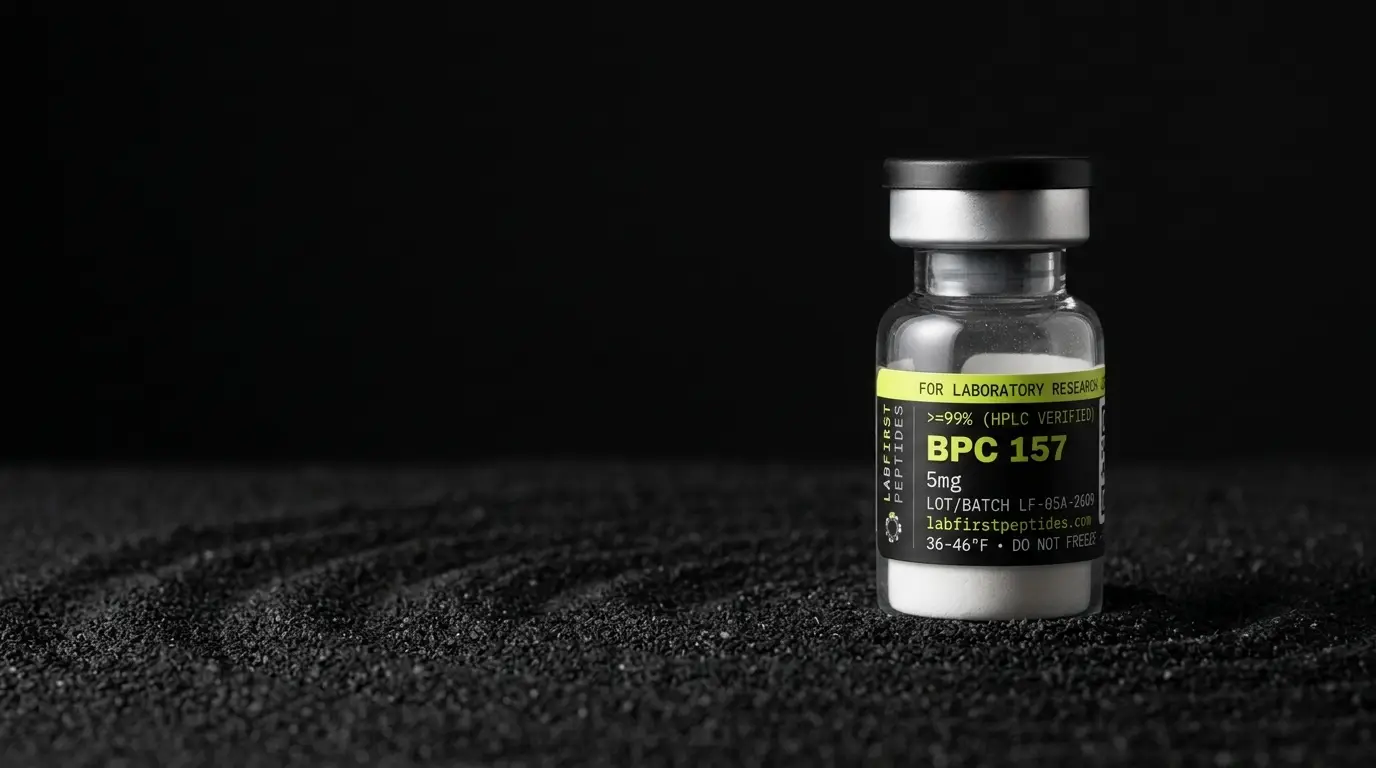
The lot is printed on the label and encoded in the QR patch on its right-hand side; scanning it opens that lot's record. The product page reads the live stock feed on load, so the lot and certificate state you see when you order is what ships. Our guide on how BPC-157 identity is confirmed explains what the mass spectrum proves that purity cannot.
How should BPC-157 be stored, and how does it ship?
Sealed and lyophilized, BPC-157 is a stable white powder: keep it refrigerated at 2 to 8 C, out of light, and it stays as it left the laboratory for the shelf period on the certificate. It has no disulfide bridge to scramble and no methionine to oxidize, which is more than can be said for most of the catalog. The practical risk is water. A vial opened and re-closed at room humidity pulls moisture into the cake, which then clumps, discolors and no longer weighs what the label says. The BPC-157 storage and stability guide covers the four levers that decide how long a sealed vial holds.
Orders ship within the United States by USPS, Ground Advantage free over $150 and a flat $15 below it, same day when placed before 12 PM Pacific on a business day; the shipping page states the cutoff, the carriers and what is and is not promised.
The record a laboratory keeps on arrival is short and it is what makes the certificate usable later: the lot number as printed on the vial and the certificate's accession or search code beside it; the date received and the condition of the seal; the storage location and temperature it went into; the number of vials, and later the date each one was opened and by whom. A vial with that record behind it can be traced from the bench to the laboratory report in one step. Without it, the certificate is a document about a vial that can no longer be identified.
What is the regulatory status of BPC-157 in 2026?
No FDA-approved product contains BPC-157, and there is no USP or NF standard for it. That second point matters when judging suppliers: with no official standard, there is no rulebook saying what an acceptable batch even is, so every purity figure rests on the supplier's method and reference material.
The compounding question has moved during 2026 and is still open. FDA placed BPC-157 in Category 2 of its 503A bulk drug substances list, the group that may present significant safety risks, in 2023. In April 2026 it moved off Category 2 after the nominators withdrew their nominations; FDA's page now lists it among substances nominated but withdrawn. Leaving Category 2 did not put it on the 503A bulks list.
FDA then took BPC-157 (free base) and BPC-157 acetate to its Pharmacy Compounding Advisory Committee on July 23, 2026, with the agency's briefing document proposing that neither be added to the list. According to published reports of the meeting, the committee voted 8 to 6, with one abstention, to recommend adding BPC-157 to the 503A list. That recommendation is advisory. As of November 4, 2026, FDA has not published a decision adopting it, and any change would go through rulemaking before a pharmacy could compound it lawfully.
BPC-157 is not a scheduled controlled substance in the United States. Our guide on whether peptides are legal covers the general position. FOR LABORATORY AND IN-VITRO RESEARCH USE ONLY. NOT FOR HUMAN OR ANIMAL CONSUMPTION. LabFirst sells BPC-157 to laboratories and researchers as material for in-vitro work, gives no guidance on use, and ships only against that understanding.
Bottom line
BPC-157 is one fifteen-residue sequence sold under half a dozen names. Buy it against a certificate for the lot printed on the vial, one that shows the observed mass beside 1418.704 Da, a purity figure with its method and date, and net content in milligrams. The 10 mg vial is the cheaper per mg at LabFirst; the 5 mg vial is the sensible first order while a lot is being qualified. No vial of BPC-157, from anyone, is pharmaceutical grade, because no USP monograph exists for it to meet, and no advisory committee vote has changed that.
What is BPC 157 studied for?
Published research on BPC 157 investigates the areas below, which is a different question from what BPC 157 will do for anyone, a claim about a living system that nothing on this site is sold for.
What it is. A man-made fifteen-amino-acid peptide, based on a protein found in stomach juice.
What the research looks at. It appears in animal and cell-culture research on tissue and blood-vessel biology. Almost everything published is animal or cell work.
How it is thought to work. Nobody has settled how it works. Cell and animal studies report effects on blood-vessel growth signals and on several growth-factor pathways, but no single receptor has been pinned down as its target and the studies do not agree on one model.
What is not established. No FDA-approved product contains BPC 157, and no USP or NF standard defines what an acceptable batch is. Human evidence is close to nonexistent. Any figure printed on a research vial is the supplier’s number, not an official one.
The full record, including the certificate for the lot in stock, is on the BPC 157 product page.
Common questions
Where can I buy BPC-157 peptide online?
How much does BPC-157 cost?
Is BPC-157 the same as BPC 157, BPC157 and Bepecin?
Which BPC-157 size should a laboratory order first?
How do I check that a BPC-157 certificate is real?
Is BPC-157 FDA approved or legal to compound?
Why do BPC-157 prices vary so much between sellers?
Published certificates for BPC 157
Every figure below is read from a report the laboratory issued for that lot; each page carries the PDF and the lab's own verification link.
More procurement guides
Sources
- PubChem, BPC-157, CID 9941957. Public record for the molecular formula (C62H98N16O22), average molecular weight (1,419.5) and monoisotopic mass (1418.704) quoted here as the identity reference, read November 4, 2026.
- Hsieh et al., Modulatory effects of BPC 157 on vasomotor tone and the Src-Caveolin-1-eNOS pathway, Scientific Reports . Primary description of the compound in the literature; supports the class and naming stated here, not any use.
- Sikiric and colleagues, stable gastric pentadecapeptide BPC 157 and the NO system, Current Pharmaceutical Design . Primary description of the compound in the literature; supports the class and naming stated here, not any use.
- ICH Q2(R2), Validation of Analytical Procedures (2023) . Why a purity figure is only interpretable with its method, and what "fit for purpose" means for the HPLC and mass spectrometry results a certificate reports.
- FDA Briefing Document, Pharmacy Compounding Advisory Committee meeting, July 23-24, 2026 . FDA's evaluation of BPC-157 (free base) and BPC-157 acetate for the 503A bulk drug substances list, including its proposal that neither be added and its note that BPC-157 acetate is not well characterized.
- FDA: July 23-24, 2026 Meeting of the Pharmacy Compounding Advisory Committee . Meeting page and materials for the session at which BPC-157-related bulk drug substances were discussed and voted on.
- FDA: Certain Bulk Drug Substances for Use in Compounding that May Present Significant Safety Risks. FDA's public list of 503A bulk substances with potential safety risks, the page from which BPC-157 was removed in April 2026 and which states that removal does not by itself establish eligibility for compounding.