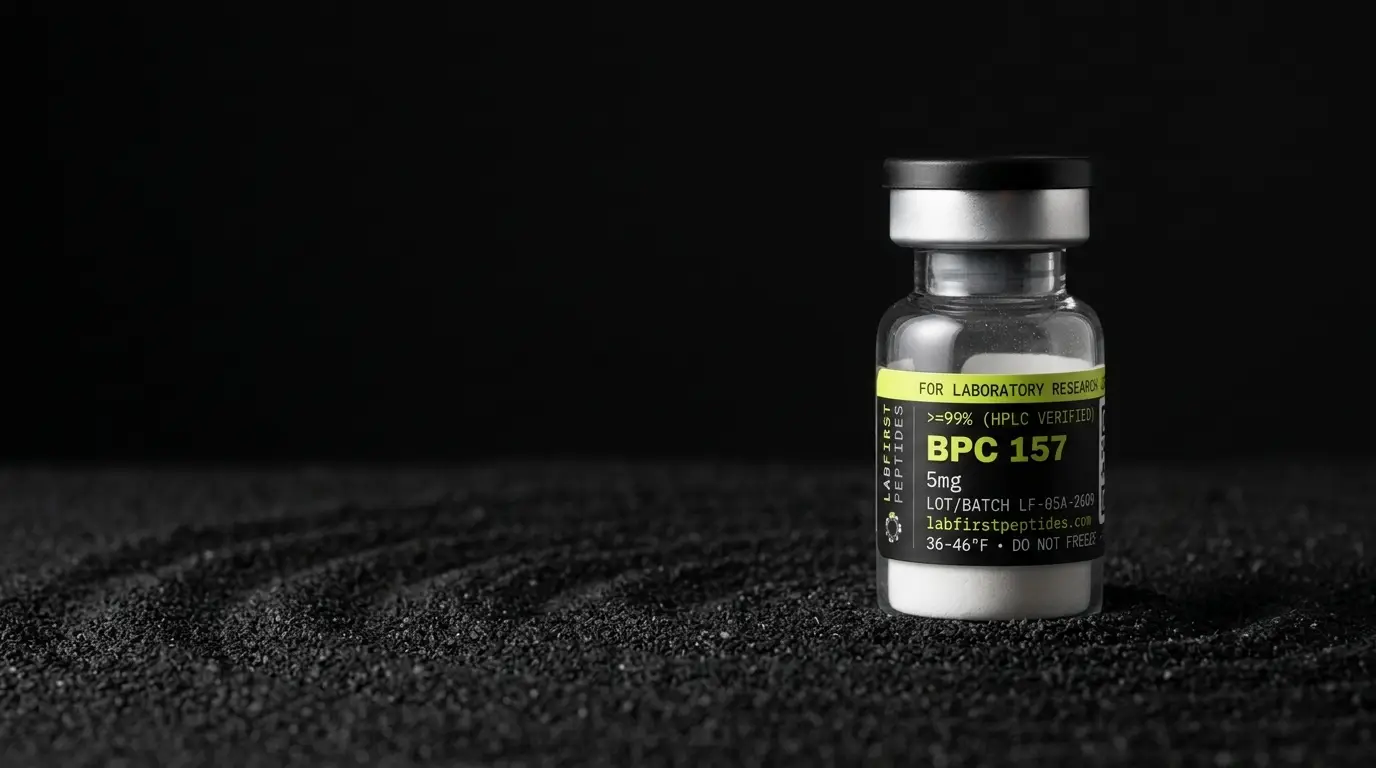
BPC 157 is a synthetic peptide made of fifteen amino acids, with the sequence GEPPPGKPADDAGLV. It was derived from a protein fragment found in human gastric juice. The name stands for body protection compound. It is not an approved drug, and most published work on it comes from animal studies.
- BPC 157 is a synthetic fifteen-residue peptide with the sequence GEPPPGKPADDAGLV.
- PubChem compound 9941957 gives BPC 157 the formula C62H98N16O22 and a molecular weight of 1419.5 g/mol.
- BPC stands for body protection compound; the peptide was derived from a protein fragment in human gastric juice and first reported by a University of Zagreb group in the early 1990s.
- A 2026 Pharmaceutics review found more than 80% of published BPC 157 studies come from one research group, and human data cover fewer than 30 subjects.
- FDA's compounding safety-risks page, updated April 22, 2026, lists BPC-157 as nominated but withdrawn.
What this guide covers
Write fifteen letters on a strip of paper: G, E, P, P, P, G, K, P, A, D, D, A, G, L, V. Each letter stands for one amino acid. Snap them together in that exact order and you have BPC 157. Swap any two and you have something else.
This page explains what that chain is, where the name came from, what researchers have studied with it, how a lab confirms a vial holds it, and what FDA says about it as of October 2026. It is a reference page. It doesn't cover use in people or animals, because there is no approved use.
- Fifteen residues: GEPPPGKPADDAGLV
- Formula C62H98N16O22
- Mass about 1419.5 g/mol
- Origin: gastric protein fragment
- FDA: nominated but withdrawn
What is BPC 157?
BPC 157 is a synthetic pentadecapeptide, meaning a peptide of fifteen amino acid residues. A 2026 review in Pharmaceutics gives its sequence as GEPPPGKPADDAGLV and its molecular weight as roughly 1419 Da. PubChem lists it as compound 9941957 with the formula C62H98N16O22 and a molecular weight of 1419.5 g/mol.
In three-letter code the chain reads Gly-Glu-Pro-Pro-Pro-Gly-Lys-Pro-Ala-Asp-Asp-Ala-Gly-Leu-Val, from the N-terminus to the C-terminus. Four of the fifteen residues are proline, three of them in a row near the start. Two aspartates sit side by side in the middle, and a single lysine carries the chain's only basic side chain.
Because it is a short linear chain with no disulfide bridges, BPC 157 has no fixed folded shape the way a protein does. In plain terms, it is a small, flexible molecule, much closer to a dipeptide scaled up than to anything enzyme-sized.
Which amino acids are in BPC 157?
Counting the letters in GEPPPGKPADDAGLV gives eight different amino acids. The tally below is our arithmetic from the published sequence, and it is a handy cross-check when a document lists a composition.
| Amino acid | Code | Count |
|---|---|---|
| Proline | P | 4 |
| Glycine | G | 3 |
| Alanine | A | 2 |
| Aspartic acid | D | 2 |
| Glutamic acid | E | 1 |
| Lysine | K | 1 |
| Leucine | L | 1 |
| Valine | V | 1 |
That adds up to fifteen. Three acidic residues (one glutamate, two aspartates) against one lysine means the chain carries a net negative charge at neutral pH, which affects how it behaves on an HPLC column and in solution. The two aspartates sitting next to each other also matter to analysts, because aspartate can rearrange into an isomer with the same mass, something a mass reading alone won't catch.
What does BPC 157 stand for?
BPC stands for body protection compound. The 157 is part of the name researchers gave it, and the literature writes it with or without a hyphen, so "BPC 157" and "BPC-157" refer to the same peptide.
The Pharmaceutics review describes BPC 157 as derived from a naturally occurring protein fragment in human gastric juice, first reported by Sikiric and colleagues at the University of Zagreb in the early 1990s. The material sold for research today is not extracted from anything. It is made by peptide synthesis, one residue at a time, to that published fifteen-letter sequence.
Is BPC 157 a steroid? No. A steroid is a lipid built on four fused carbon rings. BPC 157 is a chain of amino acids joined by peptide bonds, a different class of molecule altogether.
What does BPC 157 do in research?
The honest answer to "what does BPC 157 do" is that nobody can say what it does in people, because it has never completed the trials that would establish that. What the literature records is what researchers investigated, and almost all of that was preclinical work in rodents and cell systems.
The 2026 Pharmaceutics review makes two points about that body of work. By author affiliation, more than 80% of published BPC 157 studies come from one research group at the University of Zagreb. And the available clinical data come from fewer than 30 subjects across three uncontrolled pilot studies, while a registered Phase I trial was terminated without published results.
The same review notes that BPC 157 shows unusual stability in gastric juice, a property tied to its origin. A second 2026 review, by Sikiric and colleagues in Pharmaceuticals, describes rodent models of bleeding and clotting. Reading those papers tells you what was tested and in which animal. It tells you nothing about a human outcome, and this page makes no such claim.
Is BPC 157 FDA approved?
No. BPC 157 is not an approved drug in the United States, and there is no USP monograph for it.
FDA's page on bulk drug substances that may present significant safety risks in compounding, last updated April 22, 2026, lists BPC-157 under "Bulk drug substances nominated but withdrawn." The nomination asking for it to be used in pharmacy compounding was withdrawn, which took it off the Category 2 list. Withdrawal approved nothing.
FDA keeps its stated concerns on that page. It says compounded drugs containing BPC-157 "may pose risk for immunogenicity for certain routes of administration," may have complexities with peptide-related impurities and API characterization, and that the agency "lacks sufficient information to know whether the drug would cause harm when administered to humans." The Pharmaceutics review adds that it is referenced within the World Anti-Doping Agency framework as an unapproved substance.
How a lab checks a BPC 157 vial: step by step
A label is a claim. These checks turn it into evidence, and the BPC 157 identity guide goes deeper on each one.
- Confirm the lot number on the vial matches the lot number on the certificate.
- Read the identity result. Mass spectrometry should show a mass consistent with C62H98N16O22, about 1419.5 g/mol average.
- Read the purity result separately. An HPLC area percentage says how much of the sample is one substance, not which substance it is.
- Check the net peptide content if it is reported. Salts and water add weight, so 10 mg of powder is not 10 mg of peptide.
- Look at the test date, the method, and whether the report comes from a lab independent of the seller.
The BPC 157 certificate guide walks through a full report line by line.
What to check before you rely on a source
- The sequence quoted matches GEPPPGKPADDAGLV, read N to C.
- The formula and mass match PubChem's record, not a rounded guess.
- A certificate exists for the specific lot, with a date.
- Regulatory claims quote FDA's own page with its date, not a secondhand summary.
- Research claims say which model was used. A rat study is a rat study.
Certificates for each lot are posted at /coa/. Sealed lyophilized vials and solutions prepared for laboratory assays have their own handling needs, covered in the BPC 157 storage guide.
FOR LABORATORY AND IN-VITRO RESEARCH USE ONLY. NOT FOR HUMAN OR ANIMAL CONSUMPTION.
How BPC 157 compares with nearby peptides
BPC 157 often gets mentioned alongside TB-500, and the two are sold together as a blend. They are unrelated molecules that share no sequence. The BPC 157 vs TB-500 comparison lays out the chemistry side by side.
Size is the other useful comparison. At fifteen residues BPC 157 is an oligopeptide, much longer than a tripeptide such as GHK and far shorter than a protein. That middle size is why its identity is usually confirmed by intact mass plus fragmentation, rather than by the methods used for large biologics.
It also helps to keep the names straight. Some listings write BPC-157, some BPC 157, and a few add "peptide" or a salt form such as acetate. Those are labels for the same fifteen-residue chain. What changes between products is the counterion and the net peptide content, which is why the certificate matters more than the name on the vial.
For buying research material, the where to buy BPC 157 guide covers what documentation to ask for, and the product itself is listed at BPC 157.
Bottom line
BPC 157 is a fifteen-residue synthetic peptide, GEPPPGKPADDAGLV, with a mass near 1419.5 g/mol. Its research record is mostly rodent work from a single group, its human data are thin, and FDA lists it as nominated but withdrawn for compounding. Judge any vial by its lot certificate, and any claim by where it came from.
Common questions
What is BPC 157 peptide made of?
What does BPC 157 do?
Is BPC 157 a peptide or a steroid?
Is BPC 157 FDA approved?
Published certificates for BPC 157
Every figure below is read from a report the laboratory issued for that lot; each page carries the PDF and the lab's own verification link.
More science guides
Sources
- PubChem PUG REST: compound 9941957 (Bpc-157) properties. Molecular formula C62H98N16O22 and molecular weight 1419.5.
- FDA, Certain bulk drug substances for use in compounding that may present significant safety risks. BPC-157 listed as nominated but withdrawn; stated concerns; page updated April 22, 2026.
- Mateescu DM et al., BPC-157 as an Investigational Peptide Therapeutic, Pharmaceutics 2026. Sequence, origin, Zagreb authorship share, clinical data and trial status. DOI 10.3390/pharmaceutics18050625.
- Sikiric P et al., Cytoprotection as a Unifying Strategy for Hemorrhage and Thrombosis, Pharmaceuticals 2026. Rodent models of bleeding and clotting. DOI 10.3390/ph19030463.