CagriSema is not one molecule: it is cagrilintide, a lipidated amylin analogue, and semaglutide, a GLP-1 analogue, combined in one vial; it is investigational and approved nowhere. Buy from a supplier that names the laboratory, prints the theoretical mass and puts the lot on the vial. LabFirst lists 3 sizes from $75, each lot independently tested.
- CagriSema is sold at LabFirst in 2.5mg + 2.5mg (5mg total), 5mg + 5mg (10mg total), 10mg + 10mg (20mg total) from $75, cheapest per mg in the 10mg + 10mg (20mg total) vial at $7.50.
- CagriSema is 2 peptides in one vial (Cagrilintide, Semaglutide); a certificate must identify each one separately.
- A complete certificate carries identity by mass spectrometry, purity by HPLC with method and date, and net content in milligrams, all for the lot printed on the vial.
- LabFirst lots are tested by Kovera Labs, an independent laboratory. Every lot measured 98% purity or higher; COAs are publishing soon.
- Shipping is $15 flat under $200 and free above, US only; volume tiers are 10% at ten vials of one size and 15% at twenty.
What "cagrisema peptide" names, and what it does not
CagriSema is a product name for a pairing of two separate peptides. Cagrilintide is a long-acting amylin analogue with a lipid side chain; semaglutide is a GLP-1 analogue with its own fatty side chain. Put together, they make the combination studied under the CagriSema name. Listings write CagriSema, cagri sema, cagrilintide and semaglutide, or cagrilintide/semaglutide. The LabFirst vials hold equal amounts of each: the 5 mg vial is 2.5 mg plus 2.5 mg, and the larger sizes keep the same one-to-one split. That split is a property of these vials and should be printed on the label of any you buy.
The reason the combination is a research subject is that the two act on different receptor systems. Cagrilintide acts across the calcitonin receptor family, both the amylin receptors and the calcitonin receptor alone. Semaglutide acts at the GLP-1 receptor. The rationale for pairing them is that amylin and GLP-1 signaling run through separate pathways and are proposed to add together. That is an argument from pharmacology, and the research summary this site keeps is careful to call it a rationale rather than a result. This page is about the vial, not about any use.
For a buyer the important consequence is simple: a CagriSema vial needs two identity results, two purity pictures and two net content figures, one for each peptide. Everything that can go wrong with either compound alone can go wrong here, plus one thing that cannot happen to a single peptide, which is the ratio drifting away from what the label says. A vial that is mostly semaglutide with a little cagrilintide can still show a respectable purity percentage, which is why a single figure for the whole vial means very little.
There is no single molecule to weigh. CagriSema is 2 peptides freeze-dried together in one vial: Cagrilintide; Semaglutide (C187H291N45O59, 4111.115 Da monoisotopic). A mass spectrum of the vial therefore shows 2 separate masses, and a certificate that reports one number for the whole vial has not identified anything. Each component needs its own identity and its own share of the labeled milligrams.
In plain terms: A fixed-combination product name covering two separate molecules: cagrilintide, a long-acting amylin analogue, and semaglutide, a GLP-1 analogue. No approved product. Nothing here is a single molecule, and the properties of the combination are not the sum of the components.
- Lot on the vial matches the certificate
- Laboratory named, with its own lookup
- Theoretical mass printed and correct
- Purity has a method and a date
- Net content stated in milligrams
CagriSema sizes and price per mg
LabFirst lists CagriSema in 3 sizes (2.5mg + 2.5mg (5mg total), 5mg + 5mg (10mg total), 10mg + 10mg (20mg total)) from $75 to $150, priced per vial with the per-mg figure beside it so sizes can be compared without arithmetic. Per mg, the 10mg + 10mg (20mg total) vial is the cheapest at $7.50 and the 2.5mg + 2.5mg (5mg total) the dearest at $15, which is the usual shape: the vial, stopper, seal, fill and laboratory run cost the same whatever mass goes in.
| Size | Price | Per mg | 10 units | 20 units | Availability |
|---|---|---|---|---|---|
| 2.5mg + 2.5mg (5mg total) | $75 | $15 | $675 ($13.50/mg) | $1275 ($12.75/mg) | Backorder, join the waitlist |
| 5mg + 5mg (10mg total) | $145 | $14.50 | $1305 ($13.05/mg) | $2465 ($12.32/mg) | Backorder, join the waitlist |
| 10mg + 10mg (20mg total) (best per mg) | $150 | $7.50 | $1350 ($6.75/mg) | $2550 ($6.38/mg) | Backorder, join the waitlist |
The volume tiers are per size, not per basket: ten vials of one size take 10% off that line and twenty take 15%, and mixed sizes do not combine. Shipping is a flat $15 on orders under $200 and free from $200, within the United States only, with same-day dispatch on orders placed before 12 PM Pacific on a business day. The cost per mg tool runs the same comparison across any two listings, ours or anyone else's.
CagriSema costs roughly what its two components cost together, since each one is a long lipidated synthesis with its own purification, and a vial carrying both needs a laboratory to measure both. LabFirst lists 5 mg, 10 mg and 20 mg vials, each half cagrilintide and half semaglutide. Compare it per milligram of total peptide with any other listing, but only after confirming the other listing states the split and measures each component; a cheaper vial with an unstated ratio is a different product at a different real price.
The cheap CagriSema listing often fails on the ratio. Semaglutide is easier to source than cagrilintide, so a vial weighted toward it costs less to fill and looks the same as powder. The other common failure is a certificate borrowed from a semaglutide lot, showing one clean mass under a two-peptide title. Our only discounts are the volume tiers on this page, applied per size and unchanged from month to month, and the per-milligram column in the table is the honest comparison between sizes.
The certificate a CagriSema lot must carry
Three tests answer three different questions, and a certificate of analysis for CagriSema is only complete when it carries all three for the exact lot on the vial. Identity for a blend means one confirmed mass per component: Cagrilintide at 4409 Da average, Semaglutide at 4111.115 Da. A single mass for the vial is not an identity result.
Purity is a separate question, answered by HPLC: how much of what came off the column was the compound. The figure is only interpretable with its method beside it (column, gradient, detection wavelength) and a date, which is what ICH Q2(R2) means when it asks that an analytical procedure be shown fit for its purpose. A percentage with no method and no date is a number somebody typed, and a certificate that carries every test but for a different lot number than the vial is the most common failure of all and the easiest to catch. Net content is the third test and the one most often missing: the milligrams of CagriSema actually in the vial, measured, against the size printed on the label.
The certificate should report each component separately: a deconvoluted mass for semaglutide against its published value of about 4,111 Da monoisotopic, and a deconvoluted mass for cagrilintide against about 4,409 Da average, both from an electrospray spectrum. Each has a known wrong answer. Semaglutide without its side chain is roughly 700 Da lighter; cagrilintide without its lipid chain is hundreds of daltons lighter, and with its disulfide open it is about 2 Da heavier. A certificate that shows only one mass, or one number for the whole vial, has not identified the product.
HPLC on a mixture needs a method that separates the two peaks cleanly, and the chromatogram should show both with their areas. The most useful single line on a CagriSema certificate is the measured amount of each peptide, by quantitative HPLC against reference standards. That one figure tells you both the net content and the real ratio, so you can check whether a 2.5 mg plus 2.5 mg vial actually holds something close to that. Without it, the label split is a claim that nobody has measured, and the purity number covers it up rather than answering it.
Checking a supplier of CagriSema: five checks before you order from anyone
Every seller of cagrisema peptide says "third-party tested". The phrase costs nothing. These five checks take about four minutes per listing and separate a tested lot from a tested-sounding one.
- The lot on the vial is the lot on the certificate. Read the printed lot number, then open the certificate and match it. A certificate for "CagriSema" with no lot, or a lot that does not match, describes some other vial.
- The laboratory is named and has its own lookup. The report should come from a laboratory the seller does not own, with a search code you can enter on the laboratory's own site. LabFirst lots are tested by Kovera Labs and the laboratory's report is published for each lot; anything that exists only as the seller's own summary has not been verified.
- The theoretical mass is printed, and it is the right one. For CagriSema that means one mass per component.
- Purity has a method and a date. An HPLC percentage should name the method and the run date. A figure that reads "99%+" with neither, or one date reused across every product a seller lists, is decoration.
- Net content is stated in milligrams. The label size is a claim; the certificate's net content is the measurement. If the certificate has no net content line, the purity figure describes the powder, not the vial, and the price per mg you calculated is fiction.
How listings for CagriSema specifically mislead:
- One mass on a CagriSema certificate. Two peptides give two masses; a single clean mass is almost always a semaglutide certificate under a combination title.
- No ratio on the label. The split between cagrilintide and semaglutide defines the product, and a listing that does not state it has not said what it sells.
- One purity figure for the whole vial. A mixture can score well overall while one component is short or degraded; each peptide needs its own result.
- A price far under the two components bought separately. The usual explanation is a vial weighted toward semaglutide, the cheaper of the two to source.
- Trial results quoted on the listing. CagriSema is investigational and approved nowhere, and clinical figures for a drug candidate say nothing about a research vial.
How to verify a LabFirst CagriSema lot
Every CagriSema size is on backorder today. Join the waitlist on the product page and the restock email carries the lot and its certificate when they exist.
Verification runs through the laboratory, not through us. Open the certificate index, find the lot, and read the laboratory's report; it is Kovera Labs' own document, not ours, and the laboratory will confirm it against its records.
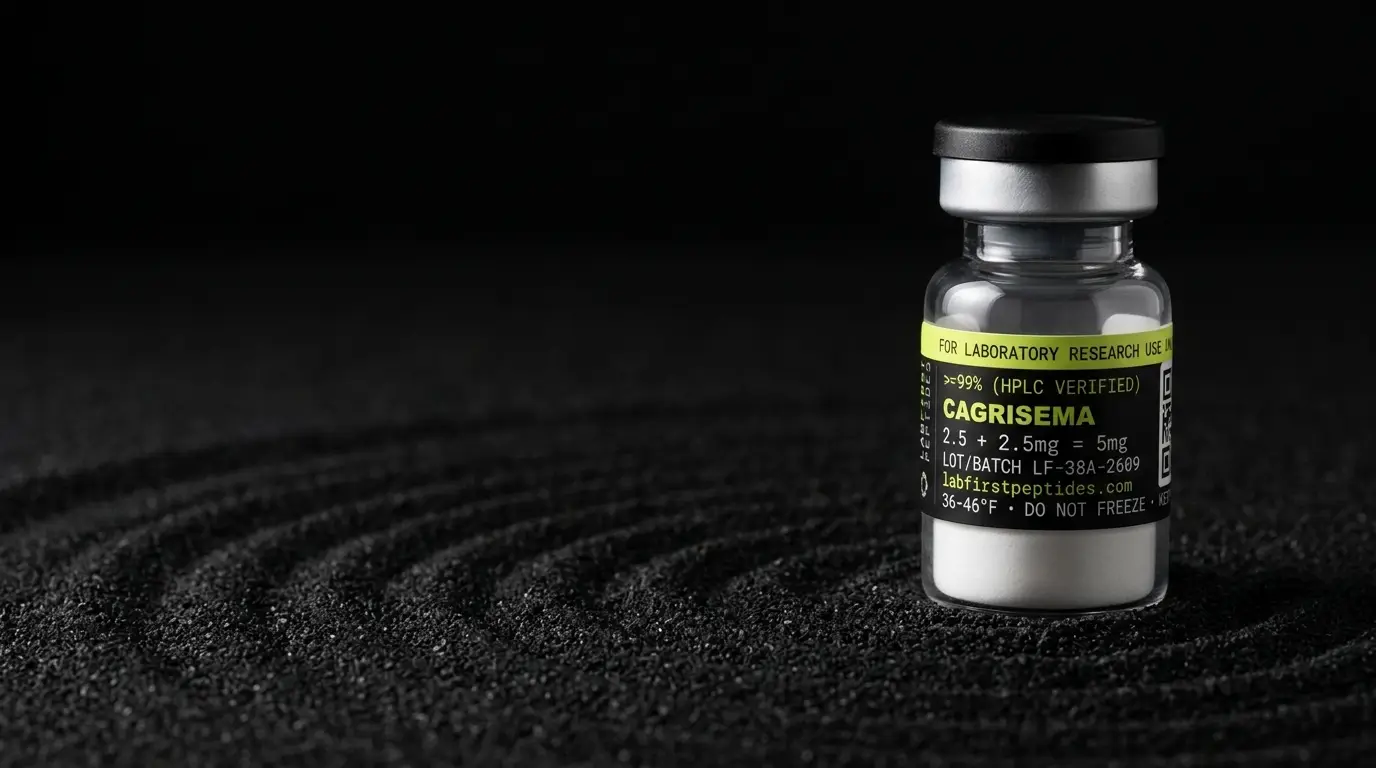
The product page reads the live stock feed on load (stock, lot and certificate state for every size), so what you see when you order is what ships. The lot is printed on the label and encoded in the QR patch on its right-hand side; scanning it opens that lot's record.
Storage and shipping for CagriSema
Sealed and freeze-dried, a CagriSema vial keeps for the shelf period on its certificate when stored cold and dark. The two peptides have different weak points: semaglutide's tryptophan and side chain, cagrilintide's disulfide ring and lipid chain, and the asparagine and glutamine residues in both. All of that chemistry is slow in a dry cake and faster in solution, and the two components may not age at the same rate once dissolved, so a prepared solution is dated, kept cold and used within the laboratory's own stability record rather than any figure on a label.
The sealed powder's main enemy is moisture from the air once the vial is opened. Open each vial once for the work it was bought for, and do not reseal a partly used vial for storage. The arrival record matters more than usual here, because a later question about the ratio can only be answered by going back to the certificate for that exact lot.
Orders ship within the United States, flat $15 under $200 and free above it, same day when placed before 12 PM Pacific on a business day, and the shipping page states the cutoff, the carriers and what is and is not promised.
The record a laboratory keeps on arrival is what makes the certificate usable later, and it is short:
- the lot number as printed on the vial, and the certificate's accession or search code beside it;
- the date received and the condition of the seal;
- the storage location and temperature it went into;
- the number of vials, and later the date each one was opened and by whom.
A CagriSema vial with that record behind it can be traced from the bench to the laboratory report in one step; without it, the certificate is a document about a vial that can no longer be identified.
Regulatory status, and what this page is not
CagriSema is investigational and approved nowhere, per the research summary this site keeps for each compound. Semaglutide on its own is the active ingredient of approved medicines, but that approval belongs to those products and their manufacturing and confers nothing on a research vial, alone or combined with cagrilintide. No equivalence to any medicine or drug candidate is claimed or possible from a certificate, which measures one lot and not a process. Every figure on a research vial is the supplier's number, backed by the laboratory it names.
FOR LABORATORY AND IN-VITRO RESEARCH USE ONLY. NOT FOR HUMAN OR ANIMAL CONSUMPTION. LabFirst sells CagriSema to laboratories and researchers as material for in-vitro work, gives no guidance on use, and ships only against that understanding. Nothing on this page or on the product page describes preparing or administering anything.
What is CagriSema studied for?
Published research on CagriSema investigates the areas below, which is a different question from what CagriSema will do for anyone, a claim about a living system that nothing on this site is sold for.
What it is. A fixed-combination product name covering two separate molecules: cagrilintide, a long-acting amylin analogue, and semaglutide, a GLP-1 analogue.
What the research looks at. Investigational combination, developed by Novo Nordisk. The two components each have their own separate literature.
How it is thought to work. Two distinct mechanisms in one product. Cagrilintide acts non-selectively at calcitonin family receptors — the amylin receptors and the calcitonin receptor. Semaglutide acts at the GLP-1 receptor. The combination rationale is that amylin and GLP-1 signalling act through different pathways and are proposed to be additive.
What is not established. No approved product. Nothing here is a single molecule, and the properties of the combination are not the sum of the components.
The full record, including the certificate for the lot in stock, is on the CagriSema product page.
Common questions
Where can I buy CagriSema online?
How much does CagriSema cost?
Is CagriSema the same as buying cagrilintide and semaglutide separately?
Which CagriSema size should a laboratory order first?
How do I check that a CagriSema certificate is real?
How much does CagriSema cost per milligram?
More procurement guides
Sources
- PubChem, undefined, CID 171397054. Formula and average mass (4409 Da) for the Cagrilintide component.
- PubChem, Semaglutide, CID 56843331. Formula and monoisotopic mass (4111.115 Da) for the Semaglutide component.
- Fletcher and colleagues, AM833 is a novel agonist of calcitonin family G protein-coupled receptors: pharmacological comparison with six selective and nonselective agonists, Journal of Pharmacology and Experimental Therapeutics . Primary description of the compound in the literature; supports the class and naming stated here, not any use.
- Lau and colleagues, Discovery of the once-weekly glucagon-like peptide-1 (GLP-1) analogue semaglutide, Journal of Medicinal Chemistry . Primary description of the compound in the literature; supports the class and naming stated here, not any use.
- ICH Q2(R2), Validation of Analytical Procedures (2023) . Why a purity figure is only interpretable with its method, and what "fit for purpose" means for the HPLC and mass spectrometry results a certificate reports.