Cagrilintide, developed as AM833, is a lipidated long-acting analogue of amylin, C194H312N54O59S2 at about 4,409 Da; it is investigational and approved nowhere. Buy it from a supplier that names the laboratory, prints the theoretical mass, dates the purity run and puts the lot on the vial. LabFirst lists 3 sizes from $60, each lot independently tested.
- Cagrilintide is sold at LabFirst in 2mg, 5mg, 10mg from $60, cheapest per mg in the 10mg vial at $8.50.
- The identity reference for Cagrilintide is the published formula C194H312N54O59S2, 4409 Da average.
- A complete certificate carries identity by mass spectrometry, purity by HPLC with method and date, and net content in milligrams, all for the lot printed on the vial.
- LabFirst lots are tested by Kovera Labs, an independent laboratory. Every lot measured 98% purity or higher; COAs are publishing soon.
- Shipping is $15 flat under $200 and free above, US only; volume tiers are 10% at ten vials of one size and 15% at twenty.
What "cagrilintide peptide" names, and what it does not
Cagrilintide is an amylin analogue: a synthetic peptide built on the hormone also called islet amyloid polypeptide, modified to last far longer than the natural one and carrying a lipid side chain for that purpose. Its development code was AM833, and older papers use that name. Listings write cagrilintide, cagrilintide peptide, AM833 and sometimes just cagri. All of them mean the single lipidated peptide. It is not CagriSema, which is cagrilintide and semaglutide together in one vial, and a certificate for one is no evidence for the other.
The pharmacology is what makes it a research subject. Cagrilintide is deliberately non-selective across the calcitonin receptor family: it acts at the amylin receptors, which are the calcitonin receptor paired with accessory proteins, and at the calcitonin receptor alone. Compounds with that profile are called dual amylin and calcitonin receptor agonists. How much each receptor contributes to what is observed in preclinical models is an open argument in the field, per the papers cited below. None of that is a claim about any use, and this page makes none.
For a buyer the chemistry is the part that matters. At about 4,409 Da this is a large, lipidated peptide with two cysteines that should be joined in a ring, so a correct lot depends on the full sequence, the lipid side chain attached in the right place and the disulfide closed. Each of those can go wrong separately and each shows up as a different mass. The peptide without its lipid chain is cheaper to make and much lighter, which is why the observed mass on a certificate is the first line to read.
The reference point for identity is public. PubChem lists undefined as CID 171397054 with molecular formula C194H312N54O59S2, an average molecular weight of 4409 Da. Those are the numbers a mass spectrometer is checked against, and the number a certificate must print beside the observed mass.
In plain terms: Lipidated long-acting analogue of amylin (islet amyloid polypeptide). No approved product. The relative contribution of amylin-receptor versus calcitonin-receptor activation to any observed effect is an open question the field is actively arguing about.
- Lot on the vial matches the certificate
- Laboratory named, with its own lookup
- Theoretical mass printed and correct
- Purity has a method and a date
- Net content stated in milligrams
Cagrilintide sizes and price per mg
LabFirst lists Cagrilintide in 3 sizes (2mg, 5mg, 10mg) from $60 to $85, priced per vial with the per-mg figure beside it so sizes can be compared without arithmetic. Per mg, the 10mg vial is the cheapest at $8.50 and the 2mg the dearest at $30, which is the usual shape: the vial, stopper, seal, fill and laboratory run cost the same whatever mass goes in.
| Size | Price | Per mg | 10 units | 20 units | Availability |
|---|---|---|---|---|---|
| 2mg | $60 | $30 | $540 ($27/mg) | $1020 ($25.50/mg) | Backorder, join the waitlist |
| 5mg | $75 | $15 | $675 ($13.50/mg) | $1275 ($12.75/mg) | Backorder, join the waitlist |
| 10mg (best per mg) | $85 | $8.50 | $765 ($7.65/mg) | $1445 ($7.22/mg) | Backorder, join the waitlist |
The volume tiers are per size, not per basket: ten vials of one size take 10% off that line and twenty take 15%, and mixed sizes do not combine. Shipping is a flat $15 on orders under $200 and free from $200, within the United States only, with same-day dispatch on orders placed before 12 PM Pacific on a business day. The cost per mg tool runs the same comparison across any two listings, ours or anyone else's.
A long synthesis, a lipidation step and a disulfide closure make cagrilintide one of the costlier peptides to produce well, and each step is a place where a cheaper maker can cut a corner. LabFirst lists it in 2 mg, 5 mg and 10 mg vials. The per-milligram price falls as the vial gets bigger because the vial, fill, seal and laboratory run are fixed costs spread over more peptide. A laboratory qualifying a new lot usually buys the smallest vial once and reads its certificate before committing to the larger size.
The cagrilintide price trap is the unlipidated peptide. It is easier and cheaper to make, it can be sold under the same name, and without a mass spectrum nobody can tell the difference by looking at the powder. A listing well under the market with a certificate that shows no observed mass is the pattern to walk away from. Our only discounts are the volume tiers on this page, per size and fixed from month to month, and they apply only within one size.
The certificate a Cagrilintide lot must carry
Three tests answer three different questions, and a certificate of analysis for Cagrilintide is only complete when it carries all three for the exact lot on the vial. Identity is settled by mass spectrometry against the published mass for Cagrilintide (4409 Da average). The certificate should print the theoretical value beside the observed one; a tick in a box is not an identity result.
Purity is a separate question, answered by HPLC: how much of what came off the column was the compound. The figure is only interpretable with its method beside it (column, gradient, detection wavelength) and a date, which is what ICH Q2(R2) means when it asks that an analytical procedure be shown fit for its purpose. A percentage with no method and no date is a number somebody typed, and a certificate that carries every test but for a different lot number than the vial is the most common failure of all and the easiest to catch. Net content is the third test and the one most often missing: the milligrams of Cagrilintide actually in the vial, measured, against the size printed on the label.
The identity result for cagrilintide should be a deconvoluted mass from an electrospray spectrum, since a molecule this size flies as a series of multiply charged ions rather than one peak. A certificate that prints the charge-state envelope beside the deconvoluted figure has shown its work. Two wrong answers to know: a mass about 2 Da high means the disulfide never closed, and a mass hundreds of daltons light means the lipid side chain is missing. Either one is a different compound from the one on the label, whatever the purity percentage says.
HPLC on a lipidated peptide is sensitive to method, because the lipid changes how strongly it binds the column, so the column, gradient and detection wavelength belong next to the result. Look for the impurities that elute close to the main peak: the reduced open-ring form, deletion sequences, and oxidized or deamidated variants. Net content is the line that pays on a peptide at this price. Quantitative HPLC or amino acid analysis gives the milligrams of cagrilintide in the vial, as distinct from the salt and water that make up the rest of the powder.
Checking a supplier of Cagrilintide: five checks before you order from anyone
Every seller of cagrilintide peptide says "third-party tested". The phrase costs nothing. These five checks take about four minutes per listing and separate a tested lot from a tested-sounding one.
- The lot on the vial is the lot on the certificate. Read the printed lot number, then open the certificate and match it. A certificate for "Cagrilintide" with no lot, or a lot that does not match, describes some other vial.
- The laboratory is named and has its own lookup. The report should come from a laboratory the seller does not own, with a search code you can enter on the laboratory's own site. LabFirst lots are tested by Kovera Labs and the laboratory's report is published for each lot; anything that exists only as the seller's own summary has not been verified.
- The theoretical mass is printed, and it is the right one. For Cagrilintide the figure should match the published formula C194H312N54O59S2.
- Purity has a method and a date. An HPLC percentage should name the method and the run date. A figure that reads "99%+" with neither, or one date reused across every product a seller lists, is decoration.
- Net content is stated in milligrams. The label size is a claim; the certificate's net content is the measurement. If the certificate has no net content line, the purity figure describes the powder, not the vial, and the price per mg you calculated is fiction.
How listings for Cagrilintide specifically mislead:
- A certificate with one rounded mass and no spectrum. A 4,409 Da peptide produces a charge-state envelope that has to be deconvoluted; a bare number with no trace could describe anything.
- A price far under the market. The cheap version is usually the peptide without its lipid chain, hundreds of daltons lighter and a different compound under the same name.
- Cagrilintide and CagriSema used interchangeably. One is a single peptide and the other is two peptides in one vial; their certificates cannot cover each other.
- A 10 mg label with no net content. On a peptide this expensive, the gap between powder weight and peptide weight is real money, and only a measured content figure settles it.
- Clinical results quoted on the listing. Cagrilintide is investigational and approved nowhere, and trial figures for a drug candidate say nothing about a research vial's contents.
How to verify a LabFirst Cagrilintide lot
Every Cagrilintide size is on backorder today. Join the waitlist on the product page and the restock email carries the lot and its certificate when they exist.
Verification runs through the laboratory, not through us. Open the certificate index, find the lot, and read the laboratory's report; it is Kovera Labs' own document, not ours, and the laboratory will confirm it against its records.
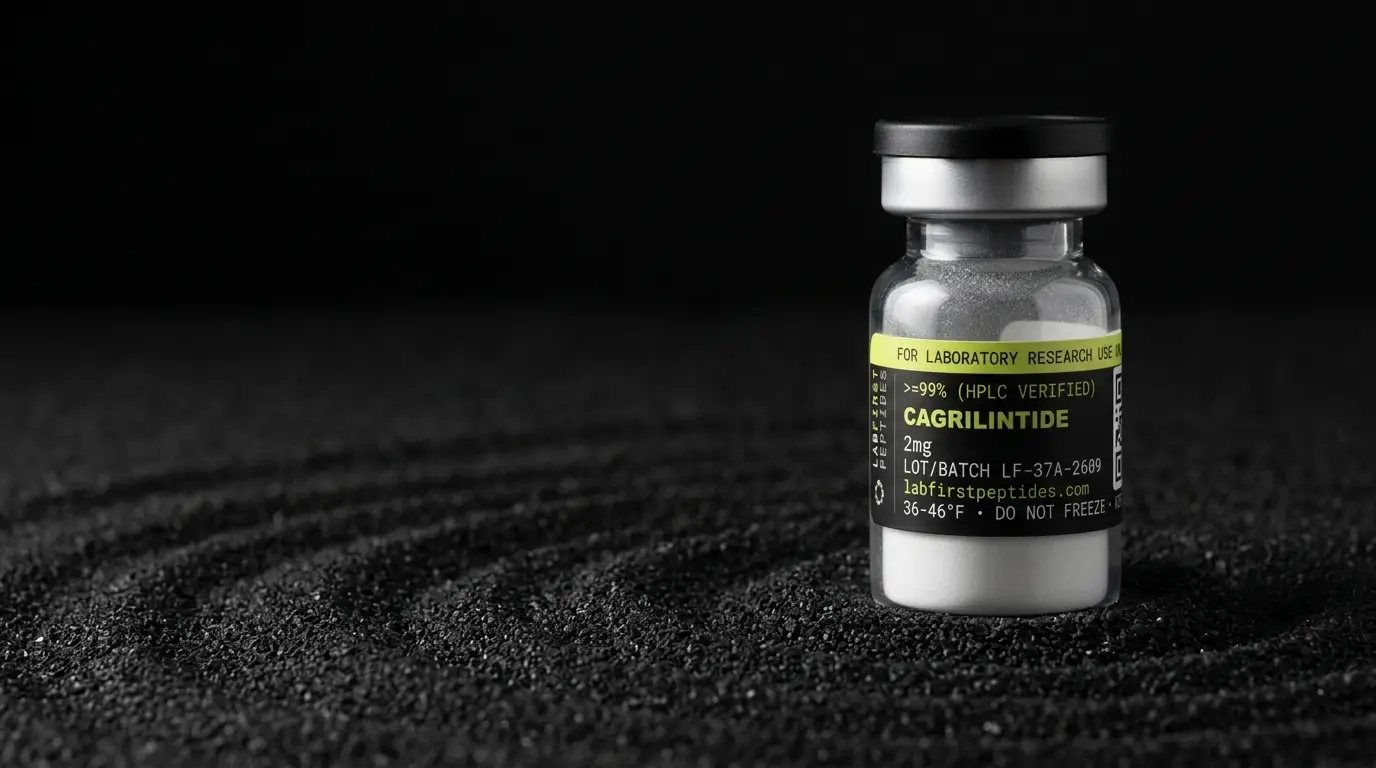
The product page reads the live stock feed on load (stock, lot and certificate state for every size), so what you see when you order is what ships. The lot is printed on the label and encoded in the QR patch on its right-hand side; scanning it opens that lot's record.
Storage and shipping for Cagrilintide
Freeze-dried and sealed, cagrilintide holds for the shelf period on its certificate when kept cold and out of light. The lipid side chain makes it more prone to sticking to surfaces and clumping once in solution, and the disulfide ring and the asparagine and glutamine residues are where slow degradation starts when water is present. The dry cake is the stable form. A prepared solution is a separate material with its own date, kept cold and dark and used within the laboratory's own stability record, not a figure from any label, ours included.
Moisture is the main enemy of the sealed powder. A lyophilized cake starts drawing water from the air as soon as the seal is broken, so each vial should be opened once for the work it was bought for and not resealed for storage. For a peptide at this price the arrival record is worth the minute it takes: lot, accession, date received and storage location, so the certificate can be tied to the vial on the bench months later.
Orders ship within the United States, flat $15 under $200 and free above it, same day when placed before 12 PM Pacific on a business day, and the shipping page states the cutoff, the carriers and what is and is not promised.
The record a laboratory keeps on arrival is what makes the certificate usable later, and it is short:
- the lot number as printed on the vial, and the certificate's accession or search code beside it;
- the date received and the condition of the seal;
- the storage location and temperature it went into;
- the number of vials, and later the date each one was opened and by whom.
A Cagrilintide vial with that record behind it can be traced from the bench to the laboratory report in one step; without it, the certificate is a document about a vial that can no longer be identified.
Regulatory status, and what this page is not
Cagrilintide is investigational and approved nowhere, per the research summary this site keeps for each compound. No medicine containing it can be bought, so there is no approved product a research vial could be compared with and no drug specification it could claim to meet. Every figure on a research vial is therefore the supplier's number backed by the laboratory it names. Trial results for the drug candidate describe a manufacturer's own material in a clinical program, and they say nothing about what is in any research lot.
FOR LABORATORY AND IN-VITRO RESEARCH USE ONLY. NOT FOR HUMAN OR ANIMAL CONSUMPTION. LabFirst sells Cagrilintide to laboratories and researchers as material for in-vitro work, gives no guidance on use, and ships only against that understanding. Nothing on this page or on the product page describes preparing or administering anything.
What is Cagrilintide studied for?
Published research on Cagrilintide investigates the areas below, which is a different question from what Cagrilintide will do for anyone, a claim about a living system that nothing on this site is sold for.
What it is. Lipidated long-acting analogue of amylin (islet amyloid polypeptide).
What the research looks at. Receptor pharmacology across calcitonin-family receptors, and preclinical metabolic models in high-fat-diet and diabetic rats. Investigational; developed by Novo Nordisk.
How it is thought to work. A non-selective agonist at calcitonin family G-protein-coupled receptors — it activates both the amylin receptors, which are heterodimers of the calcitonin receptor with receptor activity-modifying proteins, and the calcitonin receptor itself. Compounds with this profile are termed dual amylin and calcitonin receptor agonists.
What is not established. No approved product. The relative contribution of amylin-receptor versus calcitonin-receptor activation to any observed effect is an open question the field is actively arguing about.
The full record, including the certificate for the lot in stock, is on the Cagrilintide product page.
Common questions
Where can I buy Cagrilintide online?
How much does Cagrilintide cost?
Is cagrilintide the same as AM833, and the same as CagriSema?
Which Cagrilintide size should a laboratory order first?
How do I check that a Cagrilintide certificate is real?
What does cagrilintide cost, and which size is cheapest per milligram?
More procurement guides
Sources
- PubChem, undefined, CID 171397054. Public record for the molecular formula (C194H312N54O59S2) and average molecular weight (4409 Da) quoted here as the identity reference.
- Fletcher and colleagues, AM833 is a novel agonist of calcitonin family G protein-coupled receptors: pharmacological comparison with six selective and nonselective agonists, Journal of Pharmacology and Experimental Therapeutics . Primary description of the compound in the literature; supports the class and naming stated here, not any use.
- Larsen and colleagues, Does receptor balance matter? Comparing the efficacies of the dual amylin and calcitonin receptor agonists cagrilintide and KBP-336 on metabolic parameters in preclinical models, Biomedicine and Pharmacotherapy . Primary description of the compound in the literature; supports the class and naming stated here, not any use.
- ICH Q2(R2), Validation of Analytical Procedures (2023) . Why a purity figure is only interpretable with its method, and what "fit for purpose" means for the HPLC and mass spectrometry results a certificate reports.