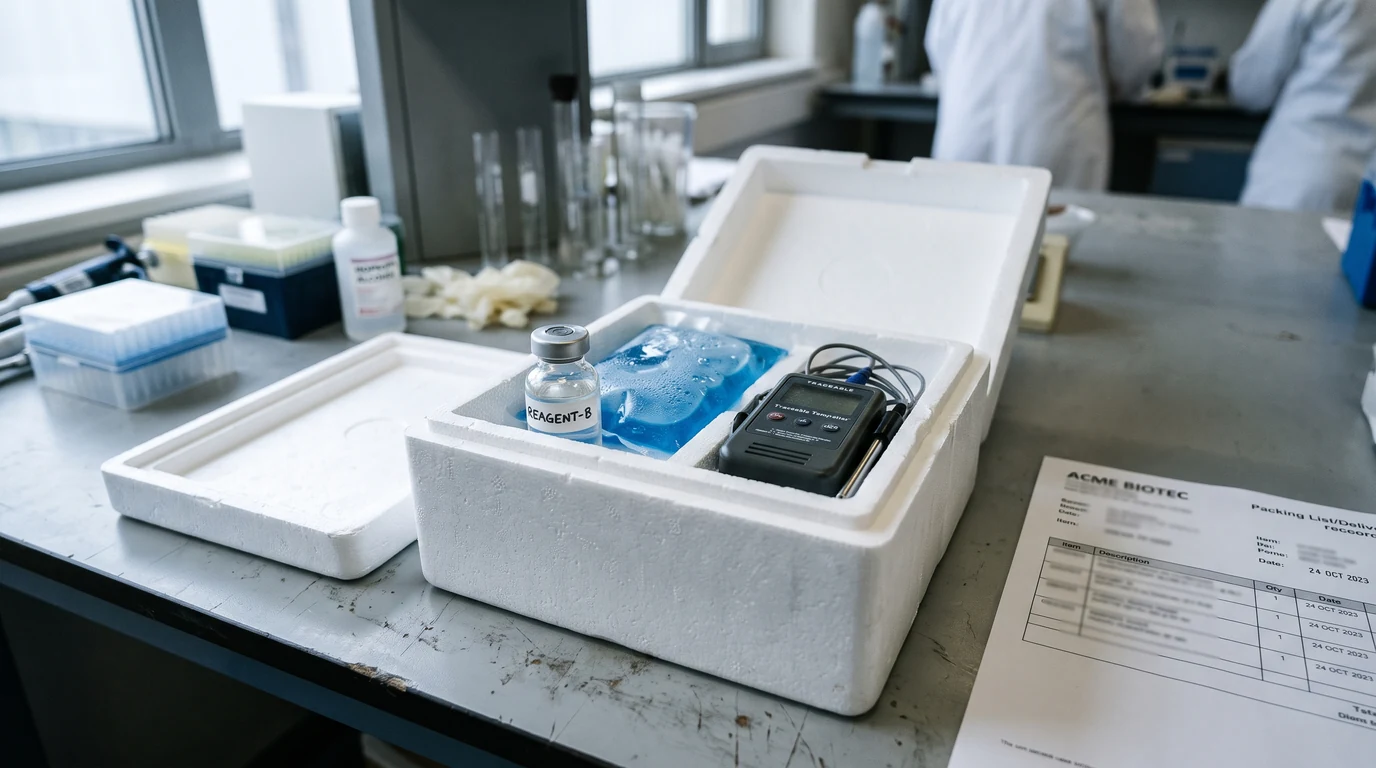
A peptide travel case or cooler is an insulated container with a refrigerant that holds a chosen temperature while material moves between laboratories. Sealed lyophilized peptide powder tolerates several days at room temperature and usually ships without one. Solutions, labeled peptides and samples bound for a testing laboratory are the cases where a cooler and a temperature record matter.
- Sealed lyophilized peptide powder tolerates several days of ambient ground transit and usually ships without a cold chain.
- A temperature excursion is any period outside the range prescribed for storage or transport, per the WHO model guidance for time- and temperature-sensitive products.
- ICH Q1A(R2) sets the refrigerated condition at 5 degrees Celsius plus or minus 3 and the freezer condition at minus 20 plus or minus 5.
- A frozen water gel pack holds about 0 degrees Celsius while melting; dry ice sublimes at about minus 78.5 degrees Celsius.
- A temperature logger belongs beside the product, never against the refrigerant, and its report belongs in the lot file.
- The excursion that damages a lyophilized vial is opening it cold, so that room moisture condenses onto the cake.
What is a cold chain, and does lyophilized peptide need one?
A cold chain is an unbroken series of storage and transport steps that keeps a material inside a set temperature range from the moment it leaves one controlled space until it enters the next. The World Health Organization's model guidance for time- and temperature-sensitive pharmaceutical products defines the failure case too: a temperature excursion is any event in which the material is exposed to temperatures outside the range prescribed for its storage or transport. The range is set by whoever is responsible for the material, from stability data, and it may differ between the warehouse shelf and the truck.
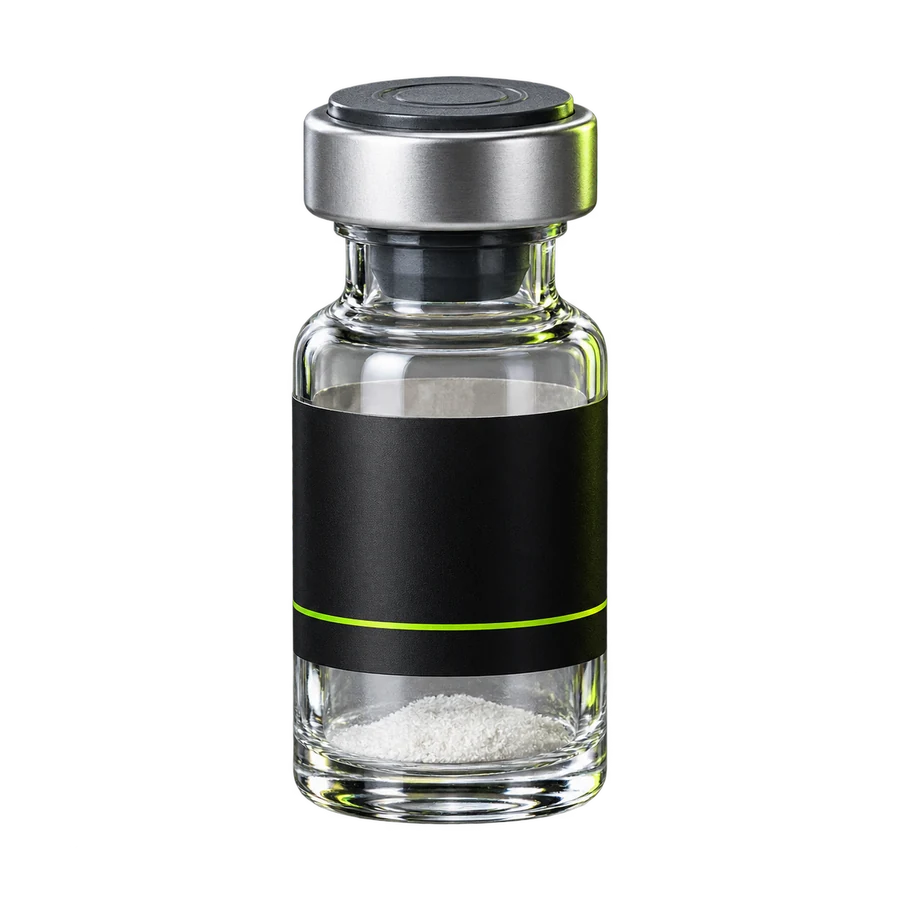
Sealed lyophilized peptide powder is the easy case. Freeze-drying removes the water that drives hydrolysis, so a dry cake degrades far more slowly than the same peptide in solution. That is the reason a research peptide can travel by ordinary ground service in an opaque padded mailer, and it is how LabFirst ships, as the shipping page and the transit-time guide describe. A few days at summer ambient temperature is not what shortens the life of a sealed vial. Opening it cold, so that room moisture condenses onto the cake, is.
So the honest answer to the question in the heading is that most lyophilized shipments do not need a cold chain, and adding one does not make them better. The rest of this guide covers the cases where a laboratory does need one, what the equipment does, and how to read the record it leaves behind.
- Record the lot and the sealed-vial state before anything goes in the box
- Condition the refrigerant to its set point so the first hours do not freeze the product
- Place the logger beside the product, away from the refrigerant
- Note the logger start time on the packing record
- On arrival, stop and read the logger before the inner packaging is opened
When does a laboratory actually need a peptide cooler?
A laboratory needs a peptide cooler when the material in transit is in a state that the lyophilization literature treats as unstable, or when the receiving site will judge the shipment by its temperature record. Four situations come up in practice.
The first is a peptide in solution. Once water is present, the chemistry that the dry cake was protected from starts again: hydrolysis of the amide backbone, deamidation at asparagine and glutamine, oxidation at methionine and tryptophan. A solution that leaves one bench for another should travel cold, and a long trip may call for frozen transport.
The second is a labeled or conjugated peptide, where a fluorescent dye, a biotin tag or an isotope label has its own stability limits that may be tighter than the peptide's.
The third is a sample going to an analytical laboratory for identity or purity work. The laboratory is going to report a number against that vial, and the lot owner will want to show that the sample arrived in the state it left in. A temperature logger in the box is what makes that argument.
The fourth is a receiving site with a written policy. Some institutional stores refuse any peptide parcel without a cold-chain record, whatever the chemistry says. That is a procurement fact rather than a stability one, and arguing with it rarely works.
How do insulated cases and ice packs hold a temperature?
An insulated shipper holds temperature by slowing heat flow with an insulating wall and absorbing the heat that still gets through with a refrigerant that changes phase. The two parts do different jobs and both have to be sized for the trip.
The insulation is usually expanded polystyrene foam, polyurethane foam or, for long or valuable trips, a vacuum insulated panel. Thicker walls and a smaller internal cavity both lengthen the hold time, which is why a cooler packed with more refrigerant than product outperforms a half-empty one.
The refrigerant sets the temperature. A frozen water-based gel pack sits at about 0 degrees Celsius while it melts, because melting absorbs heat without a change in temperature; that plateau is what a 2 to 8 degree shipment relies on, with the product separated from the pack so it is cooled rather than frozen. Phase-change materials are formulated to plateau at other points, including a few degrees above zero for products that must never freeze. Dry ice, which is solid carbon dioxide, sublimes at about minus 78.5 degrees Celsius at sea-level pressure, so a dry-ice shipper holds a frozen state until the last of it is gone, after which the temperature climbs quickly.
| Refrigerant | Temperature held | Typical use | Watch for |
|---|---|---|---|
| Frozen water gel pack | About 0 degrees Celsius during melt | Refrigerated range, 2 to 8 degrees | Product touching the pack can freeze |
| Phase-change material, formulated | Set point above freezing, often 4 to 5 degrees | Never-freeze refrigerated shipments | Needs conditioning to its set point before packing |
| Dry ice | About minus 78.5 degrees Celsius | Frozen solutions and labeled material | Hazardous-goods labeling; vents gas; sudden warm-up when spent |
What temperature ranges do the standards actually define?
The storage ranges used across the industry come from ICH Q1A(R2), the stability guideline that regulators adopted for drug substances, and the same numbers are borrowed for research material because no separate standard exists. Its general case runs long-term stability at 25 degrees Celsius plus or minus 2 with 60 percent relative humidity, or 30 degrees with 65 percent humidity, and accelerated studies at 40 degrees with 75 percent humidity. A substance meant for a refrigerator is studied at 5 degrees plus or minus 3, and one meant for a freezer at minus 20 degrees plus or minus 5.
Those tolerances are the point for transit. A refrigerated range is written 2 to 8 degrees because 5 plus or minus 3 is the condition the data were generated under. A frozen range is written minus 25 to minus 15 for the same reason. When a shipper or a label says one of those, it is pointing back at a stability study, and a logger reading of 9.5 degrees is outside the range not because 9.5 is dangerous but because nobody measured what happens there.
The guideline also says what to do with the data when a trip goes wrong. Results from the accelerated condition, and from the intermediate one where it was run, are what a manufacturer uses to judge the effect of short-term excursions outside the label condition, and the text names shipping and handling as the examples. That is the regulatory version of the question every receiving laboratory asks when a logger shows a spike.
What does a temperature excursion mean for a lyophilized vial?
A temperature excursion on a lyophilized peptide vial means the parcel left its stated range for some period, and on its own it says very little about the powder inside. The chemistry of a dry cake is governed by residual moisture, the glass transition of the solid, and exposure to light and oxygen far more than by a few hours above a threshold. The lyophilization review by Wang in the International Journal of Pharmaceutics sets out why: the stresses that damage freeze-dried material are the freezing and drying steps themselves and the moisture that returns afterward, with temperature acting through those variables rather than beside them.
That does not make an excursion meaningless. Two things change. First, if the material is in solution, the excursion is real time at a temperature where degradation runs, and it should be logged and judged against whatever stability data exist. Second, for any material, an excursion is a documentation event: the lot owner has to decide whether to accept, re-test or reject, and write down why. A research laboratory without a formal quality system still benefits from that habit, because the decision will be asked about later.
The excursion that matters most for a lyophilized vial is the one nobody logs: a cold parcel opened before it reached room temperature. The lyophilized storage guide covers the condensation mechanism, and it applies on the receiving dock just as it does at the freezer door.
What should a cold-chain record for a peptide shipment contain?
A usable cold-chain record names the material, the range it was supposed to stay in, the device that measured it, and what was done about any reading outside the range. The logger is the heart of it. Single-use electronic loggers record a temperature every few minutes, flag excursions, and either print a report or hand over a file when stopped. Chemical indicator cards are cheaper and only tell you whether a threshold was crossed, with no timing and no magnitude.
- Record the lot number and the sealed-vial state at packing, with a photograph if the receiving site will want one.
- Condition the refrigerant to its set point before it goes in; a gel pack straight from a deep freezer can drop a refrigerated shipment below zero for the first hours.
- Place the logger next to the product, never against the refrigerant, so it measures what the vial experienced.
- Note the start time on the logger and on the packing record, so the two can be matched later.
- On arrival, stop the logger before opening the inner packaging, read it, and record the result beside the lot before the vial is stored.
The lot number is what ties this record to the certificate that will later be read against it, which is why the batch traceability guide treats shipping records as part of the lot file rather than as freight paperwork.
How does this fit with what LabFirst ships?
LabFirst ships sealed lyophilized powder at ambient temperature by USPS from Santa Ana, California, in padded opaque packaging, because that is the state in which a research peptide is stable for the length of a domestic trip and a cold shipper would add cost without adding protection. Every lot carries a Kovera Labs certificate that can be checked with the laboratory from the certificate page. The cold-chain practices above are for the laboratory's own onward movements, solutions, labeled material and samples sent out for testing, where the chemistry or the receiving site calls for them.
FOR LABORATORY AND IN-VITRO RESEARCH USE ONLY. NOT FOR HUMAN OR ANIMAL CONSUMPTION. NOT FOR PERSONAL, MEDICAL, DIAGNOSTIC, THERAPEUTIC, OR RECREATIONAL USE.
Bottom line
Match the shipper to the state of the material. A sealed lyophilized vial travels by ground and is harmed by condensation on opening, not by a warm afternoon in a truck. A solution, a labeled peptide or a sample bound for an analytical laboratory travels in an insulated case with a conditioned refrigerant and a logger beside the product, and the logger's report goes into the lot file next to the certificate.
Common questions
Do research peptides need to ship cold?
What is a peptide travel case or cooler for?
What temperature do ice packs keep a shipment at?
What counts as a temperature excursion in peptide shipping?
Why does ICH Q1A(R2) matter for a research peptide shipment?
More handling guides
Sources
- FDA / ICH Q1A(R2), Stability Testing of New Drug Substances and Products . Source of the long-term, accelerated, refrigerated (5 plus or minus 3 degrees Celsius) and freezer (minus 20 plus or minus 5) storage conditions, and of the statement that accelerated data are used to judge short-term excursions during shipping and handling.
- WHO Technical Report Series 961, Annex 9: Model guidance for the storage and transport of time- and temperature-sensitive pharmaceutical products . Definitions of temperature-controlled storage and of a temperature excursion as exposure outside the prescribed range, and the practice points on refrigerant conditioning and logger placement.
- Wang, W. Lyophilization and development of solid protein pharmaceuticals. International Journal of Pharmaceutics 203(1-2):1-60 doi:10.1016/s0378-5173(00)00423-3. The review behind the claim that residual moisture and the freezing and drying stresses, rather than brief ambient exposure, govern the stability of freeze-dried peptide and protein material.
- PubChem Compound Summary for CID 280, Carbon dioxide. Physical property record giving the sublimation point of solid carbon dioxide, about minus 78.5 degrees Celsius at atmospheric pressure, which is the temperature a dry-ice shipper holds.