Lyophilised Thymosin Alpha-1 is stable as a dry, sealed, desiccated powder held cold and dark. Its 28-residue sequence carries no cysteine or methionine, so oxidation is a minor route; water-driven deamidation and aspartyl isomerisation are the ones to watch once a solution is prepared.
- Thymosin alpha-1 is a 28-residue peptide with an acetylated N-terminal serine and a molecular weight near 3,108 Da.
- The sequence contains no cysteine, methionine or tryptophan, so oxidation is a minor degradation route compared with most peptides.
- Deamidation at Asn28 and isomerisation of the three aspartate residues are the dominant chemical failure modes, and both are driven by water.
- With no aromatic residues, the peptide has no useful absorbance at 280 nm; UV detection and quantification must be done at 214 to 220 nm.
- Letting a sealed vial reach room temperature before opening prevents the condensation uptake that no analytical method will later reveal.
- A few milligrams of neat peptide can look like an empty vial; check the certificate for net peptide content before assuming a short fill.
The sequence predicts most of the handling
Thymosin alpha-1 (INN thymalfasin) is a linear 28-residue peptide with an acetylated N-terminal serine, corresponding to residues 2 to 29 of prothymosin alpha. Its molecular weight is close to 3,108 Da. The sequence, in one-letter code, is Ac-SDAAVDTSSEITTKDLKEKKEVVEEAEN.
Read that sequence for what is absent. There is no cysteine, so no disulfide to scramble and no thiol to oxidise. No methionine and no tryptophan, which removes the two residues that dominate oxidative degradation in most peptides. There is also no tyrosine, phenylalanine or histidine, which has an awkward analytical consequence: the molecule has no chromophore above roughly 230 nm. You cannot quantify it by absorbance at 280 nm. Anyone who reports a concentration from an A280 reading on this peptide has measured something else.
What is present is charge. Twelve of the twenty-eight residues are aspartate or glutamate, against five lysines, giving a strongly acidic peptide with an isoelectric point somewhere near 4. In practice the material is very water-soluble, intrinsically disordered in solution, weakly retained on C18 media, and much less prone to interface-driven aggregation than a lipidated peptide such as tirzepatide. The failure modes that remain are the water-driven ones.
- Moisture — the driver behind deamidation, isomerisation and hydrolysis
- pH of an unbuffered diluent — chosen by accident unless measured
- Temperature — a rate multiplier on every route, not a mechanism
- Container surfaces — adsorption losses at low concentration
- Freeze-thaw — cumulative, invisible, avoidable by aliquoting
- Oxidation — minor here; no Cys, Met or Trp in the sequence
Degradation routes that actually apply
The general chemistry of peptide and protein instability is well mapped; Manning and colleagues set out the routes and their drivers in their 2010 update in Pharmaceutical Research, and Butreddy and colleagues reviewed the same ground for lyophilised material in 2020. Applying that framework to this specific sequence narrows the list considerably.
| Route | Site in this sequence | Driver | Detectable by |
|---|---|---|---|
| Deamidation | Asn28, the C-terminal residue | Water activity, temperature, pH above about 6 | +0.98 Da on LC-MS; new peak or shoulder on RP-HPLC |
| Aspartyl isomerisation | Asp2, Asp6, Asp15 | Water, temperature, mildly acidic pH | Chromatography only; isoAsp is mass-identical |
| Backbone hydrolysis | Preferentially adjacent to Asp residues | Water, heat, low pH | Truncated fragments on LC-MS, purity loss |
| Succinimide formation | Asn28 and the Asp residues | Intermediate on the two routes above | Loss of 17 or 18 Da; often transient |
| Oxidation | No Cys, Met or Trp present | Trace metals, light; low risk here | Mass shifts of +16 Da if it occurs at all |
| Aggregation | Whole molecule at high concentration | Interfaces, agitation, freeze concentration | SEC, visual haze, unrecoverable material |
| Surface adsorption | Whole molecule at low concentration | Contact with glass and some plastics | Low recovery with no visible change |
Isomerisation deserves a second look because it is the quiet one. Aspartate can rearrange to isoaspartate through a succinimide intermediate, and the product has exactly the same mass as the starting material. A mass spectrometer will report the molecule as intact. Only a chromatographic separation, or a dedicated isoAsp assay, distinguishes them. With three aspartate residues in a 28-mer this is not a theoretical concern, and it is one reason to keep the solid solid.
Temperature appears nowhere in that table as a mechanism. It is a rate multiplier on every row. Moisture is the mechanism, which is why the sealed dry powder is the state worth protecting.
Sealed-vial handling before anything is added
A cold vial opened in a warm room takes on water. The glass sits below the dew point, condensation forms wherever it can, and a hygroscopic lyophilisate absorbs it within seconds. Nothing about the appearance of the cake changes. The vial then goes back to storage with water inside it, and the cycle repeats every time someone is in a hurry.
The control is to let the sealed vial equilibrate to room temperature before the seal is broken. Twenty to thirty minutes on the bench suits a small vial. Work briskly once it is open, reseal against a desiccant, and note the excursion if your protocol tracks them. This is the single largest avoidable loss in peptide handling and it happens before any analytical method could see it.
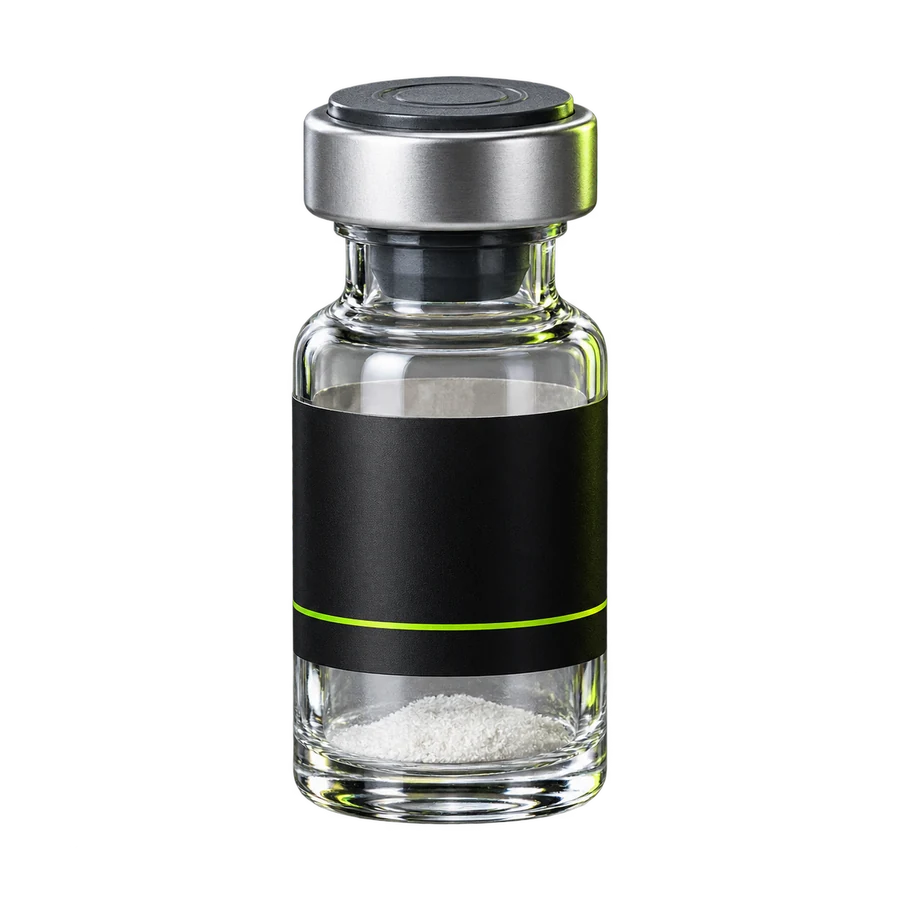
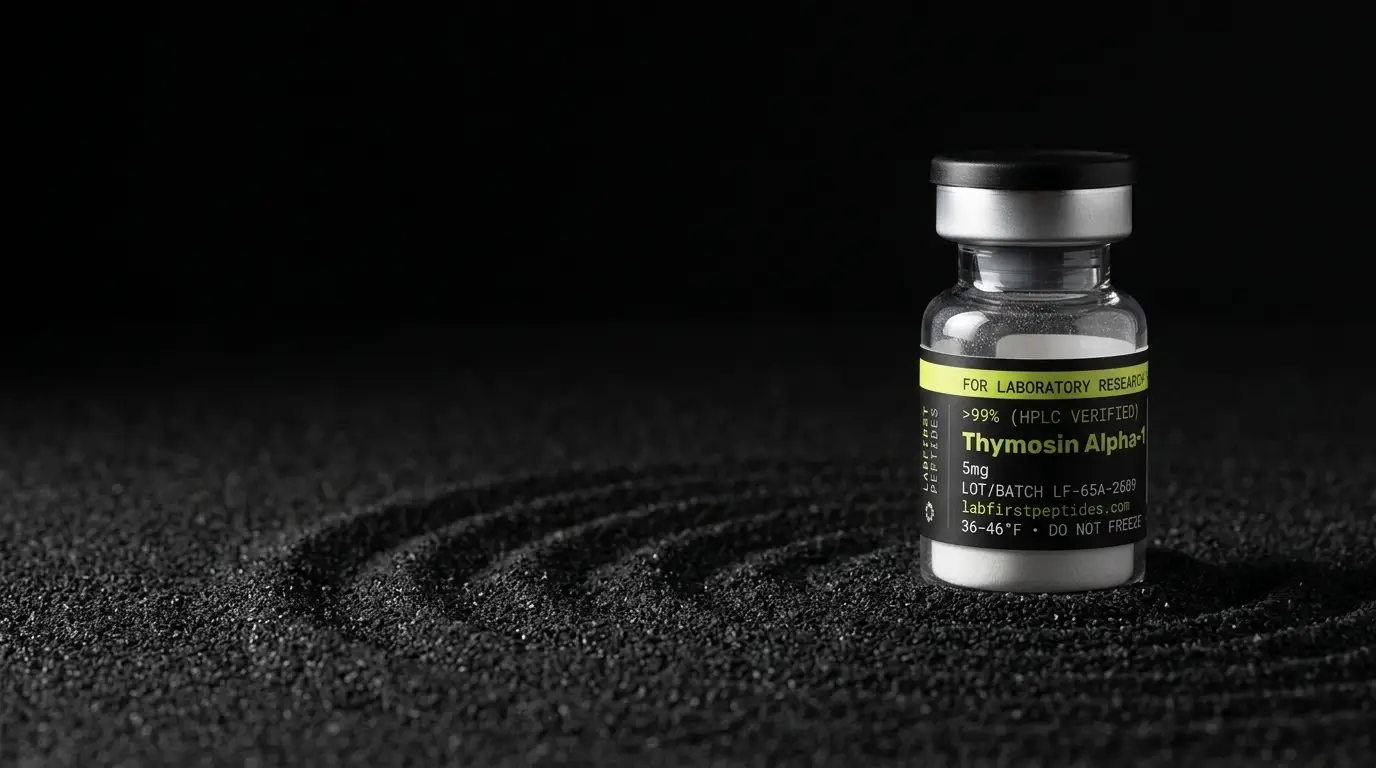
One point specific to this compound: appearance is a poor guide. The marketed thymalfasin product is formulated with a bulking agent and a phosphate buffer, so it presents as a proper white cake. A research-grade powder is often neat peptide, and a few milligrams of a 3 kDa peptide at the bottom of a 2 mL vial can look like a thin film, a faint ring, or nothing at all. An apparently empty vial is usually a correctly filled vial. Weigh or assay before concluding otherwise, and check whether the certificate states a mass of peptide or a mass of formulated powder, because those are different numbers.
Conditions by physical state
| State | Temperature | Light | Relative horizon | Reasoning |
|---|---|---|---|---|
| Sealed powder, unopened stock | Minus 20 °C or below, desiccated | Dark | Longest | Water excluded and every rate slowed |
| Sealed powder, working vial | 2 to 8 °C | Dark | Shorter than frozen | Adequate within a defined use window; avoids repeated cold openings |
| Powder in transit | Ambient | Dark, insulated | Days | A dry solid tolerates short excursions far better than any solution |
| Prepared aqueous solution | 2 to 8 °C | Dark | Days, not months | Deamidation, isomerisation and hydrolysis are now running |
| Solution, single-use aliquots | Minus 20 °C or below | Dark | Longer, with a cost per thaw | Freeze concentration and interfacial stress accumulate |
Those horizons are deliberately comparative. Putting a number of months against a research powder requires a stability study on that lot, in that container and closure, under those conditions, of the kind ICH Q1A(R2) describes for registered products. Very few research suppliers have run one. A confident figure quoted without that data behind it is a convention, and the lot's own certificate of analysis is the only document entitled to carry a date. Where it carries none, the honest position on the record is that the window is unestablished.
Once diluent goes in
Adding water starts a faster clock, and for this peptide the pH of the resulting solution matters more than it does for most. Deamidation of asparagine is slow around pH 4 to 5 and accelerates as pH rises past neutrality; isomerisation of aspartate runs faster on the acidic side. Thymosin alpha-1 is itself strongly acidic, so dissolving it in an unbuffered diluent will pull the pH down by an amount that depends on concentration and on how little buffering capacity the diluent has.
Unbuffered water gives you a pH you have not chosen and probably have not measured. If the assay tolerates it, a defined buffer is the more reproducible choice; if the protocol calls for bacteriostatic or sterile water, at least record which, and read the bacteriostatic water guide for what the benzyl alcohol content does and does not do.
Two practices carry most of the benefit. Split the solution into single-use aliquots at the moment of preparation, so no container is thawed twice. Date and label every aliquot as it is made, with ink that survives a freezer, rather than reconstructing the label later from memory.
Low-concentration work brings adsorption into play. A small, highly charged peptide at low microgram-per-millilitre concentrations will deposit a non-trivial fraction of itself on container walls, and the loss shows up as an inexplicably weak result rather than as anything visible. Borosilicate glass and untreated polystyrene are the usual suspects; low-binding polypropylene is the usual answer. Where a protocol permits a carrier protein or a small amount of surfactant, that is often the more reliable fix. Whichever you choose, fix it for the whole study and write it down, because switching container material mid-series is a good way to generate a trend that is really an artefact.
Freeze-thaw is less punishing for a disordered hydrophilic peptide than for an interface-active lipidated one, and it is not free. Each cycle carries the solution through the concentration and pH shifts that accompany ice formation. The damage accumulates and no visual inspection separates a first thaw from a fifth.
Worked example: aliquot arithmetic and what goes on the label
A vial containing 10 mg of peptide brought into 5 mL of diluent gives:
10 mg ÷ 5 mL = 2 mg/mL
If the protocol draws 0.25 mL per run, a single container holds:
5 mL ÷ 0.25 mL = 20 draws
Held as one container, the twentieth draw comes from material warmed and re-chilled nineteen times, at whatever pH the diluent settled to, after nineteen opportunities for contamination. Divided at preparation into twenty 0.25 mL aliquots, each is thawed once. The cost is a rack of low-binding tubes and ten minutes.
The vial concentration calculator handles the same arithmetic for other fills and volumes. It covers laboratory measurement only.
Each aliquot label should carry the parent solution identifier, the concentration, the preparation date and the initials of whoever made it. That is four fields. An aliquot missing any of them is an unknown, and an unknown belongs in the waste stream rather than in an experiment.
Analytical checks that detect storage damage
Storage claims are only as good as the method that would catch a failure. For this peptide the practical toolkit is reversed-phase HPLC with UV detection at 214 or 220 nm, since there is no aromatic residue to see at 280 nm, coupled to or confirmed by LC-MS.
Two things follow from the strong negative charge. The peptide is weakly retained on C18, so a gradient starting at very low organic content and an ion-pairing agent such as trifluoroacetic acid are usually needed to hold it long enough to resolve anything from it. And the degradants of interest are close in structure to the parent. A deamidated species differs by one mass unit in 3,108, which is resolvable on a decent instrument but easy to miss on a low-resolution one, and an isoaspartate species differs by nothing at all. If the method cannot separate the parent from a species that co-migrates in mass, then a clean total ion chromatogram is not evidence of an intact peptide.
When reading a certificate, separate the two numbers that get confused. Chromatographic purity is an area percentage of the peptide-related material detected by that method. Peptide content, sometimes called net peptide, is the fraction of the vial mass that is actually peptide, the remainder being counterion, residual water and any excipient. A powder can be 98% pure by HPLC and 80% peptide by mass at the same time, both figures honest. USP's general chapters on chromatography define how such a purity figure should be generated and reported; the quality standard page sets out which documents a lot here ships with. A certificate without a stated method, a stated lot number and a date is not a certificate.
What the record should say
The minimum record for a prepared solution carries the source lot identifier, the diluent and its lot, the volume added, the resulting concentration, the measured pH if the assay is pH-sensitive, the container material, the date and time of preparation, and the operator. Aliquots inherit that through a shared identifier.
The reason is diagnostic rather than administrative. When a result looks wrong, the first question is whether the material was what the protocol assumed. A record that traces a sample back through the aliquot to the solution to the vial to the certificate answers that in a minute. Without it, you repeat the work and hope. The same discipline applied to a different molecule is set out in the guide on tirzepatide storage and stability, where the chemistry differs but the paperwork does not.
Regulatory position
Thymalfasin, the INN for thymosin alpha-1, is marketed as a prescription medicine in a number of countries outside the United States, principally for chronic hepatitis B and as an immunological adjunct. It has never been approved by the FDA for marketing in the US, although orphan drug designations have been granted for several indications. Approval status differs by jurisdiction and should be checked against the relevant national register rather than assumed.
In its evaluation of bulk drug substances nominated for use in compounding, the FDA placed thymosin alpha-1 in the category reserved for substances presenting significant safety risks, a determination published in the agency's 2023 updates to that list. The effect is that the substance is not appropriate for inclusion in the 503A bulks list. The current list should be checked directly before relying on this summary.
Thymosin alpha-1 is a distinct molecule from thymosin beta-4 and its fragment analogues; the two belong to different families, differ in sequence and length, and are treated differently by regulators and by sports authorities. Do not read guidance for one as guidance for the other.
Status verified 26 August 2026.
FOR LABORATORY AND IN-VITRO RESEARCH USE ONLY. NOT FOR HUMAN OR ANIMAL CONSUMPTION. NOT FOR PERSONAL, MEDICAL, DIAGNOSTIC, THERAPEUTIC, OR RECREATIONAL USE.
What is Thymosin Alpha-1 studied for?
Published research on Thymosin Alpha-1 investigates the areas below, which is a different question from what Thymosin Alpha-1 will do for anyone, a claim about a living system that nothing on this site is sold for.
What it is. A 28-residue acetylated peptide originally isolated from thymic tissue; the pharmaceutical form is called thymalfasin.
What the research looks at. Immune suppression associated with infection, cancer and ageing, and as a vaccine adjuvant. Registered and used in a number of countries; not approved in the United States.
How it is thought to work. Acts through Toll-like receptors on myeloid and plasmacytoid dendritic cells, initiating signalling that leads to production of immune-related cytokines. The mechanism is described as pleiotropic — it affects multiple immune cell subsets rather than acting on a single target.
What is not established. No United States approval. Effects on immune cell subsets are better established than effects on clinical outcomes.
The full record, including the certificate for the lot in stock, is on the Thymosin Alpha-1 product page.
Common questions
Does lyophilised Thymosin Alpha-1 have to be kept frozen?
Why can I not measure the concentration at 280 nm?
How long is a prepared solution usable?
What degradation should I expect to see first?
Does low-concentration work need special containers?
Is research-grade material equivalent to the marketed thymalfasin product?
More handling guides
Sources
- Manning, Chou, Murphy, Payne and Katayama, Pharmaceutical Research, 2010. Update on the stability of protein and peptide pharmaceuticals; supports the degradation-route framework, the pH dependence of deamidation and the mechanism of aspartyl isomerisation via succinimide.
- Butreddy et al., International Journal of Biological Macromolecules, 2020. Review of stresses, stabilisation mechanisms and analytical techniques for lyophilised protein and peptide products; supports the primacy of solid-state, desiccated storage.
- ICH Q1A(R2), Stability Testing of New Drug Substances and Products. Establishes what a defensible shelf-life claim requires in terms of study design, container-closure and storage conditions; supports the position that undated research lots have unestablished windows.
- United States Pharmacopeia, general chapters on chromatography and on peptide-related impurities. Defines how chromatographic purity is generated and reported, and supports the distinction between area-percent purity and net peptide content.