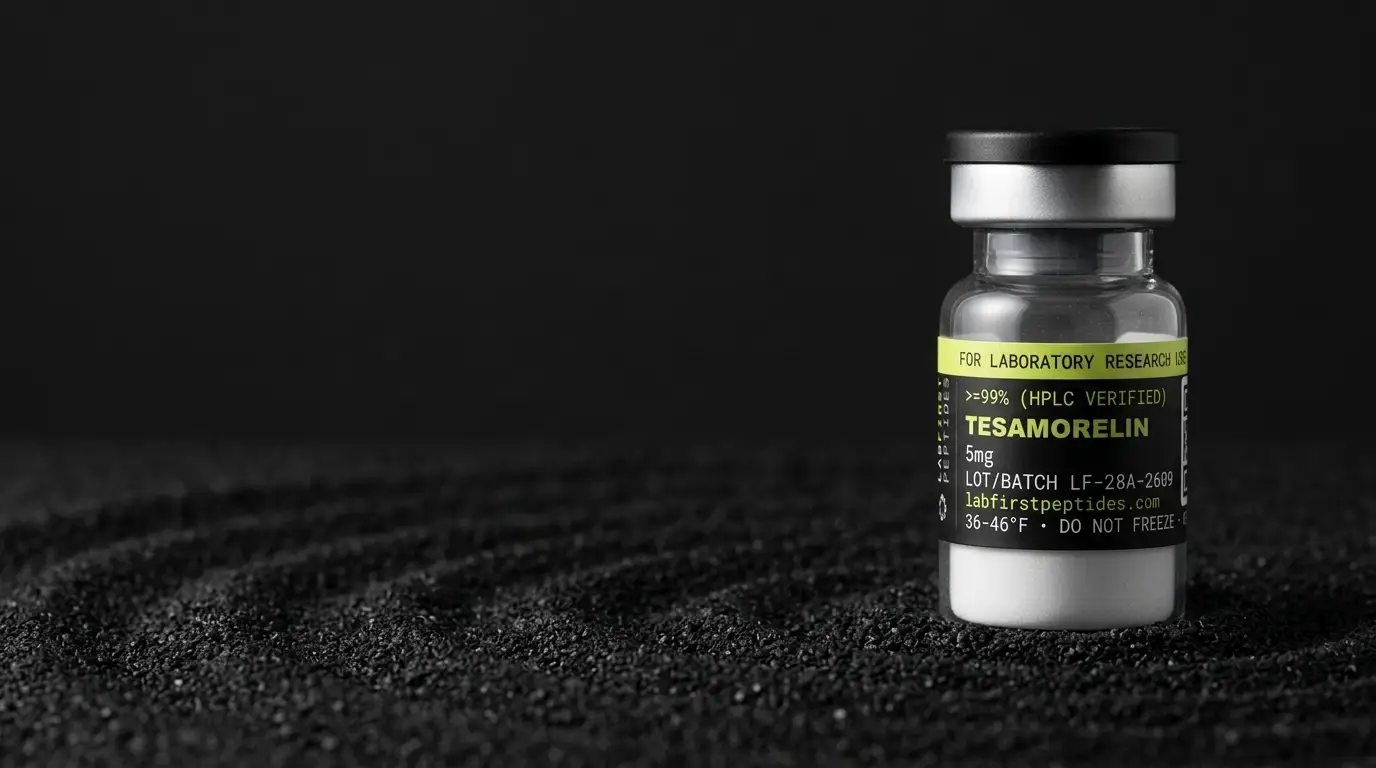
Lyophilised tesamorelin is most stable as a sealed, dry, dark, cold powder. Moisture governs the outcome more than freezer temperature does. Its single methionine and an Asn-Ser motif are the residues to watch, and the clock speeds up sharply once diluent goes in.
- Storage conditions in tesamorelin prescribing information describe formulated sterile products and do not transfer to an unformulated research powder.
- Tesamorelin is the 44-residue GRF backbone with a trans-3-hexenoyl group on Tyr1, around 5136 Da, containing one methionine and no cysteine.
- The Asn8-Ser9 motif makes deamidation the most likely first-appearing degradation product on RP-HPLC.
- Moisture, not freezer temperature, is the dominant driver for a dry peptide, and condensation on a cold vial is the usual delivery route.
- Freeze-thaw damage to a prepared solution accumulates, does not reverse, and is invisible on inspection.
- A research lot without its own stability study has an unestablished shelf life, whatever number the packaging carries.
The published storage numbers describe a formulated medicine
Search for tesamorelin storage conditions and you will mostly find figures lifted from the prescribing information for an approved product. Those numbers are real, and they are earned: they come from stability studies run on a specific sterile formulation, in a specific container closure, with mannitol as a bulking agent and a defined water-for-injection diluent. They describe that article of manufacture and nothing else.
It is a genuinely instructive comparison, though, because the tesamorelin labelling has changed. The original approved presentation carried refrigerated storage. A later reformulation of the same active moiety carries room-temperature storage in its labelling. Same peptide, different excipient system, different assigned condition. That difference exists because storage conditions are a property of the formulation, not of the amino acid sequence.
A research vial of lyophilised tesamorelin has no formulation study behind it. Usually it has no excipient matrix either, or a minimal one the certificate may or may not name. Copying either labelled condition onto that vial is guesswork wearing a lab coat. What can be reasoned about honestly is the chemistry of the sequence, the physics of a dry cake in a sealed vial, and what changes the moment someone adds water. That is what follows.
- Moisture into the cake, usually from condensation on cold glass
- Deamidation at Asn8-Ser9 once water is present
- Oxidation of Met27 from headspace oxygen and light
- Interface and agitation stress in a foamed solution
- Freeze-thaw cycling of a solution held as one container
What the sequence predicts
Tesamorelin is the 44-residue human growth hormone-releasing factor backbone carrying a trans-3-hexenoyl group on the N-terminal tyrosine. Reported molecular formula is C221H366N72O67S with a monoisotopic-adjacent average mass near 5136 Da. The single sulfur in that formula is the whole story of its oxidation behaviour: one methionine, at position 27, and no cysteine anywhere. There is no disulfide to scramble and no free thiol to dimerise, which removes an entire failure category that complicates many peptides of this size.
What remains is worth reading residue by residue. Asparagine 8 is followed immediately by serine. Asn-Ser is one of the faster deamidation motifs in the literature on peptide backbones, second in practice only to Asn-Gly, and it sits close enough to the N-terminus that a deamidated species will often separate cleanly on a reversed-phase gradient. Asparagine 35 sits next to glutamine. Aspartate 3 and aspartate 25 are candidates for isomerisation and for the slow Asp-Xaa cleavage that shows up as a low-mass fragment on LC-MS long before it shows up as anything visible.
The hexenoyl cap is the part I would not overclaim about. It is a short unsaturated acyl chain, and an alkene is in principle an oxidation target, but I am not aware of published forced-degradation work that quantifies that route for this molecule specifically. Treat it as a plausible pathway to look for rather than an established one. The cap also makes the N-terminus more hydrophobic than the parent peptide, which matters mainly for retention time on RP-HPLC and for a modest amount of surface adsorption at low concentration.
Degradation routes and what controls each
| Route | Driver | Site in this molecule | Control |
|---|---|---|---|
| Deamidation | Water activity, temperature, pH above about 6 | Asn8-Ser9 primarily; Asn35; glutamines more slowly | Keep the solid dry; buffer selection once dissolved |
| Oxidation | Headspace oxygen, light, trace metals | Met27; possibly the hexenoyl alkene | Dark storage, cold, low headspace |
| Backbone hydrolysis and Asp cleavage | Moisture, heat, acidic pH | Asp3, Asp25 | Dry sealed solid; short solution horizons |
| Aggregation | Air-water interface, agitation, freeze-thaw | Whole molecule; a 44-mer with hydrophobic patches | Swirl, never vortex or foam; single-use aliquots |
| Surface adsorption | Glass and some plastics at low concentration | Hydrophobic N-terminal region | Documented container material; carrier where the protocol allows |
Two of those rows share a driver. Deamidation and hydrolysis both need water, which is why a genuinely dry cake sits in a much slower regime than any solution at any temperature. Cold slows every row in the table, but it changes rates rather than mechanisms. Moisture is the mechanism.
Conditions by physical state
| State | Temperature | Light | Relative horizon | Why |
|---|---|---|---|---|
| Sealed powder, reserve stock | Minus 20 °C or below, desiccated | Dark | Longest | Water excluded and every rate suppressed |
| Sealed powder, in use | 2 to 8 °C, desiccated | Dark | Shorter | Adequate where the vial is consumed inside a defined window |
| Powder in transit | Ambient, insulated | Dark | Days | A dry solid tolerates short excursions; a solution does not |
| Prepared aqueous solution | 2 to 8 °C | Dark | Days | Deamidation at Asn8 and hydrolysis are now running |
| Solution, single-use aliquots | Minus 20 °C or below | Dark | Longer, at a cost per thaw | Cycling drives aggregation that assay will find before your eye does |
The horizons are relative on purpose. Assigning months to a research lot requires a stability study on that lot, in that closure, under those conditions, of the kind ICH Q1A(R2) describes for registered products. Absent that study the window is unestablished, and a supplier quoting twenty-four months for a powder they have not tested is repeating a convention. The lot's own certificate is the only paper entitled to carry a date, and where it carries none, say so in your record instead of inventing one.
Sealed-vial handling: the condensation problem
The most common avoidable loss happens in about thirty seconds. A vial comes out of a minus twenty freezer into a room at 22 °C and 55 percent relative humidity. Glass at that temperature is far below the dew point. Break the seal and moist room air meets a cold, hygroscopic cake, and water goes into the solid immediately. Then the vial returns to the freezer with the water inside it, and the next person repeats the sequence.
Nothing about this announces itself. A cake that has taken up a percent or two of moisture looks identical to one that has not. The only symptom is a purity number that drifts downward across a lot's working life, by which point the cause is weeks in the past and unrecorded.
The control is dull. Let the sealed vial equilibrate to room temperature before the seal is broken, every time. Twenty to thirty minutes on the bench suits a small vial; put it in a closed box so it warms in the dark. Work briskly once open, reseal with the vial in a desiccator or against fresh desiccant, and note the excursion if your protocol tracks openings. Where a lot will be sampled repeatedly, the better answer is to split the dry powder into several vials once, under low humidity, and never open the reserve again.
Drier is not automatically better in every formulation, incidentally. Residual moisture plays a structural role in some lyophilisates, and the optimum for a sugar-containing cake is not always the lowest achievable water content. That is a formulation finding rather than a storage instruction. For an unformulated research powder, exclude water and stop worrying about the nuance.
What changes once a solution exists
Adding diluent starts a faster clock and adds a route that dry powder does not have: microbial growth. Bacteriostatic water contains benzyl alcohol as a preservative, which addresses growth but does nothing about chemistry; sterile water addresses neither. The diluent guide covers the trade-offs and what belongs in the record either way.
Three practices carry most of the weight. Split the solution into single-use aliquots at the moment of preparation, so no container is ever thawed twice. Label each aliquot at that moment, with a marker that survives condensation and a freezer. And handle the solution gently. A 44-residue peptide with a hydrophobic cap concentrates at the air-water boundary, and a vortexed vial with foam in it has just given the molecule several square centimetres of interface to unfold against. Invert and swirl.
Freeze-thaw cost is the one people discount. Ice formation concentrates the remaining liquid and generates new interfaces, and aggregation from that stress accumulates rather than reversing. A solution on its eighth thaw is not the material the protocol assumed, and no inspection separates it from a fresh one. If you cannot aliquot, at minimum record the thaw count on the container and treat it as a variable in the data.
Adsorption deserves a line as well. At low working concentrations a measurable fraction of peptide can end up on the glass rather than in the solution, which reads out as a weak or drifting response with no degradation peak to explain it. Suspect it when mass balance fails and the chromatogram looks clean.
Worked example: aliquot arithmetic
A 5 mg vial brought into 2.5 mL of diluent gives:
5 mg ÷ 2.5 mL = 2 mg/mL
If the protocol draws 0.25 mL per run, one container yields:
2.5 mL ÷ 0.25 mL = 10 draws
Held as a single container, the tenth draw comes from material warmed and re-chilled nine times, in a vial whose headspace has grown with every withdrawal. Divided into ten 0.25 mL aliquots at preparation, each is thawed once and each has minimal headspace. The cost is a rack of tubes and five minutes.
The vial concentration calculator handles other vial masses and fill volumes. It covers laboratory measurement only.
What the record has to say
Storage discipline that is not written down is not reproducible, and for a peptide with a fast deamidation motif the record is what lets you tell a bad lot from bad handling. The minimum entry for a prepared solution names the source lot, the certificate revision it corresponds to, the diluent and its lot, the volume added, the calculated concentration, the date and time of preparation, and who made it. Aliquots inherit that through one shared identifier rather than each carrying a paragraph.
Add two fields most logs omit: the number of times the parent dry vial has been opened, and whether it was equilibrated before opening. Those are the entries that explain a purity result twelve weeks later.
On the incoming side, read the certificate before the vial goes into storage. For tesamorelin the useful boxes are an RP-HPLC purity figure with the gradient and column stated, a mass confirmation consistent with roughly 5136 Da for the intact molecule, water content, and counterion or acetate content, since a peptide supplied as an acetate salt weighs more than the free peptide and the net peptide content changes your concentration arithmetic. Our documentation standard sets out which of those we treat as non-negotiable. The same reading applies to any peptide; the tirzepatide handling guide works through the equivalent for a lipidated sequence.
Regulatory position
Tesamorelin is a growth hormone-releasing factor analogue. FDA approved tesamorelin acetate as a prescription medicine in 2010 for a specific indication in HIV-associated lipodystrophy, and a later reformulation of the same active moiety is also approved. Those products are sterile, formulated, released under pharmaceutical quality systems, and available only on prescription.
Research-grade lyophilised powder is a different article. It is supplied against a certificate of analysis covering identity and purity, which is a narrower claim about a different kind of material, and it has never been a lawful route to human use at any point in that timeline. Growth hormone-releasing factors and their analogues, tesamorelin included, are also prohibited at all times under the World Anti-Doping Agency prohibited list, which is relevant to laboratories running anti-doping reference work.
Status verified 26 August 2026.
FOR LABORATORY AND IN-VITRO RESEARCH USE ONLY. NOT FOR HUMAN OR ANIMAL CONSUMPTION. NOT FOR PERSONAL, MEDICAL, DIAGNOSTIC, THERAPEUTIC, OR RECREATIONAL USE.
Common questions
Should lyophilised tesamorelin be frozen or refrigerated?
Which degradation product should I expect to see first on HPLC?
How long is a prepared solution good for?
Does the room-temperature labelling on the approved product mean the powder is heat-stable?
Why does the certificate list acetate content?
Is a cake that has shrunk or gone glassy still usable?
More handling guides
Sources
- FDA prescribing information for tesamorelin acetate for injection. Establishes the approval of tesamorelin as a prescription medicine, its excipient system including mannitol, and the assigned storage conditions for the formulated product, including the difference in condition between the original presentation and the later reformulation.
- Butreddy et al., International Journal of Biological Macromolecules, 2020. Review of stresses, stabilisation mechanisms and analytical methods for lyophilised protein and peptide products; supports the degradation-route table and the primacy of solid-state, moisture-controlled storage.
- Manning, Chou, Murphy, Payne and Katayama. Stability of protein pharmaceuticals: an update. Pharmaceutical Research 27(4):544-575 . Basis for the chemical and physical degradation routes described here — the review covers both, and the interaction between them, for peptide and protein pharmaceuticals.
- ICH Q1A(R2), Stability Testing of New Drug Substances and Products. Defines what a stability study must contain before a shelf life can be assigned; supports the position that an untested research lot has an unestablished window.