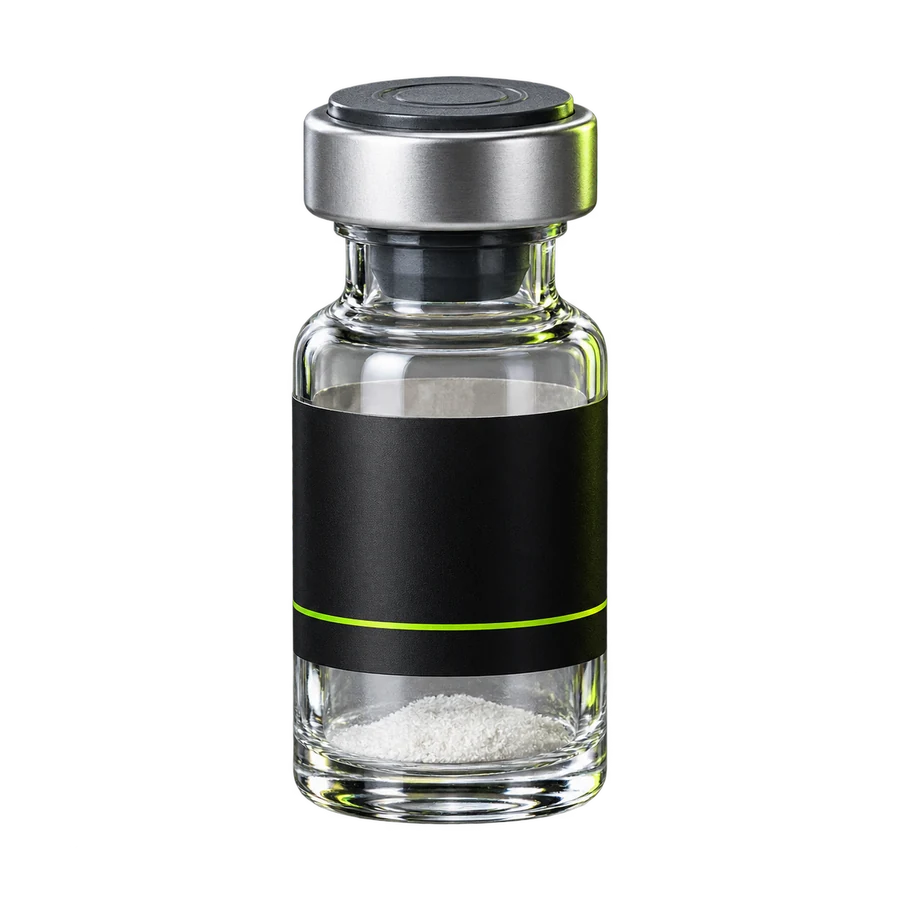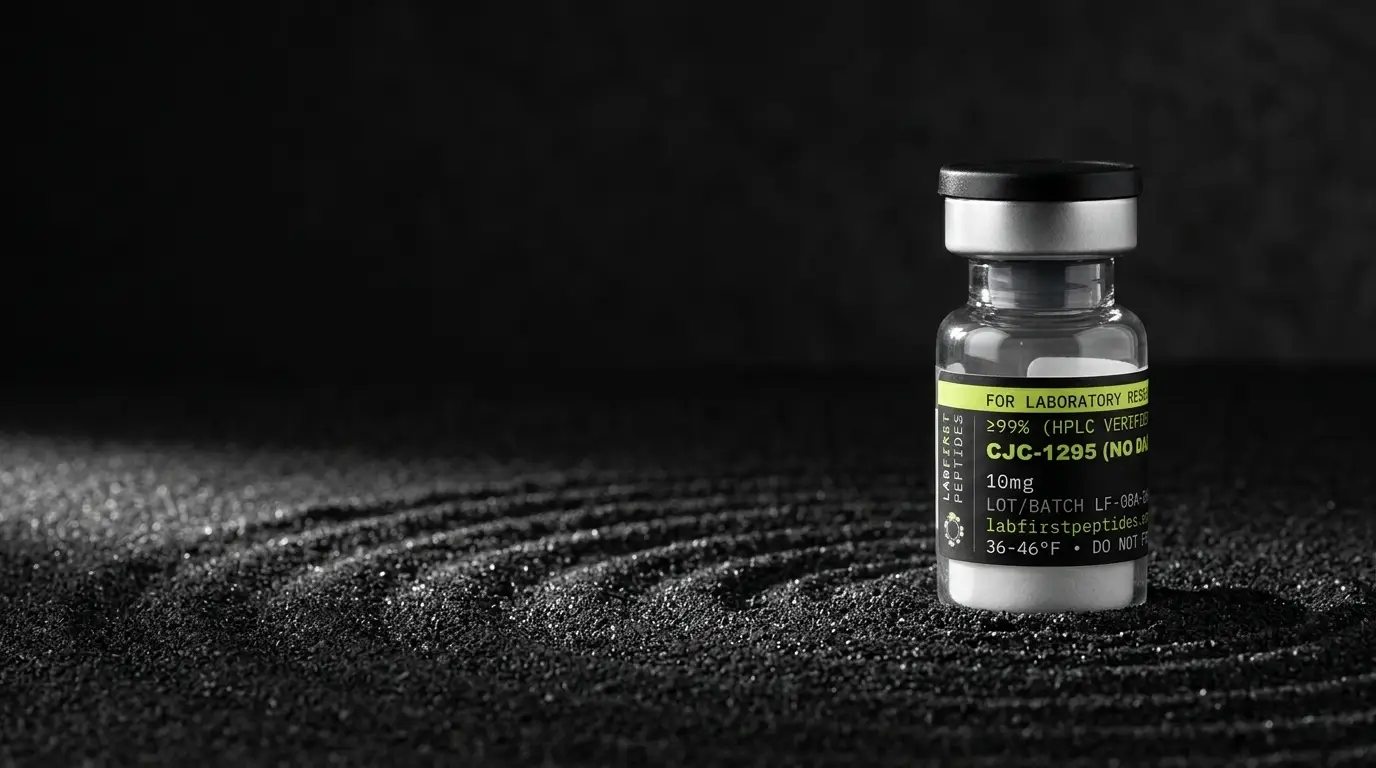
A CJC-1295 ipamorelin blend holds two synthetic peptides dried into one vial. One is CJC-1295 without DAC, a modified 29-residue GRF(1-29) chain at 3367.9 g/mol. The other is ipamorelin, a five-residue peptide at 711.9 g/mol. Our 10 mg vial lists the total; the lot certificate states the amount of each.
- CP10 is a single 10 mg vial holding CJC-1295 no DAC and ipamorelin together.
- CJC-1295 no DAC is a modified 29-residue GRF(1-29) amide, C152H252N44O42, 3367.9 g/mol.
- Ipamorelin is a pentapeptide, C38H49N9O5, 711.9 g/mol, PubChem CID 9831659.
- The DAC is an albumin-bonding maleimido group this blend's CJC-1295 does not carry.
- The LabFirst catalog states the CP10 blend total only; the lot certificate states each component amount.
- In a CJC-1295 ipamorelin blend, equal masses would mean about 4.7 ipamorelin molecules per CJC-1295 molecule.
Two peptides sharing a vial
What is actually in there? Two different molecules, one large and one small, that were dissolved together and then freeze-dried into a single white cake. Nothing links them chemically. They simply share the glass. Picture the vial as one envelope holding two separate letters.
The product here is SKU CP10, listed as CJC-1295 (no DAC)+IPA, 10 mg total. Both components are also sold on their own, as CJC-1295 no DAC and ipamorelin, which makes it easy to compare each part of the blend with its single-compound record.
This page is about composition only. For buying checks see the CJC-1295 ipamorelin blend buying guide, and for temperatures the storage temperature reference.
- CJC-1295 without DAC, 29 residues, 3367.9
- Ipamorelin, five residues, 711.9
- No chemical link between the two
- Total of 10 mg printed on the label
- Per-component milligrams on the lot certificate
- Counterion and water inside the powder weight
The larger component: CJC-1295 without DAC
CJC-1295 as first published is not quite the molecule in this vial. The Jette paper in Endocrinology identified CJC-1295 as a derivative of hGRF(1-29) carrying a maleimido group, the drug affinity complex or DAC, placed so it would bond to albumin. The no DAC material is the peptide chain without that group, often sold as modified GRF(1-29).
Its frame comes from human growth hormone releasing hormone. The UniProt record for that hormone shows a 108-residue precursor with the mature peptide cut from positions 32 to 75, and the first 29 residues of that mature peptide are the starting point. Our chemistry records describe the no DAC chain as that 29-residue amide with four substitutions, formula C152H252N44O42 and average mass 3367.9.
PubChem has no record for this molecule under any name we tried, so the formula comes from the developer literature and the mass is calculated from it.
The smaller component: ipamorelin
Ipamorelin is a pentapeptide, as Raun and colleagues described it in the European Journal of Endocrinology. PubChem lists it as C38H49N9O5 with an average mass of 711.9 and a monoisotopic mass of 711.386.
Its PubChem name spells out the five building blocks. Reading from the N-terminus, the IUPAC way: an aminoisobutyric acid unit, histidine, a 2-naphthylalanine in the D form, phenylalanine in the D form, and lysine finished as an amide. Three of those five are not among the twenty standard amino acids or appear in their mirror-image form.
Those unusual units matter for testing, because the D-form residues cannot be confirmed by mass alone.
The two side by side
| Property | CJC-1295 no DAC | Ipamorelin |
|---|---|---|
| Residues | 29 | 5 |
| Formula | C152H252N44O42 | C38H49N9O5 |
| Average mass | 3367.9 | 711.9 |
| PubChem record | None found | CID 9831659 |
| C-terminus | Amide | Amide |
| Sulfur | None | None |
The size gap is the most useful fact on the table. The CJC-1295 component is roughly 4.7 times heavier per molecule, and that shapes everything from how the vial is tested to how its label should be read.
How much of each peptide is in 10 mg?
Our catalog gives the total, 10 mg, and not the split. Rather than print a ratio the records do not support, we leave that to the lot certificate, which should state milligrams of each component.
When you do see a split, check what kind of ratio it is. A mass ratio and a molecule ratio are different claims. If a vial held equal milligrams of each, it would contain about 4.7 ipamorelin molecules for every CJC-1295 molecule, because the smaller molecule weighs so much less.
The label also refers to powder, and powder includes counterion and some water along with the peptides. The net peptide content guide explains how that fraction is measured.
What the blend name does not tell you
CJC-1295 ipamorelin is a trade description, not a defined substance. No pharmacopeial monograph sets its composition, so two suppliers can use the same name for different splits and both describe their own product accurately.
The name also invites a specific mix-up. CJC-1295 with DAC and without DAC are different molecules, and sermorelin, unmodified GRF(1-29) at 3357.9 in PubChem, sits only about ten daltons from the no DAC chain. A blend listing that says only CJC-1295 has not said which of these is in the vial.
The composition is fixed by the documents, not by the name: a formula and a mass for each component, and an amount for each.
How are the contents confirmed?
A laboratory separates the two peptides by liquid chromatography and weighs each by mass spectrometry, looking for a mass near 3367.9 and another near 711.9. Purity and content are then reported per component.
The three companion pages go into detail: reading the blend certificate, how identity is confirmed, and storage and stability.
LabFirst shows results only once the certificate for that lot is published. Nothing on this page reports a result for any of our lots. Published certificates appear through the certificate lookup page and on the CJC-1295 no DAC + ipamorelin product page.
Reading the product label
The label on a CP10 vial is short by design. It names the blend, gives the 10 mg total and carries a lot number. The lot number is the most important of the three, because it is the link to the certificate that holds everything the label leaves out.
Write the lot number down when the vial arrives. If the vial is ever separated from its box, that number is the only way to connect it back to its test results. Ending the chain of records at the vial is the most common way good documentation gets lost.
The words for laboratory research use on the label are a statement about what the material is supplied for. They tell you nothing about composition, which is the job of the certificate.
Why the two are sold together
The two components are chemically unrelated. One is built on the GHRH frame from UniProt P01286, and the other is a short synthetic pentapeptide with three nonstandard building blocks. They reach the same vial because researchers who work with one often work with the other, and a single vial saves a step at the bench.
That convenience comes with a cost in documentation. A single-compound vial needs one identity result and one purity figure. A blend needs two of each plus an amount for each, and a reader has to check more rows before trusting the label.
Buying the two separately gives full control over the ratio in a laboratory solution. Buying the blend means accepting the ratio fixed at filling, which is exactly why that ratio should be written on the certificate.
How the vial is made, in outline
Each peptide is synthesized on its own, purified, and characterized. The two are then dissolved together at the intended proportions, filled into vials, and freeze-dried so the water leaves and a dry cake remains. The stopper is seated under controlled conditions to keep moisture out.
That sequence explains two things about the finished product. First, each component carries its own synthesis impurities from before blending, so purity must be judged per component. Second, the cake contains everything that was in the solution, including counterions from purification, which is why net peptide content is reported separately from the label weight.
The lyophilized peptide guide explains the drying step in more detail.
Checking the name against the chemistry
Three quick checks cover most labeling errors. Does the listing say no DAC explicitly? Does the certificate report a mass near 3367.9 and not 3357.9, which would be sermorelin? And does it report a second mass near 711.9 for ipamorelin?
If all three hold, the vial holds what the name says. If any fails, the name and the contents disagree, and the contents win. Our types of peptides guide shows how modified and unmodified chains like these are classified.
A certificate that answers all three with printed figures is worth more than any product description, including this one.
Regulatory position
Neither component in this blend, and not the blend itself, has a United States pharmacopeial monograph. It is sold as a research chemical, and the release specification for each lot is the supplier's own.
FOR LABORATORY AND IN-VITRO RESEARCH USE ONLY. NOT FOR HUMAN OR ANIMAL CONSUMPTION.
What is CJC-1295 (no DAC)+IPA studied for?
Published research on CJC-1295 (no DAC)+IPA investigates the areas below, which is a different question from what CJC-1295 (no DAC)+IPA will do for anyone, a claim about a living system that nothing on this site is sold for.
What it is. A GHRH copy and a growth-hormone releaser, freeze-dried together in one vial.
What the research looks at. The ingredients appear separately in hormone research. The blend as sold is a way of packaging them rather than something anyone has studied.
How it is thought to work. Two molecules working on two different receptors: CJC-1295 (no DAC) on the GHRH receptor, ipamorelin on the ghrelin receptor. See each ingredient’s own record. Putting them together does not create a third mechanism.
What is not established. No approved product for either ingredient or for the combination. A vial holding two compounds has to be stored to suit the fussier one, and CJC-1295 is the fussier one here.
The full record, including the certificate for the lot in stock, is on the CJC-1295 (no DAC)+IPA product page.
Common questions
What two peptides are in the CJC-1295 ipamorelin blend?
Is the CJC-1295 in this blend the DAC version?
How many milligrams of each peptide does the 10 mg vial contain?
Why does the molecule ratio differ from the mass ratio?
Published certificates for CJC-1295 (no DAC)+IPA
Every figure below is read from a report the laboratory issued for that lot; each page carries the PDF and the lab's own verification link.
More documentation guides
Sources
- Jette et al., Endocrinology, 2005 (PubMed 15817669). The paper that names CJC-1295 as a maleimido derivative of hGRF(1-29) built to bond to albumin; the no DAC material is the peptide without that reactive group.
- Raun et al., European Journal of Endocrinology, 1998 (PubMed 9849822). Describes ipamorelin as a pentapeptide; cited here for its structure only.
- PubChem Compound Summary, Ipamorelin (CID 9831659). Formula C38H49N9O5, molecular weight 711.9, monoisotopic mass 711.386, and the IUPAC name that spells out the residues and the two (2R) centers.
- PubChem Compound Summary, Sermorelin (CID 16132413). Formula C149H246N44O42S and molecular weight 3357.9 for unmodified GHRH(1-29), the parent the CJC-1295 component must be told apart from.
- UniProt P01286, Somatoliberin, Homo sapiens. The GHRH precursor record; the mature peptide sits at positions 32 to 75, and its first 29 residues are the frame both sermorelin and the CJC-1295 component are built on.
- IUPAC-IUB JCBN, Nomenclature and Symbolism for Amino Acids and Peptides, 3AA-11 to 3AA-13. Defines a peptide as the product of amide formation between amino acids, names the peptide bond, describes the loss of water and the residue, sets the oligopeptide and polypeptide ranges, and fixes N-to-C writing order.