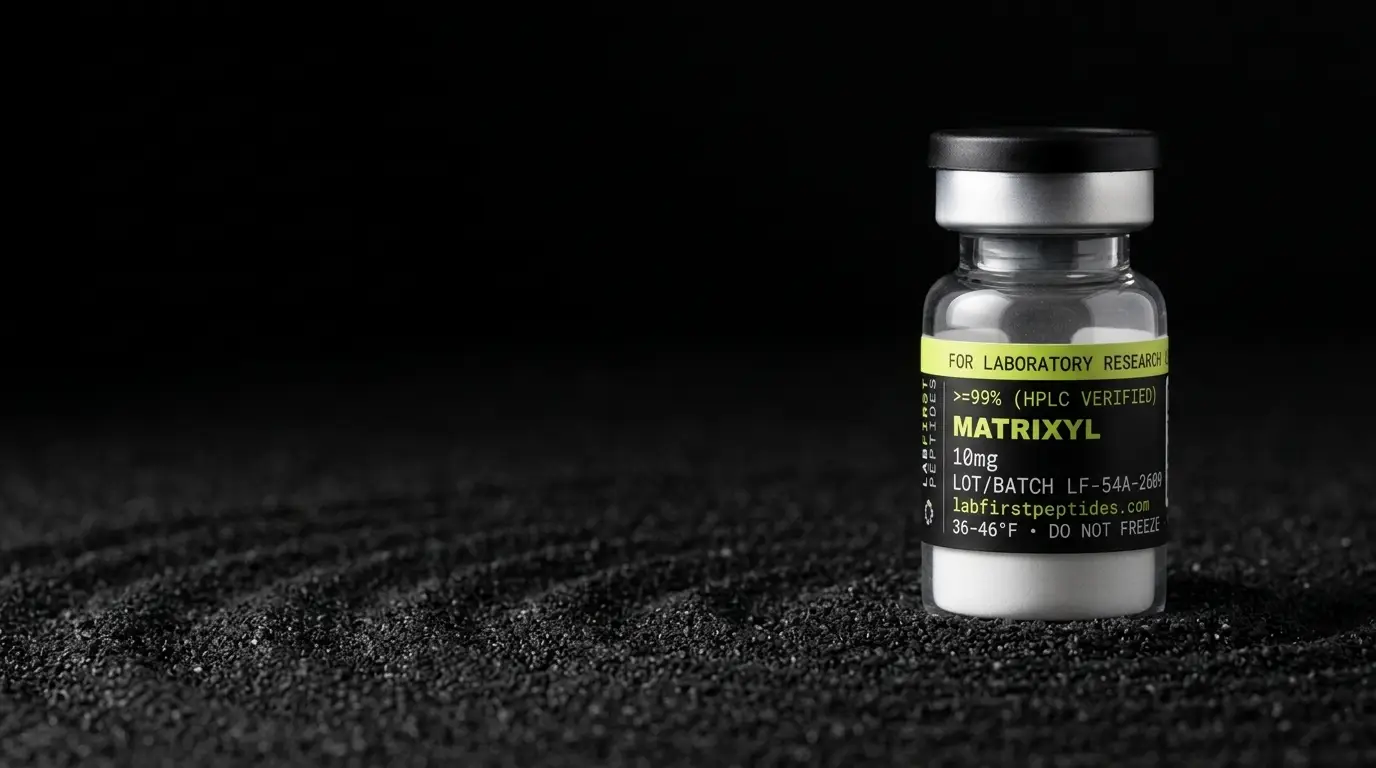
Matrixyl identity is confirmed mainly by mass spectrometry. The lab weighs the molecules in the lot and compares the result with the expected mass of palmitoyl pentapeptide-4, 801.5575 Da. A second check compares its HPLC retention time with a reference. Together they tell pal-KTTKS apart from free KTTKS and from Matrixyl 3000.
- Identity and purity are separate attributes under ICH Q6B.
- Pal-KTTKS: 801.5575 Da monoisotopic; [M+H]+ near m/z 802.57; [M+2H]2+ near 401.79.
- Free KTTKS without the palmitoyl group is about 563.33 Da.
- A mass match does not read the sequence; retention against a reference adds a second test.
- KTTKS has no aromatic residues, so detection runs near 214 nm.
What question does identity answer?
Identity answers whether the vial holds the molecule its label names. Two vials sit on a bench. Both are labeled Matrixyl, both hold white powder, both have a certificate reporting 98 percent purity. One could still be the wrong molecule. Purity cannot tell them apart. Identity testing can.
Identity asks which substance is present. Purity asks how much of the detected material is a single substance. ICH Q6B, the international guideline on specifications for biotechnological and biological products, keeps these as separate attributes and says identity tests should be highly specific, based on unique aspects of the molecular structure. It also notes that more than one test may be needed to establish identity.
For Matrixyl the question has real teeth, because the trade name has been used for more than one material. This guide covers how a laboratory settles it and what the paperwork should show. The Matrixyl certificate of analysis guide covers the rest of the certificate.
- Name the molecule: pal-KTTKS
- Compute theory: 801.56 Da monoisotopic
- Read the ions: m/z 802.57 and 401.79
- Rule out free KTTKS near 563 Da
- Match retention against a reference
The molecule being confirmed
In this catalog Matrixyl is palmitoyl pentapeptide-4, pal-KTTKS. The IUPAC name in its PubChem record, CID 9897237, describes the structure exactly: a hexadecanoyl group on the alpha-amine of lysine 1, then threonine, threonine, lysine and serine, ending in a free carboxylic acid. The two lysine side-chain amines stay free, and both threonines carry the (2S,3R) configuration of natural L-threonine.
| Property | Value |
|---|---|
| Sequence | Lys-Thr-Thr-Lys-Ser (KTTKS), free C-terminal acid |
| N-terminal group | Hexadecanoyl (palmitoyl) on the alpha-amine of lysine 1 |
| Molecular formula | C39H75N7O10 |
| Average molecular weight | 802.1 g/mol |
| Monoisotopic mass | 801.5575 Da |
Matrixyl 3000 is a different material, a blend of two other palmitoylated peptides. The palmitoyl pentapeptide-4 guide covers the names in circulation and why they get confused.
Why the name makes this harder
For many catalog compounds, the identity test confirms what everyone already assumed. With Matrixyl the name itself is loose. It has been used for the single lipopeptide pal-KTTKS, and the related trade name Matrixyl 3000 covers a blend of two different palmitoylated peptides.
That means a label alone cannot settle what is in a vial. A buyer reading Matrixyl on a listing and Matrixyl on a certificate may be looking at two documents that refer to different materials. Only the measured evidence resolves it, which is why the identity block deserves more attention here than it does for a compound with one unambiguous name.
There is a third possibility that the name hides: the peptide without its palmitoyl group. Free KTTKS is the same five residues with no acyl group, and a synthesis that failed to acylate the N-terminus would produce it. The mass check below catches it immediately.
Mass spectrometry: the primary evidence
Intact mass is the backbone of the identity file. The instrument ionizes the sample, measures the mass-to-charge ratio of what it sees, and the laboratory compares the result with theory.
| Species | How it arises | Expected value |
|---|---|---|
| Neutral molecule | Reference value from the formula | 801.56 Da monoisotopic |
| [M+H]+ | One proton added in electrospray | m/z 802.57 |
| [M+2H]2+ | Two protons; the free lysine amines help | m/z 401.79 |
| Free KTTKS | Palmitoyl group absent | about 563.33 Da, 238.23 below |
| [M+Na]+ | Sodium adduct, common and harmless | m/z 824.55 |
Every value in that table is arithmetic you can check with the PubChem monoisotopic mass. Add a proton, about 1.007 Da, for the protonated ion. Add two and divide by two for the doubly charged ion. Subtract the C16H30O acyl unit, about 238.23 Da, to find the unacylated peptide. Add sodium less a hydrogen, about 21.98, for the sodium adduct.
The unacylated mass is the check that matters most. Free KTTKS and pal-KTTKS differ by more than 200 Da, which any working instrument resolves at a glance. A certificate whose observed mass sits near 563 describes a peptide without its palmitoyl group. More on instrument choice is in the LC-MS identity testing guide.
What does a mass match not prove?
A matching mass shows the composition is consistent with the claimed structure. It does not read the sequence. The scale tells you which pieces are there, not what order they are in. KTTKS and a scrambled version such as TKKST have the same formula and the same mass. So does any other arrangement of the same five residues with the palmitoyl group attached somewhere.
Sequence-level confirmation needs fragmentation. Tandem mass spectrometry breaks the ion into pieces and reads a ladder of fragment masses against the expected backbone. Routine certificates for a catalog compound rarely go that far, and often they do not need to.
Chromatography supplies the cheaper second line. Retention time on a reversed-phase column, compared with a qualified reference standard under the same method, depends on how the molecule is put together, not only on its mass. The palmitoyl chain makes pal-KTTKS strongly retained, much more than free KTTKS. A molecule that matches both the mass and the retention of the reference has passed two independent physical tests at once, which is what Q6B means by more than one test.
Reading the identity block on a certificate
A useful identity block names the technique, ESI-MS or MALDI-TOF, then shows the theoretical mass and the observed mass for this lot, on the same basis. Monoisotopic against monoisotopic, or average against average. Mixing the two produces a gap of about half a dalton that is an accounting error rather than a finding.
Look next at what else the spectrum shows. A small sodium adduct is routine. A prominent peak near 563 or 564 means a share of the lot lacks its palmitoyl group. Peaks at unexplained masses deserve a question to the issuing laboratory.
Then check the chromatogram conditions: column, gradient, detection wavelength and retention time. Because KTTKS has no aromatic residues, detection should be at low wavelength, near 214 nm. And the lot number on the sheet has to match the lot on the vial, or none of the evidence applies to your material.
The Matrixyl product page carries lot documentation in this format once it is published. Results appear there only after the certificate for a lot is released, never before. The certificate standard sets out what every certificate in this catalog must show.
Sample handling and false results
Identity testing can go wrong in the preparation, not only in the instrument. Pal-KTTKS is amphiphilic: a hydrocarbon tail on one end and a charged, hydrogen-bonding head on the other. Molecules of this shape tend to cling to surfaces and to associate with one another in water, so a poorly dissolved sample can under-report or give a messy spectrum.
Laboratories usually handle this with organic solvent in the sample diluent and a method that runs to high organic content. If a certificate reports an odd result, the sample preparation details are one of the first things worth asking about. The Matrixyl storage and stability guide covers the same behavior from the storage side.
FOR LABORATORY AND IN-VITRO RESEARCH USE ONLY. NOT FOR HUMAN OR ANIMAL CONSUMPTION.
Where purity fits beside identity
Once identity is settled, purity tells you how much of the detected material is that one species. The two answers depend on each other. A 99 percent purity figure for the wrong molecule is worthless, and a correct identity on a lot that is half impurities is not much better.
For pal-KTTKS the likely impurities are related peptides from synthesis: sequences missing a residue, the unacylated chain, or chains carrying an extra or misplaced acyl group. Several of these differ in mass from the target, so a good report ties the minor chromatography peaks to masses where it can. The HPLC purity versus identity guide explains how the two measurements divide the work.
Neither figure says how much of the vial mass is peptide. That is net peptide content, a third measurement, covered in the certificate guide.
What to ask the laboratory
If the identity block leaves questions, a short list covers most of them. Which instrument and ionization mode was used? Is the theoretical mass monoisotopic or average? Which ions were observed, and at what intensity relative to the main one? Was a reference standard run under the same chromatography method, and did retention times agree?
A laboratory that ran the work properly can answer each of those in a sentence. Vague answers, or a reply that the result simply conforms, tell you how much weight the identity line can carry.
What is Matrixyl studied for?
Published research on Matrixyl investigates the areas below, which is a different question from what Matrixyl will do for anyone, a claim about a living system that nothing on this site is sold for.
What it is. Palmitoyl pentapeptide-4, palmitoyl-Lys-Thr-Thr-Lys-Ser (pal-KTTKS) — a lipidated fragment of type I procollagen.
What the research looks at. Topical cosmetic use on photoaged facial skin. One of very few compounds on this catalog with a published randomised placebo-controlled human trial of the actual marketed form.
How it is thought to work. KTTKS is a subfragment of the C-terminal propeptide of type I collagen, proposed to act as a feedback signal stimulating collagen synthesis. The palmitoyl group is added to make an otherwise hydrophilic pentapeptide able to cross the stratum corneum.
What is not established. Mechanism at the molecular level. The collagen-feedback hypothesis is plausible and has not been demonstrated as the operative pathway in human skin.
The full record, including the certificate for the lot in stock, is on the Matrixyl product page.
Common questions
What is the exact mass of Matrixyl?
How do you tell Matrixyl from free KTTKS by mass?
Does a correct mass prove the sequence is KTTKS?
Why does the spectrum show a doubly charged ion?
More documentation guides
Sources
- PubChem compound record: Palmitoyl pentapeptide-4 (CID 9897237). Formula C39H75N7O10, molecular weight 802.1, monoisotopic mass 801.5575, and the IUPAC name showing a hexadecanoyl group on the alpha-amine of the N-terminal lysine of Lys-Thr-Thr-Lys-Ser, with a free C-terminal acid.
- ICH Q6B, Specifications: Test Procedures and Acceptance Criteria for Biotechnological/Biological Products. Identity tests should be highly specific and based on unique aspects of molecular structure; more than one test may be needed to establish identity; purity and quantity are separate specification attributes.