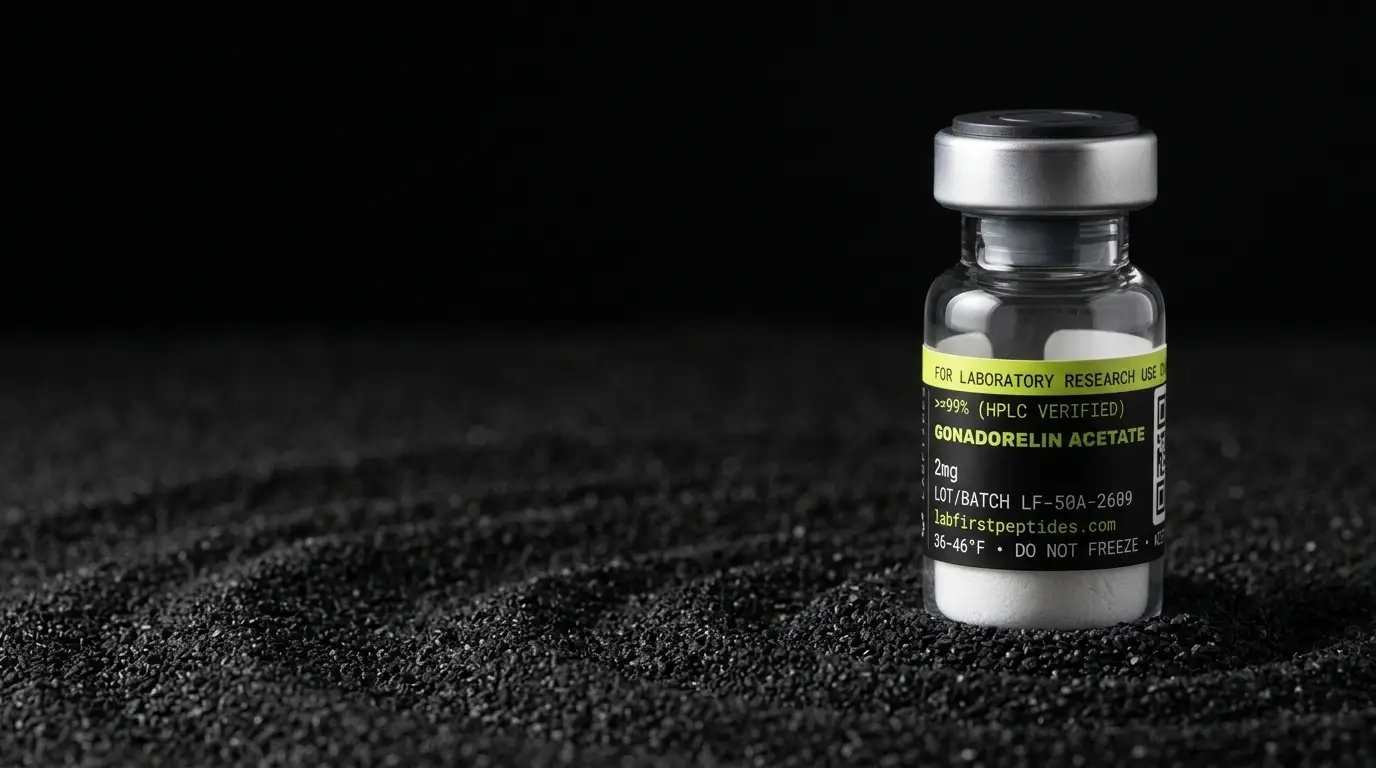
Gonadorelin is synthetic gonadotropin-releasing hormone, the native ten-residue peptide, sold as the acetate salt; PubChem lists the acetate as CID 11980076. Buy it from a supplier that names the laboratory, prints the theoretical mass, dates the purity run and puts the lot on the vial. LabFirst lists one size from $55, each lot independently tested.
- Gonadorelin Acetate is sold at LabFirst in 2mg from $55.
- The identity reference for gonadorelin is the free peptide C55H75N17O13, about 1,181.6 Da monoisotopic; PubChem's 1,242.3 Da figure (CID 11980076) includes the acetate.
- A complete certificate carries identity by mass spectrometry, purity by HPLC with method and date, and net content in milligrams, all for the lot printed on the vial.
- LabFirst lots are tested by Kovera Labs, an independent laboratory. Every lot measured 98% purity or higher; COAs are publishing soon.
- Shipping is $15 flat under $200 and free above, US only; volume tiers are 10% at ten vials of one size and 15% at twenty.
What "gonadorelin peptide" names, and what it does not
Gonadorelin is the name for synthetic GnRH, gonadotropin-releasing hormone, made with exactly the same ten residues as the natural hormone: pyroglutamate, histidine, tryptophan, serine, tyrosine, glycine, leucine, arginine, proline and an amidated glycine at the end. Older papers call it LHRH. It is sold almost always as the acetate salt, which is why the catalog record reads Gonadorelin Acetate while buyers search for gonadorelin, gonadorelin peptide and GnRH. Those names point at one molecule. The salt form matters to a buyer only in two places, the mass on the certificate and the net content, and both are covered below.
What it is not matters just as much. The long-acting GnRH analogues, leuprolide, triptorelin, goserelin and the rest, are different molecules with substituted residues, and a certificate for one of them cannot support a gonadorelin listing. Kisspeptin-10, which sits upstream of GnRH in the research literature, is also a different peptide entirely. Sellers sometimes group these together on one page because they share a pathway; on a certificate they share nothing, since each has its own sequence and its own mass.
Being the native sequence makes gonadorelin chemically simple next to most of the catalog: ten residues, no lipid chain, no unnatural amino acids. Simple is not the same as trouble-free. The N-terminal pyroglutamate forms by cyclization, and a lot where that step went wrong carries a related peptide 17 Da heavier. The tryptophan oxidizes. The research summaries cited below describe the receptor pharmacology; this page describes the powder in the vial and how to check a lot of it, and nothing about any use.
The reference point for identity is public. PubChem lists undefined as CID 11980076 with molecular formula C57H79N17O15, an average molecular weight of 1242.3 Da. Those are the numbers a mass spectrometer is checked against, and the number a certificate must print beside the observed mass.
- Lot on the vial matches the certificate
- Laboratory named, with its own lookup
- Theoretical mass printed and correct
- Purity has a method and a date
- Net content stated in milligrams
Gonadorelin Acetate sizes and price per mg
LabFirst lists Gonadorelin Acetate in one size (2mg) from $55, priced per vial with the per-mg figure beside it so sizes can be compared without arithmetic. It is sold in one size, 2mg, at $27.50 per mg.
| Size | Price | Per mg | 10 units | 20 units | Availability |
|---|---|---|---|---|---|
| 2mg (best per mg) | $55 | $27.50 | $495 ($24.75/mg) | $935 ($23.38/mg) | Backorder, join the waitlist |
The volume tiers are per size, not per basket: ten vials of one size take 10% off that line and twenty take 15%, and mixed sizes do not combine. Shipping is a flat $15 on orders under $200 and free from $200, within the United States only, with same-day dispatch on orders placed before 12 PM Pacific on a business day. The cost per mg tool runs the same comparison across any two listings, ours or anyone else's.
Gonadorelin is one of the less expensive peptides to make: ten common residues, a standard cyclization at the start, no lipidation and no conjugation. LabFirst lists it in a single 2 mg size, so price comparison comes down to the per-milligram figure against other sellers' listings, measured on the same basis. When you compare, check whether the other listing's milligrams are acetate salt or free peptide. The difference is about five percent by formula, small enough to miss and large enough to matter on a bulk order.
A price far under the market usually means one of three things: a lot with no net content figure, so the buyer cannot tell how much peptide is in the vial; an analogue sold under the gonadorelin name; or a certificate that belongs to a different lot. The first is the most common and the hardest to spot without asking. The volume tiers on this page are the only discount we run, per size and the same every month, and the gonadorelin price does not move with demand.
The certificate a Gonadorelin Acetate lot must carry
Three tests answer three different questions, and a certificate of analysis for Gonadorelin Acetate is only complete when it carries all three for the exact lot on the vial. The mass number needs one correction before you use it. PubChem's record for gonadorelin acetate, CID 11980076, gives C57H79N17O15 at 1,242.3 Da, and that figure includes one acetic acid. A mass spectrometer sees the peptide, not the salt, so the number a certificate should report is the free peptide: C55H75N17O13, 1,182.3 Da average or about 1,181.6 Da monoisotopic, usually observed as the singly or doubly protonated ion. A certificate printing 1,242 Da as the observed mass has copied the salt record rather than measured anything.
Purity is a separate question, answered by HPLC: how much of what came off the column was the compound. The figure is only interpretable with its method beside it (column, gradient, detection wavelength) and a date, which is what ICH Q2(R2) means when it asks that an analytical procedure be shown fit for its purpose. A percentage with no method and no date is a number somebody typed, and a certificate that carries every test but for a different lot number than the vial is the most common failure of all and the easiest to catch. Net content is the third test and the one most often missing: the milligrams of Gonadorelin Acetate actually in the vial, measured, against the size printed on the label.
On a ten-residue peptide, purity by HPLC is a cleaner measurement than it is on a 40-mer, and that cuts both ways: a good lot should show one dominant peak with small, well-separated neighbors, so a messy trace means something. The impurities to look for are the open-chain glutamine form where pyroglutamate failed to close, deletion sequences missing one residue, and the oxidized tryptophan. The chromatogram with its column, gradient and wavelength is the evidence. A percentage with no method and no run date is a number on a page.
Net content is where the salt shows up again. A 2 mg vial of gonadorelin acetate is 2 mg of powder that includes acetate and some residual water, so the peptide content is lower than the label. That is normal and honest when it is measured and stated. Quantitative HPLC against a reference standard, or amino acid analysis, gives the real milligrams of peptide, and the counter-ion belongs beside the figure. A certificate that leaves out net content has measured the powder, which is not quite the same thing as measuring the vial.
Checking a supplier of Gonadorelin Acetate: five checks before you order from anyone
Every seller of gonadorelin peptide says "third-party tested". The phrase costs nothing. These five checks take about four minutes per listing and separate a tested lot from a tested-sounding one.
- The lot on the vial is the lot on the certificate. Read the printed lot number, then open the certificate and match it. A certificate for "Gonadorelin Acetate" with no lot, or a lot that does not match, describes some other vial.
- The laboratory is named and has its own lookup. The report should come from a laboratory the seller does not own, with a search code you can enter on the laboratory's own site. LabFirst lots are tested by Kovera Labs and the laboratory's report is published for each lot; anything that exists only as the seller's own summary has not been verified.
- The theoretical mass is printed, and it is the right one. For gonadorelin that is the free peptide, about 1,181.6 Da monoisotopic (1,182.3 Da average), not the 1,242.3 Da of the acetate salt record; a certificate that reports the salt mass as observed has copied a database entry.
- Purity has a method and a date. An HPLC percentage should name the method and the run date. A figure that reads "99%+" with neither, or one date reused across every product a seller lists, is decoration.
- Net content is stated in milligrams. The label size is a claim; the certificate's net content is the measurement. If the certificate has no net content line, the purity figure describes the powder, not the vial, and the price per mg you calculated is fiction.
How listings for Gonadorelin Acetate specifically mislead:
- A certificate whose observed mass is 1,242 Da. That is the acetate salt figure from a database; the peptide itself flies at about 1,182 Da, and a real spectrum shows that.
- An analogue under the gonadorelin name. Leuprolide, triptorelin and the other long-acting GnRH analogues are different sequences with different masses, and their certificates prove nothing about gonadorelin.
- "Gonadorelin for sale" with no lot number on the vial or the certificate. Without a lot, a certificate describes some batch somewhere, not the one being sold.
- A purity percentage with no chromatogram. On a short peptide a clean trace is easy to show, so a seller who will not show it is choosing not to.
- A 2 mg label and no net content. The acetate and water are part of that 2 mg; only a measured peptide content says how much gonadorelin is there.
How to verify a LabFirst Gonadorelin Acetate lot
Every Gonadorelin Acetate size is on backorder today. Join the waitlist on the product page and the restock email carries the lot and its certificate when they exist.
Verification runs through the laboratory, not through us. Open the certificate index, find the lot, and read the laboratory's report; it is Kovera Labs' own document, not ours, and the laboratory will confirm it against its records.
The product page reads the live stock feed on load (stock, lot and certificate state for every size), so what you see when you order is what ships. The lot is printed on the label and encoded in the QR patch on its right-hand side; scanning it opens that lot's record.
Storage and shipping for Gonadorelin Acetate
Freeze-dried and sealed, gonadorelin keeps well when stored cold and away from light, for the shelf period printed on its certificate. The tryptophan is the residue most sensitive to light and air, and the free C-terminal amide and the serine are where slow hydrolysis starts once water is present. None of that is fast in a dry cake. It speeds up in solution, so a prepared solution gets dated, kept cold and dark, and used within the laboratory's own stability record rather than any figure printed on a label.
The other risk to the dry powder is humid air. Once a vial is opened the cake starts taking on water, so open each vial once for the work it was bought for, and do not reseal a partly used vial for later. Small peptides like this one are easy to weigh out wrongly when they have absorbed moisture, which is one more reason the net content on the certificate is worth having before the vial is ever opened.
Orders ship within the United States, flat $15 under $200 and free above it, same day when placed before 12 PM Pacific on a business day, and the shipping page states the cutoff, the carriers and what is and is not promised.
The record a laboratory keeps on arrival is what makes the certificate usable later, and it is short:
- the lot number as printed on the vial, and the certificate's accession or search code beside it;
- the date received and the condition of the seal;
- the storage location and temperature it went into;
- the number of vials, and later the date each one was opened and by whom.
A Gonadorelin Acetate vial with that record behind it can be traced from the bench to the laboratory report in one step; without it, the certificate is a document about a vial that can no longer be identified.
Regulatory status, and what this page is not
This page makes no claim about the regulatory history of gonadorelin as a medicine, and none should be read into it. What matters here is narrower and certain: the vial sold on this site is research material, not made under any drug approval and not tested to any drug specification, and no equivalence to any approved or formerly approved product is claimed or possible from a certificate. A certificate measures one lot. It cannot say anything about a manufacturing process, which is what an approval covers, so every figure on a research vial is the supplier's number backed by the laboratory it names.
FOR LABORATORY AND IN-VITRO RESEARCH USE ONLY. NOT FOR HUMAN OR ANIMAL CONSUMPTION. LabFirst sells Gonadorelin Acetate to laboratories and researchers as material for in-vitro work, gives no guidance on use, and ships only against that understanding. Nothing on this page or on the product page describes preparing or administering anything.
What is Gonadorelin Acetate studied for?
Published research on Gonadorelin Acetate investigates the areas below, which is a different question from what Gonadorelin Acetate will do for anyone, a claim about a living system that nothing on this site is sold for.
What it is. Synthetic gonadotropin-releasing hormone — the native decapeptide, identical in sequence to endogenous GnRH.
What the research looks at. Diagnostic assessment of pituitary gonadotroph function, and reproductive endocrinology. The native peptide has a very short half-life; the therapeutically used GnRH analogues are modified for stability and deliberately exploit the desensitisation effect.
How it is thought to work. Agonist at the GnRH receptor on pituitary gonadotrophs, stimulating release of luteinising hormone and follicle-stimulating hormone. The critical property is that the response depends on PULSATILE exposure: continuous stimulation desensitises the receptor and suppresses gonadotropin release rather than increasing it.
The full record, including the certificate for the lot in stock, is on the Gonadorelin Acetate product page.
Common questions
Where can I buy Gonadorelin Acetate online?
How much does Gonadorelin Acetate cost?
Is gonadorelin the same as GnRH, and is gonadorelin acetate a different compound?
Which Gonadorelin Acetate size should a laboratory order first?
How do I check that a Gonadorelin Acetate certificate is real?
What does gonadorelin peptide cost per milligram?
More procurement guides
Sources
- PubChem, Gonadorelin, CID 638793. Public record for the free peptide: molecular formula C55H75N17O13 and molecular weight 1,182.3 Da, the identity reference quoted here.
- Matsuo and colleagues, Structure of the porcine LH- and FSH-releasing hormone. II. Confirmation of the proposed structure by conventional sequential analyses, Biochemical and Biophysical Research Communications . Primary structural description of the decapeptide sold as gonadorelin; supports the sequence and naming stated here, not any use.
- ICH Q2(R2), Validation of Analytical Procedures (2023) . Why a purity figure is only interpretable with its method, and what "fit for purpose" means for the HPLC and mass spectrometry results a certificate reports.