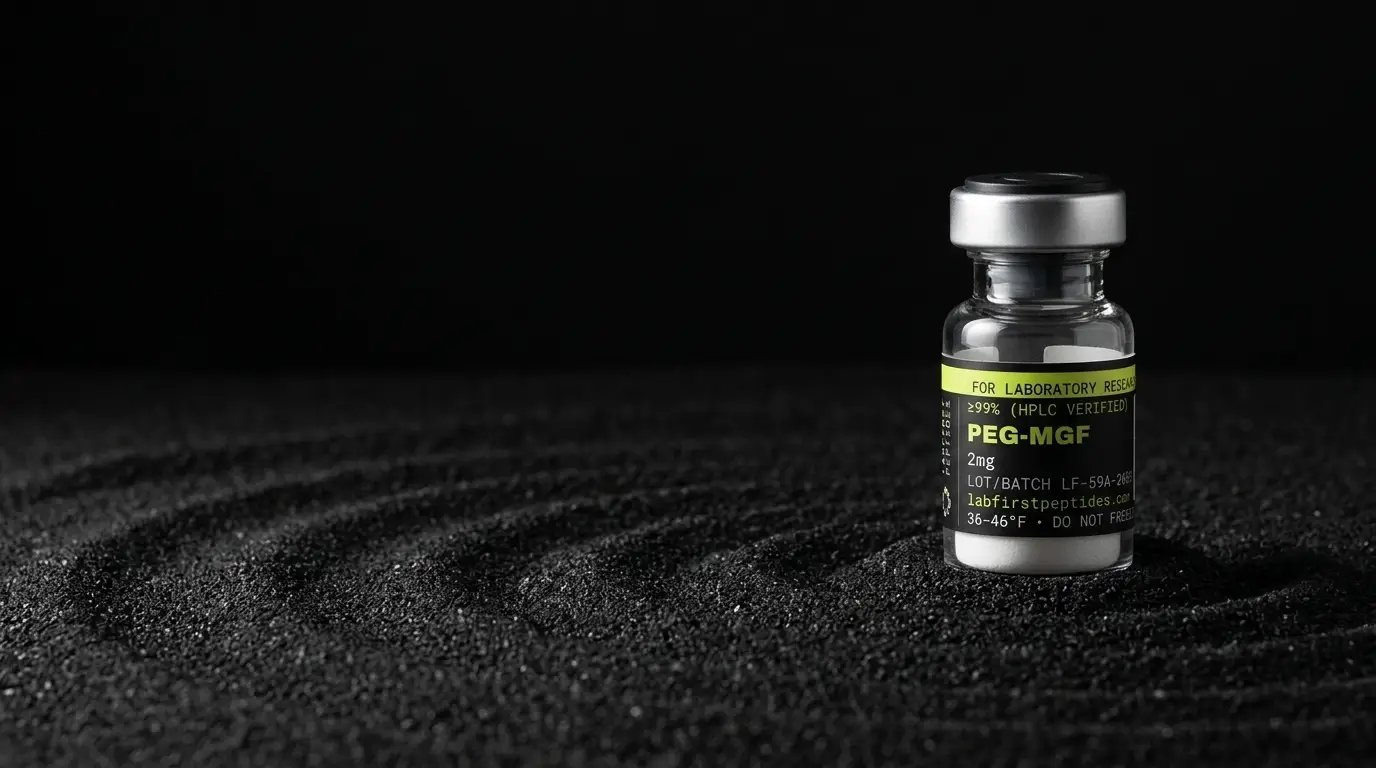
PEG-MGF is the E-domain peptide of the IGF-1Ec splice variant, known as mechano growth factor, with polyethylene glycol attached; it is a different material from plain MGF. Buy from a supplier that names the laboratory, prints the theoretical mass and puts the lot on the vial. LabFirst lists one size from $80, each lot independently tested.
- PEG-MGF is sold at LabFirst in 2mg from $80.
- PEG-MGF has no single molecular mass because PEG is a distribution of chain lengths; a certificate must name the PEG size, show the mass spread and confirm the MGF peptide separately.
- A complete certificate carries identity by mass spectrometry, purity by HPLC with method and date, and net content in milligrams, all for the lot printed on the vial.
- LabFirst lots are tested by Kovera Labs, an independent laboratory. Every lot measured 98% purity or higher; COAs are publishing soon.
- Shipping is $15 flat under $200 and free above, US only; volume tiers are 10% at ten vials of one size and 15% at twenty.
What "peg-mgf peptide" names, and what it does not
Start with the name, because it covers two products that sellers mix up. IGF-1 comes in several splice variants, and the one that responds to mechanical load in muscle tissue, IGF-1Ec, was named mechano growth factor. The peptide sold as MGF is a synthetic copy of that variant's E domain, the stretch at the end of the chain that the other variants do not share. PEG-MGF is that same peptide with polyethylene glycol attached to it. The PEG chain is the whole point of the product and also the whole difficulty in buying it, since it changes the mass, the chromatography and the price. Listings write PEG-MGF, PEG MGF, pegylated MGF and pegylated mechano growth factor, and all four mean the conjugate.
Plain MGF is not PEG-MGF. They share a peptide sequence and nothing else that a certificate measures: plain MGF has one defined mass and a sharp HPLC peak, while the pegylated version has a spread of masses and a broad peak. A listing that calls itself PEG-MGF and shows a certificate with a single clean mass near the bare peptide has, on its own evidence, shipped plain MGF. The reverse happens too, with plain MGF titles carrying PEG-MGF certificates borrowed from another product. Read which one the certificate describes before reading anything else on it.
The literature is thin and it is worth saying so plainly. The biology behind the name is real: the IGF-1Ec variant is induced in muscle by overload and damage, and cell and rodent studies describe it. No receptor for the E-domain peptide has been identified, there is no approved product, and the pegylated form in particular has almost no independent published work. Anything a seller says about what PEG-MGF does is extrapolated from the unmodified peptide at best. This page is about the material in the vial and how to check it, not any use.
There is no small-molecule record to check against. MGF is a splice variant of IGF-1, and PEG-MGF is that peptide with polyethylene glycol attached. A PEG conjugate has no single molecular mass because PEG is a distribution of chain lengths, which is why no compound record exists. UniProt P05019 is the parent protein for reference. The parent protein is UniProt P05019.
In plain terms: Pegylated synthetic peptide corresponding to the E-domain of the IGF-1Ec splice variant, known as mechano growth factor. No receptor identified for the E-domain peptide, no approved product, no human trials. The pegylated form specifically has essentially no independent published literature.
- Lot on the vial matches the certificate
- Laboratory named, with its own lookup
- Theoretical mass printed and correct
- Purity has a method and a date
- Net content stated in milligrams
PEG-MGF sizes and price per mg
LabFirst lists PEG-MGF in one size (2mg) from $80, priced per vial with the per-mg figure beside it so sizes can be compared without arithmetic. It is sold in one size, 2mg, at $40 per mg.
| Size | Price | Per mg | 10 units | 20 units | Availability |
|---|---|---|---|---|---|
| 2mg (best per mg) | $80 | $40 | $720 ($36/mg) | $1360 ($34/mg) | Backorder, join the waitlist |
The volume tiers are per size, not per basket: ten vials of one size take 10% off that line and twenty take 15%, and mixed sizes do not combine. Shipping is a flat $15 on orders under $200 and free from $200, within the United States only, with same-day dispatch on orders placed before 12 PM Pacific on a business day. The cost per mg tool runs the same comparison across any two listings, ours or anyone else's.
PEG-MGF costs more than plain MGF of the same size for a straightforward reason: it is the peptide synthesis plus a conjugation step plus a purification that has to separate conjugated, unconjugated and double-conjugated material. Every one of those steps loses yield. LabFirst carries it in a single 2 mg vial, so there is no size ladder to compare and the per-milligram price is the vial price divided by two. A laboratory qualifying a supplier usually buys one vial and reads its certificate for the PEG size and the free-peptide level before buying more.
The cheap PEG-MGF listing is usually one of two things. It is plain MGF with a PEG title, which is cheaper to make and shows up as a single sharp mass on any certificate that carries a spectrum. Or it is a real conjugate with a lot of free PEG left in the powder, which makes up the weight on the label without adding peptide. Both look like a discount and neither is one. The volume tiers on this page are the only discounts we run, per size and the same every month.
The certificate a PEG-MGF lot must carry
Three tests answer three different questions, and a certificate of analysis for PEG-MGF is only complete when it carries all three for the exact lot on the vial. Identity for a pegylated peptide is not one number. Polyethylene glycol is made as a distribution of chain lengths, so a PEG-MGF lot shows a cluster of masses spaced by the 44 Da ethylene oxide repeat, centered on whatever PEG size the maker used. A certificate should name that PEG size, show the spectrum with its spread, and confirm the peptide portion separately, usually by mass spectrometry of the peptide or by peptide mapping, so the sequence under the PEG is shown to be the MGF E domain and not something else.
Purity is a separate question, answered by HPLC: how much of what came off the column was the compound. The figure is only interpretable with its method beside it (column, gradient, detection wavelength) and a date, which is what ICH Q2(R2) means when it asks that an analytical procedure be shown fit for its purpose. A percentage with no method and no date is a number somebody typed, and a certificate that carries every test but for a different lot number than the vial is the most common failure of all and the easiest to catch. Net content is the third test and the one most often missing: the milligrams of PEG-MGF actually in the vial, measured, against the size printed on the label.
Purity by HPLC reads differently on a conjugate. A PEG-MGF main peak is broad because the PEG chains vary in length, and an honest chromatogram shows that breadth instead of a needle. The impurities that matter are the ones that sit near it: free unconjugated MGF peptide, free PEG reagent that never attached, and peptide carrying two PEG chains where the maker intended one. Each of those can hide inside a wide peak, so the chromatogram with its column, gradient and detection wavelength is the evidence. A purity percentage printed with no trace, on a material this hard to resolve, tells you very little about the vial.
Net content needs a sentence of its own here. The label size could mean milligrams of the conjugate or milligrams of the peptide inside it, and those differ by a lot because PEG is heavy. A certificate should say which, and the quantitative method behind it. Free PEG adds weight to the powder without adding any MGF, so a vial can hit its labeled mass and still carry less peptide than a buyer assumed. Ask which basis the label uses before comparing PEG-MGF prices between sellers, since two vials with the same printed size may not hold the same amount of peptide.
Checking a supplier of PEG-MGF: five checks before you order from anyone
Every seller of peg-mgf peptide says "third-party tested". The phrase costs nothing. These five checks take about four minutes per listing and separate a tested lot from a tested-sounding one.
- The lot on the vial is the lot on the certificate. Read the printed lot number, then open the certificate and match it. A certificate for "PEG-MGF" with no lot, or a lot that does not match, describes some other vial.
- The laboratory is named and has its own lookup. The report should come from a laboratory the seller does not own, with a search code you can enter on the laboratory's own site. LabFirst lots are tested by Kovera Labs and the laboratory's report is published for each lot; anything that exists only as the seller's own summary has not been verified.
- The theoretical mass is printed, and it is the right one. For PEG-MGF there is no single theoretical mass to print. The certificate should state the PEG size used, show the mass distribution rather than one rounded figure, and confirm the peptide sequence separately; a single sharp mass near the bare peptide means plain MGF, not the conjugate.
- Purity has a method and a date. An HPLC percentage should name the method and the run date. A figure that reads "99%+" with neither, or one date reused across every product a seller lists, is decoration.
- Net content is stated in milligrams. The label size is a claim; the certificate's net content is the measurement. If the certificate has no net content line, the purity figure describes the powder, not the vial, and the price per mg you calculated is fiction.
How listings for PEG-MGF specifically mislead:
- A PEG-MGF title over a certificate showing one sharp mass. That is plain MGF; a real conjugate shows a spread of masses spaced by the PEG repeat.
- No PEG size stated anywhere. The PEG chain length defines the product, and a certificate that never names it has not described what is in the vial.
- A purity figure with no chromatogram. On a broad conjugate peak, free peptide and free PEG can sit inside the number unseen; only the trace shows them.
- A label size with no basis. Milligrams of conjugate and milligrams of peptide are different quantities, and the cheaper listing is often counting the PEG.
- "Original PEG-MGF" in the title. There is no original brand to be faithful to; the word is decoration, and the lot certificate is the only thing that says what the vial holds.
- Claims about what the material does. The pegylated form has almost no published work of its own, and anything said about its effects is borrowed from other compounds.
How to verify a LabFirst PEG-MGF lot
Every PEG-MGF size is on backorder today. Join the waitlist on the product page and the restock email carries the lot and its certificate when they exist.
Verification runs through the laboratory, not through us. Open the certificate index, find the lot, and read the laboratory's report; it is Kovera Labs' own document, not ours, and the laboratory will confirm it against its records.
The product page reads the live stock feed on load (stock, lot and certificate state for every size), so what you see when you order is what ships. The lot is printed on the label and encoded in the QR patch on its right-hand side; scanning it opens that lot's record.
Storage and shipping for PEG-MGF
Freeze-dried, sealed and kept cold and dark, PEG-MGF holds for the shelf period printed on its certificate. Pegylation tends to make the peptide more stable in solution than the bare chain, which is part of why it is made, but it does not make the powder indifferent to moisture. A lyophilized cake pulls water from humid air the moment the seal is broken, and water is what starts the slow chemistry that shortens shelf life. Open a vial once, for the work it was bought for, and do not reseal a partly used vial for storage.
A prepared solution is a different material from the dry cake and needs its own record: the date it was made, how it was kept, and the laboratory's own stability data for how long it stays usable. No label figure covers that, ours included. The arrival record matters more for a conjugate than for a plain peptide, because the certificate's PEG size and lot are the only way to tell later which material a vial held.
Orders ship within the United States, flat $15 under $200 and free above it, same day when placed before 12 PM Pacific on a business day, and the shipping page states the cutoff, the carriers and what is and is not promised.
The record a laboratory keeps on arrival is what makes the certificate usable later, and it is short:
- the lot number as printed on the vial, and the certificate's accession or search code beside it;
- the date received and the condition of the seal;
- the storage location and temperature it went into;
- the number of vials, and later the date each one was opened and by whom.
A PEG-MGF vial with that record behind it can be traced from the bench to the laboratory report in one step; without it, the certificate is a document about a vial that can no longer be identified.
Regulatory status, and what this page is not
No approved medicine contains PEG-MGF and no human trials of it have been published, per the research summary this site keeps for each compound. There is no pharmacopeial standard for what an acceptable lot looks like, so every figure on a research vial is the supplier's claim backed by the laboratory named on the certificate. That is why the certificate carries all the weight on this page, and why a listing that cannot produce one for the exact lot has nothing else to offer.
FOR LABORATORY AND IN-VITRO RESEARCH USE ONLY. NOT FOR HUMAN OR ANIMAL CONSUMPTION. LabFirst sells PEG-MGF to laboratories and researchers as material for in-vitro work, gives no guidance on use, and ships only against that understanding. Nothing on this page or on the product page describes preparing or administering anything.
Common questions
Where can I buy PEG-MGF online?
How much does PEG-MGF cost?
Is PEG-MGF the same as MGF?
Which PEG-MGF size should a laboratory order first?
How do I check that a PEG-MGF certificate is real?
Why is there no exact molecular weight for PEG-MGF?
More procurement guides
Sources
- UniProt P05019, Insulin-like growth factor 1, 195 aa, 21,841 Da. Parent protein record for the IGF-1 splice variants, cited for the sequence family only; a pegylated peptide has no single-mass record.
- Harridge, Ageing and local growth factors in muscle, Scandinavian Journal of Medicine and Science in Sports . Primary description of the compound in the literature; supports the class and naming stated here, not any use.
- Imanaka and colleagues, Growth hormone stimulates mechano growth factor expression and activates myoblast transformation in C2C12 cells, Kobe Journal of Medical Sciences . Primary description of the compound in the literature; supports the class and naming stated here, not any use.
- ICH Q2(R2), Validation of Analytical Procedures (2023) . Why a purity figure is only interpretable with its method, and what "fit for purpose" means for the HPLC and mass spectrometry results a certificate reports.