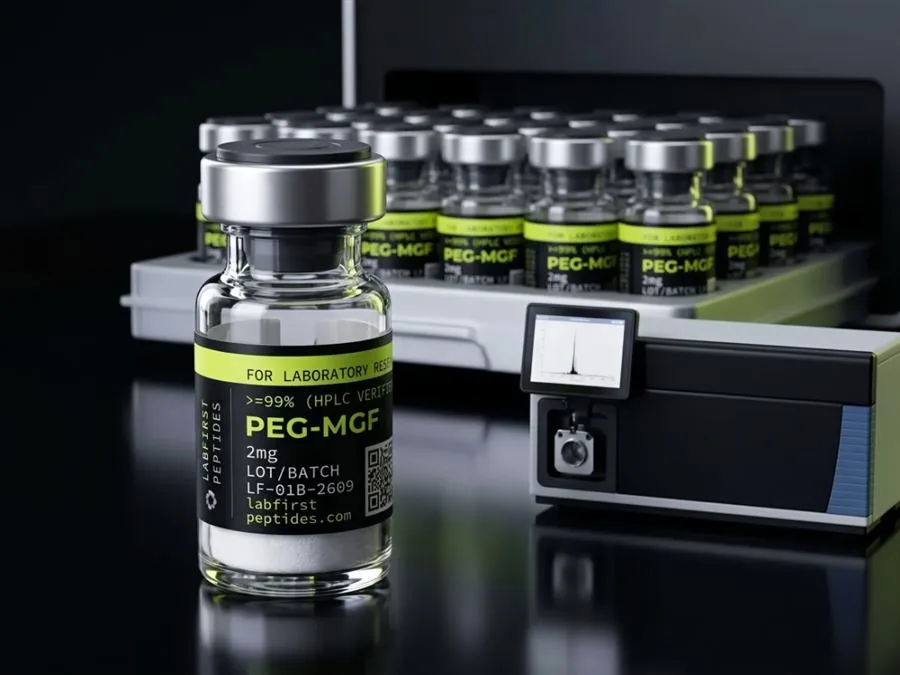
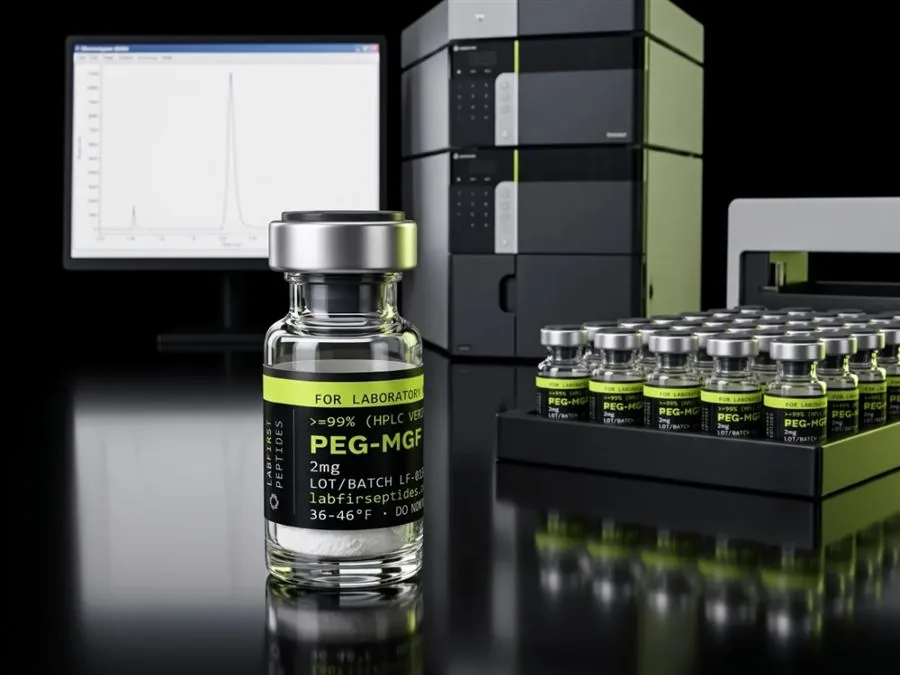
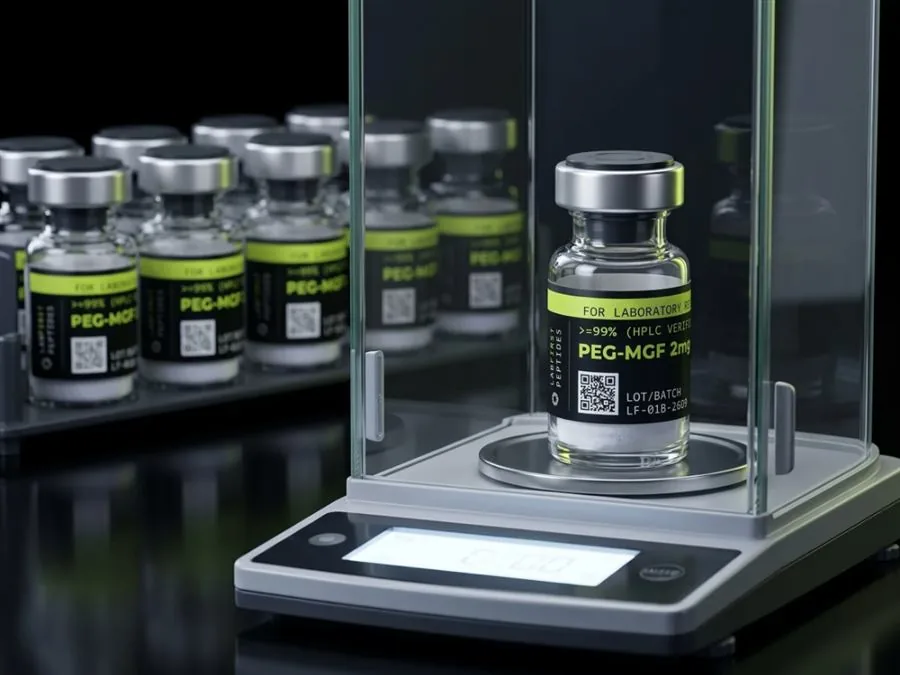
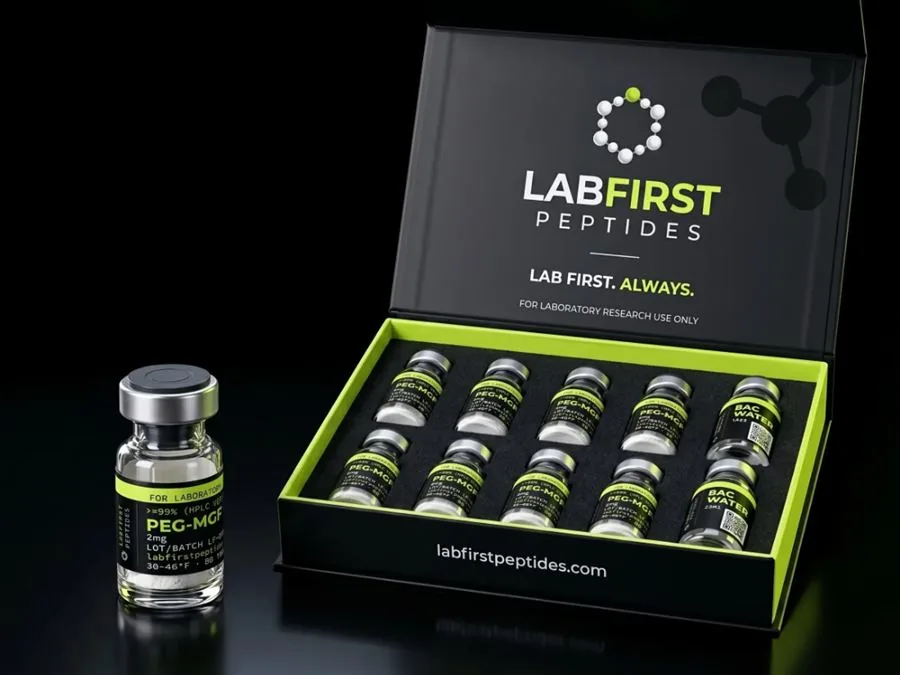
Shop / PEG-MGF research peptide
Buy PEG-MGF Peptide
Pegylated synthetic peptide corresponding to the E-domain of the IGF-1Ec splice variant, known as mechano growth factor, supplied freeze-dried in a sealed vial and tested lot by lot at Kovera Labs.
PEG-MGF Peptide price by sizeBackordered
$80.00$40.00 per mgSave 0% per mg
Join the waitlist for
We are restocking this size and expect it in stock within 5 to 7 days. Everyone on the waitlist hears first.
You are on the list. Check your inbox.
FOR LABORATORY AND IN-VITRO RESEARCH USE ONLY. NOT FOR HUMAN OR ANIMAL CONSUMPTION.
Backordered: join the waitlist and we email you the moment it lands
Free shipping on orders over $150.00
Lab certificate · 2mg
This size's lot is in testing. Its results appear here as soon as the lab report is in.
In short: PEG-MGF is pegylated synthetic peptide corresponding to the E-domain of the IGF-1Ec splice variant, known as mechano growth factor. PEG-MGF is sold here for laboratory research in 1 size (2mg), from $80.00 a vial. It is not an FDA-approved medicine. Research use only, and never for people or animals.
Often bought with
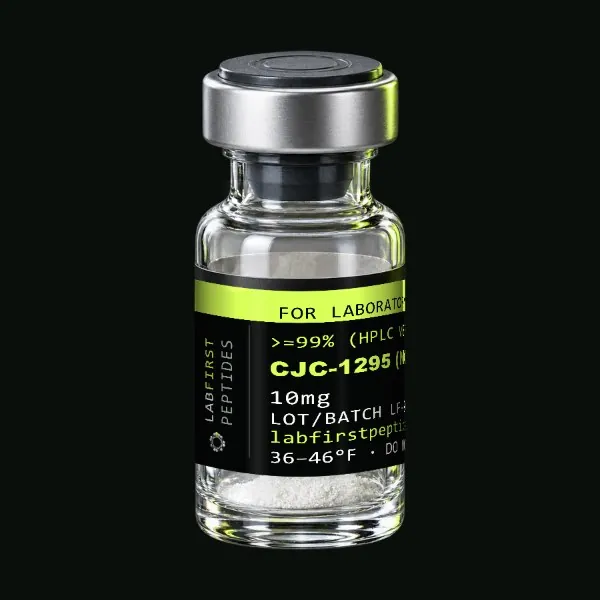
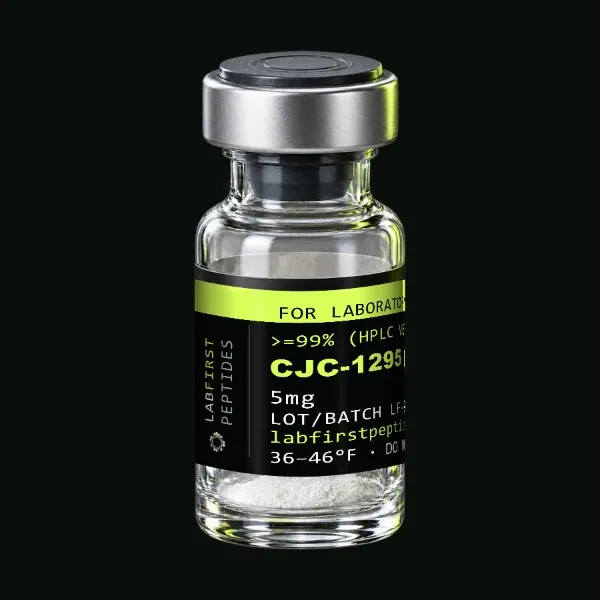
PEG-MGF specifications
| Product name | PEG-MGF |
|---|---|
| Also sold as | PEG MGF peptide, pegylated mechano growth factor |
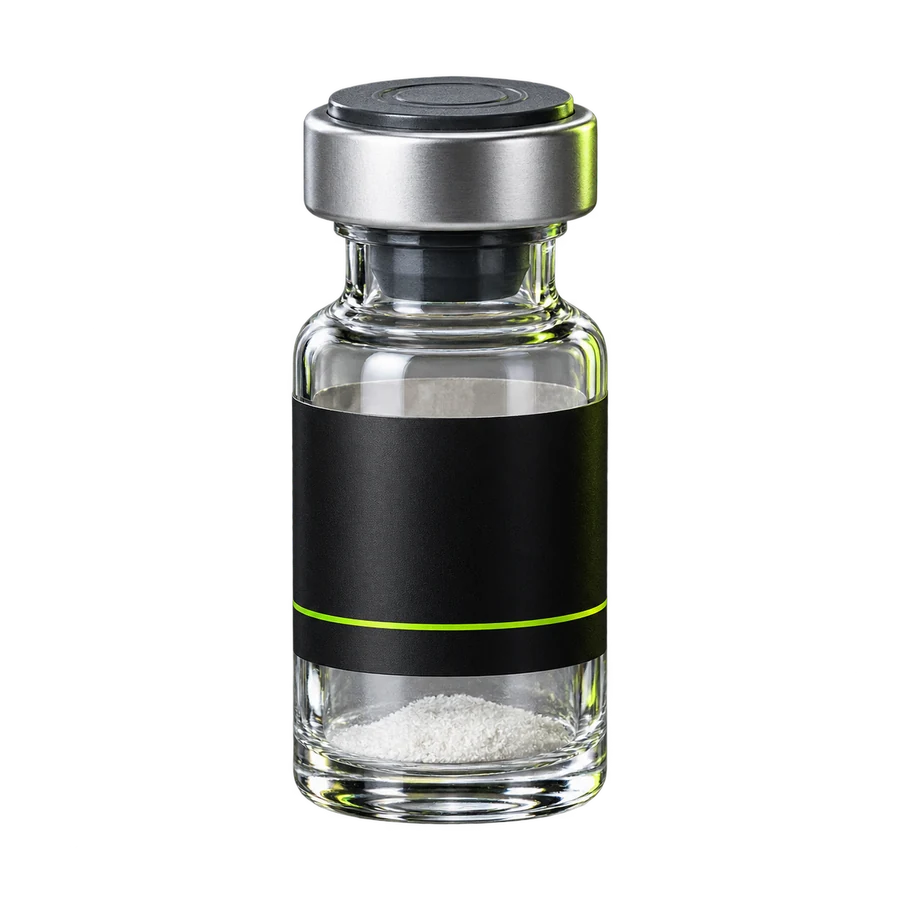
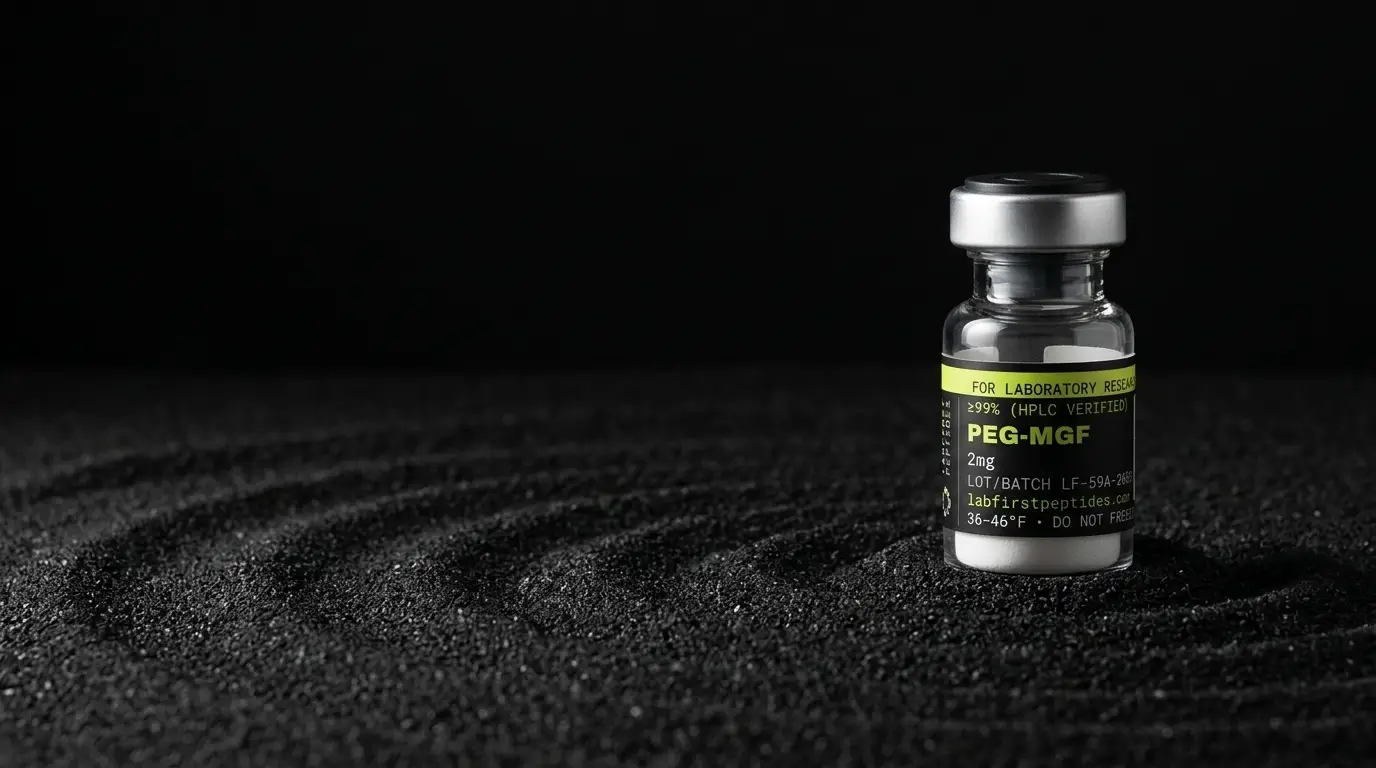
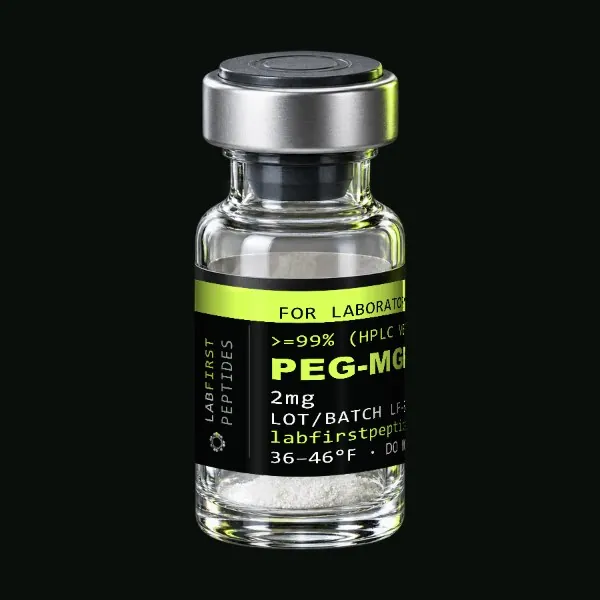
| Physical form | Freeze-dried powder, a solid cake in a sealed vial |
| Appearance | White to off-white cake |
| Sizes on this page | 2mg |
| Purity specification | ≥99% by RP-HPLC. The number for the lot you receive is whatever its own certificate says. |
| Identity check | Mass spectrometry, read against the mass this compound should have |
| Net content | Weighed per lot and reported separately from purity |
| Lot documentation | Tested by Kovera Labs; each lot's certificate posts here when it is reported |
| Storage | Sealed, cold and out of the light |
| Ships from | Santa Ana, California by USPS with tracking on every order, same business day on verified in-stock orders placed before 12 PM Pacific |
| Regulatory status | Not an FDA-approved drug product. Sold as laboratory material, not a medicine; status verified 2026-08-25. |
| Intended use | Laboratory research only. Not for human or animal use. |
What is PEG-MGF, and what is it used for?
PEG-MGF is also listed and searched as PEG MGF peptide, pegylated mechano growth factor. They all mean the same compound. Supplier lists write it as PEG-MGF peptides or peptide PEG-MGF as well; every one of those is this record. A name is not a test, which is why the lot record further down counts for more than the wording on a label.
Class
Pegylated synthetic peptide corresponding to the E-domain of the IGF-1Ec splice variant, known as mechano growth factor.
Mechanism
MGF is an alternatively spliced IGF-1 variant induced in skeletal muscle by mechanical overload and injury. The E-domain peptide is proposed to act separately from the IGF-1 receptor, on satellite cell activation, though its receptor has not been identified. Pegylation is a formulation change intended to slow clearance.
Where it appears in the literature
Muscle adaptation, satellite cell activation and repair following overload or injury, largely in cell lines and rodent models.
What is not established
No receptor identified for the E-domain peptide, no approved product, no human trials. The pegylated form specifically has essentially no independent published literature.
PEG-MGF for sale: 2mg vials, price per mg
PEG-MGF is sold in 1 size here, 2mg, from $80.00 a vial. Every way of buying is in the table; the per-mg figure under each price is the one that compares across sizes.
Volume and subscription pricing by size
| Size | One vial | 10–19 vials−10% | 20 vials−15% | Subscribe monthly−6% from shipment 2 | Availability |
|---|---|---|---|---|---|
| PEG-MGF 2mg | $80.00$40.00/mg | $72.00a vial · $36.00/mg | $68.00a vial · $34.00/mg | $75.20a vial, shipment 2 on · $37.60/mg | Backordered — waitlist |
Volume tiers are per size and do not combine across sizes (see bulk pricing). Subscribe & Save takes 6% every month, 4% every 2 months or 2% every 3 months off from shipment 2, two shipments minimum, and stacks on the volume tier: the lowest this record ever bills is $31.96 per mg, twenty 2mg vials on a monthly subscription from shipment 2 onward.
Nothing is added at checkout except the USPS shipping you choose; dispatch and delivery are the same on every order. The cost-per-milligram tool ranks the whole catalog by price per mg.
Where to buy PEG-MGF: what to check before you order from anyone
Where to get PEG-MGF, and how to buy PEG-MGF online
PEG-MGF for sale, or PEG-MGF peptide for sale, means this page: one record, 1 size. You can buy PEG-MGF online here with guest checkout; verified in-stock orders placed before 12 PM Pacific are dispatched the same day.
Before ordering PEG-MGF from anyone, us included, run the 5 checks on verifying a certificate; the first is that the report resolves on the laboratory's own site, and a seller who cannot pass them is asking for the trust a certificate exists to replace.
The PEG-MGF certificate: lot, purity, identity, and how to verify it
A certificate answers identity, purity and net content as three separate questions, each with the method that produced it and the date it was run, how to read one covers what each field does and does not cover. MGF is a splice variant of IGF-1, and PEG-MGF is that peptide with polyethylene glycol attached. A PEG conjugate has no single molecular mass because PEG is a distribution of chain lengths, which is why no compound record exists. UniProt P05019 is the parent protein for reference. So the mass on the lot certificate is the one to read; a listing that quotes the published figure for this material is quoting the wrong molecule.
PEG-MGF certificates post here and in the certificate index when Kovera Labs reports on the lot.
Solution arithmetic for the bench, with no administration guidance: the vial concentration calculator, preset to PEG-MGF.
PEG-MGF research: what the published studies examine
Status: No FDA-approved application. This compound is sold as laboratory material. Where research on it has been published, it sits at the animal, cell or early-human stage, and this record does not summarize what it found. A supplier is not a neutral judge of evidence about its own catalog.
The starting point is real biology: IGF-1 exists in multiple isoforms, and one of them, IGF-IEc, is particularly responsive to mechanical signals and muscle damage, which is why it was named mechano growth factor. It differs from the systemic liver-type isoform IGF-IEa in its C-terminal E domain. The compound sold here is a synthetic peptide corresponding to that E domain, pegylated. Two gaps sit between the biology and the product.
The E-domain peptide is proposed to act through a mechanism distinct from IGF-1 receptor binding, and no receptor for it has been identified — so its mechanism is described by what it is not. And pegylation is a substantial modification: attaching polyethylene glycol changes size, clearance and tissue access, and a pegylated peptide is not pharmacokinetically the same molecule as the unmodified one, however similar the sequence.
| Reported observation | Model | Source |
|---|---|---|
| IGF-1 exists in multiple isoforms, and IGF-IEc — mechano growth factor — is described as particularly sensitive to mechanical signals and muscle damage, distinct from the systemic IGF-IEa isoform. Local IGF-1 produced within muscle for autocrine and paracrine action is implicated in repair and adaptation, acting in part through activation, proliferation and differentiation of satellite cells. | review of local growth factor biology in muscle and ageing | Harridge, Ageing and local growth factors in muscle, Scandinavian Journal of Medicine and Science in Sports (2003) |
| In C2C12 mouse muscle cells, growth hormone increased MGF mRNA at 1 hour while IGF-IEa mRNA rose only at 4 hours, and the same divergent pattern appeared with chemically induced muscle injury. Growth hormone also increased MyoD and M-cadherin expression with peaks parallel to MGF, which the authors interpret as consistent with satellite cell activation. | C2C12 mouse muscle cell line | Imanaka and colleagues, Growth hormone stimulates mechano growth factor expression and activates myoblast transformation in C2C12 cells, Kobe Journal of Medical Sciences (2008)This measures endogenous MGF expression in a cell line. It is not a study of administered MGF peptide, and certainly not of the pegylated form. |
Open questions. The distance between the cited literature and the product is larger here than on most pages in this catalog, and it should be stated rather than glossed. The published work concerns an endogenous splice variant expressed by muscle in response to load and injury. The product is a synthetic fragment of that variant, chemically modified with polyethylene glycol. No receptor for the E-domain peptide has been identified, so there is no receptor-level mechanism to describe.
There are no human trials, no approved product, and the pegylated form specifically has almost no independent published literature — claims about it are largely extrapolation from work on endogenous MGF expression. Pegylation itself deserves attention when comparing lots: PEG attachment produces a heterogeneous product by nature, and identity and purity testing on a pegylated peptide is a materially harder analytical problem than on an unmodified one.
Each row above describes an observation in the stated model. None of it describes what PEG-MGF would do in a person or an animal outside that model, and none of it is a recommendation to use it for anything.
How to store PEG-MGF: refrigeration and shelf life
Keep the sealed vial cold and out of the light and it stays as it left the lab. Once it is mixed into a solution, how long it holds up depends on the compound, what it was mixed with, how strong the solution is and how cold it is kept — too many variables for anyone to print one shelf life on a label. So laboratories write the date on whatever they prepare and keep their own record of it.
For solution preparation arithmetic on the bench, concentration, per-graduation values and molarity, use the vial concentration calculator, which opens with the PEG-MGF sizes stocked here already loaded. It covers laboratory measurement only and contains no administration guidance.
Questions about PEG-MGF
Where to buy PEG-MGF Peptide, and can I get it online?
Here, in 1 size, with guest checkout and shipping across the United States. All sizes are on the waitlist at the moment, and are being restocked, expected within 5 to 7 days. Each size carries its own lot record and certificate, verifiable at the issuing laboratory before you order.
What is PEG-MGF used for?
In the published research, Muscle adaptation, satellite cell activation and repair following overload or injury, largely in cell lines and rodent models. No receptor identified for the E-domain peptide, no approved product, no human trials. The pegylated form specifically has essentially no independent published literature. This record sells it for laboratory work and says nothing about use in a person or an animal.
How does PEG-MGF work, and what does it do?
At the level the published literature describes it, mGF is an alternatively spliced IGF-1 variant induced in skeletal muscle by mechanical overload and injury. No receptor identified for the E-domain peptide, no approved product, no human trials. The pegylated form specifically has essentially no independent published literature. This record sells it for laboratory work and says nothing about use in a person or an animal.
What does PEG-MGF do?
At the level the published literature describes it, mGF is an alternatively spliced IGF-1 variant induced in skeletal muscle by mechanical overload and injury. No receptor identified for the E-domain peptide, no approved product, no human trials. The pegylated form specifically has essentially no independent published literature. This record sells it for laboratory work and says nothing about use in a person or an animal.
What is PEG-MGF peptide?
PEG-MGF is pegylated synthetic peptide corresponding to the E-domain of the IGF-1Ec splice variant, known as mechano growth factor. It is sold here in a sealed vial with a certificate for the lot, for laboratory work only.
For laboratory and in-vitro research use only. Not for human or animal consumption.