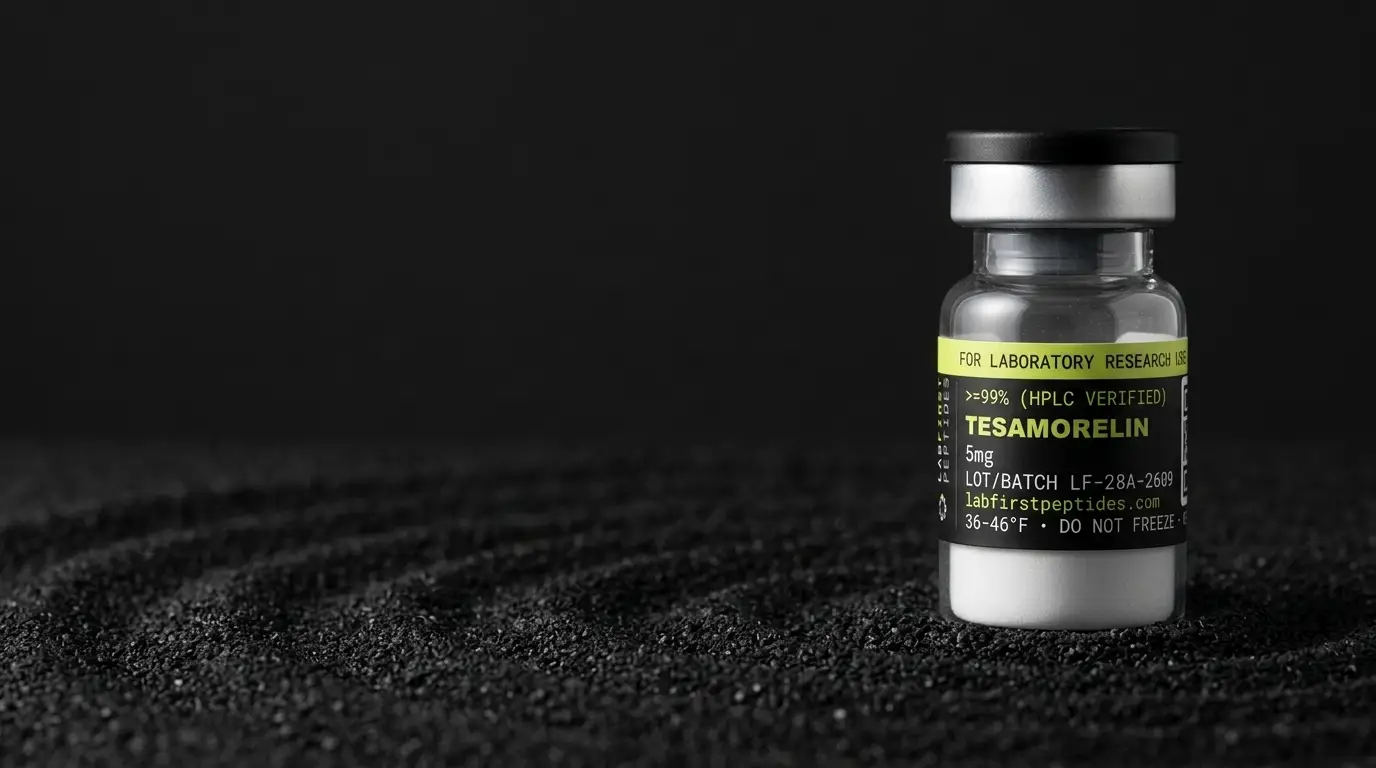
Tesamorelin is a synthetic peptide 44 amino acids long that copies the full sequence of human growth hormone-releasing hormone, with a six-carbon trans-3-hexenoyl group attached to the tyrosine at the start of the chain. Its formula is C221H366N72O67S and it weighs about 5,136 g/mol. A prescription medicine containing it has been FDA approved since 2010.
- Tesamorelin is a synthetic analog of human growth hormone-releasing hormone consisting of its full 44-amino-acid sequence with a trans-3-hexenoyl group on the N-terminal tyrosine.
- PubChem CID 16137828 lists tesamorelin with the formula C221H366N72O67S, a molecular weight of 5,136 g/mol and CAS number 218949-48-5.
- The human GHRH sequence tesamorelin copies is YADAIFTNSYRKVLGQLSARKLLQDIMSRQQGESNQERGARARL-NH2, residues 32 to 75 of the precursor in UniProt P01286.
- The hexenoyl cap adds about 96 Da, so tesamorelin weighs about 5,136 g/mol against roughly 5,040 for unmodified GHRH(1-44) amide.
- The EGRIFTA SV and EGRIFTA WR labels on DailyMed list tesamorelin as an acetate salt with Initial U.S. Approval: 2010.
- Sermorelin is GHRH(1-29) amide, 29 residues and about 3,358 g/mol, and is a fragment of the hormone tesamorelin copies in full.
What this guide covers
Tesamorelin is one of the few research peptides with a counterpart in an FDA-approved medicine, which makes it easier to describe precisely and easier to describe wrongly. The approved product's label gives an exact structure. Research listings often give a looser one.
This page sets out what the molecule is: the 44-residue hormone it copies, the one chemical change that makes it tesamorelin rather than the hormone, the formula and mass a certificate should match, and what the regulatory record says. It also explains how tesamorelin relates to sermorelin, a shorter cousin. It stops at chemistry and status. It does not describe use in people or animals, and it does not cover handling of a vial.
- 44 residues: the full human GHRH sequence
- trans-3-hexenoyl cap on Tyr1 adds about 96 Da
- Formula C221H366N72O67S
- About 5,136 g/mol; CAS 218949-48-5
- Sermorelin is the 29-residue fragment
- Approved medicine since 2010; research material is not it
What is tesamorelin?
Tesamorelin is a synthetic analog of human growth hormone-releasing hormone, a 44-amino-acid peptide the body makes in the hypothalamus. The FDA label for EGRIFTA SV describes it as a human growth hormone-releasing factor (GRF) analog produced synthetically, consisting of the 44 amino acid sequence of human GRF with a hexenoyl group attached to the tyrosine at the N-terminal end. Growth hormone-releasing factor and growth hormone-releasing hormone are two names for the same peptide; the label uses GRF and most of the literature uses GHRH.
PubChem's record for tesamorelin (CID 16137828) gives the molecular formula as C221H366N72O67S, an average molecular weight of 5,136 g/mol and a monoisotopic mass of 5,132.72. Its synonym list carries the CAS registry number 218949-48-5, the developer code TH9507, the plain description GHRH(1-44), and the systematic name N-((3E)-1-oxo-3-hexenyl)somatoliberin. Somatoliberin is yet another name for GHRH. The (3E) in that name is the chemists' way of writing trans, so the cap is a trans-3-hexenoyl group: a six-carbon acyl chain with one double bond at the third carbon.
The single sulfur atom in the formula belongs to the one methionine in the chain, at position 27. That methionine can oxidize to a sulfoxide in air over time, adding 16 mass units, which is one reason sealed, dry storage matters for this peptide and one thing a mass spectrum can reveal.
Our tesamorelin product page lists the sizes we stock, and each lot's certificate is posted at /coa/.
What is the tesamorelin sequence, and where does it come from?
The tesamorelin sequence is the 44-residue sequence of human GHRH, which UniProt lists in its record for the GHRH precursor (P01286). That precursor, called somatoliberin in the database, is 108 amino acids long. The mature hormone is cut from positions 32 to 75 and reads YADAIFTNSYRKVLGQLSARKLLQDIMSRQQGESNQERGARARL in one-letter code, with the final leucine carrying an amide group rather than a free acid.
Tesamorelin keeps all 44 of those residues and the C-terminal amide. What changes is the N-terminus. In the natural hormone the first tyrosine carries a free amino group. In tesamorelin that amino group is acylated with trans-3-hexenoic acid, so the chain begins with a short unsaturated fatty tail rather than a bare amine.
| Feature | Human GHRH(1-44) amide | Tesamorelin |
|---|---|---|
| Length | 44 residues | 44 residues |
| Sequence | YADAIFTNSYRKVLGQLSARKLLQDIMSRQQGESNQERGARARL-NH2 | Same sequence |
| N-terminus | Free amine on Tyr1 | trans-3-hexenoyl group on Tyr1 |
| C-terminus | Leucine amide | Leucine amide |
| Formula | Not given as a small-molecule formula in UniProt | C221H366N72O67S |
| Average mass | About 5,040 Da (calculated from the sequence) | 5,136 g/mol (PubChem); 5,135.9 Da (label, free base) |
| Record | UniProt P01286 | PubChem CID 16137828; CAS 218949-48-5 |
The mass difference between the two rows is about 96 Da, which is the hexenoyl group (C6H8O) added to the chain. That difference is large enough that a mass spectrometer tells tesamorelin from the unmodified hormone without difficulty, and small enough that a certificate quoting a mass near 5,040 instead of 5,136 should be read as describing the wrong molecule rather than as rounding.
Why does the hexenoyl group matter chemically?
The hexenoyl cap exists to protect the start of the chain. GHRH, like many peptide hormones, is cut by the enzyme dipeptidyl peptidase-4, which removes the first two residues from a chain whose second residue is alanine or proline. GHRH has alanine at position 2. Capping the N-terminal amine changes what the enzyme sees at the start of the chain. The label does not describe the mechanism in those terms, and this page reports the chemistry of the modification rather than its effect in a body.
For a laboratory the cap has three practical consequences.
- The mass includes it. The 96 Da it adds is part of the reference value a certificate must match.
- The chain has no free N-terminal amine. Methods that rely on a free amine at the start of the peptide, such as some Edman sequencing steps, behave differently with a capped peptide.
- The double bond in the hexenoyl group is a fixed trans geometry. Writing the cap as simply "hexanoyl" (no double bond) or "hexenoyl" without the position and geometry names a different group.
Tesamorelin is usually supplied as an acetate salt. The EGRIFTA SV label gives the formula of tesamorelin acetate as C221H366N72O67S with about seven molecules of acetic acid (x of about 7 in the label's notation) and states the molecular weight of 5,135.9 Da as the free base equivalent. A vial of acetate salt weighs more per milligram of powder than the peptide alone, so a certificate should say which form it measured and give a net peptide content figure. Our guide on reading a tesamorelin certificate covers that field.
How does tesamorelin differ from sermorelin?
Sermorelin is the first 29 residues of GHRH with an amide at the end, and tesamorelin is all 44 residues with the hexenoyl cap. Both copy the same human hormone. They differ in length by 15 residues and in whether the N-terminus is modified.
The first 29 residues of GHRH are the part most often studied as the minimum needed for receptor binding, which is why sermorelin stops there. Tesamorelin keeps the full chain. Its mass is about 5,136 g/mol against roughly 3,358 g/mol for sermorelin, so a mass spectrum separates them at a glance. Our guide on what sermorelin is covers the shorter peptide in detail.
Listings sometimes describe tesamorelin as "modified sermorelin" or "long sermorelin". Neither is accurate. Tesamorelin is a modified copy of the full hormone, and the 29-residue peptide is a fragment of it, not a parent.
Is tesamorelin FDA approved?
A prescription medicine containing tesamorelin is FDA approved, and research-grade tesamorelin is not that medicine. The EGRIFTA SV label on DailyMed carries the line Initial U.S. Approval: 2010, and the EGRIFTA WR label, a second presentation of the same active ingredient, carries the same year. Both are listed as tesamorelin kits.
The label's stated indication is the reduction of excess abdominal fat in HIV-infected adult patients with lipodystrophy. That sentence describes a prescription product made under pharmaceutical quality rules and handed over on a doctor's order. It says nothing about material sold for laboratory research, which is made and documented under a different set of rules and is not a substitute for the approved product. Our guide on FDA-approved peptide drugs explains that distinction across the whole class.
Tesamorelin has no United States Pharmacopeia monograph that we could find, so there is no compendial specification a research certificate can claim to meet. What a certificate can do is report a measured mass against the PubChem and label reference values and a measured purity by HPLC. Our guide on how tesamorelin identity is confirmed walks through both.
How to confirm a vial is tesamorelin: step by step
A label is a claim. The sequence, the mass and the lot number turn it into evidence.
- Check the stated identity. The product page or certificate should give the 44-residue sequence, the formula C221H366N72O67S, or the CAS number 218949-48-5.
- Find the mass spectrometry result. The deconvoluted mass should sit near 5,136 (average) or 5,132.7 (monoisotopic), allowing for the charge states the instrument reports. A peptide this size usually appears as several multiply charged ions.
- Look for the cap. A mass near 5,040 describes unmodified GHRH(1-44). A peak 16 units heavier than expected points to oxidized methionine.
- Note the salt form and net peptide content. An acetate salt weighs more per milligram than the free peptide.
- Read the HPLC purity as a separate figure. It says how much of the sample is one compound, never which one. HPLC purity versus identity explains why both are needed.
- Match the lot number on the certificate to the lot on the vial.
What to check before you order
- A product page that gives the sequence, formula or CAS number, not just a name.
- A lot-specific certificate with both a mass spectrum and an HPLC trace.
- A stated salt form and a net peptide content figure.
- Sizes stated as milligrams of peptide per vial.
- Clear research-use-only labeling.
- Storage guidance for the sealed vial; see tesamorelin storage and stability.
For vetting any seller, where to buy tesamorelin peptide lists the checks we apply to our own listings.
Bottom line
Tesamorelin is human GHRH(1-44) amide with a trans-3-hexenoyl group on its first tyrosine: 44 residues, formula C221H366N72O67S, about 5,136 g/mol, CAS 218949-48-5. The cap adds about 96 Da to the natural hormone and is the whole difference between the two. A prescription product containing it has been approved since 2010; research-grade material is not that product. What a buyer can verify is the chemistry, and that comes down to a mass spectrum, an HPLC trace and a lot number that match.
FOR LABORATORY AND IN-VITRO RESEARCH USE ONLY. NOT FOR HUMAN OR ANIMAL CONSUMPTION. NOT FOR PERSONAL, MEDICAL, DIAGNOSTIC, THERAPEUTIC, OR RECREATIONAL USE.
Common questions
What is tesamorelin made of?
Is tesamorelin the same as GHRH?
Is tesamorelin FDA approved?
What is the difference between tesamorelin and sermorelin?
What mass should a tesamorelin certificate show?
Published certificates for Tesamorelin
Every figure below is read from a report the laboratory issued for that lot; each page carries the PDF and the lab's own verification link.
More science guides
Sources
- PubChem PUG REST: CID 16137828 properties and synonyms (tesamorelin). Formula C221H366N72O67S, molecular weight 5,136, monoisotopic mass 5,132.72; synonyms include CAS 218949-48-5, TH9507, GHRH(1-44) and N-((3E)-1-oxo-3-hexenyl)somatoliberin. Read November 1, 2026.
- UniProt P01286, Somatoliberin (growth hormone-releasing hormone, human). 108-residue precursor; mature somatoliberin at positions 32 to 75, sequence YADAIFTNSYRKVLGQLSARKLLQDIMSRQQGESNQERGARARL, C-terminal leucine amide.
- EGRIFTA SV (tesamorelin) prescribing information, DailyMed, sections 1 and 11. Describes tesamorelin as a synthetic human GRF analog comprising the 44 amino acid sequence of human GRF with a hexenoyl moiety on the N-terminal tyrosine, prepared as an acetate salt, formula C221H366N72O67S with about 7 acetic acid, molecular weight 5135.9 Da as free base; Initial U.S. Approval 2010.
- EGRIFTA WR (tesamorelin) prescribing information, DailyMed. Second presentation of the same active ingredient; same structural description and Initial U.S. Approval 2010.