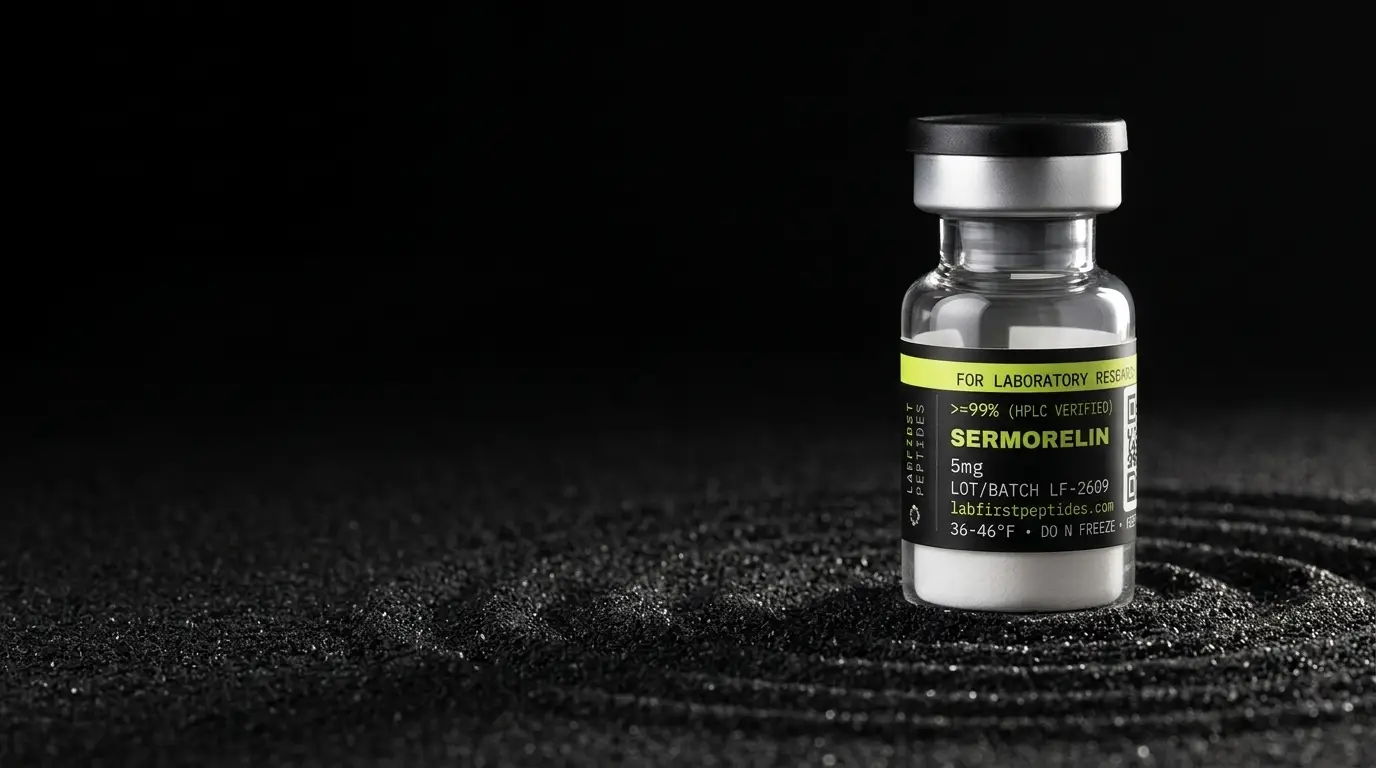
Sermorelin peptides for sale for research are the acetate salt of GHRH(1-29)-NH2. That is the 29-residue amidated fragment of human growth hormone-releasing hormone. A sound purchase rests on paperwork: an RP-HPLC purity figure, mass spec identity, and a certificate for that exact lot. No FDA-approved sermorelin product has been marketed since 2008.
- Sermorelin is GHRH(1-29)-NH2, the amidated 29-residue N-terminal fragment of human growth hormone-releasing hormone, supplied for research as an acetate salt.
- The free peptide's molecular formula is C149H246N44O42S with an average mass near 3358 Da; bound water and the acetate counterion make a vial's gross mass overstate its peptide content.
- Modified GRF(1-29), widely sold as CJC-1295 without DAC, is a different molecule with four substitutions, and the two names are routinely conflated in listings.
- Deamidation at Asn8 is the documented dominant degradation route in solution, which is why the material ships and stores as a lyophilized solid.
- Sermorelin was approved and marketed as Geref, with a first approval recorded in 1990; US marketing ended in 2008 and no FDA-approved sermorelin product is marketed today.
What a sermorelin listing is selling
Every listing that answers this query is offering, or claiming to offer, the same single molecule. Sermorelin is the amidated 29-residue N-terminal fragment of human growth hormone-releasing hormone, supplied for research as an acetate salt, and nothing about the words "for sale" changes that chemistry. The chemistry is what the paperwork behind a listing has to prove, and most listings are separated less by the material than by whether that proof exists.
This reference covers what a laboratory buyer needs at the point of purchase: the compound's identity and the several names it trades under, the analytical work that separates a verified lot from a labeled one, the degradation routes that decide how it is stored, and the regulatory record with dates attached. A listing is a claim. A certificate of analysis is evidence. The distance between the two is where procurement mistakes live.
Sermorelin is also unusual among research-catalog peptides in having once been an approved medicine, a history covered in the regulatory section below. That history cuts both ways: the molecule is thoroughly characterized in the primary literature, and none of that characterization transfers legitimacy to unverified material sold under its name.
- One molecule, many names: GHRH(1-29)-NH2, GRF(1-29), sermorelin acetate
- Modified GRF(1-29), sold as CJC-1295 no DAC, is a different compound
- Purity by RP-HPLC area percent; identity by observed mass
- Net peptide content converts label mass to real material
- Approved as Geref, first approval 1990; US marketing ended 2008
Identity and nomenclature
Sermorelin is a fully defined chemical entity: the first 29 residues of human growth hormone-releasing hormone with an amidated C-terminus. The primary literature from the early 1980s, which isolated the native 44-residue hormone and mapped its active core, established that this 1-29 fragment carries the full activity of the parent molecule, and the fragment is what entered pharmaceutical development. The sequence is Tyr-Ala-Asp-Ala-Ile-Phe-Thr-Asn-Ser-Tyr-Arg-Lys-Val-Leu-Gly-Gln-Leu-Ser-Ala-Arg-Lys-Leu-Leu-Gln-Asp-Ile-Met-Ser-Arg-NH2. The free peptide has the molecular formula C149H246N44O42S and an average mass close to 3358 Da; research material is supplied as the acetate salt, which weighs more than the free peptide, a distinction the worked example below returns to.
| Name | What it denotes |
|---|---|
| Sermorelin | The INN/USAN, assigned under the -relin stem reserved for release-stimulating peptides; USAN recorded 1989 |
| Sermorelin acetate | The salt form actually manufactured, listed and supplied |
| GRF(1-29)-NH2, hGRF(1-29) | The literature name; older papers call the hormone growth hormone-releasing factor |
| GHRH(1-29)-NH2 | The same fragment under the hormone's current abbreviation |
| Geref | The former brand under which it was approved and marketed |
| Groliberin | A synonym recorded in the ChEMBL curation |
One adjacent name is a different molecule. Modified GRF(1-29), widely listed as CJC-1295 without DAC, carries four amino-acid substitutions on the sermorelin backbone and a correspondingly different mass. The two are conflated across the research market, sometimes within a single listing. A supplier that treats the names as interchangeable has told you it does not know what is in its own vials, and mass spectrometry settles the question in one run.
How identity and purity are verified
Two measurements do the work, and they answer different questions. RP-HPLC reports purity: the peptide is run on a reversed-phase column and the main peak's share of the total chromatogram area becomes the headline figure, stated as area percent at a given detection wavelength. LC-MS reports identity: the observed mass of that main peak against sermorelin's theoretical mass. A purity figure without a mass is a percentage of something unnamed. A mass without a chromatogram says nothing about what else is in the vial. A certificate worth the name shows both, with method conditions and the lot number on the same page.
The third number almost nobody reads is net peptide content. A lyophilized fill is never pure peptide by mass; the solid carries bound water and the acetate counterion, which together commonly account for ten to twenty percent of the gross weight. Peptide content is established separately, usually by amino acid analysis or nitrogen determination, and it is the figure that converts a vial's label mass into actual peptide. Two listings at the same price with the same 5 mg label can differ meaningfully once peptide content is applied.
At the point of purchase this reduces to three checks: the lot number on the vial matches the certificate, the certificate shows method and result rather than a bare claim, and the observed mass matches sermorelin's rather than that of a substituted analog. The quality standard page describes the documentation this catalog publishes for every lot.
Degradation chemistry and storage
Sermorelin's sequence reads like a stability worksheet. The asparagine at position 8 is the documented weak point: peptide-stability studies on growth hormone-releasing factor analogs identified deamidation at Asn8 as the dominant degradation route in aqueous solution, with rearrangement at the aspartate in position 3 close behind. The single methionine at position 27 gives oxidation a target, which is the argument for dark storage and minimal headspace. There are no cysteines, so disulfide scrambling is one problem this molecule does not have.
All of that chemistry needs water to run at meaningful speed, which is why the material ships and stores as a lyophilized solid. Dry, sealed, cold and dark, the powder sits in a slow regime; dissolved, the Asn8 clock starts. The handling discipline is the one the storage and stability guide sets out in full, and the step most often skipped is the cheapest: let a cold vial reach room temperature before breaking the seal, because condensation drawn into a cold open vial is water delivered directly to a hygroscopic cake.
Once in solution, standard multi-entry logic applies. A working stock drawn from across days is only defensible in a preserved diluent, for the reasons the bacteriostatic water guide covers; single-use aliquots frozen at preparation sidestep the question entirely. Date everything at first entry. An undated solution of a deamidation-prone peptide is not an unknown age, it is an unknown compound.
Worked example: what a vial actually contains
The catalog lists sermorelin acetate in 5 mg and 10 mg fills. A 5 mg vial brought into 2 mL of diluent gives:
5 mg ÷ 2 mL = 2.5 mg/mL
Now apply peptide content. If the certificate states 85% net peptide, the vial holds 4.25 mg of actual peptide and the solution runs at:
(5 mg × 0.85) ÷ 2 mL ≈ 2.1 mg/mL
The same correction belongs in price comparison. A listing priced per gross milligram with no peptide-content figure cannot be compared honestly against one that states it; divide price by milligrams of peptide rather than milligrams of fill. The vial concentration calculator handles the volume arithmetic for other fills, and the cost-per-mg tool runs the per-milligram comparison across vial sizes. Both cover laboratory measurement only.
Procurement diligence
Twenty-nine residues is routine solid-phase synthesis, and sermorelin has been manufactured at scale since the 1980s, so the compound itself is inexpensive to produce relative to long or heavily modified sequences. What separates listings on price is mostly everything around the peptide: purification grade, batch scale, and the documentation the supplier is willing to generate and stand behind. Analytical work is a real cost. A lot that ships with its own chromatogram, mass spectrum and peptide-content assay costs more to release than one that ships with a number typed on a label.
| Check | What it should show | If it is missing |
|---|---|---|
| Lot number | On the vial and on the certificate, matching | The material has no traceable history at all |
| Purity | Area-percent figure with the method stated | The number is a claim nobody can test |
| Identity | Observed mass against the theoretical mass | The vial could hold any white solid, including a substituted analog |
| Peptide content | Assay method and percentage | Every per-milligram comparison overstates the material |
| Nomenclature | Sermorelin and modified GRF(1-29) listed as distinct products | The supplier cannot tell its own catalog apart |
Transit is the one leg of the chain a buyer cannot inspect. A lyophilized solid tolerates days at ambient temperature far better than any solution, which is why the material ships dry; the shipping page sets out transit times and packaging. What arrives should be a sealed, intact, labeled vial with the cake dry and undisturbed, and anything less is a conversation with the supplier before it is an experiment.
Regulatory record
Sermorelin's regulatory history runs longer than most of the research catalog's. The name is an INN/USAN assigned under the -relin stem for release-stimulating peptides, with the USAN recorded in 1989, and the ChEMBL curation records a first approval in 1990. It was marketed as Geref, and the WHO ATC index carries it twice: as a diagnostic agent for pituitary-function testing (V04CD03) and in the somatropin-agonist group (H01AC04).
US marketing of Geref ended in 2008, and no FDA-approved sermorelin product has been marketed since. The clinical development program that produced Geref ended with it; where sermorelin appears in the current literature it is chiefly as a reference GHRH analog rather than an active development asset. None of that history attaches to research-grade material, which is manufactured outside pharmaceutical quality systems and has never been a lawful route to human use.
Status verified 25 August 2026.
FOR LABORATORY AND IN-VITRO RESEARCH USE ONLY. NOT FOR HUMAN OR ANIMAL CONSUMPTION. NOT FOR PERSONAL, MEDICAL, DIAGNOSTIC, THERAPEUTIC, OR RECREATIONAL USE.
Common questions
Is sermorelin the same as GHRH?
Is sermorelin the same compound as CJC-1295 without DAC?
Why does a 5 mg vial hold less than 5 mg of peptide?
Is sermorelin FDA approved?
How should sermorelin be stored?
Where can I buy Sermorelin Acetate online?
How much does Sermorelin Acetate cost?
Which Sermorelin Acetate size should a laboratory order first?
How do I check that a Sermorelin Acetate certificate is real?
What do the small extra peaks on a sermorelin certificate mean?
Related guides: buying and vetting a supplier
Sources
- ChEMBL database record for sermorelin acetate. Identity, the synonym set including Geref and Groliberin, the 1989 USAN under the -relin stem, the first approval recorded in 1990, and the ATC codes V04CD03 and H01AC04.
- Primary growth hormone-releasing factor literature, early 1980s. Isolation of the native 44-residue hormone and the finding that the 1-29 N-terminal fragment retains full activity; described generically because the finding spans several groups' papers.
- Manning, Chou, Murphy, Payne and Katayama. Stability of protein pharmaceuticals: an update. Pharmaceutical Research 27(4):544-575 . Basis for the stability discussion: the review covers chemical and physical degradation of peptide pharmaceuticals in both solution and the dried state.
- FDA listings for discontinued drug products. Geref's US discontinuation in 2008 and the absence of a currently marketed FDA-approved sermorelin product.