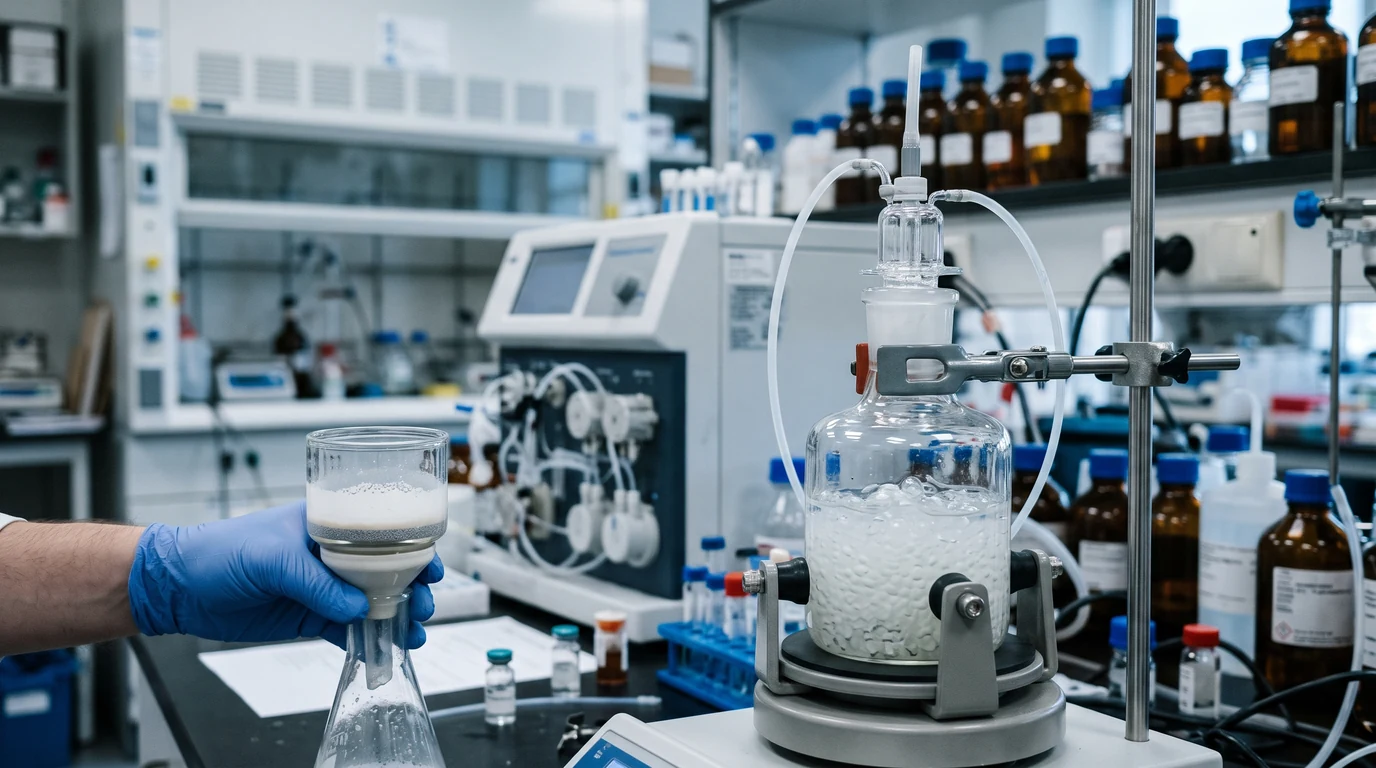
Peptide synthesis today means solid-phase peptide synthesis, in which the growing chain is anchored to a resin bead and built one amino acid at a time from the C-terminus. Each cycle removes an Fmoc protecting group, couples the next protected residue, and washes. Acid cleavage releases the peptide, and every incomplete step leaves an impurity the certificate must account for.
- Solid-phase peptide synthesis was introduced by Bruce Merrifield in 1963 and builds the peptide one residue at a time while it is anchored to a resin bead.
- Fmoc, the 9-fluorenylmethoxycarbonyl group introduced by Carpino and Han in 1972, is removed by 20 percent piperidine in dimethylformamide while side-chain groups stay on.
- Wang resin gives a C-terminal acid, Rink amide resin gives a C-terminal amide, and 2-chlorotrityl resin releases protected fragments under very dilute acid.
- Cleavage uses about 90 to 95 percent trifluoroacetic acid with scavengers, and the trifluoroacetate counterion it leaves is what most certificates report.
- A deletion sequence is one residue short of the target and differs from it by exactly that residue mass; a truncation is a chain capped by acetic anhydride after a failed coupling.
- At 99 percent coupling efficiency, about 74 percent of chains are complete after thirty cycles, which is why purification always follows synthesis.
What is solid-phase peptide synthesis?
Solid-phase peptide synthesis is the method of building a peptide while one end of it is bonded to an insoluble resin bead, so that excess reagents and by-products can be washed away between steps while the product stays behind. Bruce Merrifield described it in the Journal of the American Chemical Society in 1963 with the synthesis of a tetrapeptide, and the idea was simple enough to change the field: if the chain cannot leave the bead, purification between steps becomes a filtration.
Before Merrifield, each residue added to a peptide in solution meant an isolation, a purification and a yield loss, and a chain of ten residues was a serious project. Anchoring the chain let the same cycle of reactions be repeated without isolating anything, which made automation possible and eventually made a thirty-residue peptide a routine order. The approach earned Merrifield the Nobel Prize in Chemistry in 1984.
Nearly every research peptide in commerce is made this way, which is why its characteristic impurities appear on certificate after certificate. Understanding the cycle is the fastest way to understand what a purity figure is measuring and what sits in the other few percent. The custom synthesis vs catalog guide covers the buying decision; this page covers the chemistry underneath it.
- Deprotect: piperidine in dimethylformamide removes the Fmoc group from the chain end
- Rinse out base: dimethylformamide carries away piperidine and the fluorene by-product
- Couple: the next Fmoc amino acid is activated and forms the amide bond
- Rinse out reagent: unreacted amino acid and coupling reagent are removed before the next cycle
- Cleave: after the last cycle, trifluoroacetic acid releases the peptide and strips side-chain groups
What does Fmoc mean, and why did it replace Boc?
Fmoc is the 9-fluorenylmethoxycarbonyl group, a protecting group that sits on the alpha-amino group of each incoming amino acid so that only one amine in the reaction can form a bond. Carpino and Han introduced it in the Journal of Organic Chemistry in 1972. Its defining property is that it comes off in a mild base, usually a 20 percent solution of piperidine in dimethylformamide, while the side-chain protecting groups and the link to the resin stay put because they are removed by acid instead.
Merrifield's original chemistry used the tert-butyloxycarbonyl group, Boc, on the alpha-amine. Boc comes off in trifluoroacetic acid, and the side-chain groups that survive it need a much stronger acid at the end, anhydrous hydrogen fluoride, which requires special apparatus. Fmoc chemistry splits the two jobs between base and acid, so the final cleavage needs only trifluoroacetic acid, and the laboratory never handles hydrogen fluoride. The 2016 review by Behrendt, White and Offer in the Journal of Peptide Science describes Fmoc solid-phase synthesis as the method of choice, supported by the volume production of therapeutic peptides that has driven down the cost of high-quality Fmoc building blocks.
The scheme is called orthogonal protection because the two classes of protecting group are removed by conditions that do not touch each other. Isidro-Llobet, Alvarez and Albericio cataloged the full set in Chemical Reviews in 2009: tert-butyl for serine, threonine, tyrosine, aspartate and glutamate side chains; Boc for lysine and tryptophan; trityl for asparagine, glutamine, histidine and cysteine; and the Pbf sulfonyl group for arginine. All come off in the final acid step.
How does one synthesis cycle work, step by step?
One cycle of Fmoc solid-phase peptide synthesis adds one amino acid to the chain and has four stages, repeated for every residue in the sequence from the C-terminus toward the N-terminus. The chain grows in the opposite direction to the way a sequence is written and read.
- Deprotection. The resin-bound chain is treated with piperidine in dimethylformamide, which removes the Fmoc group from the terminal amine and exposes it for the next bond.
- Washing. Dimethylformamide washes away the piperidine and the fluorene by-product, so neither interferes with coupling.
- Coupling. The next Fmoc-protected amino acid, with its side chain protected, is activated at its carboxyl group by a coupling reagent, such as a uronium salt like HBTU or HATU, or a carbodiimide such as diisopropylcarbodiimide with an additive like Oxyma, and it forms an amide bond with the free amine. The reagent is used in excess to drive the reaction to completion.
- Washing again, to remove unreacted amino acid and reagent before the next deprotection.
A synthesizer runs those four stages for every residue and tracks the Fmoc release, since the fluorene by-product absorbs ultraviolet light and its signal reports whether deprotection went to completion. A thirty-residue peptide is thirty cycles, each of which has to work almost perfectly for the final product to be mostly the right molecule. If each coupling reaches 99 percent, the fraction of chains that are complete after thirty cycles is 0.99 to the thirtieth power, about 74 percent. That arithmetic is the reason purity on a crude synthetic peptide is never 100 and the reason purification follows.
What do the different resins do?
The resin decides what the C-terminus of the finished peptide will be and how harsh the final cleavage must be. The bead itself is usually cross-linked polystyrene or a polyethylene glycol graft of it, swollen in solvent so reagents can reach the chains inside. What matters chemically is the linker, the small molecule bonded to the bead that the first amino acid attaches to.
| Resin | C-terminus produced | Cleavage condition | Typical use |
|---|---|---|---|
| Wang resin | Free carboxylic acid | Concentrated trifluoroacetic acid | Peptides ending in a C-terminal acid |
| Rink amide resin | Carboxamide | Concentrated trifluoroacetic acid | Peptides with a C-terminal amide, which many research peptides carry |
| 2-Chlorotrityl chloride resin | Free carboxylic acid | Very dilute acid | Protected fragments and sequences prone to side reactions at the first residue |
Many research peptides, among them ipamorelin and sermorelin, end in an amide rather than an acid, and a Rink amide resin is how that amide gets there: the linker itself becomes the nitrogen of the C-terminal amide when the peptide is cleaved. A certificate that lists the molecular formula and mass has already accounted for that choice, since an amide ending weighs about one dalton less than the corresponding acid.
What happens at cleavage?
Cleavage is the final acid treatment that releases the finished peptide from the resin and removes every side-chain protecting group at the same time. The reagent is trifluoroacetic acid, PubChem CID 6422, formula C2HF3O2, used at around 90 to 95 percent in a mixture with scavengers. The scavengers, commonly water, triisopropylsilane and sometimes a thiol, exist to trap the carbocations that fly off the protecting groups as they leave, because those cations would otherwise attach themselves to tryptophan, methionine, cysteine or tyrosine side chains and create new impurities.
After cleavage the peptide is precipitated in cold diethyl ether, collected and dried. At this stage it is a crude product carrying every incomplete chain from every cycle, plus whatever the cleavage itself created. Purification by reversed-phase HPLC follows, with fractions collected across the main peak, and the purified material is lyophilized from a solution that still contains trifluoroacetic acid.
That is where the counterion on a certificate comes from. Each basic group on the peptide, the N-terminal amine and the side chains of lysine, arginine and histidine, pairs with a trifluoroacetate anion, and that salt is what the vial contains unless the supplier has exchanged it for acetate. The net peptide content guide explains why the counterion means the peptide itself is only part of the weighed mass.
Where do deletion, truncation and other impurities come from?
The impurities on a synthetic peptide certificate come from the synthesis cycle doing its job slightly less than completely, and each kind of failure leaves a recognizable signature in the mass spectrum. The purity vs identity guide explains why a purity figure alone does not name them; this section explains what they are.
A deletion sequence is a chain that missed one residue. If a coupling failed on some beads and the next deprotection went ahead anyway, those chains carry on growing without the skipped amino acid, and the finished peptide is one residue short. It differs from the target by exactly the residue mass that was skipped, and because it is so similar in size and charge it often elutes close to the main peak on HPLC.
A truncation sequence is a chain that stopped growing. Synthesizers often deliberately cap any amine that failed to couple by treating it with acetic anhydride, which converts the dead chain into an acetylated stub that can never grow again. That cap is intentional: a truncated chain is far easier to separate from the full-length product than a deletion sequence is, so capping trades a little yield for a cleaner purification.
Several side reactions add their own products. Aspartimide formation happens when an aspartate side chain cyclizes onto the backbone nitrogen beside it during the piperidine step, especially at Asp-Gly, giving a ring that reopens into a mixture of the right peptide, its isomer and a piperidide adduct. Racemization at histidine or cysteine during activation converts an L residue to D with no change in mass. Oxidation of methionine adds 16 daltons; incomplete removal of a tert-butyl group adds 56; a leftover trityl adds 242. Each is a reason that a lot can read 98 percent pure and still deserve a look at what the other 2 percent is.
How does the synthesis show up on a certificate?
The synthesis shows up on a certificate of analysis as the pattern of minor peaks around the main one, and as the counterion that explains the gap between gross weight and peptide content. Identity by mass spectrometry confirms that the main peak has the theoretical mass of the full sequence. Purity by reversed-phase HPLC reports the main peak's share of total peak area, with deletion and side-reaction products in the remainder. Where a supplier reports the masses of the main impurities, a reader can assign them: minus one residue mass is a deletion, plus 16 is an oxidation, plus 56 is a tert-butyl left behind.
LabFirst sells catalog peptides made by this chemistry, and each lot carries a Kovera Labs certificate that can be checked from the certificate page. FOR LABORATORY AND IN-VITRO RESEARCH USE ONLY. NOT FOR HUMAN OR ANIMAL CONSUMPTION. NOT FOR PERSONAL, MEDICAL, DIAGNOSTIC, THERAPEUTIC, OR RECREATIONAL USE.
Bottom line
Fmoc solid-phase peptide synthesis builds a chain one residue at a time on a resin, removing the Fmoc group with piperidine, coupling the next protected amino acid, and washing between every step. Trifluoroacetic acid cleaves the finished peptide and strips the side-chain groups, leaving the trifluoroacetate salt that most certificates report. Every incomplete coupling or deprotection leaves a deletion, truncation or adduct, and reading those minor peaks against the residue masses is how a laboratory sees the synthesis in the certificate.
Common questions
What is solid-phase peptide synthesis?
What does Fmoc stand for in peptide synthesis?
Why is trifluoroacetic acid used to cleave peptides?
What is a deletion sequence in a synthetic peptide?
Why is a synthetic peptide never 100 percent pure before purification?
More science guides
Sources
- Merrifield RB. Solid Phase Peptide Synthesis. I. The Synthesis of a Tetrapeptide. Journal of the American Chemical Society 85(14):2149-2154 doi:10.1021/ja00897a025. The original description of building a peptide on an insoluble resin so that purification between steps becomes a wash.
- Carpino LA, Han GY. The 9-fluorenylmethoxycarbonyl amino-protecting group. Journal of Organic Chemistry 37(22):3404-3409 doi:10.1021/jo00795a005. Introduction of the base-labile Fmoc group that made orthogonal protection with acid-labile side-chain groups possible.
- Behrendt R, White P, Offer J. Advances in Fmoc solid-phase peptide synthesis. Journal of Peptide Science 22(1):4-27 doi:10.1002/psc.2836. Review of current Fmoc practice, including the aspartimide and racemization side reactions and the economics of Fmoc building blocks.
- Isidro-Llobet A, Alvarez M, Albericio F. Amino acid-protecting groups. Chemical Reviews 109(6):2455-2504 doi:10.1021/cr800323s. The catalog of side-chain protecting groups, their removal conditions and the orthogonality between base- and acid-labile sets.