Strictly speaking, polypeptide foods are simply all foods that contain protein. Polypeptides are chains of amino acids joined by amide bonds. Food proteins such as caseins, glutens and collagens are long, folded examples. Labs measure them by nitrogen analysis, amino acid analysis, chromatography and mass spectrometry.
- Every dietary protein is a polypeptide, so any protein-containing food is a polypeptide food; chemistry recognizes no narrower category behind the phrase.
- The peptide bond is planar with partial double-bond character, a geometry established by Pauling and Corey in 1951.
- The naming boundaries are conventions: oligopeptide below roughly twenty residues, polypeptide above, protein at about fifty residues with a stable fold.
- Kjeldahl and Dumas nitrogen methods estimate protein through a conversion factor and cannot distinguish peptide nitrogen from any other, the gap the 2008 melamine adulteration exploited.
- Chain-aware measurements (amino acid analysis, SDS-PAGE, RP-HPLC, LC-MS) are what actually confirm and identify polypeptides in a matrix.
A search phrase chemistry does not quite recognize
In plain terms, a polypeptide is a long chain of beads, and each bead is an amino acid. Any food with protein holds these chains, from milk to bread. So the phrase names ordinary protein, and no special food group.
The phrase suggests a special category of foods, and the honest place to start is that chemistry has no such category. A polypeptide is a chain of amino acids joined end to end by amide bonds. A protein is a polypeptide that is long enough, and folded stably enough, to have earned the grander name. Every food that contains protein therefore contains polypeptides, because the protein is the polypeptide. Milk, wheat, eggs, meat, beans: each is a polypeptide food in exactly the sense the query intends, and none is special for it.
Where the phrase comes from is easier to guess than to document. Polypeptide turns up on cosmetic ingredient lists and in supplement marketing because it sounds more engineered than protein, and search queries inherit the vocabulary of the labels people read. This page takes the question literally instead: what the word means, how the bond that defines it works, where the naming lines between peptide, polypeptide and protein actually sit, which specific polypeptides common foods contain, and how a laboratory measures any of it. That last part is the useful one. The others are definitions; the measurement is where the chemistry earns its keep.
- Amino acid: the monomer, one α-amine and one α-carboxyl
- Dipeptide: two residues, one amide bond
- Oligopeptide: up to roughly twenty residues
- Polypeptide: the long chain, folded or not
- Protein: a polypeptide with a stable fold and a name of its own
The bond that builds every one of them
A peptide bond forms when the carboxyl carbon of one amino acid condenses with the α-amino nitrogen of the next, releasing a molecule of water and leaving an amide linkage. Run that reaction down a chain and the repeating backbone it produces, nitrogen to α-carbon to carbonyl carbon, is identical in a dipeptide, in β-casein, and in a myosin heavy chain nearly two thousand residues long. The side chains vary. The backbone never does.
The bond itself has more character than a generic single bond. Pauling and Corey established in 1951 that the amide group is planar: resonance lends the carbon–nitrogen link partial double-bond character and shortens it measurably, rotation about it is restricted, and the six atoms of the amide plane move as a unit. Nearly every peptide bond in a natural polypeptide sits in the trans configuration, with the familiar exception of bonds preceding proline, where the cis form appears at meaningful rates. The chain's real conformational freedom lives in the two rotatable bonds flanking each α-carbon, which is how a backbone built of rigid planes still manages helices, sheets and everything between.
One more property carries practical weight. The amide bond is thermodynamically unstable in water yet kinetically very slow to hydrolyze; estimates of the uncatalyzed half-life at neutral pH run to centuries. Enzymes, hot acid and strong base collapse that timescale to hours. Both halves of the fact get put to work below. The slowness is why polypeptides survive as materials at all, in a cheese cave or a sample vial alike, and it is the same hydrolysis chemistry that eventually limits any prepared laboratory solution, as the storage and stability guide sets out. The acid route is how a laboratory takes a chain apart on purpose to count its residues.
Peptide, polypeptide, protein: where the names change
The names are assigned by residue count, and the boundaries are conventions rather than discoveries. Two residues make a dipeptide, three a tripeptide, and so on up through the oligopeptides, a prefix usually retired somewhere below twenty residues. Past that the chain is a polypeptide. Protein is generally reserved for chains of roughly fifty residues and up that hold a defined three-dimensional fold, though usage wobbles at the boundary: insulin, fifty-one residues across two chains, is a protein in one textbook and a polypeptide in the next, and both readings are defensible. No chemistry changes at any of these thresholds.
The conventions that do carry authority are the IUPAC–IUB recommendations on amino acid and peptide nomenclature. They fix the things worth fixing. Sequences are written and numbered from the amino terminus to the carboxyl terminus; residues take standardized three-letter and one-letter codes; a position such as Lys20 means the twentieth residue counted from the N-terminus, a lysine. Every sequence claim on a certificate of analysis is readable only because those rules are shared, which is a quiet argument for taking nomenclature seriously.
A rule of thumb connects length to mass: an average residue contributes about 110 daltons, so a chain of one hundred residues runs near 11 kDa. The arithmetic matters when reading analytical output, because size-based methods report mass while synthesis documentation reports residue counts, and the reader has to move between the two descriptions of the same chain.
The polypeptides common foods actually contain
Talking about foods in polypeptide terms is unusual, and also perfectly well defined; the chain inventories of the major food matrices are documented in the food-chemistry literature to a level of detail most readers never need. A representative sample:
| Matrix | Principal polypeptides | Chain length (residues) | Structural note |
|---|---|---|---|
| Cow's milk | αs1-, αs2-, β- and κ-caseins; β-lactoglobulin; α-lactalbumin | About 123 to 224 | The caseins are natively disordered and held in micelles; the two whey proteins are compact folded globules |
| Egg white | Ovalbumin, ovotransferrin, lysozyme | 129 to about 686 | Lysozyme, at 129 residues, is among the smallest true proteins in any common food |
| Wheat | Gliadins and glutenin subunits | Roughly 250 to 800 per subunit | Glutenin subunits crosslink through disulfide bonds into polymers of very large aggregate mass |
| Muscle tissue | Actin, myosin heavy chain, collagen | 375 to about 1,900 | Gelatin is collagen after partial hydrolysis, a polypeptide product made from a polypeptide |
| Soybean | Glycinin and β-conglycinin subunits | Roughly 400 to 600 | Seed storage globulins, assembled into multi-subunit complexes |
Foods also carry genuinely short peptides. Glutathione, a tripeptide found across plant and animal tissue, deserves a chemical aside: one of its two amide bonds runs through the side-chain carboxyl of glutamate rather than the α-carboxyl, making it a peptide with a non-standard linkage. Carnosine and anserine, dipeptides of skeletal muscle, appear in any careful analysis of meat. And proteolysis during cheese ripening or soy fermentation cleaves the parent caseins and globulins into hundreds of short fragments, which is where much of a ripened cheese's flavor chemistry comes from, including the documented bitterness of certain hydrophobic fragments.
Measuring polypeptides in a laboratory
The oldest measurement is to count nitrogen and multiply. The Kjeldahl method digests a sample in hot sulfuric acid, converts the liberated nitrogen to ammonia and titrates it; the Dumas method burns the sample and measures nitrogen gas directly. Both are AOAC official methods, both stand behind the protein figures on nutrition labels, and both share one blind spot: they count nitrogen atoms, and nothing about a nitrogen atom says it came from a peptide bond. The conversion factors, 6.25 as the general default, 6.38 for dairy, 5.7 for wheat, are averages built on the typical nitrogen content of each matrix's proteins.
The blind spot is not hypothetical. The 2008 melamine adulteration episode worked precisely because melamine is about two-thirds nitrogen by mass, so spiking a protein-diluted material with it restored the Kjeldahl number without restoring any polypeptide. Regulatory laboratories responded by pairing nitrogen methods with techniques that see the chain itself.
Those techniques are the standard peptide-chemistry stack. Amino acid analysis hydrolyzes the sample in 6 M hydrochloric acid at around 110 °C for a day, then quantifies the freed amino acids chromatographically; the hydrolysis destroys tryptophan and converts asparagine and glutamine to their acid forms, so those residues carry standard caveats in any report. SDS-PAGE spreads a matrix's polypeptides by size. RP-HPLC resolves the peptides of an extract or hydrolysate by hydrophobicity, and LC-MS assigns each one a mass, down to sequencing individual fragments from a ripened cheese by tandem MS. For deliberately hydrolyzed products there is also degree of hydrolysis, followed by derivatizing free amino groups with OPA or TNBS reagents: every cleaved peptide bond exposes one new amine, so a count of amines is a count of broken bonds.
A reader who has spent time with peptide certificates will recognize all of it. Identity by mass, purity by chromatography, composition by hydrolysis: the questions a food laboratory asks of a cheese are the questions a certificate of analysis answers for a synthetic chain.
A food polypeptide and a research-grade peptide are different materials
The search phrase blurs a distinction that matters in practice. A polypeptide in a food is a population. β-lactoglobulin from a dairy stream arrives with genetic variants, processing-induced modifications such as lactosylation, and the company of everything else in the matrix; its characterization is statistical, and for food purposes that is the appropriate kind of description.
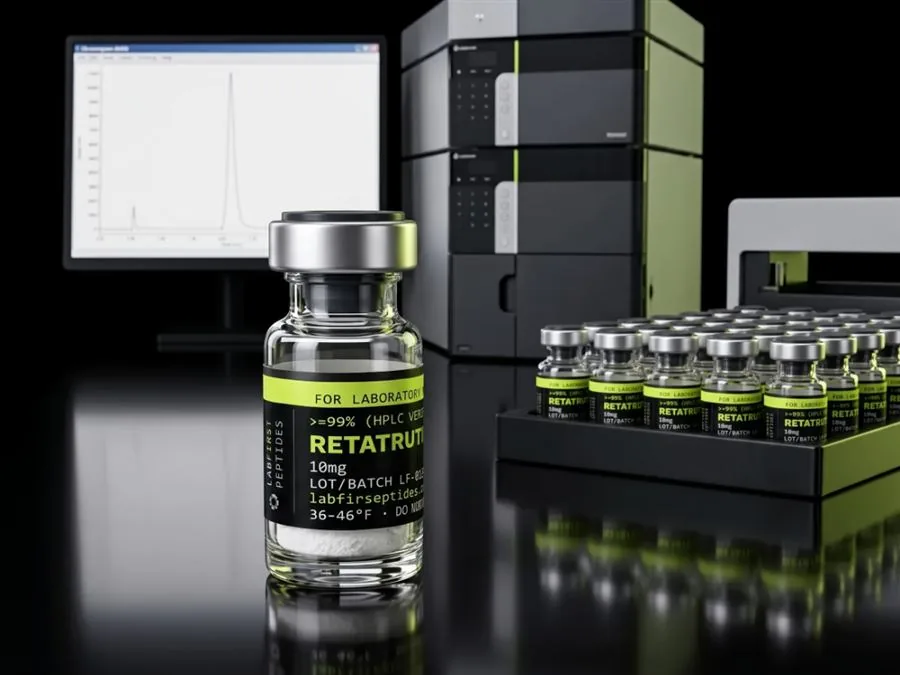
A research-grade peptide is the opposite object: one defined sequence, chemically synthesized, purified by reversed-phase chromatography, and shipped with a certificate of analysis stating identity by mass spectrometry and purity as the area fraction of a single named molecule. What that documentation has to show, and how to read it, is set out in the quality standard. The material arrives as a lyophilized solid and is brought into solution with laboratory diluents chosen for the work, a decision the laboratory diluent guide covers in detail.
The two categories never meet. Food polypeptides are constituents of regulated foods. Research-grade peptides are laboratory reagents sold under research-use-only terms; they are not ingredients, not supplements, and not foods of any kind, and their labeling says so. FOR LABORATORY AND IN-VITRO RESEARCH USE ONLY. NOT FOR HUMAN OR ANIMAL CONSUMPTION. NOT FOR PERSONAL, MEDICAL, DIAGNOSTIC, THERAPEUTIC, OR RECREATIONAL USE.
Common questions
Is there a difference between a polypeptide and a protein?
Which foods contain polypeptides?
Why doesn't a nitrogen measurement prove protein content?
How does a laboratory identify a specific peptide in a food matrix?
Are research-grade peptides related to food polypeptides?
Related guides: peptide chemistry basics
Sources
- Pauling and Corey, Proceedings of the National Academy of Sciences, 1951. The series of structural papers establishing the planar peptide unit and its partial double-bond character; foundation of the backbone geometry described here.
- IUPAC–IUB Joint Commission on Biochemical Nomenclature, recommendations on amino acid and peptide nomenclature. Fixes N-to-C sequence direction, residue numbering, and the standard three- and one-letter codes assumed by any sequence claim on a certificate of analysis.
- AOAC official methods for nitrogen determination (Kjeldahl and Dumas combustion). The compendial nitrogen methods behind labeled protein figures, and the matrix-specific nitrogen-to-protein conversion factors quoted in the measurement section.
- FDA and WHO records of the 2008 melamine adulteration incident. Documents the exploitation of nitrogen-based protein assays and the regulatory shift toward chain-aware confirmatory methods.