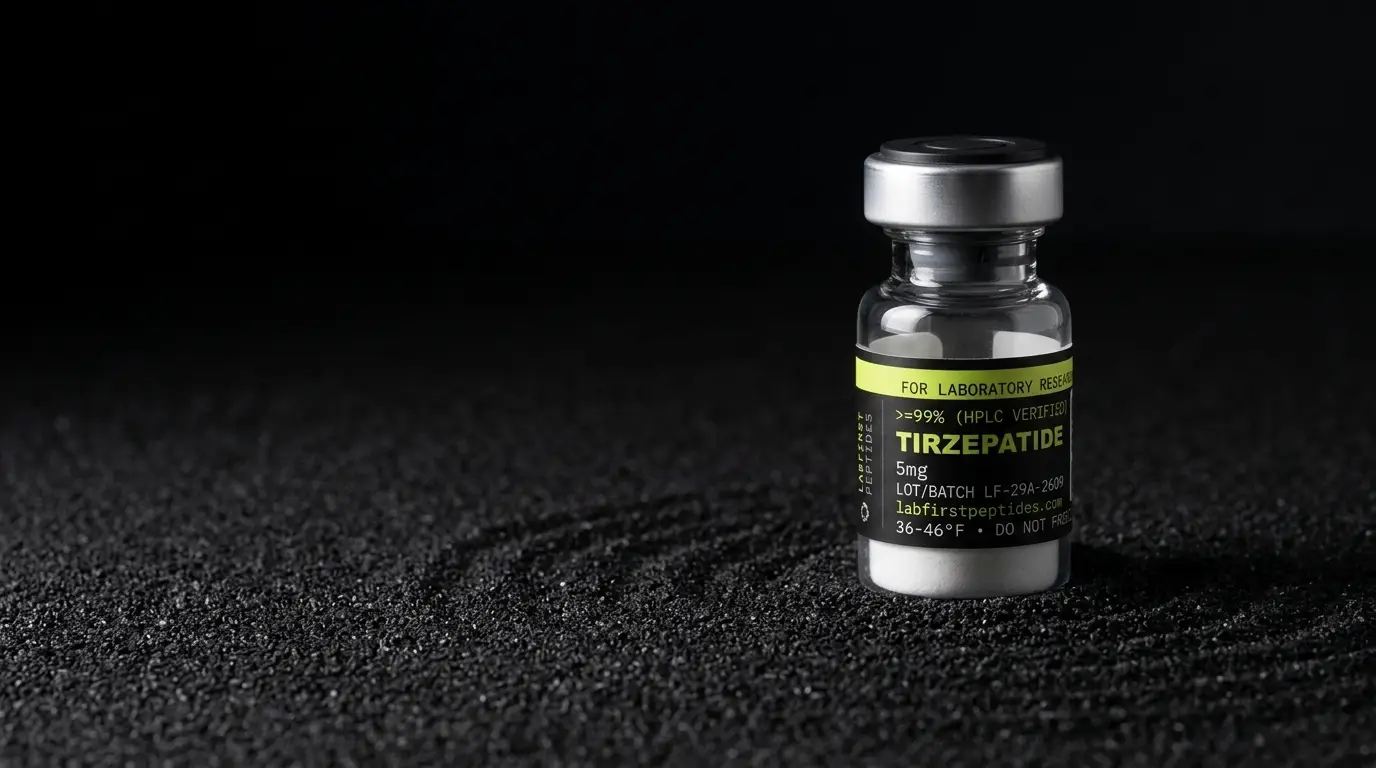
Yes, tirzepatide is a peptide: a chain of 39 amino acids joined by peptide bonds, per the FDA prescribing information. It is a modified one. Two spots carry an unusual amino acid called Aib, the chain ends in an amide, and lysine 20 carries a C20 fatty diacid through a linker.
- Tirzepatide is a 39-amino-acid modified peptide per the FDA prescribing information.
- In tirzepatide, aminoisobutyric acid (Aib) occupies positions 2 and 13.
- The tirzepatide chain ends in a C-terminal amide.
- Tirzepatide lysine 20 carries 1,20-eicosanedioic acid, a C20 fatty diacid, through a linker.
- Tirzepatide has the formula C225H348N48O68 and a molecular weight of 4813.53 Da.
The short answer
Picture a bead necklace with 39 beads on it. Most of the beads are the ordinary kind found in any protein, two are an unusual shape, and one bead has a long waxy tail tied to it. The string of beads is what makes tirzepatide a peptide. The tail is what makes it a modified one.
The IUPAC-IUB nomenclature rules define a peptide as any compound produced by amide formation between the carboxyl group of one amino acid and the amino group of another. Tirzepatide meets that definition without any stretching. The FDA prescribing information for the approved product describes it as a 39-amino-acid modified peptide, and those 39 residues form one continuous chain.
So the question has a plain yes for an answer. The more useful follow-up is which parts of the molecule are standard peptide chemistry and which are not, because the non-standard parts are why tirzepatide behaves differently in a laboratory from an unmodified chain of the same length.
- 39 residues in one chain
- Aib at positions 2 and 13
- C-terminal amide
- C20 fatty diacid on lysine 20 via a linker
- Formula C225H348N48O68, 4813.53 Da
Where it sits on the size scale
The same IUPAC-IUB section gives rough size conventions. Peptides with fewer than about 10 to 20 residues may be called oligopeptides. Longer chains are polypeptides, and polypeptides of specific sequence with more than about 50 residues are usually known as proteins.
At 39 residues, tirzepatide falls in the polypeptide range. It is too long to be an oligopeptide and short of the point where chemists would call it a protein. That explains why its molecular weight sits near 4.8 kDa, rather than a few hundred daltons like a dipeptide or tens of thousands like a large folded protein.
The boundaries are conventions, not sharp lines. Nothing chemical changes at residue 20 or residue 50. What decides the classification is the backbone: a linear chain of residues joined through amide bonds, read from the N-terminus to the C-terminus. The guide to polypeptide chains covers that backbone in more detail.
The three modifications
The FDA description names three features that set tirzepatide apart from a plain chain built only from the twenty coded amino acids.
| Feature | Where | What it is |
|---|---|---|
| Aminoisobutyric acid (Aib) | Positions 2 and 13 | A non-coded amino acid |
| C-terminal amide | The last residue | The terminal carboxyl group is an amide instead of a free acid |
| Fatty diacid on a linker | Lysine at position 20 | 1,20-eicosanedioic acid, a C20 diacid, attached through a linker |
Aib is still an amino acid. It carries an amine and a carboxyl group and joins the chain the same way its neighbors do, so its presence does not change the classification. The label calls it non-coded because the genetic code has no codon for it, which means a cell cannot build it into a protein. It enters tirzepatide during chemical synthesis.
The C-terminal amide is common in peptide chemistry. It removes the negative charge a free carboxyl group would carry at neutral pH, and it changes the mass by a small, predictable amount.
The fatty diacid is the largest departure. The prescribing information calls it a C20 fatty diacid moiety: 1,20-eicosanedioic acid, a twenty-carbon chain with a carboxylic acid at each end. It is joined to the side chain of lysine 20 through a linker. It hangs off the chain rather than sitting in it, so the backbone is still a continuous peptide from end to end.
Does the fatty acid stop it being a peptide?
No. The IUPAC-IUB definition asks how the residues are joined, not whether anything else is attached. Plenty of peptides carry groups that are not amino acids: acetyl caps, amides, phosphates, sugars and lipid chains. Chemists call these modified, conjugated or lipidated peptides, and the peptide label stays.
A smaller example in this catalog follows the same pattern. Palmitoyl pentapeptide-4 is five residues with a sixteen-carbon acyl chain on its N-terminus, and it is described as a peptide without hesitation. Tirzepatide does the same thing at larger scale, with the lipid on a side chain instead of the terminus.
What the attached chain does change is behavior on the bench. A long hydrocarbon segment makes part of the molecule strongly water-avoiding, so the molecule is retained longer on a reversed-phase column and can associate with itself and with surfaces. Those are handling and analysis questions. The tirzepatide storage and stability guide deals with them.
Modified peptide or something else?
Chemists have several words for molecules near the edge of the peptide family, and it helps to see why none of the others fits better here. A peptidomimetic imitates a peptide with a backbone that is partly or wholly not made of amide-linked amino acids. Tirzepatide keeps a true amino acid backbone for all 39 positions, so that word does not apply.
A conjugate joins a peptide to some other molecule. The fatty diacid and linker on lysine 20 make tirzepatide a conjugate in that loose sense, and the FDA wording, modified peptide, covers it. Either way the core noun stays the same.
Formula, mass and what they tell a laboratory
The FDA prescribing information gives the empirical formula as C225H348N48O68 and the molecular weight as 4813.53 Da. PubChem lists the same formula under CID 166567236, with a monoisotopic mass of 4810.52. The gap between those numbers is not an error. Average molecular weight averages over the natural isotopes of each element, while monoisotopic mass counts only the lightest one, and for a molecule this size the two sit a few daltons apart.
That distinction matters when reading a mass spectrum. A certificate for a tirzepatide lot should say which basis it compares against. An observed mass that matches theory within the instrument tolerance is consistent with the claimed structure, fatty diacid and linker included. A reading far below theory would point to a chain missing its side-chain modification.
The tirzepatide identity guide works through that comparison in full, and the tirzepatide certificate of analysis guide explains how the mass sits alongside the purity figure and the lot record. For background on reading any formula, see peptide molecular formula and weight.
What the formula says without drawing it
A formula can be read for clues before any structure is drawn. C225H348N48O68 contains carbon, hydrogen, nitrogen and oxygen and nothing else. There is no phosphorus, so no phosphate groups, and no sulfur, so no cysteine or methionine anywhere in the chain.
The nitrogen count is also telling. Every residue in a peptide contributes at least one backbone nitrogen, and some side chains add more. Forty-eight nitrogens across 39 residues plus a linker is exactly the kind of count a peptide of that length produces. A small organic molecule of similar weight would not come close.
None of this replaces a measured spectrum. It is a quick sanity check that the formula printed on a document belongs to a peptide at all.
Why the classification matters for documentation
Calling tirzepatide a peptide is more than vocabulary. It tells a laboratory which analytical toolkit applies: intact mass, reversed-phase chromatography with detection near the backbone amide absorbance, and, where needed, fragmentation or digestion to confirm sequence. All of those apply here, adjusted for the lipid side chain.
It also tells a buyer what the paperwork should look like. A research-grade tirzepatide lot is a synthetic polypeptide, so its certificate should carry an identity result by mass, a purity figure with method and wavelength stated, and a lot number that matches the vial. The tirzepatide product page lists the sizes in this catalog, and results for a lot appear there only once the certificate for that lot is published.
The FDA document cited on this page is the prescribing information for an approved medicine. It is quoted here only for its description of the molecule. Research material in this catalog is a laboratory reagent.
FOR LABORATORY AND IN-VITRO RESEARCH USE ONLY. NOT FOR HUMAN OR ANIMAL CONSUMPTION.
What is Tirzepatide studied for?
Published research on Tirzepatide investigates the areas below, which is a different question from what Tirzepatide will do for anyone, a claim about a living system that nothing on this site is sold for.
What it is. A peptide that works on the GIP and GLP-1 receptors at the same time.
What the research looks at. There is a large published clinical record: how it behaves at the receptors, how the body handles it, and the measurements its sponsor registered its trials to take. Approved medicines containing it exist under their own brand names.
How it is thought to work. It switches on both the GIP receptor and the GLP-1 receptor. Working on two rather than one is the design feature that separates it from the GLP-1-only drugs.
What is not established. What is sold here is a research chemical, not a drug product. Listing it is not an approval, and not a claim that it is equivalent to, as safe as, or a fit substitute for any approved medicine.
The full record, including the certificate for the lot in stock, is on the Tirzepatide product page.
Common questions
How many amino acids are in tirzepatide?
Is tirzepatide a protein?
What is the C20 fatty diacid on tirzepatide?
What is the molecular weight of tirzepatide?
Published certificates for Tirzepatide
Every figure below is read from a report the laboratory issued for that lot; each page carries the PDF and the lab's own verification link.
More science guides
Sources
- FDA prescribing information for Mounjaro (tirzepatide), sections 11 and 12.1. Describes tirzepatide as a 39-amino-acid modified peptide based on the GIP sequence, with Aib at positions 2 and 13, a C-terminal amide, and Lys20 attached to 1,20-eicosanedioic acid through a linker; molecular weight 4813.53 Da; a C20 fatty diacid moiety.
- PubChem compound record: Tirzepatide (CID 166567236). Molecular formula C225H348N48O68, molecular weight 4813 and monoisotopic mass 4810.52.
- IUPAC-IUB JCBN, Nomenclature and Symbolism for Amino Acids and Peptides, 3AA-11 Definitions of Peptides. Defines a peptide as any compound produced by amide formation between a carboxyl group of one amino acid and an amino group of another, and gives the oligopeptide, polypeptide and protein size conventions.