An oligopeptide is a short peptide made of a few amino acids joined by peptide bonds. IUPAC wording puts the boundary loosely: peptides with fewer than about 10 to 20 residues may be called oligopeptides, and longer ones polypeptides. There is no sharp cutoff, so the term describes size, not a class.
- An oligopeptide is a short peptide; IUPAC wording puts the boundary at fewer than about 10 to 20 residues.
- Longer chains are polypeptides, and chains of specific sequence past about 50 residues are usually called proteins.
- A linear chain of n residues has n minus 1 peptide bonds.
- Peptides are written from the N-terminus to the C-terminus, so Gly-Ala and Ala-Gly differ.
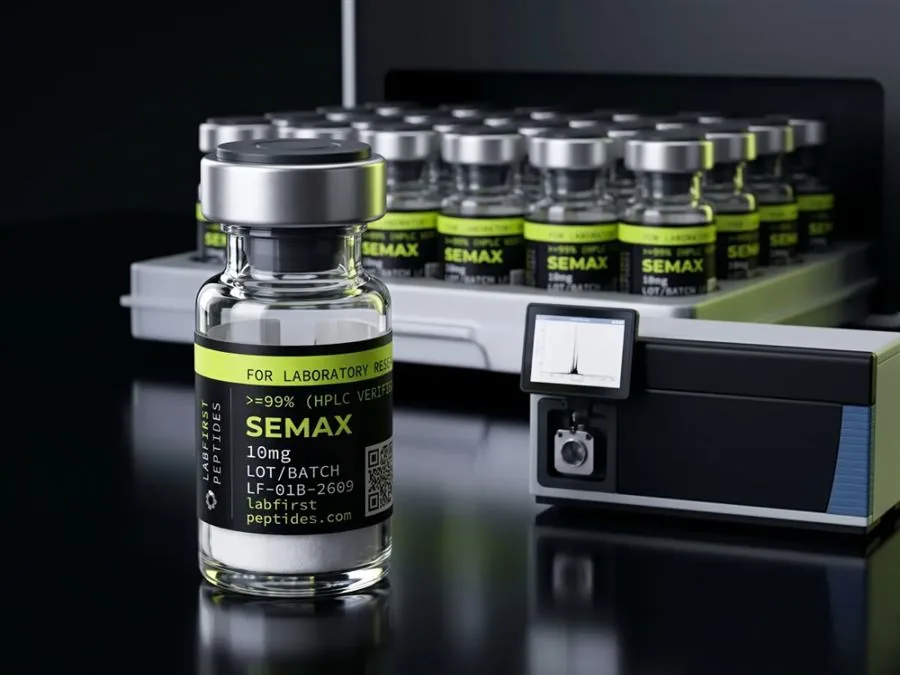
- Semax, Met-Glu-His-Phe-Pro-Gly-Pro, is a seven-residue oligopeptide with formula C37H51N9O10S.
A short chain with a loose definition
Count the beads on a short bracelet. Two beads, three beads, seven beads: at some point you stop saying "a few" and start saying "a lot", but nobody agrees on the exact bead. Oligopeptide works the same way. The word comes from the Greek for "few", and it names a peptide with only a handful of amino acids.
The IUPAC-IUB Joint Commission on Biochemical Nomenclature defines a peptide as any compound produced by amide formation between the carboxyl group of one amino acid and the amino group of another. On length, its wording is deliberately soft. Peptides with fewer than about 10 to 20 residues may also be called oligopeptides, and those with more are called polypeptides. The same text notes that polypeptides of a specific sequence longer than about 50 residues are usually called proteins, and adds that authors differ greatly on where that term starts.
So oligopeptide is a size description. It does not tell you what a molecule does, where it came from, or whether it was made in a lab or a cell. A two-residue dipeptide is an oligopeptide. So is a three-residue tripeptide, and so is a seven-residue chain like Semax. If you want the broader picture of what the word peptide covers first, the guide to what peptides are starts there.
- Dipeptide: two residues, one bond
- Tripeptide: three residues, two bonds
- Oligopeptide: a few residues, up to roughly 10 to 20
- Polypeptide: longer chains past that gray zone
- Protein: usually over about 50 residues with a defined sequence
The length terms, side by side
Chemists name the smallest peptides by an exact count, using Greek number prefixes. Past about ten residues the exact names get awkward, and people fall back on the general terms.
| Term | Residues | Peptide bonds in a linear chain |
|---|---|---|
| Dipeptide | 2 | 1 |
| Tripeptide | 3 | 2 |
| Tetrapeptide | 4 | 3 |
| Pentapeptide | 5 | 4 |
| Hexapeptide to decapeptide | 6 to 10 | 5 to 9 |
| Oligopeptide | a few, up to roughly 10 to 20 | one fewer than the residue count |
| Polypeptide | more than roughly 10 to 20 | one fewer than the residue count |
| Protein | usually more than about 50, with a defined sequence | varies; often several chains |
The bond column follows from how the chain forms. Each peptide bond joins two neighbors and releases one water, so a straight chain of n residues has n minus 1 peptide bonds. Cyclic peptides break that rule, because the two ends join as well.
Notice the overlap in the middle rows. A 15-residue chain can fairly be called either an oligopeptide or a polypeptide, and you will find both in published papers. Neither is wrong. When precision matters, the residue count or the full sequence says more than either word.
How are oligopeptides named and written?
Short peptides are named from the amino end to the carboxyl end, the N-terminus to the C-terminus. Every residue except the last takes an -yl ending, so the dipeptide of glycine then alanine is glycylalanine, and the IUPAC text uses alanylleucyltryptophan as an example of a longer one. That style becomes unreadable fast, which is why most papers and certificates use three-letter codes joined by hyphens, or the one-letter codes run together.
Semax is a handy example. Its PubChem record, CID 9811102, gives the formula C37H51N9O10S and an IUPAC name that reads out as methionine, glutamic acid, histidine, phenylalanine, proline, glycine, proline. In three-letter code that is Met-Glu-His-Phe-Pro-Gly-Pro. In one-letter code it is MEHFPGP. Seven residues, six peptide bonds, and firmly an oligopeptide by any reading of the IUPAC wording.
Direction matters. Gly-Ala and Ala-Gly contain the same two amino acids and are still different compounds, because a different residue sits at each end. The guide to peptide sequences covers how that order is written and read.
Modified ends get their own notation. An acetyl group on the N-terminus is written Ac- in front of the sequence, and an amide on the C-terminus is written -NH2 after it. Those small caps change the formula and the mass, which is why a certificate has to state them.
Where do oligopeptides turn up?
Oligopeptides are everywhere in chemistry and biology, mostly because short chains are easy to make and easy to measure. Some familiar ones are only two or three residues long. Glutathione is a tripeptide. Carnosine is a dipeptide. Aspartame, the sweetener, is a dipeptide methyl ester.
A second group comes from breaking bigger proteins apart. Enzymes cut long chains into short pieces, and a digest of a protein is largely a mixture of oligopeptides and free amino acids. That is the idea behind peptide mapping, where a protein is cut on purpose and the pieces are measured to confirm its sequence. It is also why some research preparations, Cerebrolysin among them, are described as mixtures of low-molecular-weight peptides rather than as one defined molecule.
A third group is made on purpose by solid-phase synthesis. Most research peptides sold as defined compounds, are synthetic oligopeptides or short polypeptides. Synthesis becomes harder with every residue added, because each coupling step has to work, so short chains are where synthetic chemistry is most at home.
Common mix-ups with the word
Three confusions come up often. The first is treating oligopeptide as a category of function, as if all oligopeptides did something in common. They do not. The word says the chain is short and nothing else. A sweetener, a laboratory reference standard and a fragment cut from a muscle protein can all be oligopeptides.
The second is reading the 10 or 20 residue figure as a rule. The IUPAC text says "about" and gives a range on purpose. A paper that calls a 12-residue chain a polypeptide has not made a mistake, and neither has one that calls it an oligopeptide.
The third is mixing up residues and amino acids. Once an amino acid is built into a chain, it has lost the atoms of one water at each bond it forms, so chemists call it a residue. The count that defines a dipeptide or an oligopeptide is a count of residues. That is also why the mass of a peptide is the sum of its amino acids minus about 18 for each peptide bond, not the plain sum.
A related term, oligomer, is broader still. It covers any molecule built from a few repeating units, and oligonucleotides and oligosaccharides use the same Greek root for short chains of nucleotides and sugars.
How does an oligopeptide differ from a polypeptide in practice?
In practice, an oligopeptide differs from a polypeptide mostly in what its size allows. The line between the two terms matters less than the practical differences that come with size. A short chain has little room to fold into a stable three-dimensional shape, so its chemistry is dominated by its sequence and its ends. A longer chain can fold, and a folded protein behaves in ways its sequence alone does not predict.
Size also changes how a laboratory measures the molecule. An oligopeptide usually shows up in a mass spectrum as one or two clear ions, and its mass can be calculated exactly from the formula. A large polypeptide carries many charges at once, and its spectrum has to be deconvoluted before the mass can be read. The guide to polypeptide chains picks up the story for the longer end of the scale.
Short chains also tend to be soluble and quick to separate by reversed-phase HPLC, and their impurities are easier to see, because a missing residue or an oxidized methionine shifts the mass by a known amount. That is one reason synthetic oligopeptides are practical reference materials in analytical chemistry.
Checking identity and purity of a short peptide
For a defined oligopeptide, identity and purity are two different questions. Purity by HPLC is an area ratio: how much of the ultraviolet signal sits in the main peak. It says nothing about which molecule made that peak. Identity comes from mass spectrometry, where the observed mass is compared with the mass calculated from the sequence and any end modifications.
For Semax, that means a result read against an average mass near 813.9. An N-terminal acetyl group would add about 42, and a C-terminal amide would take away about 1, so each variant has its own target. A laboratory that reports only a purity percentage has not shown which of them is in the vial. The HPLC purity versus identity guide walks through why both results are needed, and the certificate index shows how lot documents are published.
FOR LABORATORY AND IN-VITRO RESEARCH USE ONLY. NOT FOR HUMAN OR ANIMAL CONSUMPTION.
Common questions
How many amino acids are in an oligopeptide?
Is an oligopeptide the same as a polypeptide?
Is an oligopeptide a protein?
How many peptide bonds does an oligopeptide have?
More science guides
Sources
- IUPAC-IUB Joint Commission on Biochemical Nomenclature, 3AA-11 and 3AA-13: peptides. Defines a peptide, gives the 'fewer than about 10-20 residues' oligopeptide boundary, and the rough 50-residue point where authors start to say protein.
- PubChem Compound Summary for CID 9811102, Semax. Formula C37H51N9O10S, average mass 813.9, monoisotopic mass 813.348, and the IUPAC name from which the Met-Glu-His-Phe-Pro-Gly-Pro order is read.