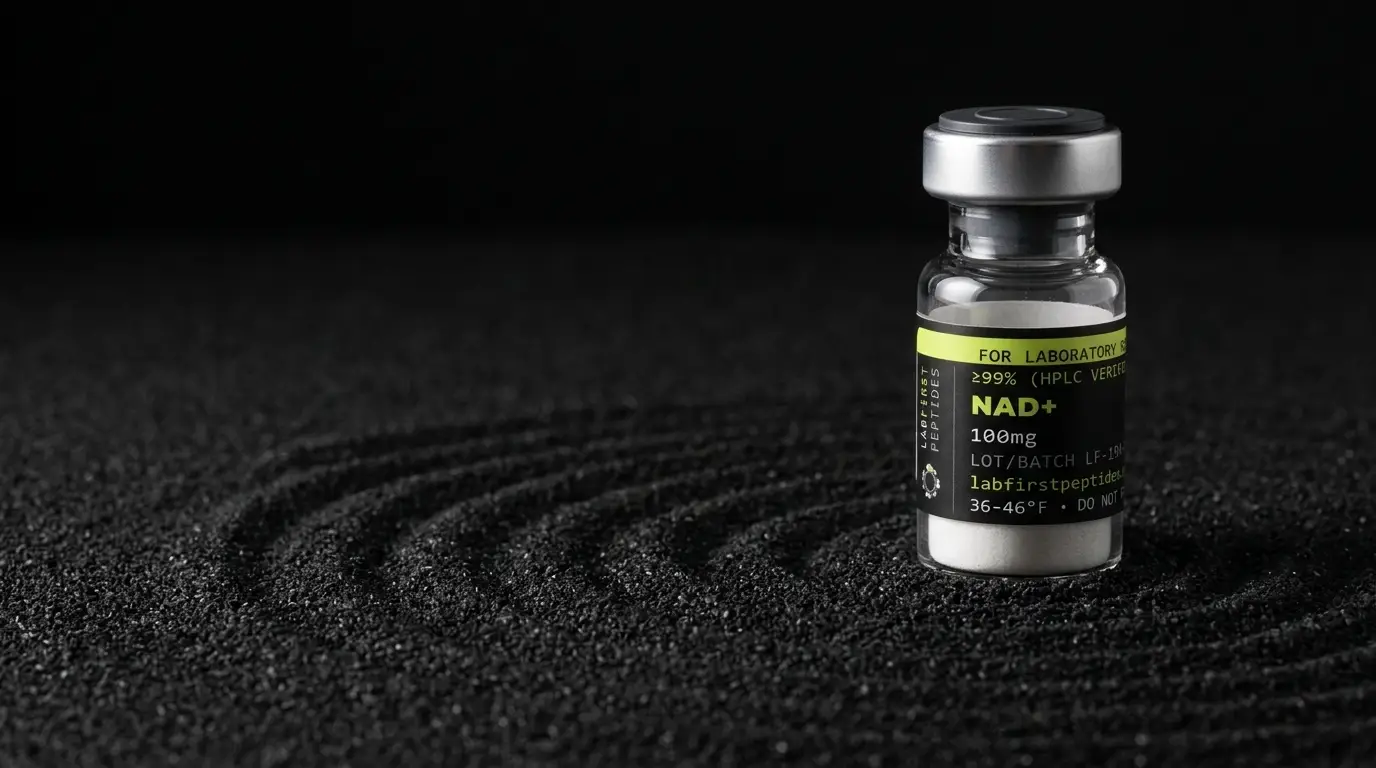
No, NAD+ is not a peptide. It is a dinucleotide: an adenine nucleotide and a nicotinamide nucleotide joined through a diphosphate bridge. It contains no amino acids and no peptide bonds. Research suppliers list it beside peptides because it is handled, stored and documented the same way.
- NAD+ is a dinucleotide, not a peptide.
- NAD+ contains no amino acids and no peptide bonds.
- PubChem lists NAD+ as CID 5892, formula C21H27N7O14P2, molecular weight 663.4.
- The two nucleotides in NAD+ are joined through linked phosphate groups.
- NAD+ is sold beside peptides because it is handled, stored and documented the same way.
A test you can do on paper
Ask one question of any molecule: is it built from amino acids linked by amide bonds? If yes, it is a peptide. If no, it is something else, however it is packaged. Put NAD+ through that question and the answer comes back no.
The IUPAC-IUB nomenclature rules define a peptide as any compound produced by amide formation between the carboxyl group of one amino acid and the amino group of another. The whole category rests on those two ingredients: amino acids, and the amide bonds between them.
NAD+, short for nicotinamide adenine dinucleotide, has neither. Its building blocks are sugars, phosphate groups and two nitrogen-containing ring systems. It belongs to the nucleotide family, the same broad family as the units of DNA and RNA.
- Look for amino acid residues: none
- Look for peptide bonds: none
- Find the phosphate bridge
- Count phosphorus in the formula: two
- Verdict: a dinucleotide
What is NAD+ made of?
The PubChem record for NAD+ (CID 5892) gives the molecular formula C21H27N7O14P2 and a molecular weight of 663.4. The IUPAC name in that record lays out the structure: two ribose rings, one carrying adenine and one carrying a nicotinamide ring, each linked through a phosphate, with the two phosphates joined to each other.
| Part | Chemical family | In a peptide? |
|---|---|---|
| Adenine | Purine base | No |
| Nicotinamide | Pyridine carboxamide | No |
| Two ribose rings | Five-carbon sugars | No |
| Diphosphate bridge | Linked phosphate groups | No |
| Amino acid residues | Not present in NAD+ | Always |
Each half is a nucleotide: a base, a ribose and a phosphate. Two nucleotides joined together make a dinucleotide, which is exactly what the name says. The plus sign marks the oxidized form. PubChem draws the nicotinamide nitrogen as a pyridinium, which is where that positive charge sits.
One detail can mislead. Nicotinamide carries a carboxamide group, and a peptide bond is also an amide. But the amide in NAD+ is a substituent on a ring and links nothing to anything. It does not join two amino acids, so it is not a peptide bond.
How the two halves connect
The IUPAC name in the PubChem record is long, but it can be read in pieces. One piece describes a ribose ring bonded to 6-aminopurine, which is adenine. Another describes a second ribose ring bonded to a 3-carbamoylpyridinium, which is the charged nicotinamide ring. Each ribose connects through a carbon outside its ring to a phosphate group.
The two phosphate groups are joined directly to each other. That phosphorus-oxygen-phosphorus link is the bridge holding the molecule together. A chemist would describe the whole thing as two nucleosides joined through a diphosphate.
Nowhere in that name is there an amino acid or a bond from the carboxyl group of one amino acid to the amine of another. The name alone settles the question, before any chemistry beyond reading it.
Peptide and nucleotide side by side
Putting the two classes next to each other shows how far apart they are.
| Property | A peptide | NAD+ |
|---|---|---|
| Monomer | Amino acid | Nucleotide |
| Linkage | Amide (peptide) bond | Phosphate bridge |
| Phosphorus | Only if modified | Two atoms |
| Written as | Residue letters, N to C | A single named molecule |
The phosphorus count is the quickest tell in a formula. A plain peptide built from the coded amino acids contains carbon, hydrogen, nitrogen and oxygen, plus sulfur if cysteine or methionine is present. NAD+ carries two phosphorus atoms. You can spot the difference in C21H27N7O14P2 without drawing a single bond.
Size is another clue, though a weaker one. At 663.4 g/mol, NAD+ is about as heavy as a short peptide of five or six residues, so weight alone cannot sort the two. Composition can.
For a refresher on the peptide side, the dipeptide guide starts from the simplest case, and amino acids versus protein shows how chains grow from there.
Why is NAD+ sold beside peptides?
Research catalogs group products by who buys them and how they are handled, not only by chemical class. NAD+ ends up next to peptides for practical reasons.
It is supplied the same way. Research-grade NAD+ usually arrives as a dry powder in a sealed vial, weighed in milligrams, like a lyophilized peptide. It goes in the same freezer, through the same receiving check and into the same lot log. A laboratory ordering both wants one supplier and one paperwork format.
It is documented the same way, too. A NAD+ lot needs an identity result, a purity figure with its method stated, and a lot number that matches the vial. That is the certificate structure a peptide lot carries. The analytical details differ, and the NAD+ identity guide covers where they do, but the reading habits transfer.
This catalog files NAD+ under cellular energy in its metabolic group, not under any peptide class. The NAD+ product page shows the 100 mg, 500 mg and 1000 mg sizes, and the where to buy NAD+ guide covers what to check before ordering it from anyone.
What changes in the laboratory
Because NAD+ is not a peptide, some peptide habits do not carry over. There is no residue sequence to confirm, so fragmenting the molecule to read a residue ladder does not apply. The question of net content still matters, but it becomes how much of the powder is NAD+ as against water and counterion, not how much is peptide.
The identity comparison uses the PubChem figures: 663.4 on an average basis, or a monoisotopic mass of 663.109. A certificate should state which one it compares the observed mass against, exactly as a peptide certificate should.
Read a NAD+ certificate as a nucleotide certificate. Look for the observed mass against the theoretical value, a purity figure with the method and wavelength named, and the lot number. Results for any NAD+ lot in this catalog appear only once the certificate for that lot is published.
Storage follows the familiar pattern even so. A sealed vial of dry powder kept cold, dark and away from moisture is the starting point, and a cold vial should warm to room temperature before it is opened so that condensation stays on the outside. The chemistry behind those habits differs from a peptide, but the bench routine is the same, which is one more reason the two share a shelf.
Where the confusion comes from
The question is common for understandable reasons. NAD+ is sold in the same small vials as peptides, often on the same pages, and shoppers reasonably assume that things sold together are the same kind of thing. The word dinucleotide is also unfamiliar to most people, while peptide has become a catch-all term in some corners of the market.
There is a chemistry reason too. Both peptides and nucleotides are built from repeating units joined into chains, and both are rich in nitrogen. At a glance they share a family resemblance. Look closer and the units, the links and the elements differ.
A good listing clears this up itself. It should name the compound fully, give the formula or a registry number such as the PubChem CID, and describe the material as what it is. A listing that calls NAD+ a peptide is telling you something about the care that went into the rest of the page.
Common mix-ups
Three confusions come up often. The first is treating anything sold in a peptide-style vial as a peptide. Packaging says nothing about chemistry, and a catalog shelf is not a chemical category.
The second is reading the amide in nicotinamide as a peptide bond, which the section above rules out. The third is assuming that because NAD+ contains nitrogen, it must contain amino acids. Nitrogen appears in amino acids and in nucleobases alike, so on its own it tells you nothing.
When in doubt, go back to the definition and the formula. No amino acids, no peptide bonds, two phosphorus atoms: NAD+ is a dinucleotide.
FOR LABORATORY AND IN-VITRO RESEARCH USE ONLY. NOT FOR HUMAN OR ANIMAL CONSUMPTION.
What is NAD+ studied for?
Published research on NAD+ investigates the areas below, which is a different question from what NAD+ will do for anyone, a claim about a living system that nothing on this site is sold for.
What it is. Nicotinamide adenine dinucleotide, a helper molecule rather than a peptide.
What the research looks at. A very large basic-science record on how cells make energy, on oxidation and reduction, and on enzymes. Most of it is about what the molecule does inside cells rather than about any product sold in a vial.
How it is thought to work. It carries hydrogen back and forth in the reactions that make energy, switching between two forms, and it is also used up as raw material by two families of enzymes, the sirtuins and the PARPs. Its basic biochemistry is textbook material and nobody disputes it.
What is not established. Well-understood biochemistry says nothing about any particular preparation in a vial. NAD+ is chemically different from the precursors it is often lumped in with, and material of this kind pulls in water from the air and degrades in light, which makes the handling paperwork matter more than usual.
The full record, including the certificate for the lot in stock, is on the NAD+ product page.
Common questions
Is NAD+ a protein or a peptide?
What is the molecular formula of NAD+?
Why do peptide suppliers sell NAD+?
Does NAD+ have peptide bonds?
Published certificates for NAD+
Every figure below is read from a report the laboratory issued for that lot; each page carries the PDF and the lab's own verification link.
More science guides
Sources
- PubChem compound record: NAD+ (CID 5892). Formula C21H27N7O14P2, molecular weight 663.4, monoisotopic mass 663.109, and the IUPAC name showing adenine and nicotinamide ribosides joined through a diphosphate.
- IUPAC-IUB JCBN, Nomenclature and Symbolism for Amino Acids and Peptides, 3AA-11 Definitions of Peptides. Defines a peptide as any compound produced by amide formation between a carboxyl group of one amino acid and an amino group of another, and gives the oligopeptide, polypeptide and protein size conventions.