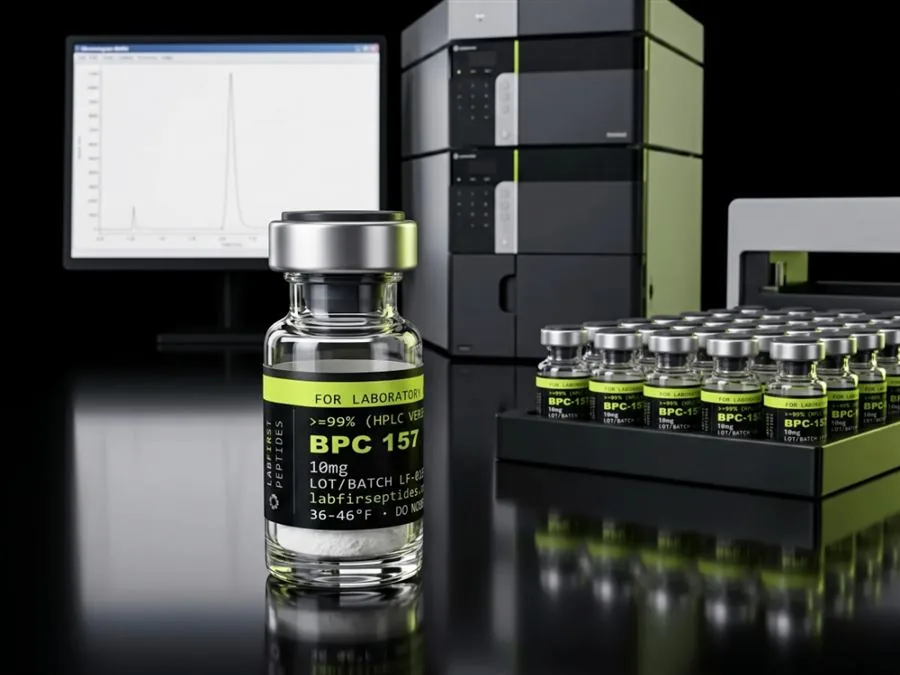
High purity research peptides are peptides whose HPLC trace shows the target compound as nearly all of the detected material, usually stated as an area percentage. Purity alone does not prove identity or how much peptide is in the vial. A credible claim pairs the purity figure with a mass spectrometry identity result and a lot number.
- Peptide purity is usually measured by reversed-phase HPLC with UV detection and reported as the main peak's share of total peak area.
- The ICH Q3A(R2) impurity guideline lists peptides among the drug substance types it does not cover.
- Common synthetic peptide impurities include deletions, insertions, substitutions and racemization, plus deamidation and oxidation during storage.
- FDA's 2021 guidance for generic synthetic peptides asks for assessment of new impurities measured between 0.10% and 0.5% of the drug substance.
- A 2009 study found about 30% of peptide concentrations based on weighing were inaccurate because peptides absorb moisture.
What this guide covers
A bag of rice labeled "99% rice" tells you most of what is in the bag is rice. It does not tell you whether the bag holds a full kilo, or whether that rice is the variety printed on the front. A purity number on a peptide has the same blind spots.
This page explains what "high purity" means for a research peptide, how the number is produced, what it leaves out, and how to check a supplier's claim before you rely on it. For the deeper split between the two measurements, our guide on HPLC purity versus peptide identity goes further.
- Lot number that matches the vial
- HPLC purity with its method named
- Mass spectrometry identity result
- Net content if amount matters
- Test date and a way to verify
What does high purity mean for a research peptide?
For a research peptide, high purity means the target peptide makes up nearly all of the material a chromatography method can see. The figure is almost always measured by reversed-phase HPLC with a UV detector and reported as the main peak's share of the total peak area.
Chromatography, as USP general chapter 621 describes it, separates the parts of a sample by how they distribute between a stationary phase and a moving one. Similar molecules come off the column at different times and show up as separate peaks. If the target peptide is one tall peak and everything else is small, the area percentage is high.
There is no single legal cutoff for "high purity" on a research product. The phrase is a description, and its value depends on the method behind it, the lot it came from and whether the certificate shows the work. A claim with no chromatogram, method or lot attached is a marketing line.
What impurities does a purity test look for?
Most impurities in a synthetic peptide are other peptides that look almost like the target. A 2025 review in Frontiers in Immunology lists insertions, deletions, substitutions and racemization from synthesis, plus deamidation, oxidation and disulfide changes that occur during manufacture and storage.
A deletion product is the chain missing one residue because a coupling step failed. An insertion has one residue too many. Racemization swaps an L amino acid for its D mirror image, which barely changes the mass. These related impurities are why a good HPLC method needs enough resolving power to pull near-identical peaks apart.
Drug regulators treat peptide impurities as a separate problem from small-molecule ones. The ICH Q3A(R2) guideline on impurities in new drug substances states that peptides are among the types it does not cover. For approved generic synthetic peptides, the same 2025 review notes that FDA's 2021 guidance asks for assessment of any new impurity measured between 0.10% and 0.5% of the drug substance. Those numbers come from drug regulation and show the scale chemists work at; a research-grade label is not held to them.
What does a purity figure not tell you?
A purity figure does not tell you the peptide is the right one. HPLC measures how much of the visible material is one component. If the wrong sequence were made cleanly, it would still give one tall peak. Identity needs a separate test, usually mass spectrometry, which compares the measured mass with the mass calculated from the sequence.
It also does not tell you how much peptide is in the vial. Water, salts and counterions such as trifluoroacetate absorb little or no UV light at the detection wavelength, so they are invisible to the purity number. A 2009 paper on quantifying standard peptides points out that peptides are hygroscopic and pick up moisture, so weighing overstates the amount. It found about 30% of concentrations based on weight were inaccurate and used amino acid analysis after acid hydrolysis instead.
That gap is called net peptide content. Our guide to peptide net content testing works through the arithmetic.
How is peptide content measured if not by weight?
Peptide content is usually measured by amino acid analysis. The sample is hydrolyzed in acid, which breaks every peptide bond and frees the individual amino acids, and those amino acids are then counted against standards. Because the count comes from the peptide itself, water and salts in the powder do not inflate it.
The 2009 study mentioned above built this kind of method with UPLC and tandem mass spectrometry. It needed under 10 nanograms of peptide, measured 20 amino acids in less than ten minutes per sample, and reported relative standard deviations of about 8% within a day and 5% between days.
For a buyer, the practical point is plain. A purity figure and a content figure answer different questions, and a certificate that reports both lets you work out how much target peptide is in the vial rather than assuming the label weight is all peptide.
How to check a high purity claim, step by step
Use this order when a supplier says its peptides are high purity.
- Find the lot number on the vial and make sure the certificate names the same lot.
- Read the purity line and confirm it names a method, normally reversed-phase HPLC, and shows a chromatogram.
- Look for an identity result: a measured mass from mass spectrometry next to the expected mass for the sequence.
- Check whether net peptide content or a quantity per vial is reported, since purity alone says nothing about amount.
- Look at the date and who ran the test, and whether the report can be checked with the issuer.
- Be wary of one certificate reused across many lots or sizes; each lot is its own batch.
What to check on the certificate
- Lot number matching the vial.
- Purity method, figure and chromatogram.
- Identity method with expected and measured mass.
- Net content or measured quantity, if reported.
- Test date and a way to verify the report.
Certificates for each lot are posted at /coa/. Our guide on how to read a peptide COA explains each of these fields with examples.
Why do two labs report different purity for the same lot?
Two laboratories can report different purity for the same lot because purity depends on the method. Column chemistry, gradient, run time and detection wavelength all change how well minor peaks separate from the main one. A short, fast gradient can hide an impurity under the main peak; a longer one can split it out and lower the number.
Integration choices matter as well. Where the software draws the baseline and which small peaks it counts can move the result by a fraction of a percent. That is why the method belongs on the certificate. A figure without its method can't be compared with any other figure.
Sample handling adds variation too. A peptide that has picked up moisture or begun to oxidize between tests may show new peaks the first test never saw. Our guide to peptide purity testing covers how the numbers are produced in more detail.
Is higher purity always better for research?
Higher purity is better only up to the point the experiment needs. A cell-based assay can be thrown off by a related impurity that binds the same target, so it calls for a clean, well-characterized lot. A peptide used as a rough chromatography marker may not need the same standard.
What matters more than a headline number is knowing what you have. A lot with a stated purity, a confirmed identity and a known net content can be used with confidence. A lot with a high number and nothing else leaves the researcher guessing, and the guesswork shows up later as results that will not repeat.
Bottom line
"High purity" is a statement about one HPLC measurement: how much of the detected material is the target peptide. It needs an identity result beside it and a net content figure if amount matters. Read the lot, the method and the date before you trust the number.
FOR LABORATORY AND IN-VITRO RESEARCH USE ONLY. NOT FOR HUMAN OR ANIMAL CONSUMPTION.
Common questions
What are high purity peptides?
What purity percentage counts as high purity?
Does high purity mean the peptide is the right one?
Why is net peptide content lower than purity?
How can I verify a supplier's high purity research peptides claim?
More science guides
Sources
- USP-NF General Chapter 621, Chromatography. Definition of chromatographic separation between stationary and mobile phases.
- ICH Q3A(R2), Impurities in New Drug Substances. Scope statement listing peptides among the drug substances the guideline does not cover.
- Immunogenicity of therapeutic peptide products: bridging the gaps regarding the role of product-related risk factors, Frontiers in Immunology (2025). Types of synthesis and storage impurities and the FDA 2021 0.10% to 0.5% assessment range for new impurities.
- Accurate quantitation of standard peptides used for quantitative proteomics (2009). Hygroscopic peptides, inaccuracy of weight-based quantitation and amino acid analysis after hydrolysis.