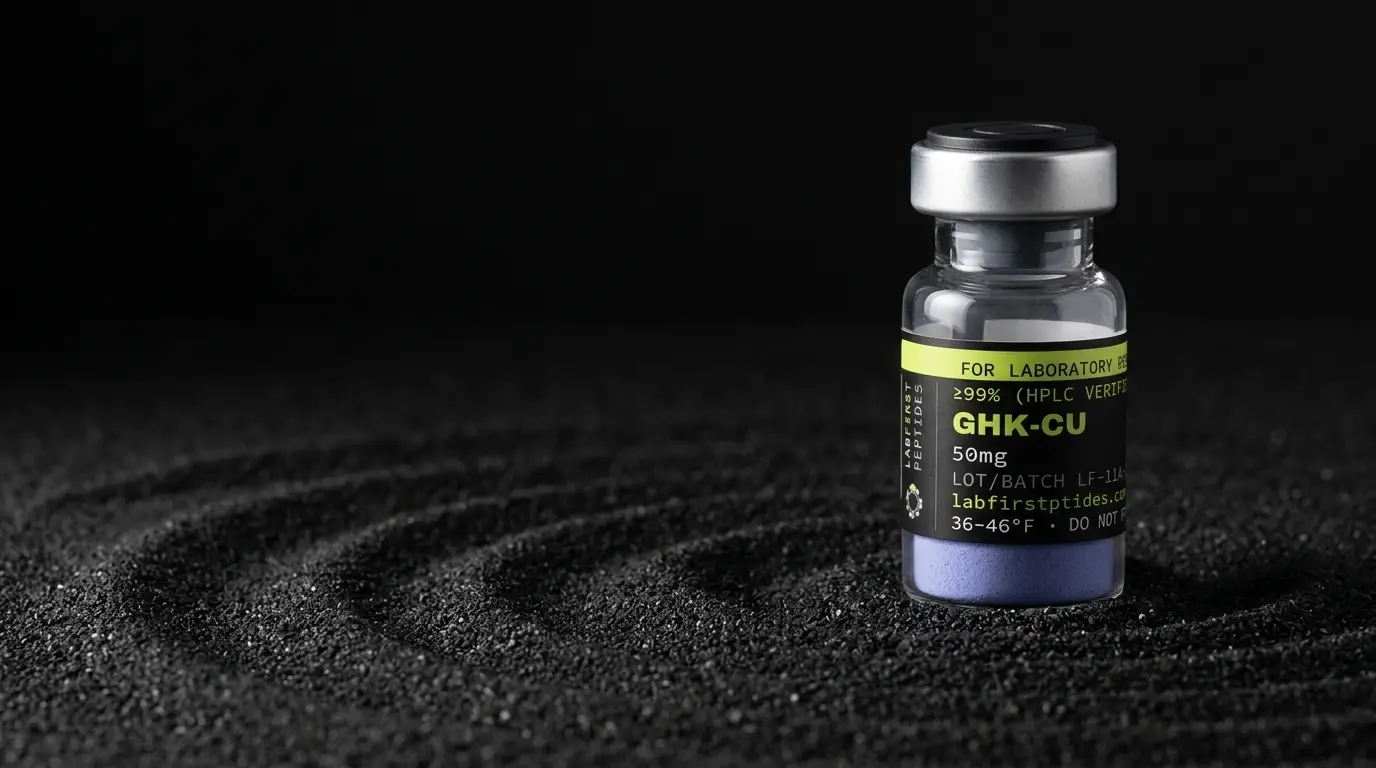
GHK-Cu copper peptide powder is blue because copper(II) bound to the tripeptide glycyl-L-histidyl-L-lysine absorbs orange-red light near 606 nm and passes blue. The copper sits in a square-planar pocket made of three nitrogen atoms from the peptide and one oxygen. PubChem lists the 1:1 complex as C14H23CuN6O4+, 402.92 g/mol, about 15.8% copper by mass.
- The free tripeptide GHK (PubChem CID 73587) is C14H24N6O4 at 340.38 g/mol and is a white powder; the copper complex (CID 71587328, prezatide copper) is C14H23CuN6O4+ at 402.92 g/mol and is blue.
- Copper(II) in GHK-Cu is held by the glycine amino nitrogen, the deprotonated amide nitrogen of the Gly-His bond and the histidine imidazole nitrogen, with one oxygen completing a square-planar set.
- The d-d absorption band of Cu(II)GHK in solution sits at 606 nm, which is why the complex looks blue to the eye.
- In solution at neutral pH the complex is a 1:1 mononuclear species; the oxygen-bridged copper pairs seen in the 1980 crystal structure do not persist in water.
- Copper makes up about 15.8% of the mass of the 1:1 complex, which is the figure a copper assay on a certificate should be read against.
- An HPLC purity figure and a peptide mass characterize the peptide only; the copper content needs its own line on the certificate, from an elemental method.
What this guide covers
This guide is about the powder in the vial: what the copper complex in GHK-Cu is, why it has a color when most peptide powders are white, and what a laboratory measures to say that a given powder is GHK-Cu and not something close to it. It is chemistry and documentation only. What GHK-Cu is, in the broader sense of where the peptide was found and what the literature has studied, is a separate guide, and the identity test and the certificate each have a page of their own.
A short orientation. GHK is a tripeptide: three amino acids in a row, glycine, histidine and lysine, read from the N-terminus. On its own it is a white solid. Add copper in its common +2 state and the peptide folds around the metal ion and holds it, and the solid turns blue. That folding-around is what chemists call chelation, and the blue is a direct readout of how the copper is held. Everything below follows from those two facts.
FOR LABORATORY AND IN-VITRO RESEARCH USE ONLY. NOT FOR HUMAN OR ANIMAL CONSUMPTION. NOT FOR PERSONAL, MEDICAL, DIAGNOSTIC, THERAPEUTIC, OR RECREATIONAL USE.
- 606 nm: where the copper(II) complex absorbs, which is why the powder is blue
- 3 nitrogens plus 1 oxygen: the square-planar pocket that holds the metal
- 340.38 to 402.92 g/mol: free peptide to 1:1 complex, a gap of one copper less one hydrogen
- 15.8%: copper by mass in a fully loaded complex, the figure a copper assay is read against
- 1:1 in solution: mononuclear at neutral pH; the crystal's bridged pairs do not survive dissolving
- 3 lines on a certificate: peptide mass, peptide purity, copper assay
What is the copper complex in GHK-Cu?
The copper complex in GHK-Cu is one copper(II) ion bound to one molecule of glycyl-L-histidyl-L-lysine, and PubChem files the two substances separately so the numbers can be compared. The free peptide, compound 73587, has the formula C14H24N6O4 and a molecular weight of 340.38 g/mol. The copper complex, compound 71587328, is filed under the name prezatide copper with the formula C14H23CuN6O4+ and a molecular weight of 402.92 g/mol. The plus sign is part of the entry: the complex as filed carries a positive charge, and the peptide has given up one hydrogen to make room for the metal.
| Substance | PubChem CID | Formula | Molecular weight (g/mol) | Color of the solid |
|---|---|---|---|---|
| GHK, glycyl-L-histidyl-L-lysine | 73587 | C14H24N6O4 | 340.38 | White |
| GHK-Cu, prezatide copper (1:1 complex, cation) | 71587328 | C14H23CuN6O4+ | 402.92 | Blue |
| Difference | +Cu, -H | 62.54 |
The difference row is worth a moment. Copper's atomic weight is 63.55 and hydrogen's is 1.008, so adding one copper and removing one hydrogen adds 62.54 g/mol, which is exactly the gap between the two PubChem weights. Copper is then 63.55 divided by 402.92, or about 15.8% of the complex by mass. That figure is our arithmetic from PubChem's numbers rather than a published measurement, and it is the number a copper assay on a certificate gets compared with. A powder sold as GHK-Cu that assays at 8% copper is half-loaded; one that assays near zero is GHK.
In the vial the cation has a counter-ion with it, usually acetate from the way the material is made and purified, and that counter-ion adds mass the formula above does not include. A certificate that reports net peptide content is accounting for exactly this. The GHK-Cu product page lists what our lots carry.
How does the peptide hold the copper?
The peptide holds the copper with three nitrogen atoms and one oxygen arranged in a flat square around the metal, a geometry chemists call square-planar. The clearest early evidence is from electron paramagnetic resonance, a technique that reads the magnetic environment of an unpaired electron, which copper(II) has. Laussac, Haran and Sarkar reported in the Biochemical Journal in 1983 that between pH 6.0 and 9.6 the spectrum shows seven lines of nitrogen superhyperfine splitting, the signature of three nitrogen atoms bound to the copper, with parameters of 19.5 mT and 2.21 for the parallel hyperfine coupling and g value. They concluded that copper(II) is bound through three nitrogens and one oxygen in a square-planar arrangement.
Which three nitrogens is settled by later work. A 2021 paper in Inorganic Chemistry describes the binding as the amino nitrogen of the glycine at the N-terminus, the deprotonated amide nitrogen of the bond between glycine and histidine, and the imidazole ring nitrogen of the histidine side chain, which together form two fused five- and six-membered rings around the metal. The fourth position in the square is open or weakly held, which is why GHK-Cu readily forms three-part complexes with other small molecules; Lau and Sarkar's 1981 potentiometric study measured such ternary complexes with free histidine, and found that the lysine side chain's amino group raises the stability of the complex compared with the shorter peptides glycyl-histidine and glycyl-histidyl-glycine.
The hold is strong. The 2021 paper gives a conditional stability constant at pH 7.4 of log K equals 12.62, and Lau and Sarkar found that at equal concentrations of albumin and peptide at pH 7.5, about 42% of the copper was on the peptide, meaning GHK competes with the body's main copper carrier protein for the metal in a test tube. Whether that competition matters anywhere outside a test tube is a question for the literature guide, not this one.
Why is GHK-Cu powder blue?
GHK-Cu powder is blue because the copper(II) ion in the complex absorbs light in the orange-red part of the spectrum, and what is left for the eye is blue. Copper(II) has nine electrons in its outer d shell, and when the ion sits in a square of nitrogen and oxygen atoms those electrons split into levels a visible photon can bridge. Chemists call the resulting absorption a d-d transition. For Cu(II)GHK in water the 2021 Inorganic Chemistry paper puts the band at 606 nm, which is orange light. Remove orange from white light and the remainder reads blue.
The exact shade reports on the coordination. A copper complex with four nitrogens around the metal absorbs at shorter wavelength and looks violet; one with more oxygen and fewer nitrogens absorbs at longer wavelength and looks greener. Three nitrogens and one oxygen lands at about 600 nm and blue, which is the color of GHK-Cu, and a shift of the band is a sign that the coordination has changed. The same 2021 paper noted a small blue shift to about 595 nm when a thiol was added and began to reduce the copper, which is the kind of change a spectrometer catches and the eye does not.
Two consequences for someone holding a vial. The free peptide GHK is white, so a blue powder has copper in it and a white one labeled GHK-Cu does not. And the color is a property of copper(II) specifically; copper(I), the reduced state, is colorless in these complexes, so a vial fading toward pale or colorless has undergone a chemical change. Freedman and colleagues reported in Biochemistry in 1982 that the complex also has three distinct pH transitions, at apparent pK values of 3.6, 9.2 and 11.4, so the solution color depends on pH too. Color is a quick check. It is never a measurement.
Is the solid the same as the solution?
The solid and the solution are not the same structure, and the difference has confused more than one reader of the older literature. Pickart and colleagues reported the first X-ray crystal structure of a GHK copper complex in Nature in 1980, during the work that identified the peptide as a copper carrier in plasma. In that crystal the copper atoms are paired, bridged by oxygen atoms, in a repeating chain. Freedman, Pickart, Weinstein, Mims and Peisach then used optical, EPR and electron spin-echo spectroscopy on the dissolved complex and reported in 1982 that at neutral pH it is a single mononuclear 1:1 copper-peptide species, and that the bridged, polymeric arrangement of the crystal does not exist in solution.
So a powder in a vial and the same powder dissolved in water are two different arrangements of the same atoms. The dissolved form is the one with the 606 nm band and the three-nitrogen EPR signature. The solid form is the one you are weighing. Neither is wrong; they are answers to different physical conditions, and a characterization method has to be matched to the state it is looking at. UV-visible and EPR spectra are solution measurements. Powder X-ray diffraction, if anyone runs it, is a solid measurement. A certificate rarely carries either for a research peptide, and that is fine, because the questions a buyer has are answered by three other measurements covered next.
For how the sealed powder behaves over time, the storage and stability guide covers moisture, light and temperature for this material specifically.
How does a laboratory characterize GHK-Cu powder?
A laboratory characterizes GHK-Cu powder with three measurements that answer three separate questions: is the peptide the right peptide, how pure is it, and how much copper is there. No one of them answers the others.
| Method | Question it answers | Expected result for GHK-Cu | What it does not tell you |
|---|---|---|---|
| RP-HPLC, UV detection | How much of the peptide material is one substance | Main peak area as a percentage of total peak area | Which peptide it is; how much copper is present; water and salt content |
| LC-MS or MALDI-TOF | Is the peptide GHK | A mass consistent with C14H24N6O4 at 340.38 g/mol | Copper loading; the complex can lose its metal in the ion source, so the peptide mass is what is read |
| Elemental analysis (ICP-MS or ICP-OES) | How much copper is in the powder | About 15.8% by mass for a fully loaded 1:1 complex, before counter-ion and water | Whether the peptide is intact or pure |
| UV-visible spectrum | Is the copper bound as copper(II) in the expected pocket | A band near 606 nm in neutral solution | Purity; exact copper quantity |
| Net peptide content | What share of the weighed mass is peptide | Peptide mass as a fraction of gross mass, after water, counter-ion and copper | Identity |
The gap buyers most often miss is the third row. Most research peptide certificates report RP-HPLC purity and a mass by LC-MS. Both are measurements of the peptide. A sheet that stops there has said nothing about the copper, and the copper is half the name. A certificate for GHK-Cu that carries no copper assay is a certificate for GHK with a note of color. What a GHK-Cu certificate should show walks through a real one line by line.
The step-by-step for someone with a vial and a sheet is short.
- Read the mass line. It should agree with the free peptide, 340.38 g/mol average, within the instrument's stated tolerance. A mass near 402.9 would mean the complex survived ionization, which is uncommon and worth noting.
- Read the purity line and the method beside it. Area percent by RP-HPLC, with the wavelength stated, is the standard.
- Look for a copper line. ICP-MS or ICP-OES, reported as percent by mass or as a molar ratio of copper to peptide. Compare with 15.8% for a full 1:1 load, adjusted for whatever counter-ion and water the net content line declares.
- Look at the powder. Blue is consistent with copper(II) bound; white means no copper; pale or gray-green means something has changed and the sheet, not the eye, should say what.
Bottom line
GHK-Cu powder is a tripeptide holding one copper(II) ion in a flat pocket of three nitrogens and one oxygen, and it is blue because that pocket makes the copper absorb orange light at about 606 nm. PubChem gives the free peptide at 340.38 g/mol and the 1:1 complex at 402.92 g/mol, a gap of one copper less one hydrogen, which puts copper at roughly 15.8% of the complex by mass. The crystal and the solution are different structures of the same atoms, which is why the old X-ray paper and the spectroscopy papers seem to disagree and do not.
For a vial, the chemistry reduces to three lines on a certificate: a peptide mass, a peptide purity and a copper assay. The first two are routine. The third is the one that distinguishes GHK-Cu from GHK, and a sheet without it has characterized half the compound.
Common questions
Why is GHK-Cu powder blue?
What is the molecular weight of GHK-Cu?
How much copper is in GHK-Cu?
Is GHK-Cu a 1:1 complex?
How is GHK-Cu powder tested?
Published certificates for GHK-Cu
Every figure below is read from a report the laboratory issued for that lot; each page carries the PDF and the lab's own verification link.
More laboratory guides
Sources
- PubChem PUG REST: compounds 73587 (glycyl-L-histidyl-L-lysine) and 71587328 (prezatide copper), formula and molecular weight . The formulas C14H24N6O4 and C14H23CuN6O4+ and the weights 340.38 and 402.92 g/mol used throughout, read live from the database.
- Laussac JP, Haran R, Sarkar B. N.m.r. and e.p.r. investigation of the interaction of copper(II) and glycyl-L-histidyl-L-lysine. Biochemical Journal, 1983 doi:10.1042/bj2090533. The EPR evidence: seven-line nitrogen superhyperfine structure between pH 6.0 and 9.6, A parallel 19.5 mT and g parallel 2.21, and the conclusion of three nitrogens and one oxygen in a square-planar arrangement.
- Freedman JH, Pickart L, Weinstein B, Mims WB, Peisach J. Structure of the glycyl-L-histidyl-L-lysine-copper(II) complex in solution. Biochemistry, 1982 doi:10.1021/bi00262a004. The 1:1 mononuclear species at neutral pH, the three pH transitions at apparent pK 3.6, 9.2 and 11.4, and the finding that the crystal's oxygen-bridged polymer does not exist in solution.
- Lau SJ, Sarkar B. The interaction of copper(II) and glycyl-L-histidyl-L-lysine, a growth-modulating tripeptide from plasma. Biochemical Journal, 1981 doi:10.1042/bj1990649. Stability constants by potentiometric titration, the role of the lysine amino group, ternary complexes with histidine, and the 42% copper-on-peptide figure against albumin at pH 7.5.
- Pickart L et al. Growth-modulating plasma tripeptide may function by facilitating copper uptake into cells. Nature, 1980 doi:10.1038/288715a0. The paper that reported the peptide co-isolating with near-equimolar copper and the first crystallographic structure of a GHK copper complex.
- Intermediate Cu(II)-Thiolate Species in the Reduction of Cu(II)GHK by Glutathione. Inorganic Chemistry, 2021 doi:10.1021/acs.inorgchem.1c02669. The 606 nm d-d band, the shift to about 595 nm on reduction, the three-nitrogen binding description with two fused chelate rings, and the conditional stability constant log K 12.62 at pH 7.4.