The main elements in proteins are carbon, hydrogen, oxygen, nitrogen and sulfur. Every amino acid has the first four, and sulfur comes from cysteine and methionine. A few proteins also hold selenium, from the rare amino acid selenocysteine. Metals, salts and water in a sample sit beside the chain, not in it.
- Every amino acid contains carbon, hydrogen, nitrogen and oxygen in its shared core.
- Cysteine (C3H7NO2S) and methionine (C5H11NO2S) are the only standard amino acids that contain sulfur.
- A disulfide bond between two cysteines removes two hydrogens, so cystine is C6H12N2O4S2.
- Selenocysteine, C3H7NO2Se, is inserted at a UGA codon with the help of a SECIS element and brings selenium into selenoproteins.
- Arginine carries four nitrogen atoms, the most of any standard amino acid.
Five letters cover almost everything
Write out the formula of glycine, the smallest amino acid: C2H5NO2. That is carbon, hydrogen, nitrogen and oxygen, and nothing else. Now write out cysteine: C3H7NO2S. The same four letters, plus one sulfur. Those five elements, C, H, O, N and S, are what proteins are made of, and the list barely changes no matter which protein you pick.
The reason becomes clear once you see how a protein is built. A protein is a chain of amino acids, and every amino acid shares the same core: an amino group, a carboxyl group and a central carbon carrying a hydrogen and a side chain. The core alone accounts for carbon, hydrogen, nitrogen and oxygen. The side chains add more of the same four, and in two cases, cysteine and methionine, they add sulfur.
So the short answer goes like this. Every protein contains carbon, hydrogen, oxygen and nitrogen. Almost every protein also contains sulfur, because it is hard to build a chain of any length without a single cysteine or methionine in it. A small number of proteins contain selenium, carried by a rare amino acid called selenocysteine. Anything else you find in a purified protein sample, such as a metal ion or a salt, is attached to the chain or sitting beside it rather than written into the amino acid sequence.
- Carbon: backbone and side chains
- Hydrogen: covers the skeleton
- Oxygen: carbonyl and carboxyl groups
- Nitrogen: every amino group, plus arginine and lysine
- Sulfur: cysteine and methionine only
- Selenium: selenocysteine, in a few proteins
Carbon, hydrogen, nitrogen and oxygen in the backbone
In plain terms, every amino acid is built on the same core, and that core alone supplies all four of the main elements. Every standard amino acid has one nitrogen in its amino group and two oxygens in its carboxyl group. That is why the formulas in PubChem all carry at least one N and two O. Alanine is C3H7NO2. Leucine and isoleucine are both C6H13NO2, a useful reminder that two different molecules can share one formula. Proline, whose side chain loops back onto its own nitrogen, is C5H9NO2.
When amino acids join into a chain, each new peptide bond releases one water. The chain loses hydrogen and oxygen at every link, so a finished protein has a slightly lower share of those two elements than the free amino acids it came from. It never loses carbon or nitrogen in the process. The carbon skeleton and the nitrogen atoms are carried straight through into the chain.
Carbon does most of the structural work. It forms the central alpha carbon of every residue, the carbonyl carbon of every peptide bond, and the whole of the side chains in residues like leucine, valine and phenylalanine. Hydrogen covers the outside of that skeleton. Oxygen sits in the carbonyl groups along the backbone and in side chains such as serine (C3H7NO3) and threonine (C4H9NO3), which each carry an extra hydroxyl group.
Where does the extra nitrogen come from?
The backbone gives each residue one nitrogen. Some side chains add more, and those residues decide how nitrogen-rich a given protein is. The table lists the formulas as PubChem records them.
| Amino acid | Formula | What the side chain adds |
|---|---|---|
| Arginine | C6H14N4O2 | Three extra nitrogens in a guanidino group |
| Lysine | C6H14N2O2 | One extra nitrogen at the end of the side chain |
| Asparagine | C4H8N2O3 | An amide nitrogen and an extra oxygen |
| Glutamine | C5H10N2O3 | An amide nitrogen and an extra oxygen |
| Tryptophan | C11H12N2O2 | A ring nitrogen in the indole group |
| Glutamic acid | C5H9NO4 | Two extra oxygens in a second carboxyl group |
| Cysteine | C3H7NO2S | One sulfur, as a thiol |
| Methionine | C5H11NO2S | One sulfur, as a thioether |
Arginine is the standout. Four nitrogens in one residue means a protein rich in arginine carries noticeably more nitrogen per gram than one built mostly from leucine and alanine. The difference is small for any single residue and adds up across a long chain.
Which amino acids contain sulfur?
Only two of the twenty standard amino acids contain sulfur. Cysteine carries it as a thiol, an -SH group at the end of a short side chain. Methionine carries it in the middle of its side chain, bonded to carbon on both sides.
The two behave very differently. Two cysteines can link through their sulfur atoms to form a disulfide bond, and PubChem's record for cystine shows what happens to the formula. Cystine is C6H12N2O4S2. Two free cysteines would add up to C6H14N2O4S2, so forming the bond removes exactly two hydrogens. That small change is how chemists spot disulfides by mass: each one lowers the mass of a protein by about two units compared with the fully reduced chain.
Disulfides hold many secreted proteins in their folded shape. Human IGF-1, for example, has three of them in a 70-residue chain, according to its UniProt record. Methionine does not form bridges like that. Its sulfur is prone to oxidation, which matters when a peptide sits in solution or open air, and it is one reason laboratories pay attention to how sulfur-containing peptides are stored.
Short synthetic peptides are a different matter from full proteins. A peptide of five or ten residues can easily have no cysteine or methionine at all, in which case its formula has no S in it.
Why does selenocysteine add selenium?
Selenocysteine adds selenium because its side chain carries a selenium atom where cysteine carries sulfur. Selenocysteine is the rare exception to the five-element list. Its PubChem formula is C3H7NO2Se: cysteine with the sulfur swapped for selenium, an element one row down in the same column of the periodic table.
It is not added to a protein after the fact. A review in Physiological Reviews describes how selenocysteine is inserted while the chain is being made, in response to a UGA codon that normally tells the ribosome to stop. Reading UGA as selenocysteine instead of stop takes dedicated machinery, including a stretch of the messenger RNA called a SECIS element. That is why selenocysteine is often called the 21st amino acid and why it appears in only a small group of proteins, called selenoproteins.
Another rare residue, pyrrolysine, sometimes comes up in the same conversations. PubChem gives its formula as C12H21N3O3, so it brings no new element into the picture.
What else turns up in a protein sample
A dried protein or peptide in a vial is rarely just the chain. Several other elements can show up in an elemental analysis without being part of the amino acid sequence.
- Counterions. Synthetic peptides are often purified with trifluoroacetic acid, and the trifluoroacetate that stays behind brings fluorine into the sample. Acetate brings only more carbon, hydrogen and oxygen.
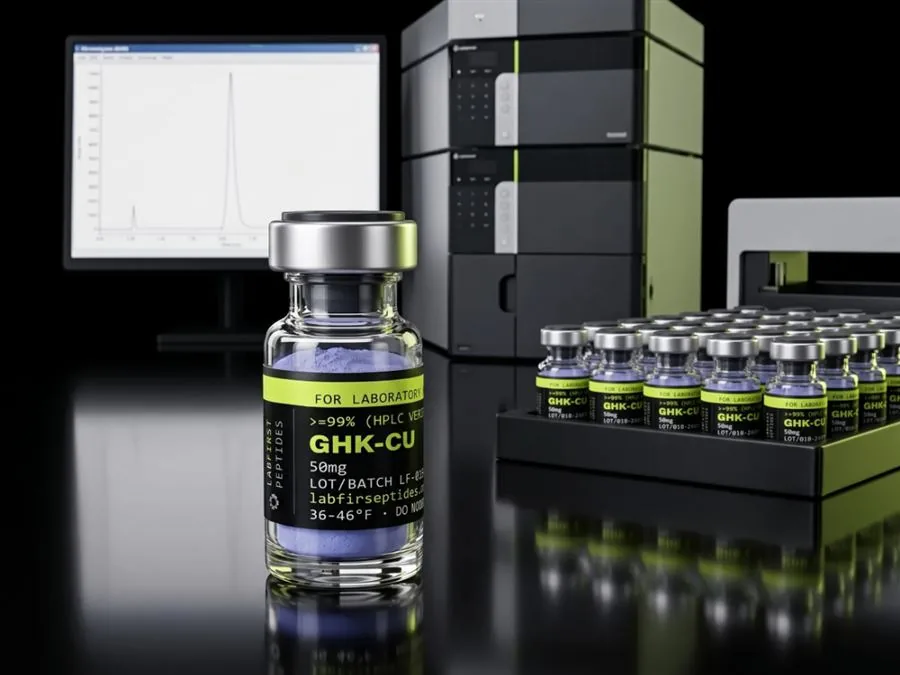
- Bound metals. Some peptides are sold as metal complexes. GHK-Cu, as its name says, carries copper.
- Water. Lyophilized powders take up moisture, which adds hydrogen and oxygen that belong to no residue at all.
Keeping these apart from the chain itself is part of reading a certificate properly. A sulfur result tells you about cysteine and methionine. A fluorine result tells you about the salt form, not the sequence.
Why the element list matters at the bench
Knowing which elements a peptide contains is more than trivia. Nitrogen is the basis of one way to measure how much actual peptide is in a vial. Every residue carries at least one nitrogen and the sequence fixes the exact count, so a measured nitrogen figure can be converted into a peptide mass. Acetate contributes no nitrogen, so it does not inflate the number.
Sulfur tells you which storage problems to expect. A sequence with methionine is open to oxidation. A sequence with cysteines either has free thiols, which can pair up in ways nobody intended, or already has disulfides whose pattern needs confirming. Our guide on the bonds that link amino acids covers the peptide bond itself, and the one on the R group explains how side chains set these differences.
Formulas also feed straight into mass. A certificate's theoretical mass is the sum of the residues' atoms, less one water per peptide bond and two hydrogens per disulfide. If you know the elements and the sequence, you can check that figure yourself before trusting it. The certificate index explains what we publish for each lot once its certificate is released.
FOR LABORATORY AND IN-VITRO RESEARCH USE ONLY. NOT FOR HUMAN OR ANIMAL CONSUMPTION.
Common questions
Do all proteins contain sulfur?
Is phosphorus one of the elements in proteins?
Why is selenocysteine called the 21st amino acid?
How does a disulfide bond change a protein's formula?
Which amino acid contains the most nitrogen?
More science guides
Sources
- PubChem compound record: Glycine (CID 750). Formula C2H5NO2 for the smallest amino acid.
- PubChem compound record: L-Arginine (CID 6322). Formula C6H14N4O2, four nitrogen atoms.
- PubChem compound records for L-cysteine (CID 5862) and L-cystine (CID 67678). Cysteine is C3H7NO2S; cystine, two cysteines joined by a disulfide, is C6H12N2O4S2, two hydrogens fewer than two free cysteines.
- PubChem compound record: L-Methionine (CID 6137). Formula C5H11NO2S.
- PubChem compound record: L-Selenocysteine (CID 25076). Formula C3H7NO2Se.
- PubChem compound record: Pyrrolysine (CID 21873141). Formula C12H21N3O3, no element beyond C, H, N and O.
- Labunskyy, Hatfield and Gladyshev, Selenoproteins: molecular pathways and physiological roles, Physiological Reviews, 2014. Cotranslational insertion of selenocysteine at UGA codons, requiring a SECIS element.
- UniProt P05019, Insulin-like growth factor 1 (human). Mature IGF-1 chain (residues 49 to 118 of the precursor, 70 residues), its sequence, and the three disulfide bonds Cys54-Cys96, Cys66-Cys109 and Cys95-Cys100 in precursor numbering.