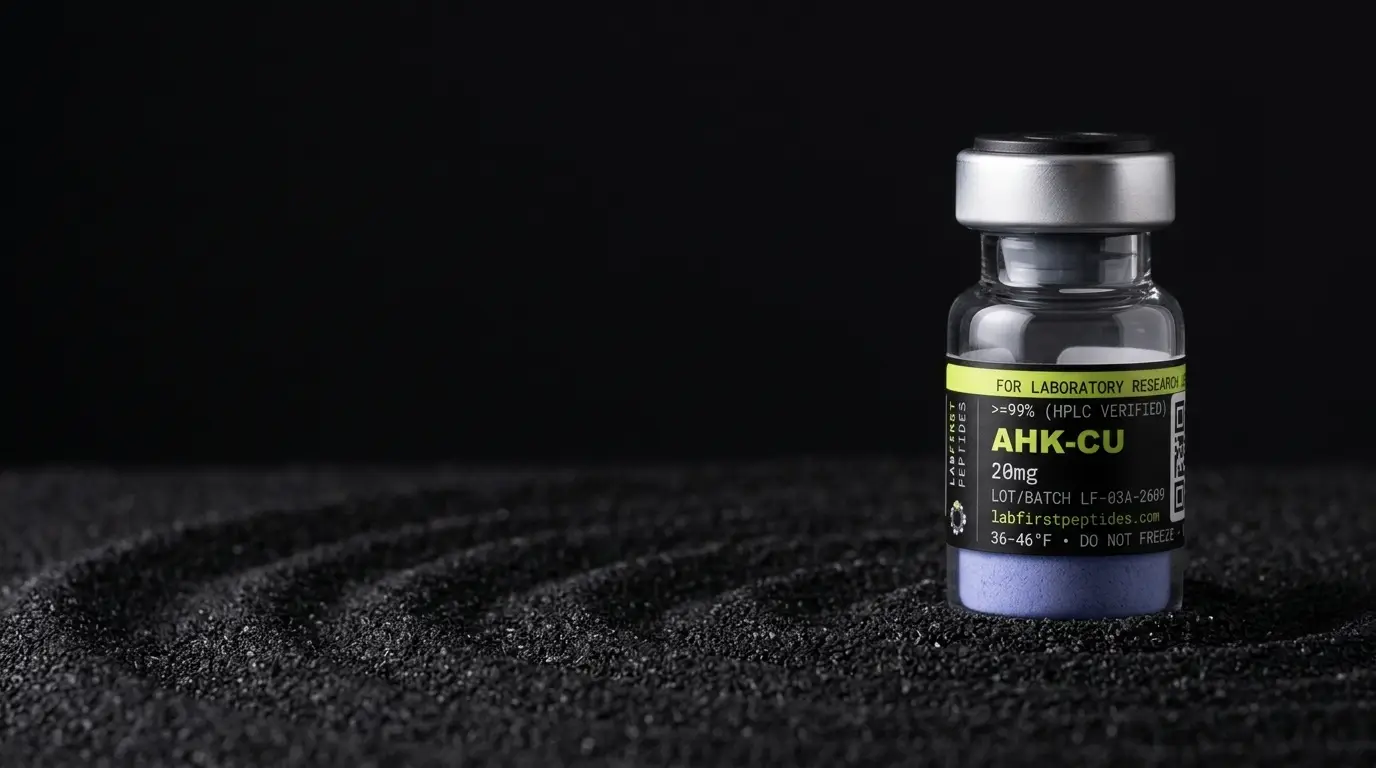
AHK-Cu is a three-building-block peptide (alanine, histidine, lysine) joined to copper (formula C15H26N6O4, average mass 354.41 g/mol, CAS 126828-32-8). AHK-Cu is sold here for laboratory research in 2 sizes (20mg to 50mg), from $50.00 a vial. It is not an FDA-approved medicine. Research use only, and never for people or animals.
AHK-Cu specifications
| Product name | AHK-Cu |
|---|---|
| Also sold as | AHK-Cu copper peptide, AHK-Cu peptides |
| Formula | C15H26N6O4 |
| Average mass | 354.41 g/mol |
| CAS number | 126828-32-8 |
| Physical form | Freeze-dried powder, a solid cake in a sealed vial |
| Appearance | Colored cake, this compound carries its own color rather than being dyed |
| Sizes on this page | 20mg · 50mg |
| Purity specification | ≥99% by RP-HPLC. The number for the lot you receive is whatever its own certificate says. |
| Identity check | Mass spectrometry, read against the mass this compound should have |
| Net content | Weighed per lot and reported separately from purity |
| Lot documentation | Lot numbers assigned for 1 of 2 sizes; each lot's certificate posts here when Kovera Labs reports it |
| Storage | Sealed, cold and out of the light |
| Ships from | Santa Ana, California by USPS with tracking on every order, same business day on verified in-stock orders placed before 12 PM Pacific |
| Regulatory status | Not an FDA-approved drug product. Sold as laboratory material, not a medicine; status verified 2026-08-25. |
| Intended use | Laboratory research only. Not for human or animal use. |
What is AHK-Cu?
AHK-Cu is also listed and searched as AHK-Cu copper peptide, AHK-Cu peptides. They all mean the same compound. Supplier lists write it as AHK-Cu peptides or peptide AHK-Cu as well; every one of those is this record. A name is not a test, which is why the lot record further down counts for more than the wording on a label.
Chemically: molecular formula C15H26N6O4, average mass 354.41 g/mol (PubChem CID 7408502). AHK-Cu as supplied is the copper(II) complex of that tripeptide, not the free peptide, so an identity test on this material does not resolve to the figures above.
A three-building-block peptide (alanine, histidine, lysine) joined to copper.
A close relative of GHK-Cu, differing at the first building block. Like GHK-Cu it grips copper, and the copper-carrying form is what has been studied.
A smaller body of cell-culture work than GHK-Cu, on copper-peptide chemistry and skin structure.
No approved product, and a noticeably thinner evidence base than its better-known relative. The two get marketed as interchangeable; the published record does not support treating them that way.
AHK-Cu for sale: 20mg and 50mg vials, price per mg
AHK-Cu is sold in 2 sizes here, 20mg and 50mg, from $50.00 a vial. Every way of buying is in the table; the per-mg figure under each price is the one that compares across sizes.
Volume and subscription pricing by size
| Size | One vial | 10–19 vials−10% | 20 vials−15% | Subscribe monthly−6% from shipment 2 | Availability |
|---|---|---|---|---|---|
| AHK-Cu 20mg | $50.00$2.50/mg | $45.00a vial · $2.25/mg | $42.50a vial · $2.13/mg | $47.00a vial, shipment 2 on · $2.35/mg | Backordered — waitlist |
| AHK-Cu 50mg | $60.00$1.20/mg | $54.00a vial · $1.08/mg | $51.00a vial · $1.02/mg | $56.40a vial, shipment 2 on · $1.13/mg | Backordered — waitlist |
Volume tiers are per size and do not combine across sizes (see bulk pricing). Subscribe & Save takes 6% every month, 4% every 2 months or 2% every 3 months off from shipment 2, two shipments minimum, and stacks on the volume tier: the lowest this record ever bills is $2.00 per mg, twenty 20mg vials on a monthly subscription from shipment 2 onward.
Nothing is added at checkout except the USPS shipping you choose; dispatch and delivery are the same on every order. The cost-per-milligram tool ranks the whole catalog by price per mg. The certificate walked through field by field: Where to Buy AHK-Cu Peptide: Five Checks Before You Order.
Where to buy AHK-Cu: what to check before you order from anyone
AHK-Cu for sale, or AHK-Cu peptide for sale, means this page: one record, 2 sizes. You can buy AHK-Cu online here with guest checkout; verified in-stock orders placed before 12 PM Pacific are dispatched the same day.
Before ordering AHK-Cu from anyone, us included, run the 5 checks on verifying a certificate; the first is that the report resolves on the laboratory's own site, and a seller who cannot pass them is asking for the trust a certificate exists to replace.
AHK-Cu cream or serum or patches? What this vial is, and is not
Search results for AHK-Cu also show cream or serum, patches products, under listing titles such as ahk-cu powder, ahk-cu topical, topical ahk-cu, ahk cu peptide powder, ahk cu peptide patch, ahk cu peptide topical. Those are finished consumer goods made and marketed by other companies, and none of them is what this page sells. This record is freeze-dried AHK-Cu in a sealed glass vial, 20mg and 50mg, with a lot certificate, supplied for laboratory work. Its certificate describes that powder, not a capsule, spray or cream, which carry other ingredients and sit under different rules.
AHK-Cu vs GHK-Cu: different molecules, separate records
AHK-Cu vs GHK-Cu, or GHK-Cu vs AHK-Cu, is the comparison people search most, and they are not the same thing. Each is a different molecule with a different formula, mass and research record, and each has its own certificate here.
GHK-Cu vs AHK-Cu: the same comparison, side by side
| Record | Class | Formula | Avg. mass | Sizes here |
|---|---|---|---|---|
| AHK-Cu | A three-building-block peptide (alanine, histidine, lysine) joined to copper. | C15H26N6O4 | 354.41 | 20mg · 50mg from $50.00 |
| GHK-Cu | A three-building-block peptide (glycine, histidine, lysine) joined to copper. | C14H24N6O4 | 340.38 | 50mg · 100mg from $39.00 |
Documentation compared in full: AHK-Cu vs GHK-Cu, side by side.
AHK-Cu guides and documentation
Written to answer the questions that come up around AHK-Cu specifically, what its paperwork should show, how it is handled, and how to judge a supplier selling it.
- AHK-Cu certificate of analysis, field by field, and how to check one at the lab
- How AHK-Cu Identity Is Confirmed in the Laboratory
- AHK-Cu Storage and Stability: What the Data Covers
- Where to buy AHK-Cu Peptide, and what its certificate has to show
The full library, grouped by what you came to answer, is in the laboratory guides.
The AHK-Cu certificate: lot, purity, identity, and how to verify it
A certificate answers identity, purity and net content as three separate questions, each with the method that produced it and the date it was run, how to read one covers what each field does and does not cover. The figure usually quoted for AHK-Cu is 354.41 g/mol for C15H26N6O4, from PubChem CID 7408502, and it does not describe what is in this vial. AHK-Cu as supplied is the copper(II) complex of that tripeptide, not the free peptide, so an identity test on this material does not resolve to the figures above. So the mass on the lot certificate is the one to read; a listing that quotes the published figure for this material is quoting the wrong molecule.
AHK-Cu certificates post here and in the certificate index when Kovera Labs reports on the lot.
Solution arithmetic for the bench, with no administration guidance: the vial concentration calculator, preset to AHK-Cu.
AHK-Cu research: what the published studies examine
Status: No FDA-approved application. This compound is sold as laboratory material. Where research on it has been published, it sits at the animal, cell or early-human stage, and this record does not summarize what it found. A supplier is not a neutral judge of evidence about its own catalog.
AHK-Cu is a three-building-block peptide joined to copper. It belongs to the same family as GHK-Cu and shares its main feature: a histidine-containing peptide that grips copper hard, so the part that matters biologically is the copper-carrying form rather than the bare peptide. The copper is not a carrier or a preservative, it is part of the active thing, which is why these are always written with the metal in the name.
Where GHK-Cu has been studied mainly in skin repair, the reported focus for AHK-Cu is the hair follicle and the dermal papilla cell, a specialised cell population that governs how a follicle forms and grows. The proposed mechanism is about cells multiplying and surviving rather than anything hormonal, which sets it apart from the compounds usually discussed alongside it. The concentrations it has been examined at are strikingly low.
| Reported observation | Model | Source |
|---|---|---|
| At very low concentrations, AHK-Cu made human hair follicles kept alive outside the body grow longer, and made cultured dermal papilla cells multiply. At the higher of those concentrations, the balance of two proteins that decide whether a cell dies shifted toward survival and two markers of cell death fell. The drop in dying dermal papilla cells measured by flow cytometry was not statistically significant, which the authors report plainly. | human hair follicles ex vivo and cultured human dermal papilla cells | Pyo and colleagues, The effect of tripeptide-copper complex on human hair growth in vitro, Archives of Pharmacal Research (2007)The apoptosis result is worth reading closely: the protein markers moved, the cell-count measure did not reach significance. |
Open questions. This is one of the thinner evidence bases in the catalog and it should be described that way rather than dressed up. The main finding rests on a single 2007 study in isolated follicles and cultured cells. Follicles kept alive in a dish are useful models, but they are not skin on a person, and a compound that lengthens a follicle in a dish has shown nothing about what it does on a scalp. There are no controlled human trials.
The active concentrations reported are far below what cosmetic formulations typically contain, and more is not reliably better for copper peptides, since the dose-response in this family is not assumed to run in one direction. Finally, much of what circulates about AHK-Cu is borrowed from the much larger GHK-Cu literature. They are related compounds with different sequences, and evidence does not transfer between them.
Each row above describes an observation in the stated model. None of it describes what AHK-Cu would do in a person or an animal outside that model, and none of it is a recommendation to use it for anything.
How to store AHK-Cu: refrigeration and shelf life
Keep the sealed vial cold and out of the light and it stays as it left the lab. Once it is mixed into a solution, how long it holds up depends on the compound, what it was mixed with, how strong the solution is and how cold it is kept — too many variables for anyone to print one shelf life on a label. So laboratories write the date on whatever they prepare and keep their own record of it.
For solution preparation arithmetic on the bench, concentration, per-graduation values and molarity, use the vial concentration calculator, which opens with the AHK-Cu sizes stocked here already loaded. It covers laboratory measurement only and contains no administration guidance.