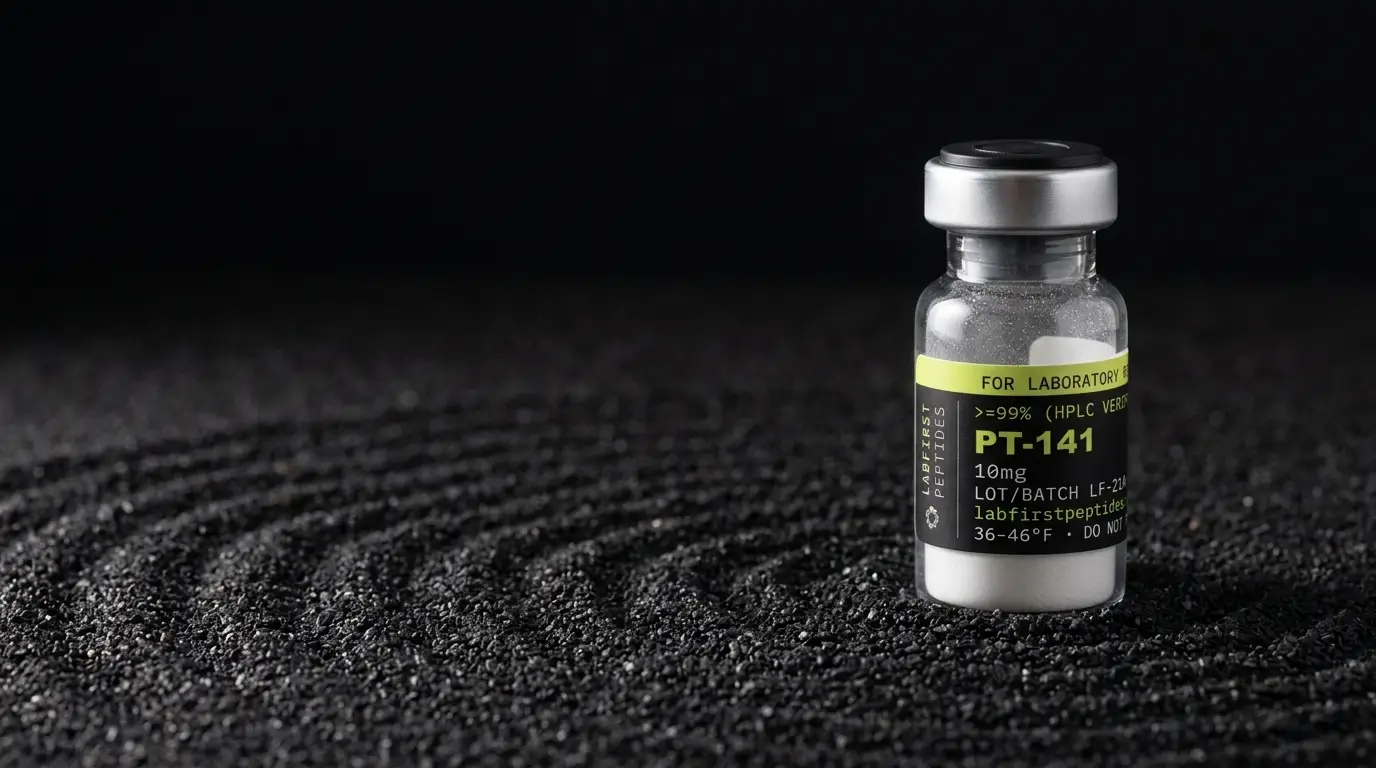
PT-141 identity is confirmed by mass spectrometry read against an average mass near 1025.2. A separation must also resolve the uncyclised precursor, and sequence-level evidence backs it up. Because the molecule is a ring, one mass result confirms two things. The chain was built, and the ring closed.
- PT-141 is bremelanotide, C50H68N14O10, average mass near 1025.2, PubChem CID 9941379.
- The mass result confirms both chain assembly and ring closure, because cyclisation releases water.
- An uncyclised linear precursor weighs roughly 18 more and may co-elute with the target.
- Retention time alone is weak identity evidence without a structure-sensitive detector.
- Mass cannot distinguish stereoisomers; only chiral analysis can.
- The method list on a certificate defines which failures the document could have detected.
What does identity mean for a synthetic peptide?
In plain terms, it is like checking a bracelet. The weight tells you all the beads are there, and a clasped bracelet sits apart from an open one. For PT-141, one mass reading can show both at once.
It means the molecule in the vial is the molecule the label names, established by evidence rather than assertion. For PT-141 that is bremelanotide, molecular formula C50H68N14O10, average mass near 1025.2, cataloged as PubChem CID 9941379.
Identity is not the same question as purity. A vial can contain the right molecule at low purity, or the wrong molecule at high purity, and the two results answer different things. A certificate reporting only one of them has answered half.
The strongest identity evidence is layered rather than singular. One instrument agreeing with itself is one result wearing two hats, and this is why good reports stack methods that look redundant at first glance.
- Observed mass against an average near 1025.2
- Ring closure confirmed: an uncyclised chain weighs about 18 more
- RP-HPLC separation with the chromatogram attached
- Detection at 214 nm, which reads the peptide bond
- Fragmentation data for sequence order, where the report carries it
- Chiral analysis for the one impurity mass cannot see
- Accession number confirmed at the issuing laboratory
What does the mass result actually confirm?
That the assembled molecule weighs what bremelanotide weighs. Electrospray ionisation puts charge on the molecule, the analyser reports mass-to-charge, and the deconvoluted result is compared against the expected value.
A match is strong evidence and it is not proof of sequence. Mass is a sum, and different arrangements of the same residues weigh the same. That limitation is why sequence-level evidence exists as a separate step rather than an optional extra.
What a mass result does rule out efficiently is a large class of wrong answers: a missing residue, an extra one, an unremoved protecting group, a truncated chain. Each shifts the mass by an amount an instrument sees easily and an eye cannot see at all.
How do you know the lactam ring closed?
By the mass, and this is the most useful single fact about confirming this compound. Forming the ring releases a molecule of water, so a linear precursor that failed to cyclise weighs roughly 18 more than the finished product.
Eighteen mass units is enormous to a mass spectrometer and invisible to everything else. The uncyclised chain has the same residues, similar polarity and often similar retention, so a separation alone may not resolve it cleanly. The mass does.
This is why a certificate for a cyclic peptide should print the observed mass rather than the words identity confirmed. The number lets a reader check both questions at once. The phrase lets them check neither, and for this class of molecule that is a real loss rather than a stylistic one.
What does the chromatographic separation contribute?
It answers how much of the sample is the target, and it puts the identity result in context. Reversed-phase HPLC separates by hydrophobicity, and the target elutes at a characteristic time under stated conditions.
Retention time on its own is weak identity evidence. Many compounds elute at similar times, and a peak in roughly the right place is a starting point rather than a conclusion. Its value is as one half of a pair: the separation isolates a peak, and a mass detector on the same run says what that peak weighs.
Peptides are read at 214 nanometres because that wavelength responds to the peptide bond itself. Detection at 280 depends on aromatic residues, which is a different question about a different subset of the molecule.
What sequence evidence should a strong report carry?
Tandem mass spectrometry, where the molecule is fragmented and the fragment masses are read. The pattern of fragments constrains the order of residues rather than just their sum, which is the gap a single mass leaves open.
Amino acid analysis is the other route. The peptide is hydrolysed into its constituent residues and each is quantified, giving composition and, usefully, a genuinely independent measure of peptide content by weight.
Neither appears on most research certificates, and their absence is not automatically a failure. It is a limit worth knowing about. A report with mass and purity has established a great deal; a report that adds fragmentation has established more, and it is reasonable to ask which one you are holding.
Why does the salt form change what the numbers mean?
A synthetic peptide leaves preparative purification as a salt. The counterion is usually trifluoroacetate, sometimes acetate after an exchange step, and it travels with the peptide into the vial.
That matters for identity reporting in a way people find counter-intuitive. The mass spectrometer reports the mass of the peptide, not of the salt, so the identity result is unaffected. The balance, however, weighs everything, so the powder in the vial is peptide plus counterion plus whatever water it has taken on.
This is why a certificate that names a counterion is telling you something real about how the material was made, and why a net peptide content figure exists as a separate number from purity. Identity and quantity are answered by different instruments and they do not constrain each other.
What does a mis-identified peptide look like?
Rarely like an obvious fake. The failures that matter are close relatives: the uncyclised precursor described above, a truncated chain missing one residue, a diastereomer with the wrong stereochemistry at one position, or a batch that is genuinely the right molecule but heavily salted.
Stereochemistry is the hardest of those to catch. Two stereoisomers weigh exactly the same, so mass spectrometry cannot separate them at all, and only chiral analysis or a separation developed to resolve them will show the difference.
None of this makes certificates worthless. It makes the method list on the certificate the thing to read, because the methods define which of these failures the document could have detected.
What should you ask a supplier about identity?
Three questions, all cheap to ask and awkward to dodge. What was the observed mass, as a number rather than a verdict. Which methods produced the identity result. And can the accession number be looked up at the laboratory that issued it.
A supplier answering all three is not doing anything unusual. They are reading their own certificate aloud. A supplier who cannot produce the observed mass for a cyclic peptide is a supplier whose document could not have distinguished the finished molecule from its uncyclised precursor.
The fourth question is worth adding when the answer to any of the first three is vague: which lot are we discussing. Analytical rigour attached to the wrong batch is not rigour, and lot mismatch is the most common failure in this market by a wide margin.
How do you check the report describes your vial?
Confirm the accession or verification number at the issuing laboratory rather than with the seller. The laboratory holds the record; a seller holds a copy of a document. If the number resolves to a different lot, a different product, or nothing, the analysis is not evidence about your material.
Then match the lot number on the report to the vial. Rigorous analysis upstream counts for nothing if the document was attached to the wrong batch, and that mismatch is far more common than falsified results.
Reports for material supplied here resolve through the certificate verification page, and the sizes carried appear on the PT-141 product record. How to read the rest of the document is covered in the certificate guide.
What is the regulatory position?
International guidance on analytical validation sets what makes an identity method fit for purpose: specificity, accuracy, precision, and a demonstration that the method distinguishes the target from what else might plausibly be present. That is why a named method beside each result is not decoration.
Bremelanotide is an approved drug substance in a finished pharmaceutical product made under drug manufacturing rules. Research-grade material is not that product, and a research certificate does not confer its status.
What such a certificate can honestly establish is what a named laboratory measured, on a named lot, by named methods. Read against that standard it is strong evidence, and a vague one is none.
FOR LABORATORY AND IN-VITRO RESEARCH USE ONLY. NOT FOR HUMAN OR ANIMAL CONSUMPTION. NOT FOR PERSONAL, MEDICAL, DIAGNOSTIC, THERAPEUTIC, OR RECREATIONAL USE.
What is PT-141 studied for?
Published research on PT-141 investigates the areas below, which is a different question from what PT-141 will do for anyone, a claim about a living system that nothing on this site is sold for.
What it is. A man-made ring-shaped peptide seven building blocks long that works on melanocortin receptors, also published as bremelanotide.
What the research looks at. A registered clinical record exists, and an approved medicine containing bremelanotide exists under its own brand name for one specific use in a defined group of people.
How it is thought to work. It switches on melanocortin receptors, with reported activity at MC4R. It came out of a breakdown product of melanotan II and is a chemically different molecule from it.
What is not established. What is sold here is a research chemical and not a drug product. Listing it is not an approval, an equivalence or a safety claim, and this record does not describe use in a person.
The full record, including the certificate for the lot in stock, is on the PT-141 product page.
Common questions
What mass should PT-141 show on a certificate?
Can mass spectrometry alone prove a peptide is the right one?
Why is a purity peak at 214 nm rather than 280?
What is the hardest impurity to detect in a peptide?
How do I confirm the certificate belongs to my vial?
More documentation guides
Sources
- PubChem Compound Summary for CID 9941379, Bremelanotide. The openable record giving the molecular formula C50H68N14O10 and the average mass near 1025.2 that an identity result is read against.
- ICH Q2(R2), Validation of Analytical Procedures . Defines specificity, accuracy and precision for identity procedures, and is the basis for requiring that a certificate name the method behind each result.
- FDA guidance, Q6B Specifications: Test Procedures and Acceptance Criteria. Sets out how identity, purity and content are constructed as separate attributes and why orthogonal evidence is expected rather than one confirmatory test.
- Finnrick independent verification portal. Third-party lookup used to confirm a certificate resolves to the lot it claims to describe, rather than confirming a document with the seller who supplied it.