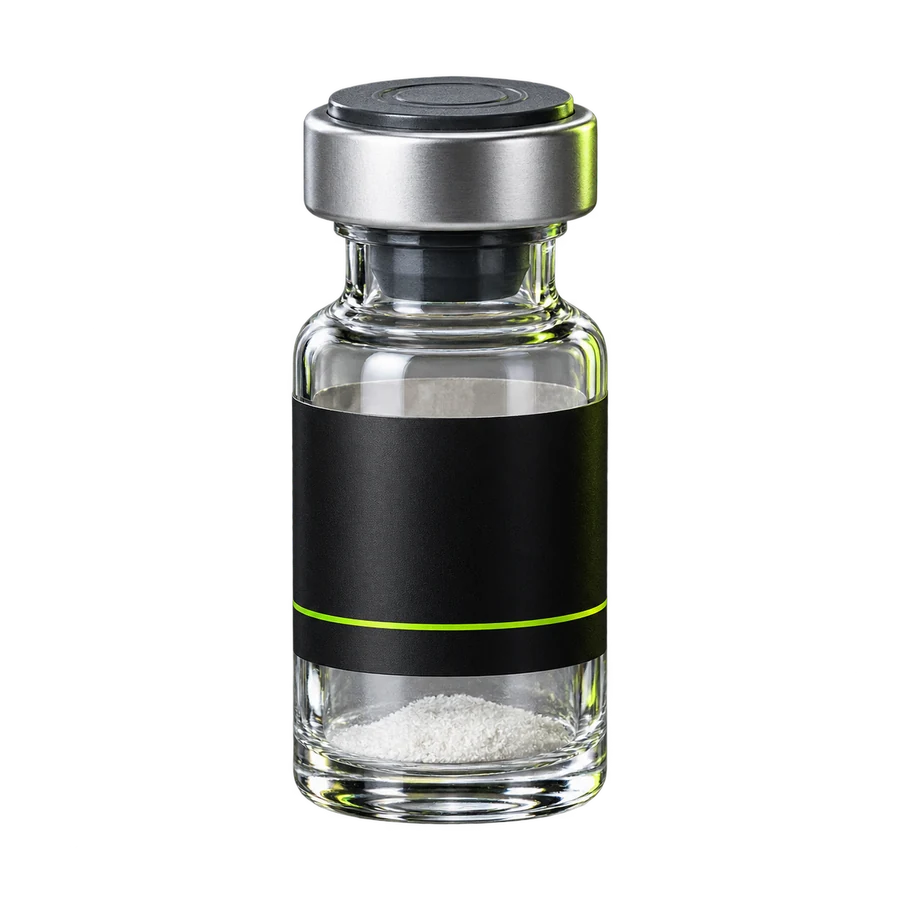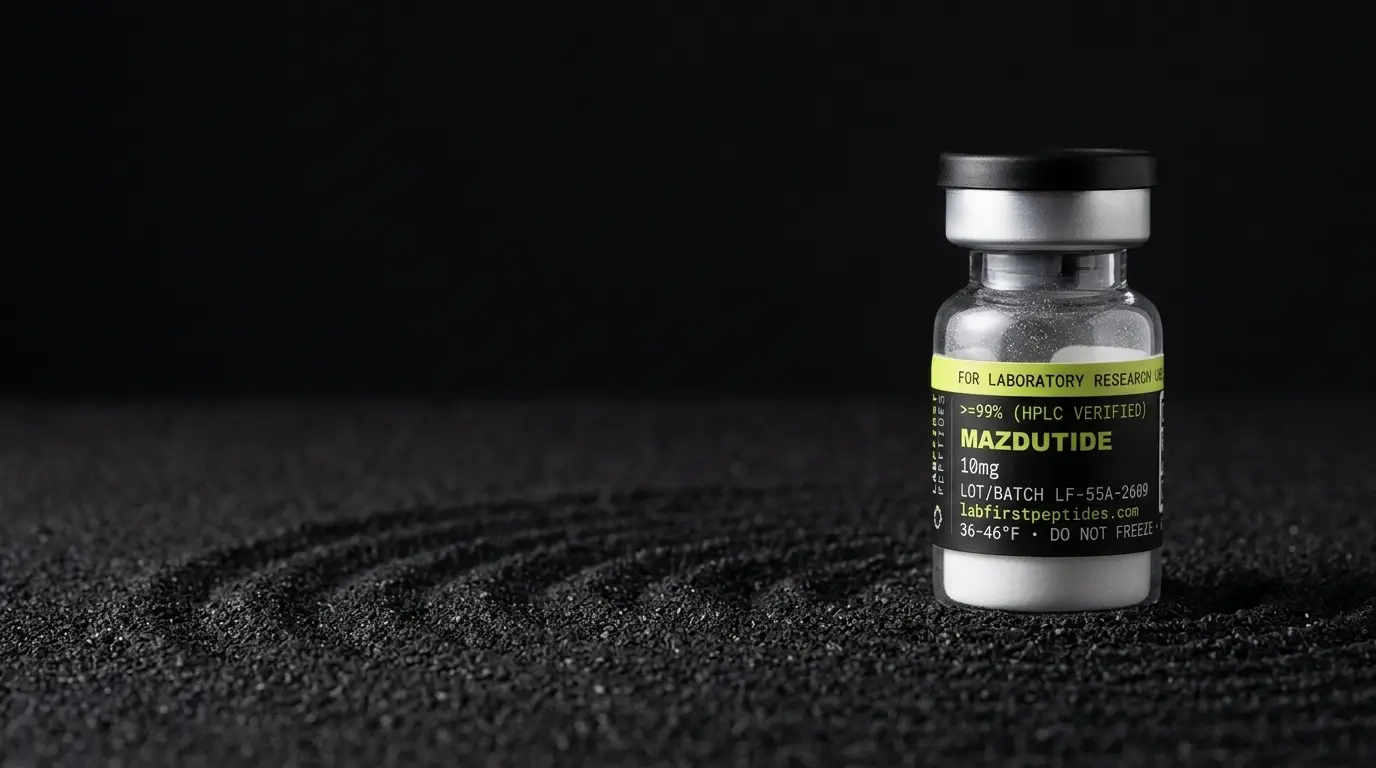
Mazdutide is oxyntomodulin analogue acting as a dual GLP-1 receptor and glucagon receptor agonist, developed as IBI362 (formula C207H317N45O65, average mass 4,476 g/mol, CAS 2259884-03-0). Mazdutide is sold here for laboratory research in 1 size (10mg), from $100.00 a vial. It is not an FDA-approved medicine. Research use only, and never for people or animals.
Mazdutide specifications
| Product name | Mazdutide |
|---|---|
| Formula | C207H317N45O65 |
| Average mass | 4,476 g/mol |
| CAS number | 2259884-03-0 |
| Physical form | Freeze-dried powder, a solid cake in a sealed vial |
| Appearance | White to off-white cake |
| Sizes on this page | 10mg |
| Purity specification | ≥99% by RP-HPLC. The number for the lot you receive is whatever its own certificate says. |
| Identity check | Mass spectrometry, read against the mass this compound should have |
| Net content | Weighed per lot and reported separately from purity |
| Lot documentation | Tested by Kovera Labs; each lot's certificate posts here when it is reported |
| Storage | Sealed, cold and out of the light |
| Ships from | Santa Ana, California by USPS with tracking on every order, same business day on verified in-stock orders placed before 12 PM Pacific |
| Intended use | Laboratory research only. Not for human or animal use. |
What is Mazdutide, and what is it used for?
Chemically: molecular formula C207H317N45O65, average mass 4476 g/mol (PubChem CID 167312357). Those figures are what the identity test on a certificate is read against.
Oxyntomodulin analogue acting as a dual GLP-1 receptor and glucagon receptor agonist, developed as IBI362.
Agonist at both the GLP-1 receptor and the glucagon receptor. Unlike survodutide, it is built on an oxyntomodulin backbone — oxyntomodulin being an endogenous proglucagon-derived peptide that naturally activates both receptors, so the molecule is an engineered version of a native dual agonist rather than a designed hybrid.
Investigational. Originating in peptide design work at Eli Lilly and developed by Innovent Biologics, principally in China, across obesity and type 2 diabetes and with programs in further indications.
No approval in the United States or European Union. The relative contribution of the glucagon arm is not established, as with the rest of this class.
Mazdutide for sale: 10mg vials, price per mg
Mazdutide is sold in 1 size here, 10mg, from $100.00 a vial. Mazdutide cost and Mazdutide price per mg by size are in the table, at each volume tier and on subscription; the per-mg figure under each price is the one that compares across sizes.
Volume and subscription pricing by size
| Size | One vial | 10–19 vials−10% | 20 vials−15% | Subscribe monthly−6% from shipment 2 | Availability |
|---|---|---|---|---|---|
| Mazdutide 10mg | $100.00$10.00/mg | $90.00a vial · $9.00/mg | $85.00a vial · $8.50/mg | $94.00a vial, shipment 2 on · $9.40/mg | Backordered — waitlist |
Volume tiers are per size and do not combine across sizes (see bulk pricing). Subscribe & Save takes 6% every month, 4% every 2 months or 2% every 3 months off from shipment 2, two shipments minimum, and stacks on the volume tier: the lowest this record ever bills is $7.99 per mg, twenty 10mg vials on a monthly subscription from shipment 2 onward.
Nothing is added at checkout except the USPS shipping you choose; dispatch and delivery are the same on every order. The cost-per-milligram tool ranks the whole catalog by price per mg.
Where to buy Mazdutide: what to check before you order from anyone
Where to get Mazdutide, and how to buy Mazdutide online
Mazdutide for sale, or Mazdutide peptide for sale, means this page: one record, 1 size. You can buy Mazdutide online here with guest checkout; verified in-stock orders placed before 12 PM Pacific are dispatched the same day.
Before ordering Mazdutide from anyone, us included, run the 5 checks on verifying a certificate; the first is that the report resolves on the laboratory's own site, and a seller who cannot pass them is asking for the trust a certificate exists to replace.
Mazdutide vs Tirzepatide and Retatrutide: different molecules, separate records
Mazdutide vs Tirzepatide, or Tirzepatide vs Mazdutide, is the comparison people search most, with Retatrutide close behind, and they are not the same thing. Each is a different molecule with a different formula, mass and research record, and each has its own certificate here.
Tirzepatide vs Mazdutide: the same comparison, side by side
| Record | Class | Formula | Avg. mass | Sizes here |
|---|---|---|---|---|
| Mazdutide | Oxyntomodulin analogue acting as a dual GLP-1 receptor and glucagon receptor agonist, developed as IBI362. | C207H317N45O65 | 4476 | 10mg from $100.00 |
| Tirzepatide | A peptide that works on the GIP and GLP-1 receptors at the same time. | C225H348N48O68 | 4813 | 5mg · 10mg · 15mg · 20mg · 30mg · 40mg · 50mg · 60mg · 70mg · 80mg · 90mg · 100mg · 110mg · 120mg from $50.00 |
| Retatrutide | An experimental peptide that works on three incretin receptors at once. | C221H342N46O68 | 4731.3 | 5mg · 10mg · 15mg · 20mg · 30mg · 40mg · 50mg · 60mg from $80.00 |
Documentation compared in full: Mazdutide vs Tirzepatide, side by side · Mazdutide vs Retatrutide, side by side.
The Mazdutide certificate: lot, purity, identity, and how to verify it
A certificate answers identity, purity and net content as three separate questions, each with the method that produced it and the date it was run, how to read one covers what each field does and does not cover. For Mazdutide that means a mass spectrum landing on 4,476 g/mol for C207H317N45O65, the figure published against PubChem CID 167312357.
Mazdutide certificates post here and in the certificate index when Kovera Labs reports on the lot.
Solution arithmetic for the bench, with no administration guidance: the vial concentration calculator, preset to Mazdutide.
Where the FDA stands on Mazdutide
FDA status, and what this listing is Not an FDA-approved drug product
The FDA has not approved this compound for anything, and nothing in this catalog is a medicine.
Status verified 2026-08-25. Check the primary source before relying on this summary.
It is sold as laboratory material under the research-use restriction below. Being listed is not an approval, and not a claim that it is safe, effective or right for any purpose.
Mazdutide research: what the published studies examine
Status: No FDA-approved application. This compound is sold as laboratory material. Where research on it has been published, it sits at the animal, cell or early-human stage, and this record does not summarize what it found. A supplier is not a neutral judge of evidence about its own catalog.
Mazdutide is a dual GLP-1 and glucagon receptor agonist, and its distinguishing feature among the compounds on this catalog is its starting point. Where retatrutide and survodutide are engineered hybrids, mazdutide derives from oxyntomodulin — a naturally occurring proglucagon-derived peptide that already activates both the GLP-1 and glucagon receptors. Nature, in other words, got to the dual-agonist idea first, and this molecule is a stabilized and extended version of that endogenous template rather than a construction from parts.
The practical consequence is the same receptor set as survodutide reached by a different route, and the same open question about how much the glucagon arm contributes.
| Reported observation | Model | Source |
|---|---|---|
| A patent-landscape review across twelve patent families filed between 2015 and 2025 traces the compound from early oxyntomodulin-analogue peptide design at Eli Lilly through formulation, clinical and indication-expansion work led by Innovent Biologics, covering obesity, type 2 diabetes, hyperuricaemia and adolescent obesity, and characterizes it as a dual GLP-1 receptor and glucagon receptor agonist. | patent landscape and development history review | Abdul Fasi, Patent landscape and therapeutic evolution of mazdutide: a dual GLP-1/glucagon receptor agonist for obesity and type 2 diabetes, Expert Opinion on Therapeutic Patents (2026)A patent and development review, not a pharmacology paper. It establishes provenance and receptor identity, not mechanism at the receptor level. |
| The mechanistic rationale for pairing glucagon receptor agonism with GLP-1 receptor agonism is described in the retatrutide characterization: GLP-1 and GIP receptor agonism act on calorie intake while glucagon receptor agonism contributes through energy expenditure, which is the reason a glucagon arm is added rather than more GLP-1 potency. | recombinant receptor cell assays and obese mice | Coskun and colleagues, LY3437943, a novel triple glucagon, GIP, and GLP-1 receptor agonist for glycemic control and weight loss: from discovery to clinical proof of concept, Cell Metabolism (2022)Cited for the class-level rationale behind glucagon-receptor agonism, not as a study of mazdutide. |
Open questions. The indexed pharmacology specific to mazdutide is thinner than for the other incretins on this catalog — the best available English-language source is a patent and development review rather than a receptor characterization, and much of the clinical program has run in China with results reported in venues that are harder to appraise from outside. That is a limitation on how confidently the compound can be described, not a criticism of the work. It is not approved in the United States or European Union.
The oxyntomodulin provenance is genuinely interesting and is also the kind of detail that gets used to imply the molecule is more natural and therefore safer, which does not follow: an engineered analogue of an endogenous peptide is still an engineered analogue. This page does not reproduce clinical efficacy endpoints.
That is a deliberate and consistent choice across every incretin compound on this catalog: those results describe a supervised therapy given to patients under medical care, which is a different thing from laboratory material, and printing them beside a purchase control would blur that distinction rather than inform anyone. Tolerability findings from the same trials are reported, because how often a compound causes adverse events is a property of the compound.
Finally, the point that applies to every reseller including this one: a vial bearing one of these names is related to the developed molecule by claimed sequence identity alone, and that claim is exactly what an identity assay on the specific lot exists to test.
Each row above describes an observation in the stated model. None of it describes what Mazdutide would do in a person or an animal outside that model, and none of it is a recommendation to use it for anything.
How to store Mazdutide: refrigeration and shelf life
Keep the sealed vial cold and out of the light and it stays as it left the lab. Once it is mixed into a solution, how long it holds up depends on the compound, what it was mixed with, how strong the solution is and how cold it is kept — too many variables for anyone to print one shelf life on a label. So laboratories write the date on whatever they prepare and keep their own record of it.
For solution preparation arithmetic on the bench, concentration, per-graduation values and molarity, use the vial concentration calculator, which opens with the Mazdutide sizes stocked here already loaded. It covers laboratory measurement only and contains no administration guidance.