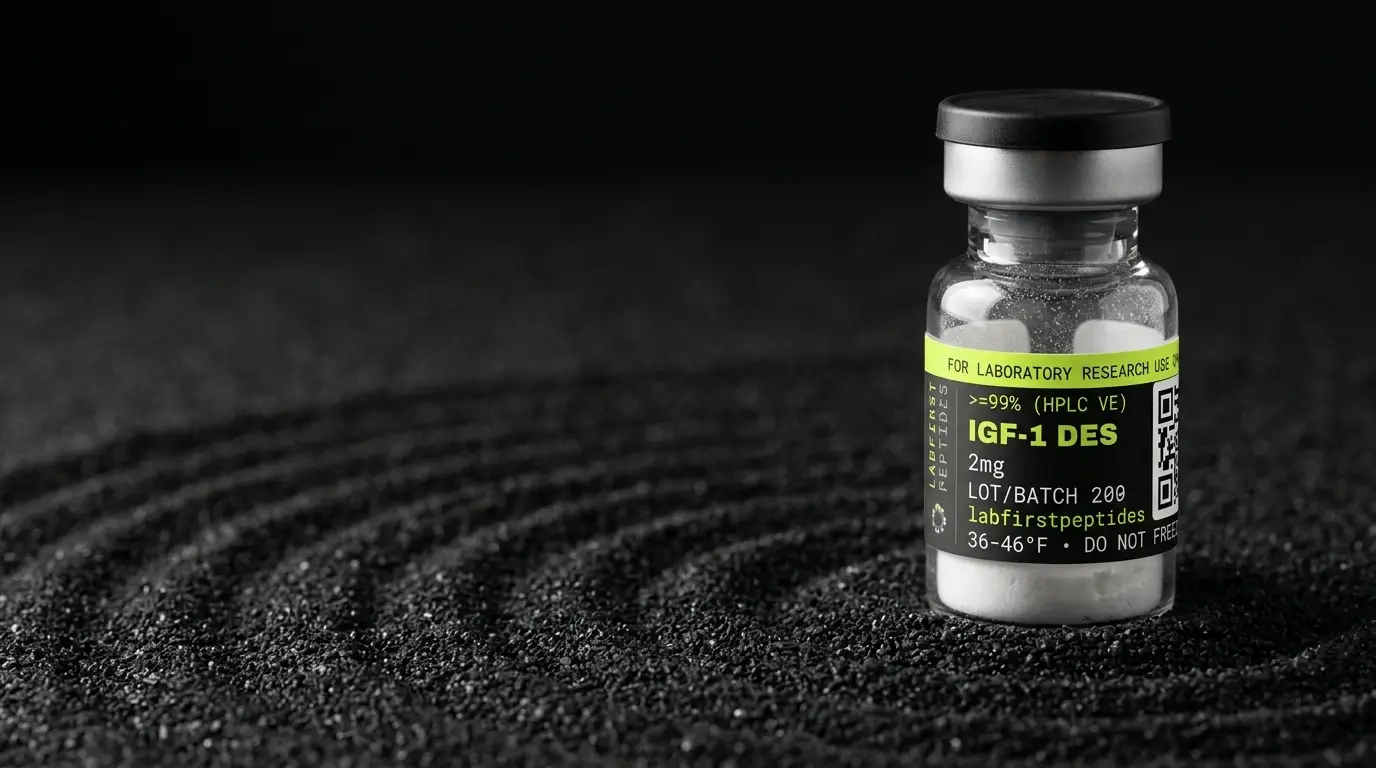
IGF-1 DES is analogue of human insulin-like growth factor 1 lacking the N-terminal tripeptide Gly-Pro-Glu. IGF-1 DES is sold here for laboratory research in 1 size (2mg), from $75.00 a vial. It is not an FDA-approved medicine. Research use only, and never for people or animals.
IGF-1 DES specifications
| Product name | IGF-1 DES |
|---|---|
| Also sold as | IGF-1 DES(1-3), DES(1-3) IGF-1, IGF DES 1, IGF-1 DES peptide |
| Physical form | Freeze-dried powder, a solid cake in a sealed vial |
| Appearance | White to off-white cake |
| Sizes on this page | 2mg |
| Purity specification | ≥99% by RP-HPLC. The number for the lot you receive is whatever its own certificate says. |
| Identity check | Mass spectrometry, read against the mass this compound should have |
| Net content | Weighed per lot and reported separately from purity |
| Lot documentation | Tested by Kovera Labs; each lot's certificate posts here when it is reported |
| Storage | Sealed, cold and out of the light |
| Ships from | Santa Ana, California by USPS with tracking on every order, same business day on verified in-stock orders placed before 12 PM Pacific |
| Regulatory status | Not an FDA-approved drug product. Sold as laboratory material, not a medicine; status verified 2026-08-25. |
| Intended use | Laboratory research only. Not for human or animal use. |
What is IGF-1 DES?
IGF-1 DES is also listed and searched as IGF-1 DES(1-3), DES(1-3) IGF-1, IGF DES 1, IGF-1 DES peptide. They all mean the same compound. A name is not a test, which is why the lot record further down counts for more than the wording on a label.
Analogue of human insulin-like growth factor 1 lacking the N-terminal tripeptide Gly-Pro-Glu.
Binds the IGF-1 receptor. Removal of the N-terminal tripeptide substantially reduces affinity for IGF binding proteins.
IGF analogue pharmacology and cell-culture work. Also of interest because des(1-3)IGF-I occurs naturally as a proteolytic product rather than only as a synthetic construct.
No approved product and no human therapeutic data. The cleaved N-terminal tripeptide Gly-Pro-Glu has its own separate neurological literature, which is a different subject and not evidence for this molecule.
IGF-1 DES for sale: 2mg vials, price per mg
IGF-1 DES is sold in 1 size here, 2mg, from $75.00 a vial. IGF-1 DES cost and IGF-1 DES price per mg by size are in the table, at each volume tier and on subscription; the per-mg figure under each price is the one that compares across sizes.
Volume and subscription pricing by size
| Size | One vial | 10–19 vials−10% | 20 vials−15% | Subscribe monthly−6% from shipment 2 | Availability |
|---|---|---|---|---|---|
| IGF-1 DES 2mg | $75.00$37.50/mg | $67.50a vial · $33.75/mg | $63.75a vial · $31.88/mg | $70.50a vial, shipment 2 on · $35.25/mg | Backordered — waitlist |
Volume tiers are per size and do not combine across sizes (see bulk pricing). Subscribe & Save takes 6% every month, 4% every 2 months or 2% every 3 months off from shipment 2, two shipments minimum, and stacks on the volume tier: the lowest this record ever bills is $29.96 per mg, twenty 2mg vials on a monthly subscription from shipment 2 onward.
Nothing is added at checkout except the USPS shipping you choose; dispatch and delivery are the same on every order. The cost-per-milligram tool ranks the whole catalog by price per mg.
Where to buy IGF-1 DES: what to check before you order from anyone
Where to get IGF-1 DES, and how to buy IGF-1 DES online
IGF-1 DES for sale, or IGF-1 DES peptide for sale, means this page: one record, 1 size. You can buy IGF-1 DES online here with guest checkout; verified in-stock orders placed before 12 PM Pacific are dispatched the same day.
Before ordering IGF-1 DES from anyone, us included, run the 5 checks on verifying a certificate; the first is that the report resolves on the laboratory's own site, and a seller who cannot pass them is asking for the trust a certificate exists to replace.
IGF-1 DES vs IGF-1 LR3: different molecules, separate records
IGF-1 DES vs IGF-1 LR3, or IGF-1 LR3 vs IGF-1 DES, is the comparison people search most, and they are not the same thing. Each is a different molecule with a different formula, mass and research record, and each has its own certificate here.
IGF-1 LR3 vs IGF-1 DES: the same comparison, side by side
| Record | Class | Formula | Avg. mass | Sizes here |
|---|---|---|---|---|
| IGF-1 DES | Analogue of human insulin-like growth factor 1 lacking the N-terminal tripeptide Gly-Pro-Glu. | — | — | 2mg from $75.00 |
| IGF-1 LR3 | Analogue of human insulin-like growth factor 1 with arginine replacing glutamate at position 3 and a thirteen-residue N-terminal extension. | — | — | 0.1mg · 1mg from $65.00 |
Documentation compared in full: IGF-1 DES vs IGF-1 LR3, side by side.
The IGF-1 DES certificate: lot, purity, identity, and how to verify it
A certificate answers identity, purity and net content as three separate questions, each with the method that produced it and the date it was run, how to read one covers what each field does and does not cover. IGF-1 DES is des(1-3)IGF-1, the IGF-1 sequence missing its first three residues. UniProt P05019 is the parent protein for reference; the truncated analogue has its own mass, which the lot certificate reports. So the mass on the lot certificate is the one to read; a listing that quotes the published figure for this material is quoting the wrong molecule.
IGF-1 DES certificates post here and in the certificate index when Kovera Labs reports on the lot.
Solution arithmetic for the bench, with no administration guidance: the vial concentration calculator, preset to IGF-1 DES.
IGF-1 DES research: what the published studies examine
Status: No FDA-approved application. This compound is sold as laboratory material. Where research on it has been published, it sits at the animal, cell or early-human stage, and this record does not summarize what it found. A supplier is not a neutral judge of evidence about its own catalog.
Des(1-3)IGF-I is human IGF-1 with the first three residues, Gly-Pro-Glu, removed. Like Long R3 it has reduced affinity for the IGF binding proteins, but it achieves that by deletion rather than substitution and extension, and it is a smaller departure from the native sequence. One point distinguishes it from most analogues on this catalog: des(1-3)IGF-I is not purely a synthetic invention — it arises naturally as a proteolytic cleavage product of IGF-1 in tissue, so it is a species the body actually produces.
In the published head-to-head comparison it performed comparably to native IGF-1 and better than Long R3, which is the opposite ordering to the one implied by how these two are usually marketed relative to each other.
| Reported observation | Model | Source |
|---|---|---|
| At 12.5 micrograms per liter, des(1-3)IGF-I increased hydrogen peroxide release by bovine neutrophils by 64%, essentially matching native IGF-I at 65% and well above long R3 IGF-I at 32%. At 100 micrograms per liter both IGF-I and des(1-3)IGF-I significantly stimulated thymidine incorporation into mononuclear cells while long R3 IGF-I did not, and in the presence of 2.5% fetal calf serum des(1-3)IGF-I was MORE potent than IGF-I. | bovine neutrophils and mononuclear cells, with IGFBP and receptor binding assays | Zhao, McBride, Trouten-Radford and Burton, Effects of insulin-like growth factor-I and its analogues on bovine hydrogen peroxide release by neutrophils and blastogenesis by mononuclear cells, Journal of Endocrinology (1993)The serum-present result is the interesting one: with binding proteins in the medium, escaping them mattered. |
Open questions. The evidence base for the isolated analogue is thin and old. The comparison above is a single 1993 study in bovine cells, and while it is a genuine head-to-head, one study in one species in two assays is not a characterization. There is no human data and no approved product. Two specific cautions. The tripeptide removed to make this analogue, Gly-Pro-Glu, is itself biologically active and has a separate neurological literature; that literature is about the fragment, not about des(1-3)IGF-I, and the two should not be conflated.
And IGF-1 receptor agonism is inherently mitogenic, which is why this axis is handled carefully in drug development regardless of which analogue is involved.
Each row above describes an observation in the stated model. None of it describes what IGF-1 DES would do in a person or an animal outside that model, and none of it is a recommendation to use it for anything.
How to store IGF-1 DES: refrigeration and shelf life
Keep the sealed vial cold and out of the light and it stays as it left the lab. Once it is mixed into a solution, how long it holds up depends on the compound, what it was mixed with, how strong the solution is and how cold it is kept — too many variables for anyone to print one shelf life on a label. So laboratories write the date on whatever they prepare and keep their own record of it.
For solution preparation arithmetic on the bench, concentration, per-graduation values and molarity, use the vial concentration calculator, which opens with the IGF-1 DES sizes stocked here already loaded. It covers laboratory measurement only and contains no administration guidance.