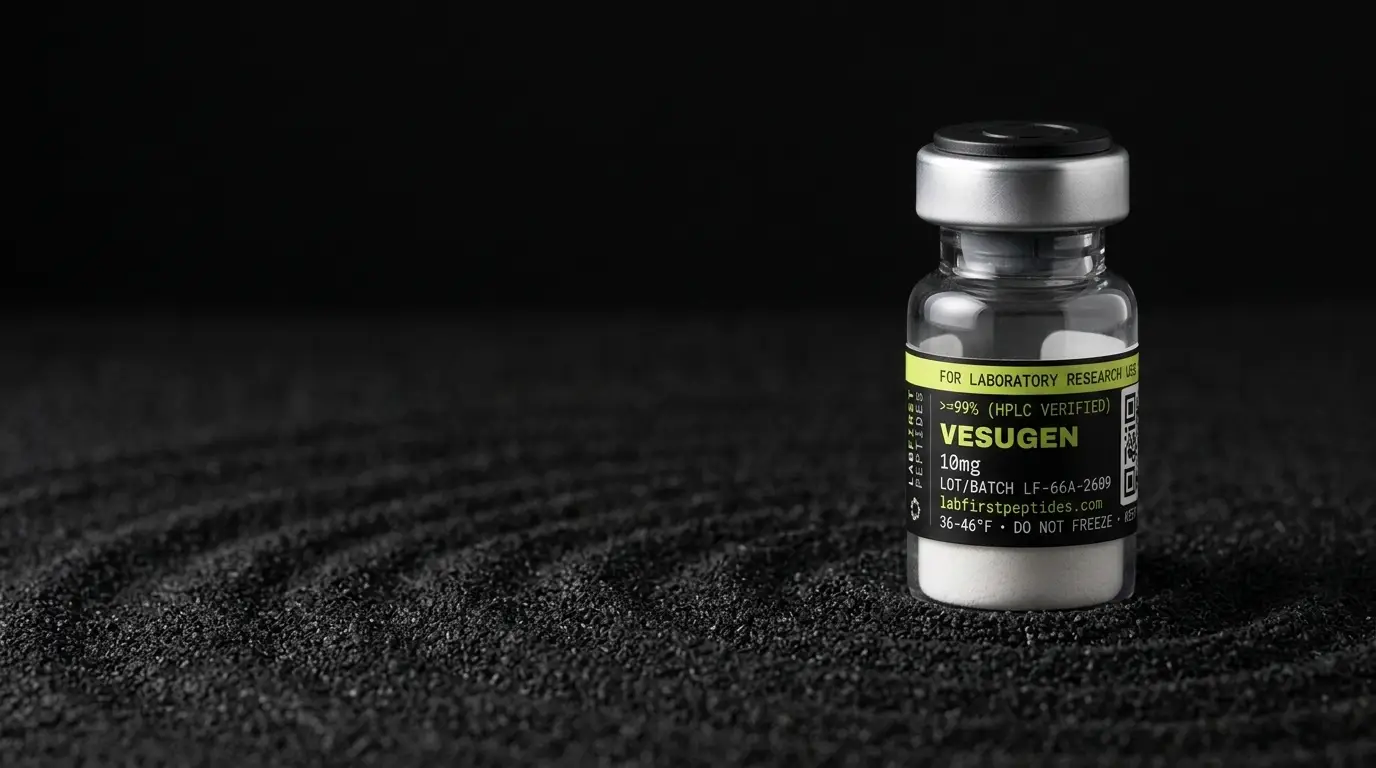
Vesugen is short synthetic peptide from the Khavinson "bioregulator" series (formula C15H26N4O8, average mass 390.39 g/mol, CAS 204271-66-9). Vesugen is sold here for laboratory research in 1 size (10mg), from $60.00 a vial. It is not an FDA-approved medicine. Research use only, and never for people or animals.
Vesugen specifications
| Product name | Vesugen |
|---|---|
| Formula | C15H26N4O8 |
| Average mass | 390.39 g/mol |
| CAS number | 204271-66-9 |
| Physical form | Freeze-dried powder, a solid cake in a sealed vial |
| Appearance | White to off-white cake |
| Sizes on this page | 10mg |
| Purity specification | ≥99% by RP-HPLC. The number for the lot you receive is whatever its own certificate says. |
| Identity check | Mass spectrometry, read against the mass this compound should have |
| Net content | Weighed per lot and reported separately from purity |
| Lot documentation | Tested by Kovera Labs; each lot's certificate posts here when it is reported |
| Storage | Sealed, cold and out of the light |
| Ships from | Santa Ana, California by USPS with tracking on every order, same business day on verified in-stock orders placed before 12 PM Pacific |
| Intended use | Laboratory research only. Not for human or animal use. |
What is Vesugen?
Chemically: molecular formula C15H26N4O8, average mass 390.39 g/mol (PubChem CID 87571363). Those figures are what the identity test on a certificate is read against.
Short synthetic peptide from the Khavinson "bioregulator" series.
Mechanism is not established in the conventional receptor sense. The originating group proposes that these peptides act epigenetically, entering cells and binding directly to specific DNA sequences to modulate transcription of tissue-relevant genes, with molecular docking used as the supporting method. That is a hypothesis about a mechanism, not a demonstrated pathway, and it has not been independently confirmed outside the groups that advanced it.
Appears in a preclinical literature of organotypic tissue culture, rodent models and gene-expression work, largely produced by the St Petersburg Institute of Bioregulation and Gerontology and collaborating Russian institutes. A substantial share is published in Russian, in journals with limited international circulation.
No approved product outside Russia, no pharmacopeial monograph, no independently replicated mechanism, and no controlled trial meeting United States or European standards. The volume of commercial writing about this series greatly exceeds what its cited sources report.
Vesugen for sale: 10mg vials, price per mg
Vesugen is sold in 1 size here, 10mg, from $60.00 a vial. Every way of buying is in the table; the per-mg figure under each price is the one that compares across sizes.
Volume and subscription pricing by size
| Size | One vial | 10–19 vials−10% | 20 vials−15% | Subscribe monthly−6% from shipment 2 | Availability |
|---|---|---|---|---|---|
| Vesugen 10mg | $60.00$6.00/mg | $54.00a vial · $5.40/mg | $51.00a vial · $5.10/mg | $56.40a vial, shipment 2 on · $5.64/mg | Backordered — waitlist |
Volume tiers are per size and do not combine across sizes (see bulk pricing). Subscribe & Save takes 6% every month, 4% every 2 months or 2% every 3 months off from shipment 2, two shipments minimum, and stacks on the volume tier: the lowest this record ever bills is $4.79 per mg, twenty 10mg vials on a monthly subscription from shipment 2 onward.
Nothing is added at checkout except the USPS shipping you choose; dispatch and delivery are the same on every order. The cost-per-milligram tool ranks the whole catalog by price per mg.
Where to buy Vesugen: what to check before you order from anyone
Vesugen for sale, or Vesugen peptide for sale, means this page: one record, 1 size. You can buy Vesugen online here with guest checkout; verified in-stock orders placed before 12 PM Pacific are dispatched the same day. A Vesugen supplier, vendor or source worth using will show you the lot number and where its certificate can be verified.
Before ordering Vesugen from anyone, us included, run the 5 checks on verifying a certificate; the first is that the report resolves on the laboratory's own site, and a seller who cannot pass them is asking for the trust a certificate exists to replace.
The Vesugen certificate: lot, purity, identity, and how to verify it
A certificate answers identity, purity and net content as three separate questions, each with the method that produced it and the date it was run, how to read one covers what each field does and does not cover. For Vesugen that means a mass spectrum landing on 390.39 g/mol for C15H26N4O8, the figure published against PubChem CID 87571363. The cataloged form is Lys-Glu-Asp (KED tripeptide), and the identity test resolves to that rather than to a related molecule with a similar name.
Listings elsewhere describe Vesugen as an acetate, an arginate salt or an N-acetyl form. Those are different chemical forms with different masses, and a certificate identifies which one was actually tested. The form of the lot on this page is whatever its certificate states; it is not assumed from a listing name, ours included.
Vesugen certificates post here and in the certificate index when Kovera Labs reports on the lot.
Solution arithmetic for the bench, with no administration guidance: the vial concentration calculator, preset to Vesugen.
Where the FDA stands on Vesugen
FDA status, and what this listing is Not an FDA-approved drug product
The FDA has not approved this compound for anything, and nothing in this catalog is a medicine.
Status verified 2026-08-25. Check the primary source before relying on this summary.
It is sold as laboratory material under the research-use restriction below. Being listed is not an approval, and not a claim that it is safe, effective or right for any purpose.
Vesugen research: what the published studies examine
Status: No FDA-approved application. This compound is sold as laboratory material. Where research on it has been published, it sits at the animal, cell or early-human stage, and this record does not summarize what it found. A supplier is not a neutral judge of evidence about its own catalog.
Vesugen is the tripeptide Lys-Glu-Asp, a sequence confirmed by PubMed's own indexing of the name. It is the vascular-associated member of the series. The originating group proposes that these peptides act epigenetically, entering cells and binding directly to specific DNA sequences to modulate transcription of tissue-relevant genes, with molecular docking used as the supporting method. That is a hypothesis about a mechanism, not a demonstrated pathway, and it has not been independently confirmed outside the groups that advanced it.
The series was developed at the St Petersburg Institute of Bioregulation and Gerontology, and the design premise is tissue specificity: each short peptide is claimed to act on the organ its parent extract came from. That premise rests principally on explant-outgrowth assays from the same group.
| Reported observation | Model | Source |
|---|---|---|
| Lys-Glu-Asp, alongside Glu-Asp-Arg, was reported to stimulate serotonin expression in ageing brain cortex cell cultures, with molecular docking proposing direct binding to a CCTGCC sequence in the tryptophan hydroxylase gene. | aged rat brain cortex cell culture, with molecular docking | Khavinson and colleagues, Short peptides stimulate serotonin expression in cells of brain cortex, Bulletin of Experimental Biology and Medicine (2014)Note this is a brain-cortex finding for a peptide marketed as vascular — the tissue-specificity premise is not visible in this result. |
| Included in a comparison of short regulatory peptides (vilon, epitalon, vesugen, pinealon) in a hypobaric hypoxia model. Vesugen was among those showing antihypoxic properties; pinealon showed the most pronounced effect of the four. | rat hypobaric hypoxia | Kozina, Investigation of antihypoxic properties of short peptides, Advances in Gerontology (2008) |
| The originating review sets out the peptide theory of ageing and the design principle behind the series: dipeptides specific for thymus and tetrapeptides specific for heart, liver, brain cortex and pineal gland stimulate outgrowth of explants from their corresponding organs. It reports lifespan extension in rats, mice and fruit flies for the pineal preparations. | review of three decades of the originating group's own work | Khavinson, Peptides and Ageing, Neuroendocrinology Letters (2002)A 134-page supplement authored by the series originator reviewing his own institute's work. Foundational for the field and not an independent appraisal of it. |
Open questions. Vesugen is sold on a vascular premise, and the indexed literature specific to it is very thin — thinner than for pinealon or epitalon, and largely consisting of appearances in multi-peptide comparisons rather than studies of this peptide in vascular tissue. Two limitations apply to every compound in this series and are worth stating plainly rather than once at the bottom of a catalog.
First, provenance: the great majority of primary work comes from one institute and its collaborators, much of it published in Russian, and independent replication outside that network is scarce. That is a limit on how confidently the findings can be read, not an allegation about them. Second, the assays: explant outgrowth in organotypic culture and gene-expression shifts in cultured cells are the dominant endpoints, and neither establishes what a compound does in an intact animal, let alone a person.
The proposed epigenetic mechanism — short peptides entering the nucleus and binding DNA directly — is supported largely by molecular docking, which is a computational prediction rather than a measurement.
Each row above describes an observation in the stated model. None of it describes what Vesugen would do in a person or an animal outside that model, and none of it is a recommendation to use it for anything.
How to store Vesugen: refrigeration and shelf life
Keep the sealed vial cold and out of the light and it stays as it left the lab. Once it is mixed into a solution, how long it holds up depends on the compound, what it was mixed with, how strong the solution is and how cold it is kept — too many variables for anyone to print one shelf life on a label. So laboratories write the date on whatever they prepare and keep their own record of it.
For solution preparation arithmetic on the bench, concentration, per-graduation values and molarity, use the vial concentration calculator, which opens with the Vesugen sizes stocked here already loaded. It covers laboratory measurement only and contains no administration guidance.