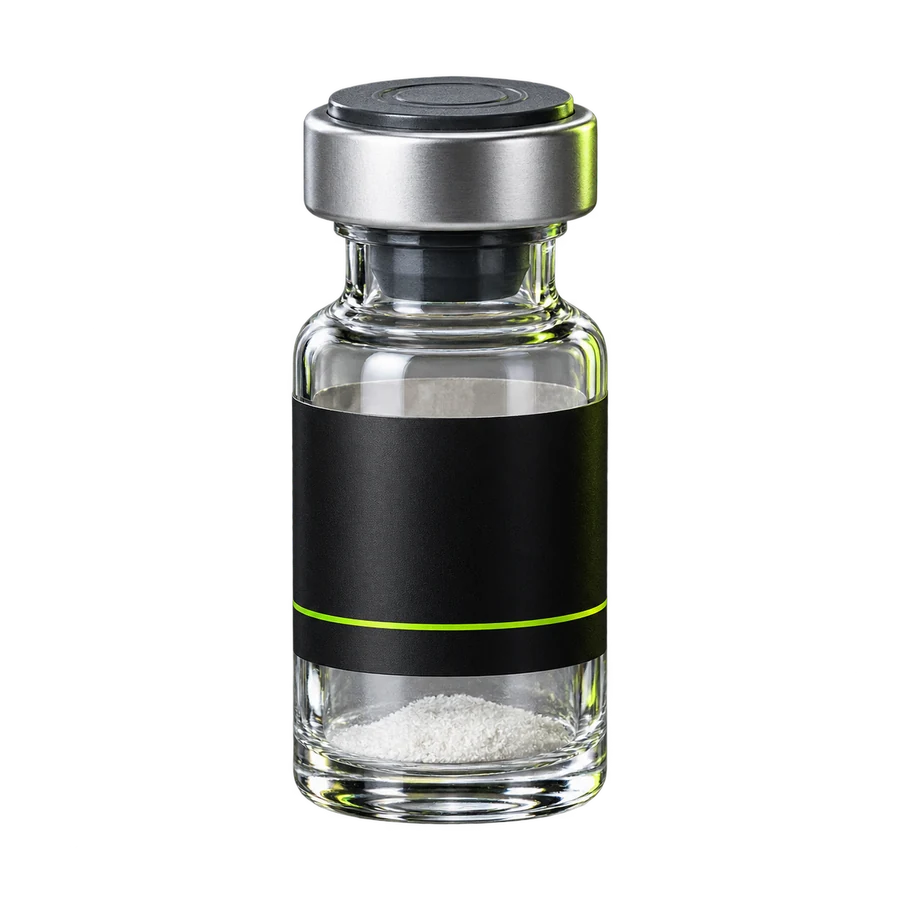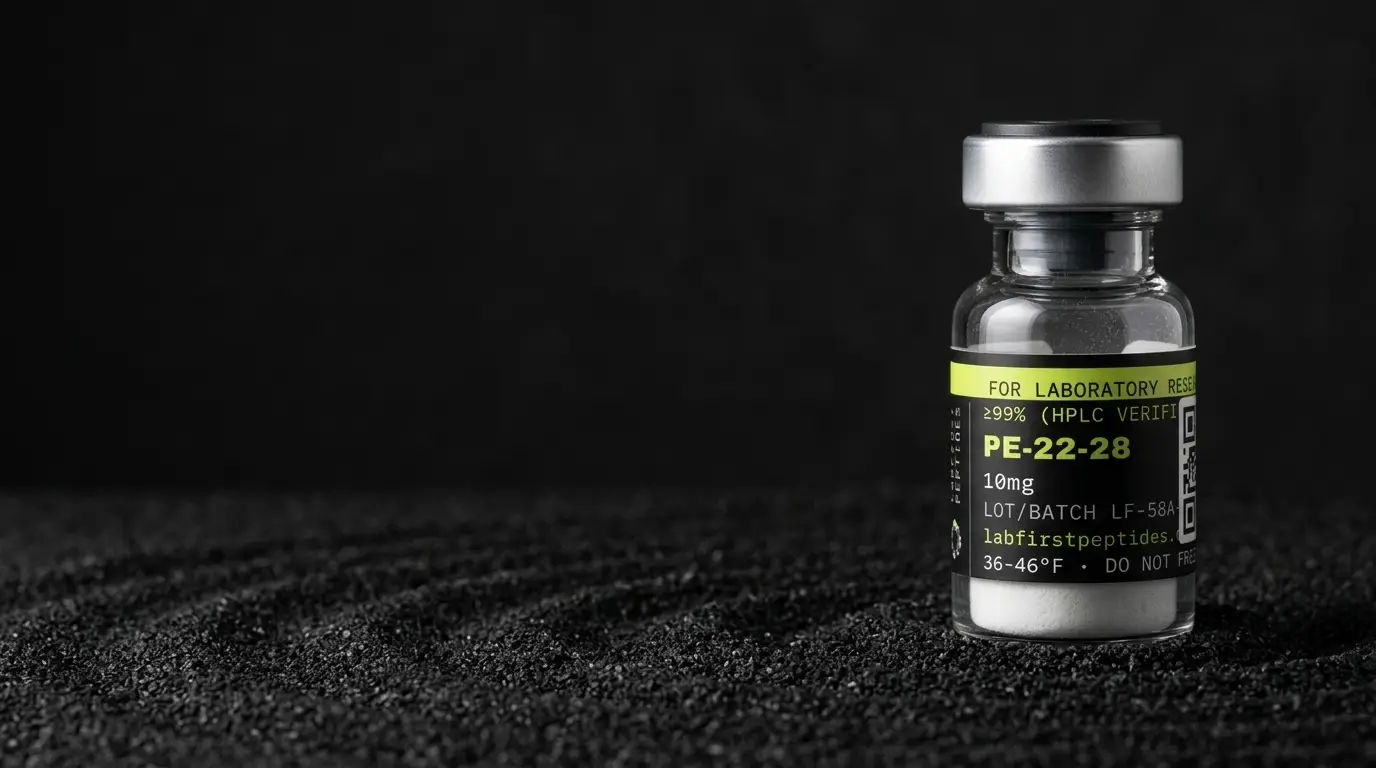
PE-22-28 is seven-residue peptide derived from spadin, itself a fragment of the sortilin propeptide (formula C35H55N11O9, average mass 773.9 g/mol, CAS 1801959-12-5). PE-22-28 is sold here for laboratory research in 1 size (10mg), from $70.00 a vial. It is not an FDA-approved medicine. Research use only, and never for people or animals.
PE-22-28 specifications
| Product name | PE-22-28 |
|---|---|
| Also sold as | PE 22-28 peptide |
| Formula | C35H55N11O9 |
| Average mass | 773.9 g/mol |
| CAS number | 1801959-12-5 |
| Physical form | Freeze-dried powder, a solid cake in a sealed vial |
| Appearance | White to off-white cake |
| Sizes on this page | 10mg |
| Purity specification | ≥99% by RP-HPLC. The number for the lot you receive is whatever its own certificate says. |
| Identity check | Mass spectrometry, read against the mass this compound should have |
| Net content | Weighed per lot and reported separately from purity |
| Lot documentation | Tested by Kovera Labs; each lot's certificate posts here when it is reported |
| Storage | Sealed, cold and out of the light |
| Ships from | Santa Ana, California by USPS with tracking on every order, same business day on verified in-stock orders placed before 12 PM Pacific |
| Regulatory status | Not an FDA-approved drug product. Sold as laboratory material, not a medicine; status verified 2026-08-25. |
| Intended use | Laboratory research only. Not for human or animal use. |
What is PE-22-28?
PE-22-28 is also listed and searched as PE 22-28 peptide. They all mean the same compound. Supplier lists write it as peptide PE-22-28 as well; every one of those is this record. A name is not a test, which is why the lot record further down counts for more than the wording on a label.
Chemically: molecular formula C35H55N11O9, average mass 773.9 g/mol (PubChem CID 165437303). Those figures are what the identity test on a certificate is read against.
Seven-residue peptide derived from spadin, itself a fragment of the sortilin propeptide.
Blocker of the TREK-1 two-pore-domain potassium channel. TREK-1 deletion in mice produces a depression-resistant phenotype, which is the origin of interest in blocking it.
TREK-1 channel pharmacology by patch clamp, and rodent behavioral models of depression, neurogenesis and synaptogenesis.
No human data, no approved product. The behavioral evidence rests on rodent screening paradigms whose predictive value for human depression is contested.
PE-22-28 for sale: 10mg vials, price per mg
PE-22-28 is sold in 1 size here, 10mg, from $70.00 a vial. Every way of buying is in the table; the per-mg figure under each price is the one that compares across sizes.
Volume and subscription pricing by size
| Size | One vial | 10–19 vials−10% | 20 vials−15% | Subscribe monthly−6% from shipment 2 | Availability |
|---|---|---|---|---|---|
| PE-22-28 10mg | $70.00$7.00/mg | $63.00a vial · $6.30/mg | $59.50a vial · $5.95/mg | $65.80a vial, shipment 2 on · $6.58/mg | Backordered — waitlist |
Volume tiers are per size and do not combine across sizes (see bulk pricing). Subscribe & Save takes 6% every month, 4% every 2 months or 2% every 3 months off from shipment 2, two shipments minimum, and stacks on the volume tier: the lowest this record ever bills is $5.59 per mg, twenty 10mg vials on a monthly subscription from shipment 2 onward.
Nothing is added at checkout except the USPS shipping you choose; dispatch and delivery are the same on every order. The cost-per-milligram tool ranks the whole catalog by price per mg.
Where to buy PE-22-28: what to check before you order from anyone
PE-22-28 for sale, or PE-22-28 peptide for sale, means this page: one record, 1 size. You can buy PE-22-28 online here with guest checkout; verified in-stock orders placed before 12 PM Pacific are dispatched the same day.
Before ordering PE-22-28 from anyone, us included, run the 5 checks on verifying a certificate; the first is that the report resolves on the laboratory's own site, and a seller who cannot pass them is asking for the trust a certificate exists to replace.
PE-22-28 nasal spray? What this vial is, and is not
Search results for PE-22-28 also show nasal spray products, under listing titles such as pe-22-28 nasal spray, pe 22 28 peptide nasal spray, pe 22-28 8mg vial. Those are finished consumer goods made and marketed by other companies, and none of them is what this page sells. This record is freeze-dried PE-22-28 in a sealed glass vial, 10mg, with a lot certificate, supplied for laboratory work. Its certificate describes that powder, not a capsule, spray or cream, which carry other ingredients and sit under different rules.
The PE-22-28 certificate: lot, purity, identity, and how to verify it
A certificate answers identity, purity and net content as three separate questions, each with the method that produced it and the date it was run, how to read one covers what each field does and does not cover. For PE-22-28 that means a mass spectrum landing on 773.9 g/mol for C35H55N11O9, the figure published against PubChem CID 165437303.
PE-22-28 certificates post here and in the certificate index when Kovera Labs reports on the lot.
Solution arithmetic for the bench, with no administration guidance: the vial concentration calculator, preset to PE-22-28.
PE-22-28 research: what the published studies examine
Status: No FDA-approved application. This compound is sold as laboratory material. Where research on it has been published, it sits at the animal, cell or early-human stage, and this record does not summarize what it found. A supplier is not a neutral judge of evidence about its own catalog.
PE 22-28 came out of a specific and rather elegant piece of drug design. Spadin, a peptide derived from the sortilin propeptide, was identified as a TREK-1 channel blocker with antidepressant-like activity in rodents, but its effect disappeared beyond about seven hours. Rather than modifying spadin directly, the group studied its BLOOD DEGRADATION PRODUCTS and designed a seven-residue peptide from what survived.
The result improved on the parent on every axis they measured: affinity for TREK-1 by roughly two to three orders of magnitude, and duration of action from about 7 hours to about 23. The target itself is well grounded — TREK-1 is a two-pore-domain potassium channel, and mice lacking it show a depression-resistant phenotype, which is why blocking it became a therapeutic idea.
| Reported observation | Model | Source |
|---|---|---|
| On hTREK-1-expressing HEK cells by patch clamp, PE 22-28 showed better specificity and affinity for TREK-1 than spadin, with IC50 of 0.12 nM against 40-60 nM for spadin. Modifications at either terminus maintained or abolished channel activity without affecting affinity. In rodent behavioral models, treated mice showed reduced immobility in forced swimming and, after four days of sub-chronic treatment, reduced latency in novelty-suppressed feeding. Four days of treatment induced neurogenesis, and PSD-95 expression rose in mouse cortical neurons. Duration of action extended to about 23 hours against about 7 hours for spadin. | hTREK-1/HEK patch clamp, mouse behavioral paradigms, mouse cortical neuron culture | Djillani and colleagues, Shortened spadin analogs display better TREK-1 inhibition, stability and antidepressant activity, Frontiers in Pharmacology (2017)CNRS Institut de Pharmacologie Moleculaire et Cellulaire. The IC50 improvement over spadin is the hard number here; the behavioral work is screening-paradigm data. |
Open questions. The channel pharmacology is precise and convincing — a 0.12 nM IC50 measured by patch clamp is a real number obtained by a direct method. The behavioral claims should be read much more cautiously. Forced swimming and novelty-suppressed feeding are screening assays: they reliably detect compounds that already work as antidepressants in people, which is not the same as reliably predicting that a new compound will. A great many molecules have reduced immobility in a forced swim test and gone nowhere.
There are no human data of any kind, no approved product, and the entire literature comes from one laboratory. Note also that the compound was designed from spadin's degradation products, so its own metabolic fate is a natural question the published work does not fully answer.
Each row above describes an observation in the stated model. None of it describes what PE-22-28 would do in a person or an animal outside that model, and none of it is a recommendation to use it for anything.
How to store PE-22-28: refrigeration and shelf life
Keep the sealed vial cold and out of the light and it stays as it left the lab. Once it is mixed into a solution, how long it holds up depends on the compound, what it was mixed with, how strong the solution is and how cold it is kept — too many variables for anyone to print one shelf life on a label. So laboratories write the date on whatever they prepare and keep their own record of it.
For solution preparation arithmetic on the bench, concentration, per-graduation values and molarity, use the vial concentration calculator, which opens with the PE-22-28 sizes stocked here already loaded. It covers laboratory measurement only and contains no administration guidance.