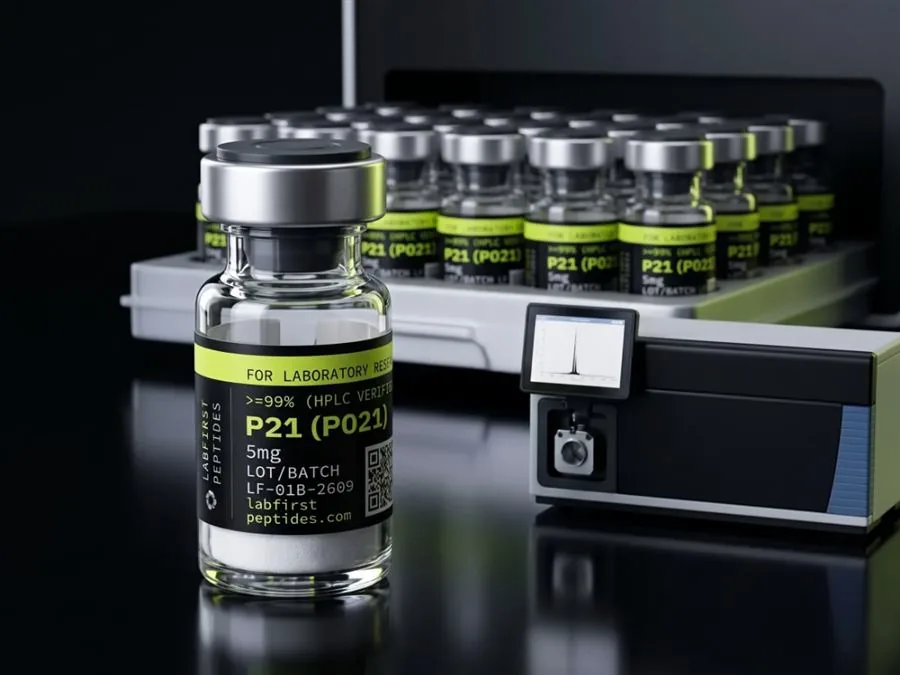
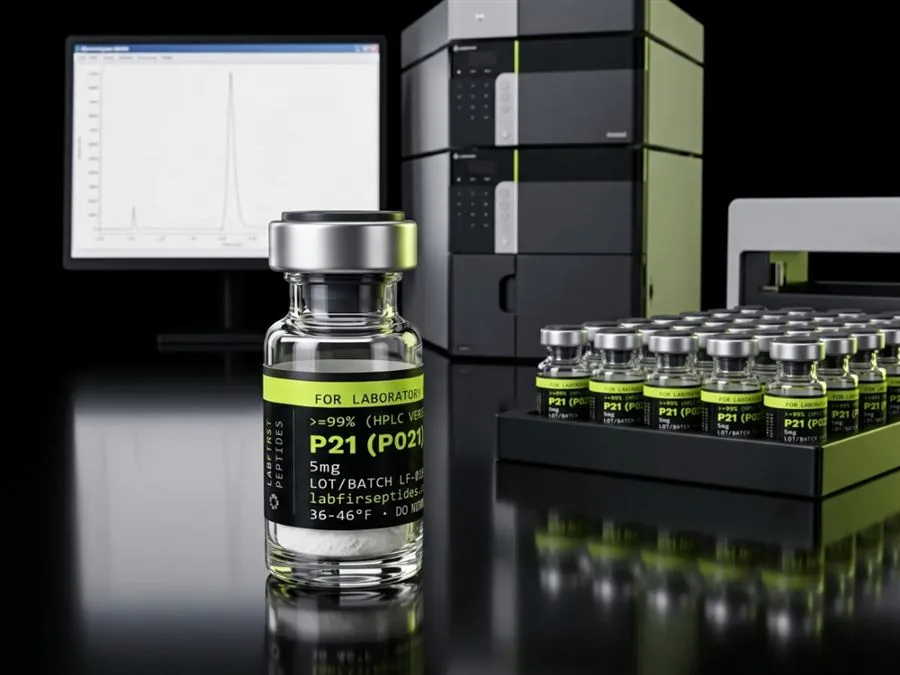
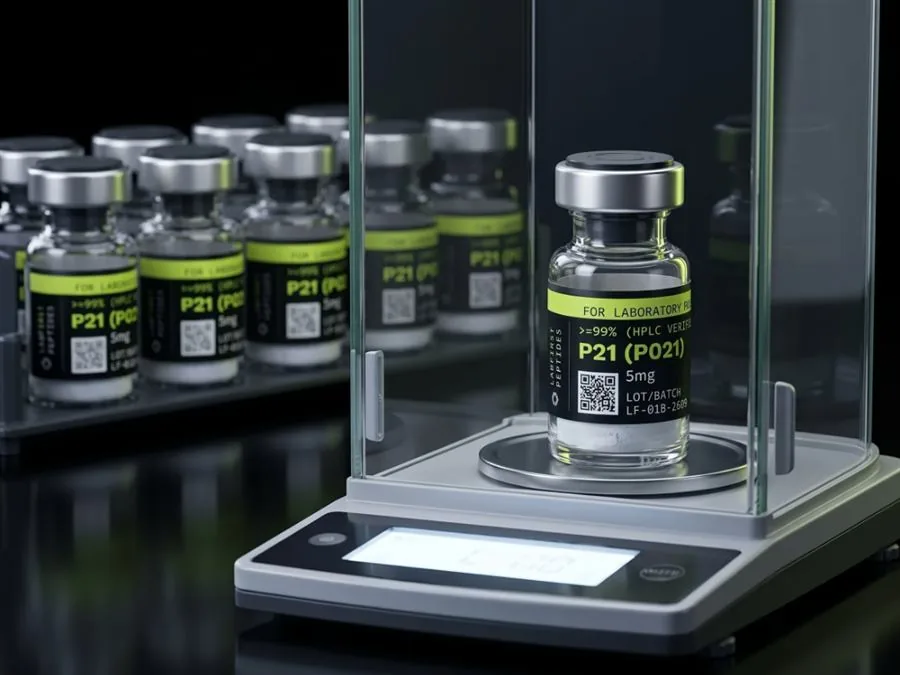
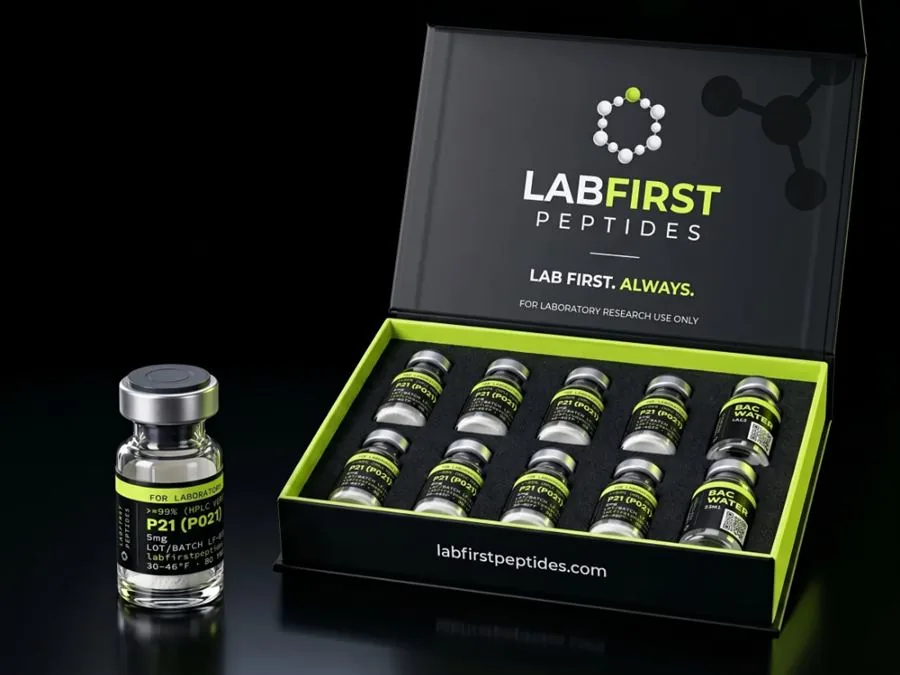
Shop / P21 research peptide
Buy P21 Peptide
Small peptidergic compound derived from ciliary neurotrophic factor, sequence Ac-DGGL(A)G-NH2 — an acetylated and amidated tetrapeptide with an adamantylated residue, supplied freeze-dried in a sealed vial and tested lot by lot at Kovera Labs.
P21 Peptide price by sizeBackordered
$95.00$19.00 per mgSave 0% per mg
Join the waitlist for
We are restocking this size and expect it in stock within 5 to 7 days. Everyone on the waitlist hears first.
You are on the list. Check your inbox.
FOR LABORATORY AND IN-VITRO RESEARCH USE ONLY. NOT FOR HUMAN OR ANIMAL CONSUMPTION.
Backordered: join the waitlist and we email you the moment it lands
Free shipping on orders over $150.00
Lab certificate · 5mg
This size's lot is in testing. Its results appear here as soon as the lab report is in.
In short: P21 is small peptidergic compound derived from ciliary neurotrophic factor, sequence Ac-DGGL(A)G-NH2 — an acetylated and amidated tetrapeptide with an adamantylated residue. P21 (P021) is sold here for laboratory research in 1 size (5mg), from $95.00 a vial. It is not an FDA-approved medicine. Research use only, and never for people or animals.
Often bought with
P21 specifications
| Product name | P21 (P021) |
|---|---|
| Also sold as | P21 (P021), P021, P21 peptide |
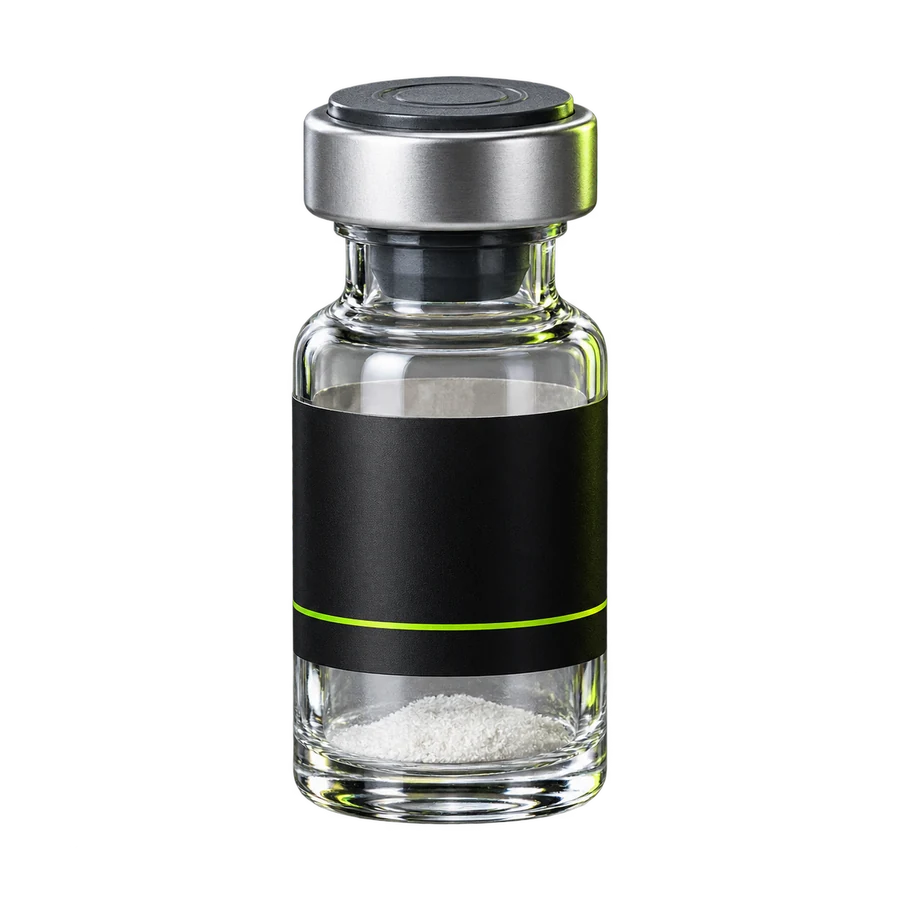
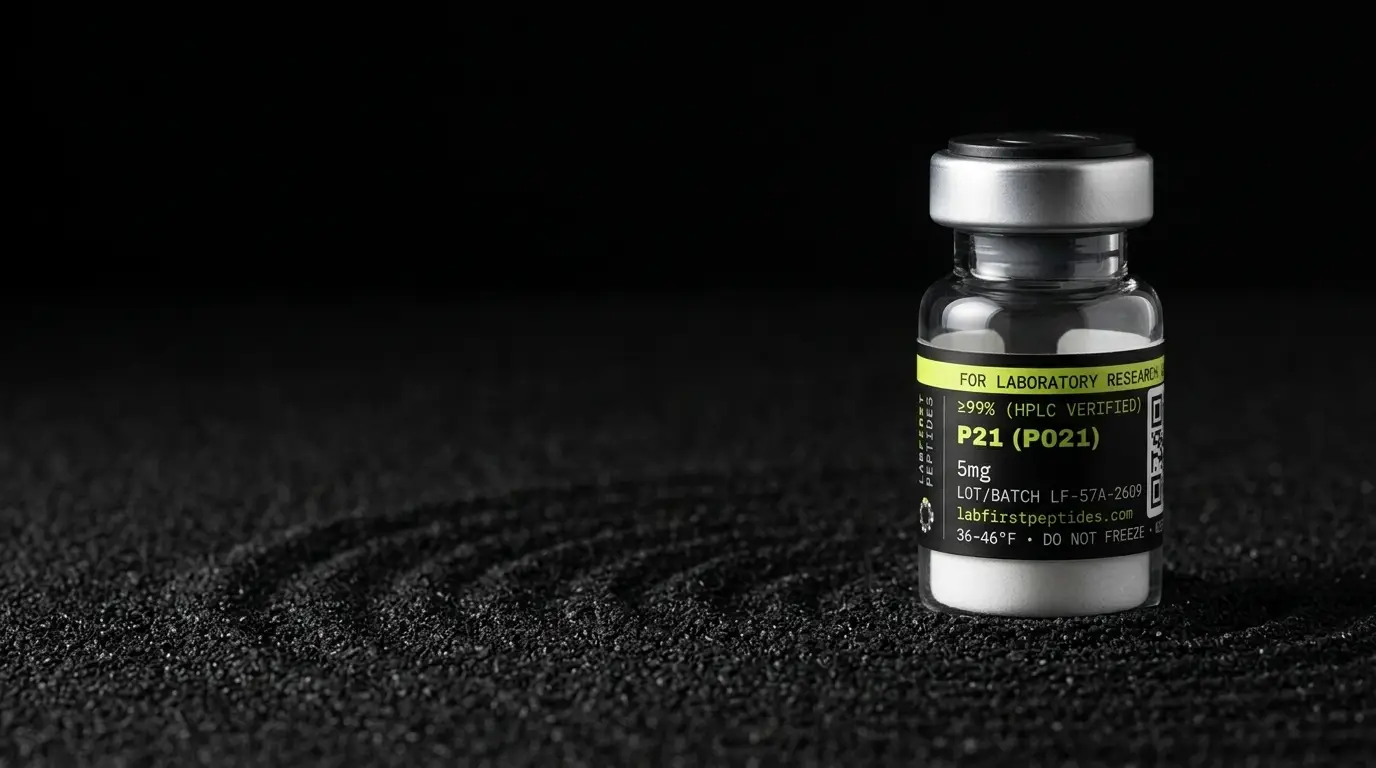
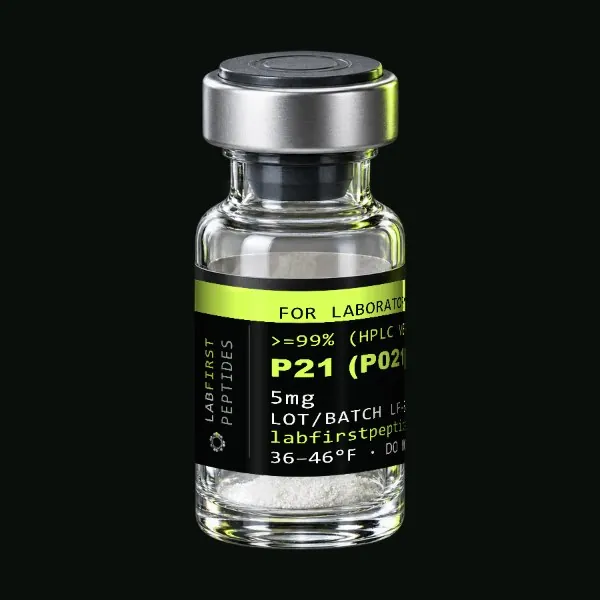
| Physical form | Freeze-dried powder, a solid cake in a sealed vial |
| Appearance | White to off-white cake |
| Sizes on this page | 5mg |
| Purity specification | ≥99% by RP-HPLC. The number for the lot you receive is whatever its own certificate says. |
| Identity check | Mass spectrometry, read against the mass this compound should have |
| Net content | Weighed per lot and reported separately from purity |
| Lot documentation | Tested by Kovera Labs; each lot's certificate posts here when it is reported |
| Storage | Sealed, cold and out of the light |
| Ships from | Santa Ana, California by USPS with tracking on every order, same business day on verified in-stock orders placed before 12 PM Pacific |
| Regulatory status | Not an FDA-approved drug product. Sold as laboratory material, not a medicine; status verified 2026-08-25. |
| Intended use | Laboratory research only. Not for human or animal use. |
What is P21, and what is it used for?
P21 is also listed and searched as P21 (P021), P021, P21 peptide. They all mean the same compound. Supplier lists write it as P21 peptides or peptide P21 as well; every one of those is this record. A name is not a test, which is why the lot record further down counts for more than the wording on a label.
Class
Small peptidergic compound derived from ciliary neurotrophic factor, sequence Ac-DGGL(A)G-NH2 — an acetylated and amidated tetrapeptide with an adamantylated residue.
Mechanism
Derived from an active region of ciliary neurotrophic factor. The reported effect is increased brain-derived neurotrophic factor expression, with downstream reduction in glycogen synthase kinase-3-beta activity. Not a receptor agonist in the conventional sense; no receptor has been identified for it.
Where it appears in the literature
Chronic oral treatment in a triple-transgenic mouse model of Alzheimer's disease, examining tau phosphorylation, amyloid burden, neurogenesis and synaptic plasticity.
What is not established
No receptor identified, no human trials, no approved product. The work comes principally from one laboratory.
P21 for sale: 5mg vials, price per mg
P21 is sold in 1 size here, 5mg, from $95.00 a vial. Every way of buying is in the table; the per-mg figure under each price is the one that compares across sizes.
Volume and subscription pricing by size
| Size | One vial | 10–19 vials−10% | 20 vials−15% | Subscribe monthly−6% from shipment 2 | Availability |
|---|---|---|---|---|---|
| P21 5mg | $95.00$19.00/mg | $85.50a vial · $17.10/mg | $80.75a vial · $16.15/mg | $89.30a vial, shipment 2 on · $17.86/mg | Backordered — waitlist |
Volume tiers are per size and do not combine across sizes (see bulk pricing). Subscribe & Save takes 6% every month, 4% every 2 months or 2% every 3 months off from shipment 2, two shipments minimum, and stacks on the volume tier: the lowest this record ever bills is $15.18 per mg, twenty 5mg vials on a monthly subscription from shipment 2 onward.
Nothing is added at checkout except the USPS shipping you choose; dispatch and delivery are the same on every order. The cost-per-milligram tool ranks the whole catalog by price per mg.
Where to buy P21: what to check before you order from anyone
P21 for sale, or P21 peptide for sale, means this page: one record, 1 size. You can buy P21 online here with guest checkout; verified in-stock orders placed before 12 PM Pacific are dispatched the same day.
Before ordering P21 from anyone, us included, run the 5 checks on verifying a certificate; the first is that the report resolves on the laboratory's own site, and a seller who cannot pass them is asking for the trust a certificate exists to replace.
The P21 certificate: lot, purity, identity, and how to verify it
A certificate answers identity, purity and net content as three separate questions, each with the method that produced it and the date it was run, how to read one covers what each field does and does not cover.
P21 (P021) certificates post here and in the certificate index when Kovera Labs reports on the lot.
Solution arithmetic for the bench, with no administration guidance: the vial concentration calculator, preset to P21 (P021).
P21 research: what the published studies examine
Status: No FDA-approved application. This compound is sold as laboratory material. Where research on it has been published, it sits at the animal, cell or early-human stage, and this record does not summarize what it found. A supplier is not a neutral judge of evidence about its own catalog.
P021 is a small compound derived from ciliary neurotrophic factor, with the sequence Ac-DGGL(A)G-NH2 — the acetyl and amide caps and the adamantylated residue are stability and permeability modifications rather than active features. The design idea is a real one in neuroscience: full neurotrophic proteins are too large and too poorly distributed to administer, so the field has repeatedly tried to reduce them to short active fragments that survive in circulation and reach the brain.
What P021 is proposed to do once there is raise BDNF expression, with a consequent fall in GSK3-beta activity — GSK3-beta being one of the kinases implicated in tau phosphorylation. That is a plausible chain and it is described as an inference from the observed changes rather than a demonstrated pathway; no receptor for the compound has been identified.
| Reported observation | Model | Source |
|---|---|---|
| Triple-transgenic and wild-type mice were treated for 12 months with P021 or vehicle diet from 9 to 10 months of age. Treated animals showed significantly reduced abnormal hyperphosphorylation and accumulation of tau at major neurofibrillary-pathology-associated sites. The effect on amyloid pathology was LIMITED — a significant decrease in soluble amyloid-beta and only a non-significant trend toward reduced plaque load in hippocampal CA1. Increased BDNF expression and decreased GSK3-beta activity were found, and deficits in cognition, neurogenesis and synaptic plasticity were reduced. | 3xTg-AD transgenic mice, 12 months of chronic oral treatment | Kazim and colleagues, Disease modifying effect of chronic oral treatment with a neurotrophic peptidergic compound in a triple transgenic mouse model of Alzheimer's disease, Neurobiology of Disease (2014)The amyloid result is explicitly partial — a trend rather than a significant plaque reduction — and the authors say so. |
Open questions. This is a well-conducted single study in a transgenic mouse model, and both halves of that description matter. Twelve months of chronic oral dosing with multiple orthogonal endpoints is real work; a 3xTg-AD mouse is a model that has produced a long series of compounds that did not translate, which is a general problem in this field rather than a criticism of this one. The amyloid result was partial by the authors' own reporting.
No receptor has been identified, which means the mechanism is described by its downstream correlates rather than by a target. The literature comes principally from one laboratory and there are no human trials and no approved product. Anyone reading claims about this compound should notice how far they travel from a mouse diet study.
Each row above describes an observation in the stated model. None of it describes what P21 (P021) would do in a person or an animal outside that model, and none of it is a recommendation to use it for anything.
How to store P21: refrigeration and shelf life
Keep the sealed vial cold and out of the light and it stays as it left the lab. Once it is mixed into a solution, how long it holds up depends on the compound, what it was mixed with, how strong the solution is and how cold it is kept — too many variables for anyone to print one shelf life on a label. So laboratories write the date on whatever they prepare and keep their own record of it.
For solution preparation arithmetic on the bench, concentration, per-graduation values and molarity, use the vial concentration calculator, which opens with the P21 (P021) sizes stocked here already loaded. It covers laboratory measurement only and contains no administration guidance.
Questions about P21
Where to buy P21 Peptide, and can I get it online?
Here, in 1 size, with guest checkout and shipping across the United States. All sizes are on the waitlist at the moment, and are being restocked, expected within 5 to 7 days. Each size carries its own lot record and certificate, verifiable at the issuing laboratory before you order.
What is P21 (P021) used for?
In the published research, Chronic oral treatment in a triple-transgenic mouse model of Alzheimer's disease, examining tau phosphorylation, amyloid burden, neurogenesis and synaptic plasticity. No receptor identified, no human trials, no approved product. The work comes principally from one laboratory. This record sells it for laboratory work and says nothing about use in a person or an animal.
What is P21 peptide?
P21 is small peptidergic compound derived from ciliary neurotrophic factor, sequence Ac-DGGL(A)G-NH2 — an acetylated and amidated tetrapeptide with an adamantylated residue. It is sold here in a sealed vial with a certificate for the lot, for laboratory work only.
For laboratory and in-vitro research use only. Not for human or animal consumption.