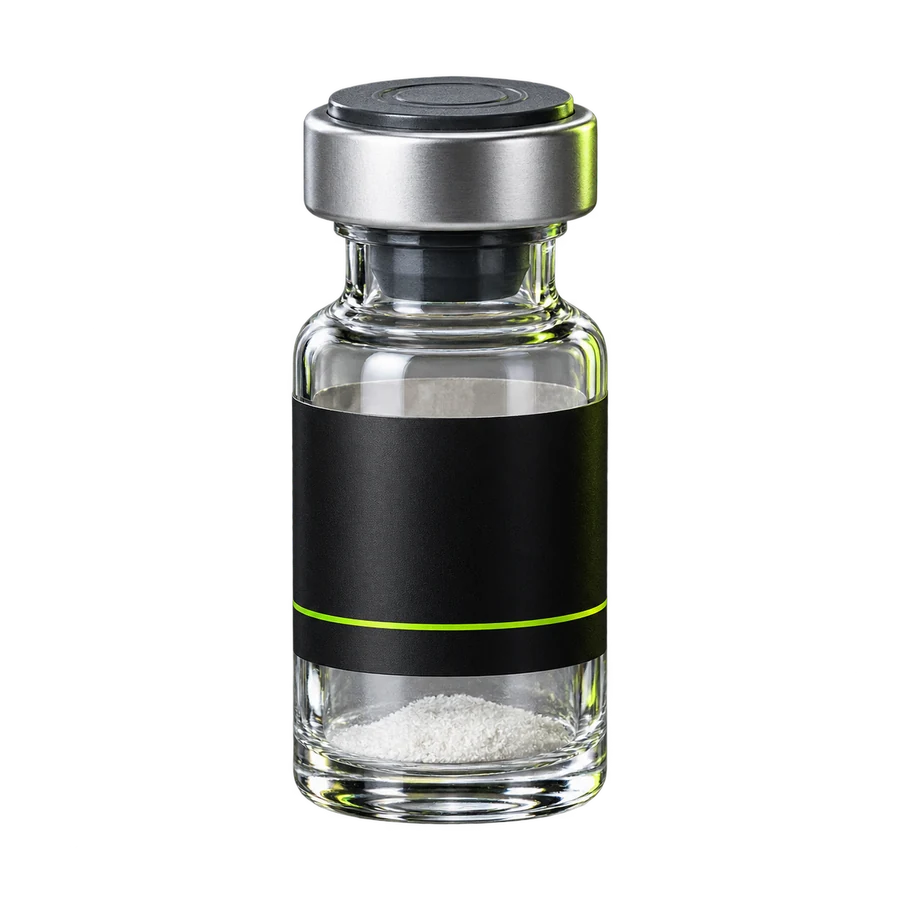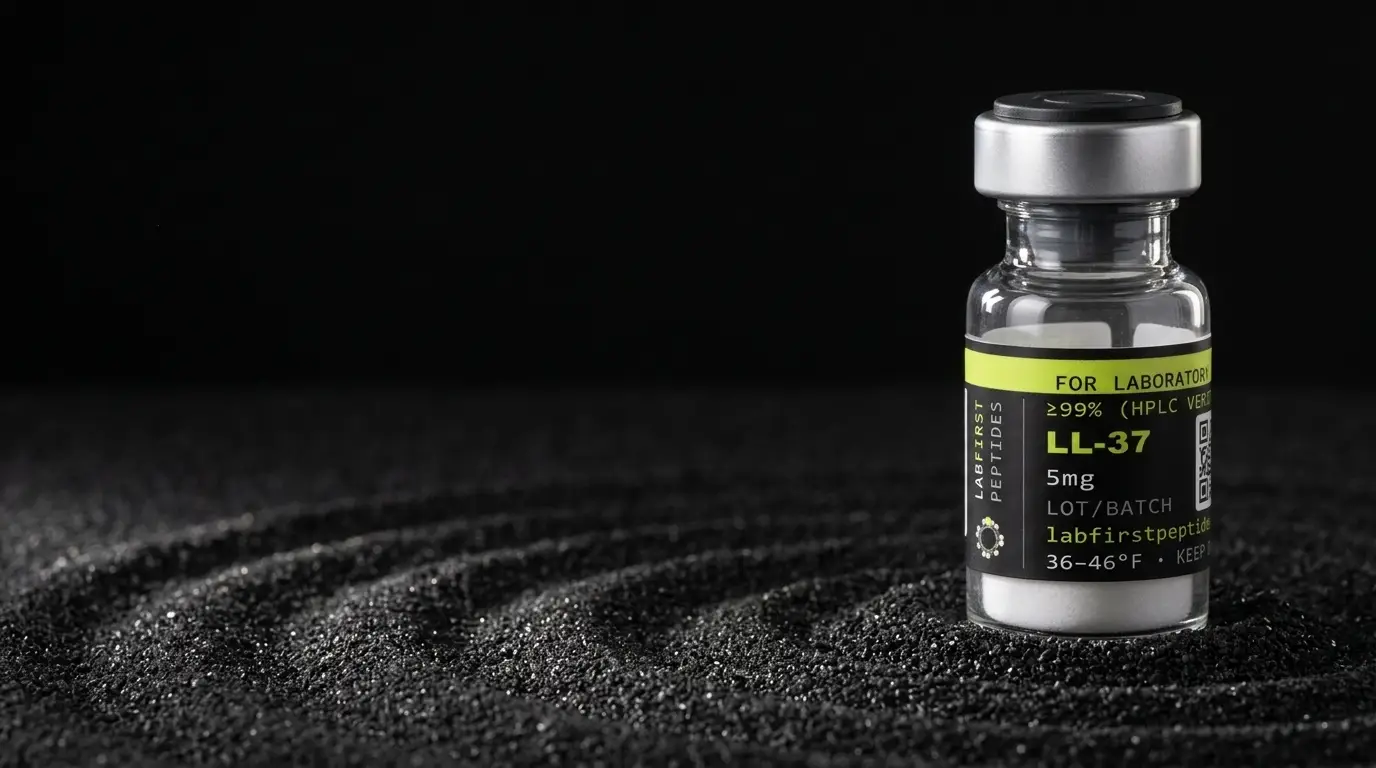
LL-37 is the 37-residue C-terminal fragment of human cathelicidin hCAP18 — an amphipathic helical host-defense peptide (formula C205H340N60O53, average mass 4,493 g/mol, CAS 154947-66-7). LL-37 is sold here for laboratory research in 1 size (5mg), from $150.00 a vial. It is not an FDA-approved medicine. Research use only, and never for people or animals.
LL-37 specifications
| Product name | LL-37 |
|---|---|
| Also sold as | LL-37 peptide, cathelicidin LL-37 |
| Formula | C205H340N60O53 |
| Average mass | 4,493 g/mol |
| CAS number | 154947-66-7 |
| Physical form | Freeze-dried powder, a solid cake in a sealed vial |
| Appearance | White to off-white cake |
| Sizes on this page | 5mg |
| Purity specification | ≥99% by RP-HPLC. The number for the lot you receive is whatever its own certificate says. |
| Identity check | Mass spectrometry, read against the mass this compound should have |
| Net content | Weighed per lot and reported separately from purity |
| Lot documentation | Lot numbers assigned for 1 of 1 size; each lot's certificate posts here when Kovera Labs reports it |
| Storage | Sealed, cold and out of the light |
| Ships from | Santa Ana, California by USPS with tracking on every order, same business day on verified in-stock orders placed before 12 PM Pacific |
| Regulatory status | Not an FDA-approved drug product. Sold as laboratory material, not a medicine; status verified 2026-08-25. |
| Intended use | Laboratory research only. Not for human or animal use. |
What is LL-37, and what is it used for?
LL-37 is also listed and searched as LL-37 peptide, cathelicidin LL-37. They all mean the same compound. Supplier lists write it as LL-37 peptides or peptide LL-37 as well; every one of those is this record. A name is not a test, which is why the lot record further down counts for more than the wording on a label.
Chemically: molecular formula C205H340N60O53, average mass 4493 g/mol (PubChem CID 16198951). Those figures are what the identity test on a certificate is read against.
The 37-residue C-terminal fragment of human cathelicidin hCAP18 — an amphipathic helical host-defense peptide.
Direct antimicrobial activity by membrane disruption, acting as a pore-forming peptide against bacterial membranes. Separately functions as an alarmin, modulating inflammation in both directions and promoting angiogenesis and wound repair. Its tendency to oligomerise in physiological solution is central to both.
Innate immunity and host defense, antimicrobial mechanism, inflammation, angiogenesis and wound healing. A large mainstream immunology literature.
No approved product. LL-37 is cytotoxic to host cells as well as bacterial ones, and the therapeutic window between the two is the central unresolved problem.
LL-37 for sale: 5mg vials, price per mg
LL-37 is sold in 1 size here, 5mg, from $150.00 a vial. LL-37 cost and LL-37 price per mg by size are in the table, at each volume tier and on subscription; the per-mg figure under each price is the one that compares across sizes.
Volume and subscription pricing by size
| Size | One vial | 10–19 vials−10% | 20 vials−15% | Subscribe monthly−6% from shipment 2 | Availability |
|---|---|---|---|---|---|
| LL-37 5mg | $150.00$30.00/mg | $135.00a vial · $27.00/mg | $127.50a vial · $25.50/mg | $141.00a vial, shipment 2 on · $28.20/mg | Backordered — waitlist |
Volume tiers are per size and do not combine across sizes (see bulk pricing). Subscribe & Save takes 6% every month, 4% every 2 months or 2% every 3 months off from shipment 2, two shipments minimum, and stacks on the volume tier: the lowest this record ever bills is $23.97 per mg, twenty 5mg vials on a monthly subscription from shipment 2 onward.
Nothing is added at checkout except the USPS shipping you choose; dispatch and delivery are the same on every order. The cost-per-milligram tool ranks the whole catalog by price per mg.
Where to buy LL-37: what to check before you order from anyone
Where to get LL-37, and how to buy LL-37 online
LL-37 for sale, or LL-37 peptide for sale, means this page: one record, 1 size. You can buy LL-37 online here with guest checkout, and purchase LL-37 or order LL-37 in any size below; verified in-stock orders placed before 12 PM Pacific are dispatched the same day. A LL-37 supplier, vendor or source worth using will show you the lot number and where its certificate can be verified.
Before ordering LL-37 from anyone, us included, run the 5 checks on verifying a certificate; the first is that the report resolves on the laboratory's own site, and a seller who cannot pass them is asking for the trust a certificate exists to replace.
LL-37 guides and documentation
Written to answer the questions that come up around LL-37 specifically, what its paperwork should show, how it is handled, and how to judge a supplier selling it.
The full library, grouped by what you came to answer, is in the laboratory guides.
The LL-37 certificate: lot, purity, identity, and how to verify it
A certificate answers identity, purity and net content as three separate questions, each with the method that produced it and the date it was run, how to read one covers what each field does and does not cover. For LL-37 that means a mass spectrum landing on 4,493 g/mol for C205H340N60O53, the figure published against PubChem CID 16198951.
Listings elsewhere describe LL-37 as an acetate, an arginate salt or an N-acetyl form. Those are different chemical forms with different masses, and a certificate identifies which one was actually tested. The form of the lot on this page is whatever its certificate states; it is not assumed from a listing name, ours included.
LL-37 certificates post here and in the certificate index when Kovera Labs reports on the lot.
Solution arithmetic for the bench, with no administration guidance: the vial concentration calculator, preset to LL-37.
LL-37 research: what the published studies examine
Status: No FDA-approved application. This compound is sold as laboratory material. Where research on it has been published, it sits at the animal, cell or early-human stage, and this record does not summarize what it found. A supplier is not a neutral judge of evidence about its own catalog.
LL-37 is the active fragment of the only cathelicidin humans make, and it is a genuine paradigm case in innate immunity — a single small amphipathic helix that carries an unusually wide functional repertoire. It kills bacteria directly by disrupting their membranes, acting effectively as a pore-forming toxin our own bodies deploy. It also functions as an alarmin that helps orchestrate the immune response, modulates inflammation in both directions (enhancing it to combat infection, limiting it to prevent tissue damage), and promotes angiogenesis and wound repair.
The mechanistic key is that its behavior depends on oligomerisation: it has a marked tendency to form oligomers under physiological solution conditions and then binds to molecular surfaces in that state, and this is what explains both its cytotoxic and its immunomodulatory effects. The uncomfortable corollary follows directly — a peptide that disrupts membranes does not distinguish sharply between bacterial and host membranes.
| Reported observation | Model | Source |
|---|---|---|
| A review of the peptide as both pore-forming antibacterial and host-cell modulator, covering how its primary and secondary structure and its marked tendency to oligomerise under physiological conditions explain its cytotoxic and immunomodulatory effects, its mode of interaction with bacterial membranes as a pore-forming toxin, and its membrane-dependent effects on host cells which underlie its other host-defense activities. | review of structural, biophysical and cellular work | Xhindoli and colleagues, The human cathelicidin LL-37 — a pore-forming antibacterial peptide and host-cell modulator, Biochimica et Biophysica Acta (2015) |
Open questions. The mechanism is well characterized and it contains its own warning. LL-37 works by disrupting lipid membranes, and the review above is explicit that its cytotoxic effects on host cells arise from the same structural properties as its antibacterial ones — this is not an impurity problem or a dosing subtlety, it is what the molecule does. That is the central reason no LL-37 product has reached approval despite decades of interest. Two further points.
Its activity is strongly dependent on the ionic conditions of the surrounding medium, so results obtained in one buffer do not necessarily transfer to another, which matters for anyone designing experiments with it. And it is 37 residues with a defined helical conformation, so a synthesis can deliver the right mass with the wrong folding behavior; ordinary purity by HPLC does not report on that.
Each row above describes an observation in the stated model. None of it describes what LL-37 would do in a person or an animal outside that model, and none of it is a recommendation to use it for anything.
How to store LL-37: refrigeration and shelf life
Keep the sealed vial cold and out of the light and it stays as it left the lab. Once it is mixed into a solution, how long it holds up depends on the compound, what it was mixed with, how strong the solution is and how cold it is kept — too many variables for anyone to print one shelf life on a label. So laboratories write the date on whatever they prepare and keep their own record of it.
For solution preparation arithmetic on the bench, concentration, per-graduation values and molarity, use the vial concentration calculator, which opens with the LL-37 sizes stocked here already loaded. It covers laboratory measurement only and contains no administration guidance.